Another video post about a common medical topic. (This one with a cameo appearance at the end of a blonde who keeps following me around.)
Archive Page 38
Abnormal Lab Tests: Not Always a Sign of Disease
Published August 3, 2022 Progress Notes Leave a CommentDosing Warfarin: From Flowsheet to Workflow. Is This Progress?
Published July 31, 2022 Progress Notes 3 CommentsWarfarin dosing requires viewing past values and past dosing. If every time a certain dose change results in an unwanted result, we should probably avoid making the same over- or under-correction again and again.
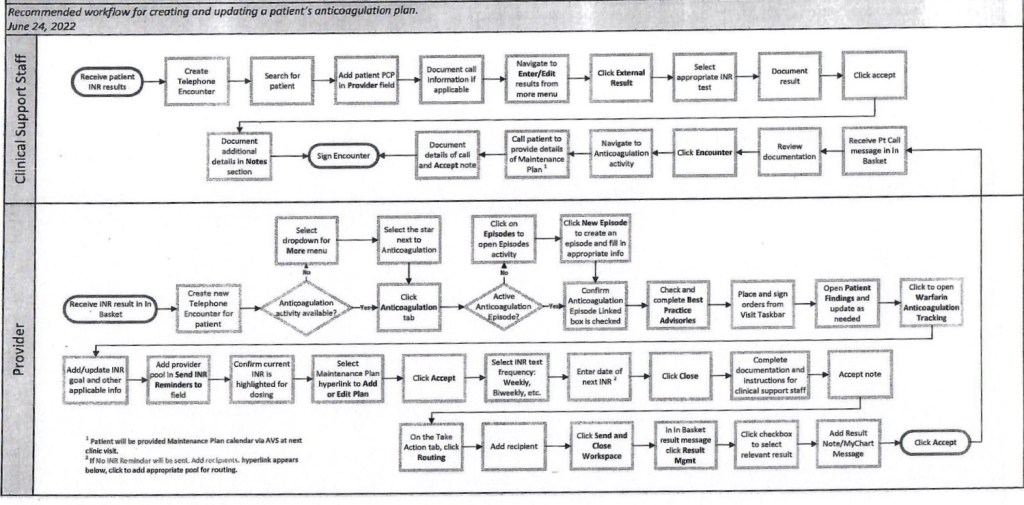
For many years I have used a paper(!) flowsheet that takes seconds to utilize and gives a practical overview. These sheets sit in a three ring binder. My nurse can flip through this binder and spot who is delinquent with their testing. The actual lab values are of course in the computer, but so far the three EMRs I have used can’t give me the overview I need within anything even close to a reasonable timeframe.
These two pictures say it all. My patient in the paper flowsheet has a home INR that requires weekly testing for the insurance to cover it. The “workflow” (how I dislike that word) on the bottom is from Epic.
I thought computers had the capability of speeding things up, but in my corner of the world that is mostly a pipe dream.

A Country Doctor Reads: Consider the Vagus Nerve, No Matter What Seems to be the Diagnosis | The Wall Street Journal
Published July 25, 2022 Progress Notes 1 CommentIt’s all about inflammation, from cancer to Alzheimer’s disease and arthritis, colitis and psoriasis in between. And now we hear the brain controls inflammation via the vagus nerve.
A couple of years ago I wrote about how the vagus nerve regulates mood and emotions. Now The Wall Street Journal writes about how it controls our immune responses. I had a professor in medical school who used to say “if you know lupus, you know medicine”. Maybe at this point in time one might say “if you understand the vagus nerve, you understand medicine”.
According to an interesting article in the Wall Street Journal the other day, a decades old discovery that the brain regulates the immune system through the vagus nerve is promising possible new ways of treating what seems to be the root cause of many chronic diseases.
Electricity Is the New Medical Miracle
“Dr. Tracey’s breakthrough two decades ago was the discovery that the brain also controls the immune system through the vagus nerve. By using electrical stimulation to hack into neural networks, it’s possible to regulate the immune response and perhaps someday cure inflammatory conditions such as multiple sclerosis, lupus and even Alzheimer’s disease.”
A Country Doctor Reads: The Solution Shop and the Production Line — The Case for a Frameshift for Physician Practices | NEJM
Published July 8, 2022 Progress Notes 3 CommentsThe other day, as we were both struggling to pull off a visit every 30 minutes with a brand new EMR following a very cursory onboarding, Autumn told me a new nurse coordinator had called and said Mr. White was due for his annual urine microalbumen test.
He had just left the office. I shrugged and said “I had all I could do just to import his medications, vitals and even the assessment and plan into his blank office note. If whoever she is knew he was due, she could have entered the order if we had a standing order. I’m a problem solver, not a bookkeeper”.
Later that day, waiting for my dinner to cook, I picked up last week’s The New England Journal of Medicine and noticed an article by Christine Sinsky and Jeffrey Panzer about exactly this kind of issue.
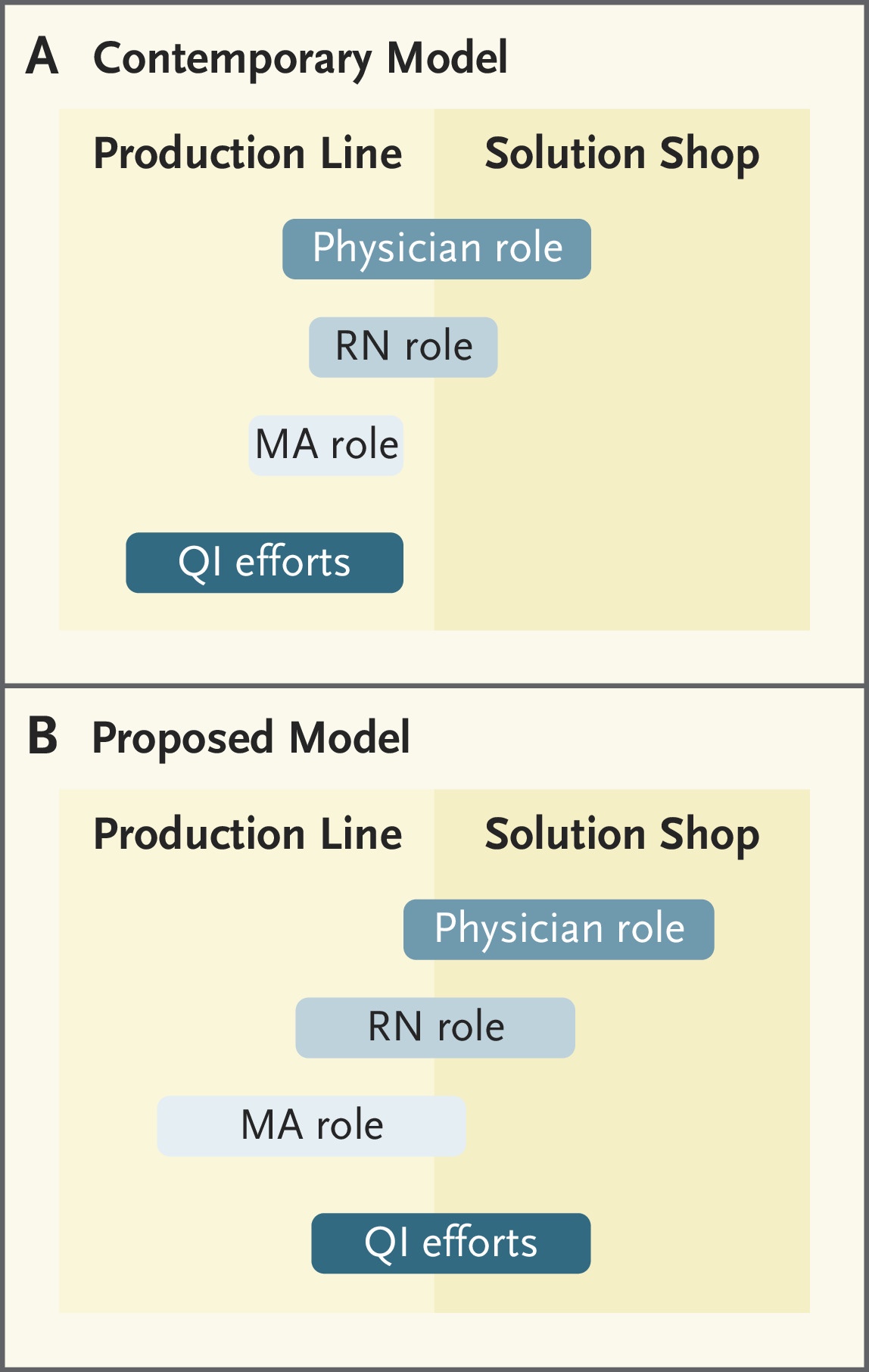 In The Solution Shop and the Production Line, they make the case that doctors shouldn’t be the ones held responsible for things that can and should be automated. Our time and effort should be more directed toward relationship building, diagnostics and treatment planning.
I think the bookkeeper analogy is perfect. I believe it is a consequence of non-clinicians trying to understand what we do and failing to grasp the complexities of medicine. Our training and our temperaments are focused on diagnosis and treatment. With all the computer power involved in healthcare these days, why does anybody think it is appropriate and cost effective for the physician to enter annual orders from memory or at the command of nurses who could easily do that with standing orders in place.
No wonder we have a perceived doctor shortage in primary care in this country: We are too often asked to do bookkeeping tasks at the expense of intellectual, clinical, educational and motivational efforts for the benefit of our patients.
Dr. Sinsky knows this. Her job at the American Medical Association is to fight physician burnout.
It can’t be said enough: The root cause of physician burnout is that we are required to do and evaluated for excessive amounts of non-physician work in today’s healthcare environment.
The Root Cause of Physician Burnout: Neither Professionals nor Skilled Workers











 A Country Doctor Writes:
