Archive Page 39

Changing EMR Again: Goodbye Greenway, Hello Epic

It was a Microsoft déjà vu: It was late 2019. Our clunky 18 year old EMR was not going to be supported anymore. We had a choice between Greenway’s “new and improved” product, Intergy, and starting over with something new. I cast my vote on eClinicalworks, a fairly simple product I had used in Bucksport. The conservative choice was to stick with the company we knew, so the decision was Greenway’s Intergy.

2 1/2 years later we were still limping along at half our previous productivity level and working without even a laboratory interface with the hospital that does the vast majority of our tests. Our providers were scrolling down endless lists to choose lab tests and x-rays with no search capability in the EMR that was supposed to be more modern.

Our suffering is now (supposedly) over, but replaced by the pains of starting over with something very different. We moved to Epic. One obvious advantage is that the hospital will have the same system, so there will be an interface. But I had heard comments like “working with Epic is like taking a semi to buy a quart of milk at the corner store”.

I have said this before: EMRs today are like VHS and Betamax of yore 100 times over. No inter-operability, and everybody waiting to see which format will become industry dominant, I am told.

So here I am, fumbling around in a system that may become the dominant player if it isn’t already. My first impression after a couple of weeks is that it really is a very large vehicle for the mostly simple errands I handle, and more complex than I need it to be. It is a funny mixture of unnecessary flexibility and annoying rigidity.

The flexibility is downright ludicrous: The system doesn’t import my assessment and plan into the office note by default. Why would anybody practicing medicine on planet earth not want that included in their office note?

Worst of all from my brief experience is the same as in other systems: the doctor is the first one to see the incoming reports, labs and imaging. It is a classic dilemma in electronic health records. I liken it to having the president open his own mail.

This new system supposedly helps me work smarter in terms of remembering who needs to go on aspirin and whatever, but it sure doesn’t let me use my team members to sort and prioritize information for me. That is a universal problem with healthcare today.

All the President’s Mail
The Useless, Almost Drive-Through, Nearly Touchless, Free But Expensive and Wasteful Physical Exam

There was a time when patients would see their personal physician only when they were sick. Then came preventive medicine and now many patients only see their doctor when they are well. When they are sick, the doctor has no openings and they are forced to go to walk-in care.

If a doctor has 1,500 – 2,000 patients and works 2,000 hours per year, more than half their time is probably spent on routine exams (for commercially insured patients) or Annual Wellness visits (for Medicare patients).

Commercially insured patients generally get a free physical, which is often cursory, and random bloodwork, often referred to as “routine”. The reimbursement for such visits is generous.

The US Public Health Service Taskforce on Prevention declared long ago that neither the exam nor the blood tests have any proven value from a prevention or early detection point of view. Choosing Wisely says the same thing.

The Medicare Wellness Visit is also called an exam, but the only thing that is more or less hands on is the mandatory blood pressure recording. Other than that, it is a talk visit. The first one of these includes a Mickey Mouse eye chart test, like the one at the Bureau of Motor Vehicles, and a baseline EKG, another test of no proven value. Every Wellness Visit pays more than a commercial insurance physical, but if you skip over offering frail 90 year olds testing for HIV, Hepatitis C or anything else on Medicare’s agenda, they might take their money back.

The cruel irony here is that sick people have deductibles and copays for their visits and testing. This can discourage patients from seeking care and getting new problems diagnosed in a timely manner.

According to The Motley Fool, a third of American families have trouble coming up with $400 to cover an emergency expense. And that’s an improvement compared to a few years ago. Yet, the typical annual deductible for commercially insured patients is several thousand dollars. So, many people hesitate to seek medical care they really would like to have.

Is that an ethical and sustainable way to provide health care coverage for hard working Americans?

It is time to consider a different copayment structure as a temporary way to humanize health care until we join the rest of the world in providing government financed universal basic health care for all:

– Provide free but voluntary mass screenings for proven things like blood pressure, blood sugar, cholesterol and mammograms.

– Cover a couple of doctor visits per year without cost for things each patient prioritizes. For some, that might be their hypertension or diabetes care, for others, their annual sinus infection or asthma/COPD flareups.

Like lawyers, we should at least be able to provide one or two free initial consultations. And, speaking of lawyers, the value of our time should not be restricted to face-to-face encounters.

But that’s a different pet peeve of mine.

Somebody Stole My Inhaler Idea. Finally!

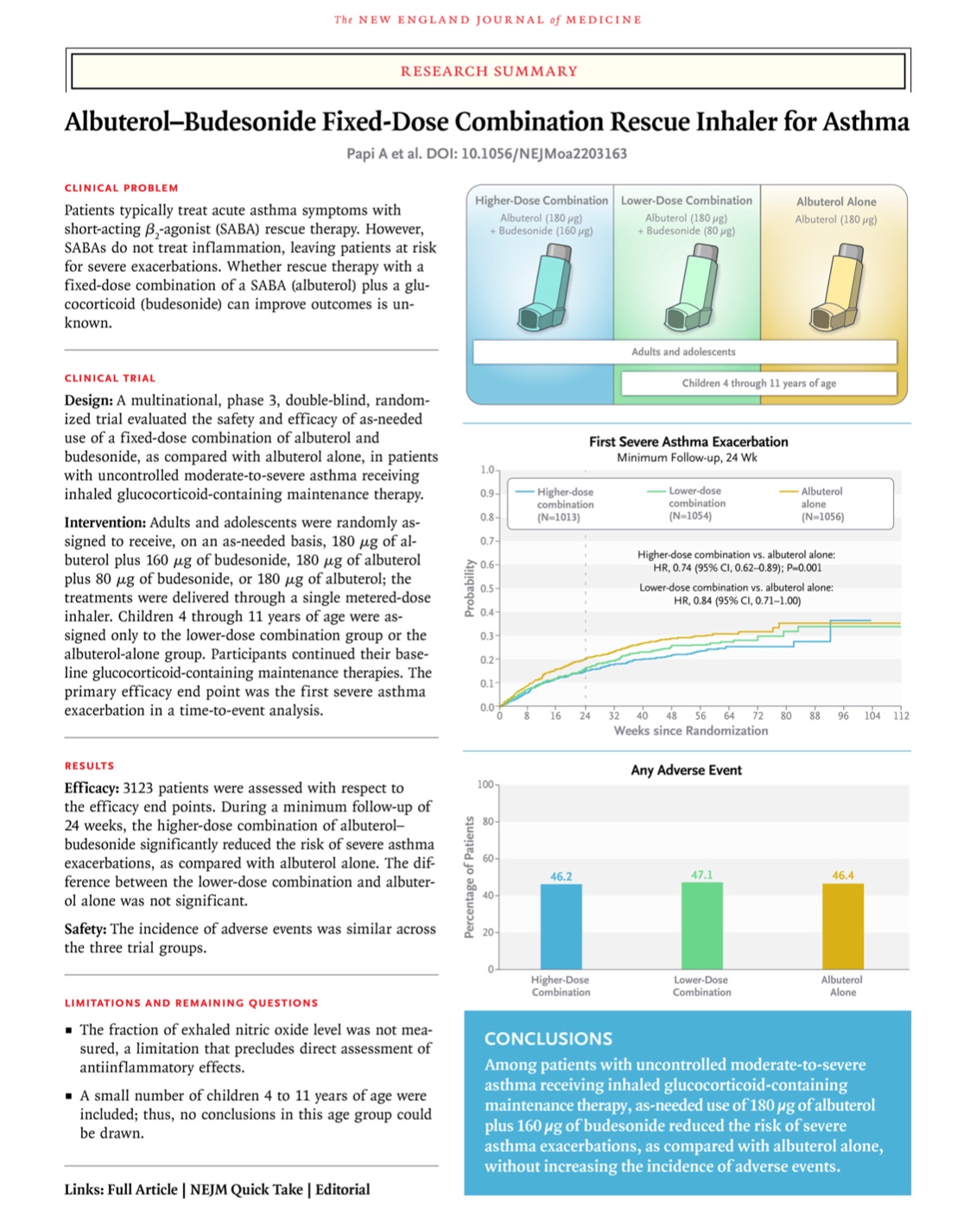
Years ago, I remember telling people I had this brilliant idea to improve asthma control. Slip some steroid into the rescue inhaler, so that the more often patients use it, the more steroid they inhale. This month, decades later the New England Journal of Medicine has an article about just this idea. No surprise, it works. This type of combination reduces risk for future severe attacks without increasing the risk for adverse effects.

I am not at all upset that somebody else finally had the same idea; I’m just a country doctor, not a researcher or statistician. I’m just happy that asthmatics who resist getting one more inhaler can have a sort of autotitration in a single prescription device.

https://www.nejm.org/doi/10.1056/NEJMoa2203163

And if anybody out there is looking for more ideas, I have often wondered why there isn’t a combination condiment for hot dogs like mutchup – half mustard and half ketchup. Go ahead and create it, I won’t sue for a share of the profits!

There Are Too Many Back Seat Drivers in Medicine Today

“Your patient may benefit from X”, “Your patient may be due for Y”, “Your patient may be non-compliant with taking their Z”.

“Care Considerations” is one of the many names for a phenomenon that seems to be exploding. Insurance companies are more and more acting like back seat drivers, hoping that such communications will improve “quality”, “compliance or “conformity” – whatever you want to call it. They are trying to tell us what to do.

Most of the time, there is some sort of admission that we are the doctors and that we may know something about our patient that they don’t. But the underlying idea is that we are not doing our jobs. Ironically, the more reminders we get, the more distracted and ineffective we might actually become.

There are two problems with what these middlemen are doing: They spew out generic data that may or may not be relevant for our patient’s unique circumstances and they try to steal our attention away from the patient’s we are actually scheduled to see today.

These back seat drivers are essentially babbling about which way to turn on a different road trip from where we are driving in the moment and saying things like “you might be out of gas” because they must have been napping when we stopped to fill up a little while ago – trying to be helpful, but ultimately doing the opposite.

This is because today’s primary care doctors are essentially working in synchronous mode, scheduled to see one patient at a time. The dirty little secret in primary care is that anything to do with patients who are not present in our clinics, physically or in a telemedicine appointment, happens “between patients” even though there are no breaks between patient appointments in our schedules. Not infrequently such tasks are done after hours, during what is quaintly called “pajama time”. (Can you spell burnout?)

Clinic driven messages are generally fairly specific and appear in our electronic records linked to each patient’s “chart”: If I get a question if a patient could increase their dose or get a refill or get a referral to go back to their specialist, all their information is there, linked to the request.

But the “Care Considerations”, arrive on paper, sometimes even in a format with several patients’ information on the same page. In order to consider any of them, we have to locate the patient’s electronic file and spend more or less time searching for their relevant information. This is time consuming and basically interrupts the workday of busy primary care doctors whose working conditions make no allowance for asynchronous communication or considerations.

In a different world, if clinics become reimbursed for managing patients and populations, maybe we could look at these kinds of letters, but in today’s reality they are essentially junk mail, trying to interrupt our clinic flow.

Most of us just toss them in our shred basket. Can you blame us?

Between Patients: The Myth of Multitasking

Quick and Easy: How to Save Primary Care

American Primary Care is a dinosaur, threatened by extinction. It is too large and too slow moving for today’s fast paced society. The Fed made us that way.

When this country needed to vaccinate more than a hundred million people, nobody imagined Primary Care offices could be of any help. Instead, pharmacies became the outlet, along with temporary sites in sports arenas and community centers.

Why were clinics like mine excluded?

It all happened because of all the requirements of comprehensiveness we slave under. Even if a patient only comes in once a year for something simple, we have to screen them for everything from food insecurity to depression to domestic abuse. We also have to address any elevated random blood pressure or gaps in preventative care, like annual flu shots or smoking cessation counseling.

This cumbersome requirement stems from the misguided notion that people who choose not to partake in preventative medicine should be ambushed (see my 2018 post Upselling in Medicine: Would You Like a Pap Smear With That ankle Brace, Ma’am?) if they happen to seek us out for a medical concern they themselves see as a priority.

We do offer those screenings when people come in for a physical or a Medicare Annual Wellness Visit, but why are we held responsible for doing them with people who elect not to come in for health maintenance visits?

In today’s reality, a quick visit for a wart or a urinary tract infection creates a lack-of-comprehensiveness quality liability. What if the patient doesn’t return for another year and we missed our opportunity to address everything our payers require of us?

The irony here is that the buzzword for Primary Care these days is Patient Centered. But it is anything but that when our required agenda pushes our patients’ own concerns aside.

The quick and easy patient driven services we could so easily perform are instead being delivered at freestanding urgent care centers, in pharmacies and big box stores, even through telemedicine companies. This fragments care and removes from our workday the less complicated, lighter visits that could give us a welcome variety in our otherwise chronic care focused workday.

Family doctors were trained to offer a broad variety of health care services according to our patients’ needs. We are instead now more and more working as geriatricians and public health policy enforcers.

Comprehensiveness is Killing Primary Care


I just realized none of the posts show on an iPad or a computer, but they do show on an iPhone. WordPress is working on this. In the meantime, please visit my Substack.


Osler said “Listen to your patient, he is telling you the diagnosis”. Duvefelt says “Listen to your patient, he is telling you what kind of doctor he needs you to be”.


BOOKS BY HANS DUVEFELT, MD

CONDITIONS, Chapter 1: An Old, New Diagnosis

Top 25 Doctor Blogs Award

Doctor Blogs

Enter your email address to subscribe to this blog and receive notifications of new posts by email.

Mailbox

contact @ acountrydoctorwrites.com
Bookmark and Share
© A Country Doctor Writes, LLC 2008-2022 Unauthorized use and/or duplication of this material without express and written permission is strictly prohibited. Excerpts and links may be used, provided that full and clear credit is given.


