I once had a separate WordPress blog, and I think im still paying for the domain ”A Country Doctor Reads”, where I wrote bout my eclectic reding, not only from medical journals, but also from major news media, business journals and even Swedish newspapers. I later made it a post category here on A Country Doctor Writes.
It occurred to me to check if today, here and now, there is any interest in occasional posts on this theme. Comments are welcome. Check out this example from 2019:
A Country Doctor Reads: January 13, 2019
Practicing Good Medicine or Chasing Star Ratings?
Published January 24, 2026 Progress Notes Leave a CommentThe other day, I saw a senior citizen for an annual wellness visit. He is a well controlled diabetic. One of the quality parameters that gets me brownie points and brings extra money to my practice is that we document an eye exam, a kidney function blood test and a urine test to look for the early warning signs of diabetic kidney disease. We are also judged on whether he takes a statin drug to lower his heart attack risk, regardless of what his cholesterol numbers are and that his blood pressure is within range.
We only got his urine test done a couple months ago, near the end of 2025. When I did his wellness visit the other day he had received a urine cup from his insurance company. I told him that it would be kind of silly to do that test now because he had it just a couple months ago. He should really have it toward the end of the year. If he doesn’t do it by then I will get dinged, but if he does it now it’s going to be fine and it wouldn’t serve any medical purpose. This is a common dilemma in today’s medicine. Do we do things that make medical sense or do we do things to chase? What in the industry is called “star ratings“?
So here’s a question for my colleagues: Would you have done the urine test now just to get the points or would you do it a year from when you did your last one?
What do Mushrooms and Charles Bonnet Syndrome Have in Common?
Published January 22, 2026 Progress Notes Leave a CommentI read an interesting piece in the BBC app on my iPhone this afternoon. It used to be free, and I’m linking to it here in case any readers are subscribers or want to subscribe ($49 for the first year). I try to balance my news sources by reading the BBC and American and Swedish news on my phone over my morning coffee.
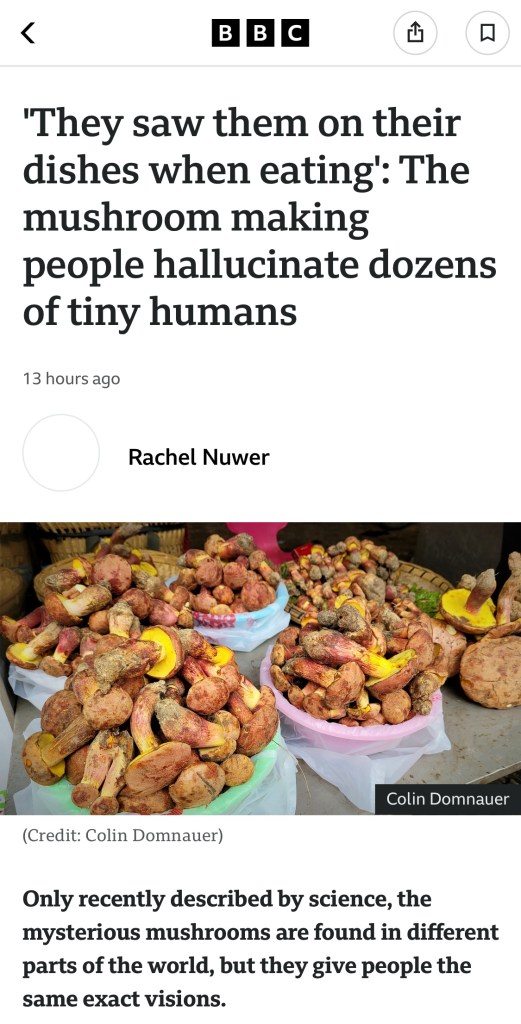
In my first year of blogging, 2008, I wrote about a patient I had with Charles Bonnet syndrome, and in 2018 I wrote another piece on the same topic. The syndrome occurs in people who are blind or severely visually impaired, and involves seeing elf like Small, childlike, figures, often playing outside in the yard. The BBC article describes very similar and consistent reports by people who consume certain presumably psychedelic mushrooms in various parts of the world.
Very thought provoking that such different circumstances can produce very similar syndromes across countries and cultures.
https://www.bbc.com/future/article/20260121-the-mysterious-mushroom-that-makes-you-see-tiny-people
WordPress links to my articles:
Visions of Little People
The Elfins Return
Substack links:
https://acdw.substack.com/p/visions-of-little-people
https://acdw.substack.com/p/the-elfins-return
P.S. Long after I first published The Elfins Return, I realized that elfin is an adjective and not actually a noun. Oh well, English is my second language.
Medicine: Quick and Easy. Metamedicine: Slow and Hard
Published January 9, 2026 Progress Notes Leave a CommentLast Friday, I spoke with a new patient who had a history of chronic abdominal pain, often worse upon awakening. Gabapentin did very little for him. Almost instantly, I recognized his symptoms as visceral hyperalgesia and prescribed him amitriptyline, 10 mg at bedtime.
Today, an “admin” day, I took a call from his wife. They switched insurance January 1 and could no longer use the medical supply company they had been dealing with for years. He was running out of colostomy supplies. I promised to try to find another supplier, knowing there are fewer and fewer companies that deal with that in Maine. I told her I would call her back when I located one.
45 minutes later I was able to call her back with the report that she would have to have them shipped from an out-of-state company operating nationally, and the three that I had found in my search had very mixed reviews by their customers.
This took a huge amount of time, but there was no way I could delegate this on a Friday afternoon. My own Health Advocate is out until Tuesday and the other two were doing home visits with and for their provider.
So my patient and his wife will research these companies and get a message back to me tomorrow, Saturday with their choice of vendor so I can put in the order.
I think I invented the term Metamedicine back in 2014. Here is that post. Note that the ICD 9 diagnostic codes have been replaced by ICD 10 since then.
Medicine is Easy, but Metamedicine is Hard
Time Travel: Measles, Tuberculosis Already, Others Likely to Follow
Published January 4, 2026 Progress Notes 1 CommentWe are used to seeing time as a forward movement when it comes to infectious diseases. This has been due to improved socioeconomics and public health, including vaccinations. As of this year with vaccine skeptics leading our public health system, measles is back as a threat we had started to not even worry about. There are now also early indications that tuberculosis is becoming more common again and it is widely anticipated that HIV will become more common in this country and definitely in other countries that had relied on US aid for treatment and prevention. With the newly declared return to fossil fuels, away from clean energy initiatives, many worry that chronic respiratory illnesses will be more common and more severe.
I don’t think we know yet if our chronic lifestyle diseases like obesity, diabetes and heart disease will increase, decrease or stay the same. But it is certainly bewildering to see us step back in time when it comes to infectious diseases.
If large numbers of Americans lose their health insurance, their food stamps or even their jobs, more bad things will happen to the state of health in this country. For example, how can people eat healthier on a smaller food budget?
With cutbacks and eliminations by Executive Order of the institutions that monitor disease trends and guide interventions, will we even know what’s going on? Will we have competing/alternate views of the reality we live in? That trend started before our regime change. Did the mRNA vaccines ultimately help lessen the severity and mortality of Covid, or would the virus have mutated in a benign direction anyway? I, for one, believe they helped, but that’s not what everyone believes.
And whatever one thinks of abortion, gender identity and the other LGBTQ societal trends that have evolved over many years, I find it almost mind blowing that the clock has been turned back to such a degree in so little time, not by consensus but by small voter margins and politically appointed Supreme Court Judges in today’s extremely polarized political climate.
As a physician, I have always avoided talking politics in my patient encounters, but that is becoming harder and more and more ethically problematic right now.
Happy New Year 2026 – or is it?









 A Country Doctor Writes:
