Archive Page 202

Oh, By the Way, Doc

Sherman Waltz had been through a lot since I saw him just before his 83rd birthday in late November to review the results of his CT scan. He had a large tumor in his liver. The cancer surgeons at our referral hospital sent him on to Boston because of the type of surgery he needed and because of his age and underlying medical conditions, dominated by severe emphysema. He is oxygen dependent even at rest. He pulled through the liver surgery without complications, but on the second postoperative day he fell and broke his hip.

Poor Sherman ended up in the Operating Room again, this time for a new hip. Again, the operation was a success. He was transferred to a rehabilitation hospital, where he caught pneumonia, which brought him to the brink of respiratory failure, but he pulled through again.

Finally back home, and with concerns that his new hip was still painful and stiff this long after the surgery, he came to see me. He wasn’t keen on going back to Boston to follow up on his hip surgery if I could help him get that taken care of closer to home. We agreed to have him se an orthopedic surgeon nearby.

We reviewed his medications, his level of functioning at home now, and the follow-up plans for his cancer. We also established that his pneumonia had cleared.

“You’re amazing,” I told him. “Three life threatening conditions in less than three months, and I couldn’t tell just looking at you!”

He smiled his typical shy smile as he adjusted the oxygen prongs in his nose and cautiously rose from the exam room chair. He turned toward the door, then back again towards me as he cleared his throat.

“Oh, By the way, Doc,” he said with his hand on the door handle. “Do you think I could try some Viagra?”

The Apostolic Nature of Our Profession

I twice had a priest for a patient and I have been the personal physician of a handful of protestant ministers of various denominations. In each of these doctor-patient relationships I have found myself entering a ministerial role vis-à-vis my pastoral patient.

I have had reason to temper the hypochondriachal tendencies of one man of the cloth, and I have cautioned another that taking care of one’s body is a form of stewardship, and as such, just as important as taking care of one’s spiritual health. I have urged a minister to quit smoking and a priest to temper his sweet tooth.

Each time I have done one of those things I have been reminded of the apostolic nature of both our professions. People come to each of us, clergy or physician, with hearts and minds that are at least to some degree more open to hear what we have to say because of the office we hold, the cloaks we wear, that make our words somehow carry more weight than those of friends, relatives or family members.

As physicians, we need to be very careful with the authority and weight people grant our words, actions, even intonations and gestures. We need to be careful not to completely disregard that aspect of our interactions, because we may not always know what need we may fill in any given encounter. It may seem politically incorrect to encourage people to put you on a pedestal, but we need to be careful to keep separate the office we represent and the human beings we are. When a judge speaks to us from the bench, we assume he is not speaking as a private citizen, and the same is often true when a physician speaks to his patient behind a closed exam room door.

Imagine someone going to confession to reveal their innermost, secret weaknesses, only to hear the priest volunteer that his own weaknesses are even worse. In the moment of administering the sacrament of confession, the priest isn’t interacting with you only as a fellow human being, but as an apostolic officiant in an ancient ritual. This may seem outmoded, but, like it or not, as physicians we also fill that kind of role some of the time, and we don’t always know in advance when we are asked to save someone’s pocketbook, someone’s life or someone’s soul.

We haven’t all taken an oath to do what we do (not all countries hold their physicians to the Hippocratic Oath), but we are all part of an ancient fraternity that has cared for the sick and injured for thousands of years, and we need to show humility and let that calling and that tradition work through us, or we will only be technicians. When even clergy come to us for advice that goes beyond the technical, we need to be humble and accept that, now and then, what we do is greater than what we know.

A Shot in the Arm

Three asthma inhalers for my wife cost us $90 in copayments this week. Not long ago, generic albuterol inhalers were about seven dollars each. The main reason for the price increase is the new U.S. law that banned the use of fluorocarbons in prescription asthma inhalers this winter. The old-fashioned inhalers are harmful to the ozone layer. This new law prompted the development of novel, brand name, delivery systems, which drove up the cost to levels many of my patients have trouble affording. It does seem ironic that people around here often have remote starters for their gas-guzzling, high-polluting Sport Utility Vehicles, so they don’t have to drive to work in a cold car, but we make our asthmatics help take care of the environment by giving up their inexpensive inhalers for newer, more expensive and not necessarily better devices.

As far as I know, you can still buy old-technology, ozone-depleting inhalers with adrenaline (epinephrine) over the counter for under $10. By the way, we use the name epinephrine in the U.S. because somebody (Parke-Davis) patented the name Adrenalin in 1900 (without the “e”, but still similar enough to force the introduction of a new generic name, epinephrine, different from what the rest of the world uses).

I remember when I was a resident in Sweden in 1981, we had asthma medicines that were years ahead of the American products. We used so-called beta-2 selective inhalers and injectables like terbutaline (Bricanyl), which had fewer side effects, as they acted mostly on the lungs without stimulating the heart the way adrenaline does. In the U.S., adrenaline (epinephrine) in injectable form is commonly used for asthma attacks and allergic reactions. It is even available in auto-injectors for personal use by allergy sufferers.

My Swedish teachers and mentors had little or no experience with adrenaline. In fact, one night in a community hospital where I worked, we had an asthmatic in the emergency room with a stubborn attack, and the senior physician decided to use straight adrenaline since the patient wasn’t responding to injections of terbutaline. We actually transferred the patient to the intensive care unit before injecting the adrenaline, more because of our fear of side efecs from the drug than fear of respiratory failure from the asthma attack.

A couple of years later, new here in town, I met Elwood “Woody” Black.

Woody Black was almost seventy when I met him, and he lived for a good many more years in spite if his bad asthma. The first day I met him, he pulled a beat-up metal case from his shirt pocket with an ancient syringe, a well used needle and a couple of vials of adrenaline. When his asthma kicked in, he would roll up his sleeve and give himself a shot in the arm with adrenaline. It was with great trepidation I agreed to refill his prescription, but he had obviously used it many times without coming to harm.

Driving home from the pharmacy with three inhalers worth about $150, I wondered if generic injectable adrenaline might see a resurgence in this country…

My Annual Checkup

Yesterday I went for my annual physical at Cityside Family Practice, which is now part of Northside Hospital Health Systems. I have been with Cityside for years, but never really seemed to get a doctor there, who stayed with the practice or cared much for me as a patient. Dr. Wilford Brown was great, but he retired and later came to my own clinic, both as a patient and a part time physician; Dr. Royson became a Hospitalist, and Dr. Washburn seemed to be longing for the beach.

My blood pressure medicine needed to be renewed, and I was overdue for a checkup, so I called for an appointment several weeks ago. Dr. Washburn didn’t have any openings, but Dr. Bill McIntyre, one of the clinic founders, did. I took that appointment, and made arrangements to take the whole day off. This way, I could also get my car serviced, take care of some banking issues and get a new set of passport pictures.

Friday morning’s newspaper had a front page article about Medicaid reimbursement cutbacks and delays in payments to hospital-owned physician practices. There was also a story about layoffs at a small, rural hospital that was taken over by Northside Hospital Health Systems just a few years ago.

The last time I visited Cityside, they were an independent group. The waiting room was cold and uninviting, but the front desk area was buzzing with activity. This time things seemed to move a lot slower. The woman who took my insurance information appeared to be laughing at something. Finally she told me her computer was acting up, and this was a daily occurence since the new management put in a whole new system when they took over the practice.

In the exam room there were a few new posters on the wall and a laptop computer. Dr, McIntryre appeared without a paper chart in his hand and we took care of our introductions. We had met only once or twice before before, were well aware of each other’s professional reputations, but didn’t know anything about each other as human beings.

Bill quickly understood that I really didn’t need a lot of high-tech interventions from him. I am up to date on my health maintenance, and he agreed with me that my cholesterol isn’t high enough to worry about with my high HDL. Our conversation instead drifted toward the business of medicine in America today.

My annual checkup turned into more of a checkup on the status of primary care physicians today. Two mid-fifties physicians, one rural and one in a small city, compared notes. He had always been fiercely independent, and was now taking marching orders from a hospital Vice President and reporting to a Medical Director whose training and experience are in a subspecialty and not in primary care.

He surprised me a little by telling me that during all the years he had been working and building a practice in the small city north of my home town, he had actually lived near the ski slopes west of here, and “camping out”, as he put it, in the city.

“A year or two from now,” he confided, “I won’t be here. I’d like to start a small housecall practice and work out of my home in the mountains. I’ve had it with beureaucrats, insurance companies and big organizations.”

I quietly counted my own blessings, dealing only with a small beaureaucracy in a small town clinic five minutes from my home. I also made a mental note that, once again, I’d be looking for a new personal physician for my next checkup.

A Physician’s Funeral

Last week I attended a funeral service in another town for a physician, who died of cancer a few months after suffering a devastating stroke. He was clearly a good doctor, who saved many lives during his career, but the one thing his funeral service illustrated for me was that this doctor was an easy-going, kind and gentle man with a big heart.

He worked in the same town for twenty-five years, raised a family, went to church, sang karaoke and played a lot of golf. Friends, family and coworkers spoke at his funeral service, and their stories painted a picture that made me think about Dr. Samuel Baumgarten, who had tried to get my friend Barbara Brennan to slow down. Sam’s thoughtful, kind advice to patients and colleagues lives on, perhaps more than his medical and surgical triumphs.

As I reflect on my own calling as a physician and role as a member of my community, I am aware that there are times when I am so busy that I limit my engagement with other human beings to those contacts that go along with my job. I know there have been times when, after a long day of offering emotional support to patients, I offer less of the same thing to my wife and grown children, somehow thinking that they need less of that than my patients do.

Not usually one to make New Year’s resolutions, I resolved after the funeral that I need to be more present as a neighbor, parent, husband, son and community member. Being a good doctor is a fine thing, and I will always strive to be the best physician I can be, but first, I am a man. Doctors come and go, especially in this day and age, but my friends and family only have one me. 

This year I will take my life as seriously as I take my work.


I just realized none of the posts show on an iPad or a computer, but they do show on an iPhone. WordPress is working on this. In the meantime, please visit my Substack.


Osler said “Listen to your patient, he is telling you the diagnosis”. Duvefelt says “Listen to your patient, he is telling you what kind of doctor he needs you to be”.


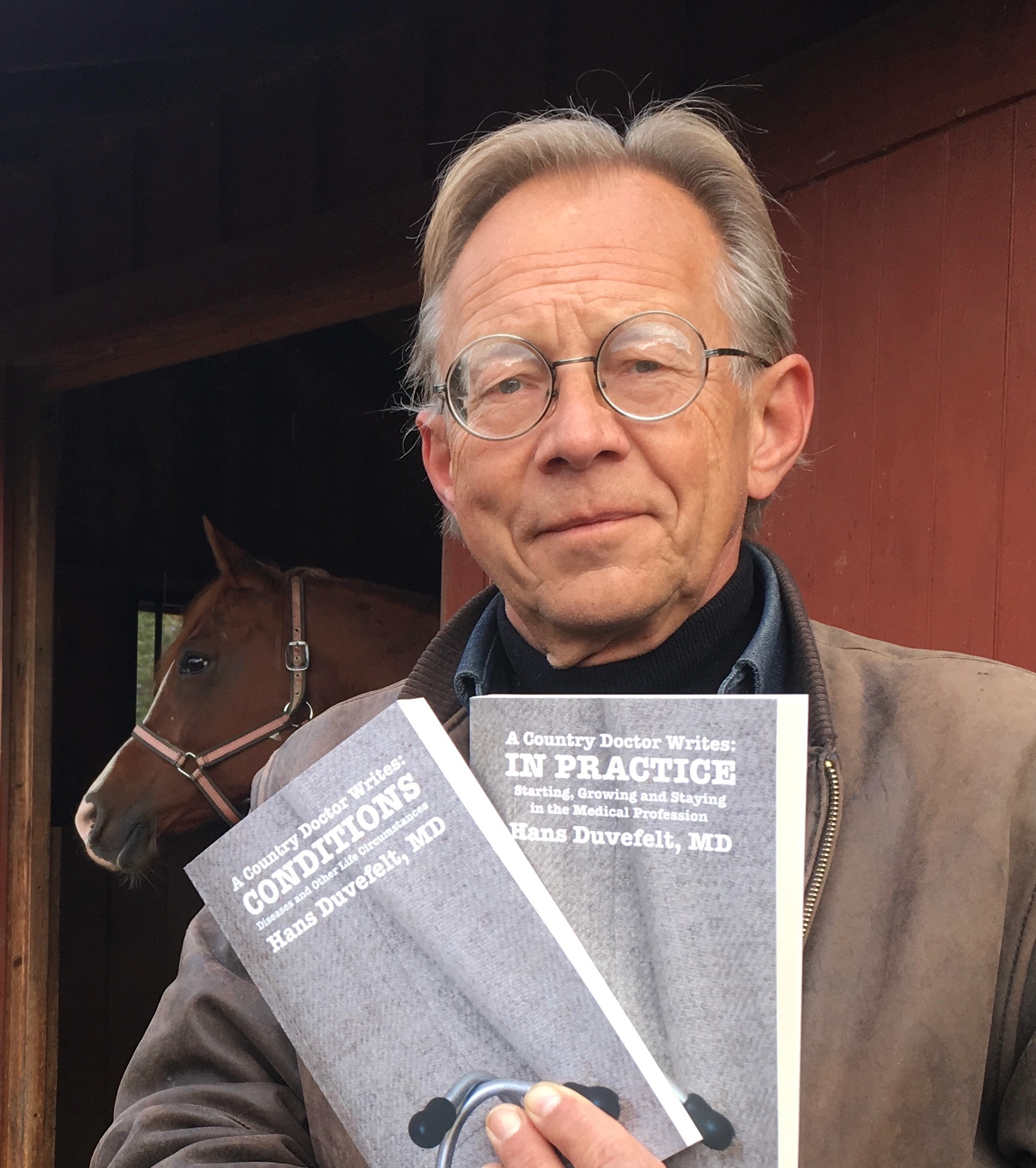
BOOKS BY HANS DUVEFELT, MD

CONDITIONS, Chapter 1: An Old, New Diagnosis

Top 25 Doctor Blogs Award

Doctor Blogs

Enter your email address to subscribe to this blog and receive notifications of new posts by email.

Mailbox

contact @ acountrydoctorwrites.com
Bookmark and Share
© A Country Doctor Writes, LLC 2008-2022 Unauthorized use and/or duplication of this material without express and written permission is strictly prohibited. Excerpts and links may be used, provided that full and clear credit is given.