Archive Page 203

Clinical Pneumonia or Virtual Health?

“So, are you saying Bobby really didn’t have pneumonia?” Mrs. Halstead asked. Her eleven-year-old son, a boy with multiple medical problems, had been in the office ten days before with fever, a bad cough, right-sided chest pain with each deep breath, and very loud crackles in the lower portion of his right lung. His blood count was normal and his chest x-ray looked almost normal – you could argue that it looked a little streaky in the right lower lobe, but the city radiologist who read his x-ray without actually listening to his lungs thought it was a normal set of pictures.

Bobby felt good at his follow-up appointment, and his lungs sounded clear. So, had I been wrong in diagnosing him with pneumonia when the radiologist didn’t agree with my interpretation of the films?

I remembered the case of Fanny Brown, my receptionist’s mother. She had a nasty cough and was losing weight. Her chest x-ray was normal, but her CT scan showed a tumor the size of a baseball – we all know a chest x-ray isn’t always the final word on what is wrong with a patient.

I tried to explain to Mrs. Halstead that a camera, even one used for x-rays, has its limitations.

“If you see a pretty rainbow and pull out your camera to capture it, but the picture doesn’t show the rainbow, does that mean you didn’t see a rainbow?” I tried.

There is an old Swedish military and Boy Scout joke, which I heard in both places: When the map and the terrain disagree, you go by the map in the military and by the terrain in the Boy Scouts. I spent more time as a Boy Scout than as a soldier – my inclination has always been to trust my assessment of the terrain.

I was on call for Christmas, and had a few days off around New Year’s. Catching up on my journals, I was delighted to find a piece in the December 25th edition of The New England Journal of Medicine by Abraham Verghese, MD, entitled “Culture Shock – Patient as Icon, Icon as Patient”. Dr. Verghese describes teaching residents, who seem more inclined to look at their patients through the “eyes” of the electronic medical record than through bedside clinical observation. He also talks about what to do when the map and terrain don’t seem to agree. He quotes Alfred Korzybski, the Polish-American philosopher credited with founding the theory of general semantics, who said, “the Map is not the Territory”. I’m not sure which of the two Korzybski thought was more real.

Bobby Halstead had been ill, and now he was well. I don’t know what his mother really thought of my diagnosis of his pneumonia, but it was a great illustration of what Dr. Verghese wrote about a short while later in “The Journal”: Our technology, invented as a way to document clinical reality, has almost become more real than the disease states it was designed to document.

A Negative Workup

Jonathan Blake is a hardworking 62-year-old janitor, who seldom complains. A few weeks ago I got several hospital reports about him.

He had gone to the emergency room with pain in the upper left portion of his chest, radiating down his left arm. He is a diabetic, who takes blood pressure and cholesterol medications, and he smoked cigarettes until five years ago. Needless to say, the hospital kept him overnight because he seemed such a high-risk patient for coronary artery disease, and put him through a stress test the next morning.

His nuclear stress test was normal, so he was discharged with a diagnosis of “non-cardiac chest pain”.

Almost two weeks later I happened to see his name on the computer screen at my workstation. Jonathan was in to see my colleague, Dr. Wilford Brown, who often sees patients the full-time doctors at our clinic cannot fit into their schedules. I always have full confidence in Dr. Brown’s ability to handle any situation, which also turned out to be the case this time.

I forgot about the whole incident until a few days later, when I, as Jonathan’s PCP (Primary Care Provider) had to sign an insurance authorization for a shoulder MRI. A few days later the MRI report arrived. Jonathan had torn a large portion of the rotator cuff of his left shoulder and he had also torn the long head of his biceps tendon.

Last week I saw him for his regular diabetes follow-up. By that time, he had already seen the orthopedic surgeon who will be repairing his rotator cuff. Jonathan showed me the telltale bulge in his upper arm, where the useless biceps muscle had contracted. At his age, that particular injury isn’t usually repaired, but the rotator cuff is essential.

“I can’t believe they didn’t pick this up at the hospital”, he said. “They didn’t listen to me. I told them all along my arm hurt, and all they worried about was my heart.”

Instant Feedback

My pager went off just after supper. The caller was Cindy Spofford, who works in a local real estate office, the patient was her four-year-old daughter Amanda, and the number was a cell phone. Their regular physician is Dr. Wilford Brown.

“Hi Doctor, thanks for calling me back. We’re down in the Capital City visiting my parents for Christmas. Amanda has had this terrible cough for two days and we just took her to the emergency room. They diagnosed her with bronchitis but didn’t give her an antibiotic. We wanted to check with you if that makes any sense.”

I inquired about her general condition. She didn’t have a high fever, had no trouble breathing, was eating and drinking fine, didn’t have any history of asthma, and her cough was dry and almost barking; I could hear her in the background, coughing in the back seat.

“Well, bronchitis is usually viral”, I explained. “Doctors have been quick to prescribe antibiotics for bronchitis for many years, but most of the time, they’re not necessary. Even ear infections are often caused by viruses, and can go away without antibiotics. You probably know how much trouble we’re having now with drug-resistant staph infections, right? They are such a problem because of all the antibiotics we have used unnecessarily over the years.”

I made sure that Amanda had had a decent physical exam and reviewed the warning signs that would warrant a return trip to the emergency room down in the Capital City.

Cindy thanked me. I wished her family a Merry Christmas and mused over how a reassuring voice on a cell phone from your hometown sometimes rates higher than an in-person opinion from a big city emergency room doctor.

Our Last Visit

Mary and Joseph Washburn are moving back to Massachusetts tomorrow after a dozen years in our little town. They were active retirees from the big city, involved in the community in several ways. Joe was a baseball coach, Mary was on the board of more than one charitable organization, and their home was a beacon on the local cocktail circuit; Joe was the best amateur bartender our community had ever seen.

Over the past few years, Joe’s faculties failed him rapidly, and Mary came down with rheumatoid arthritis. For a while, between his strong body and her sharp mind, they were able to hold things together, but as his dementia worsened, Mary’s ability to reign in his confusion lessened and a few weeks ago she told me the time had come for them to leave their adopted home town and move back to Massachusetts in order to be closer to family.

Today I saw Mary for her last visit and it was a profound ten-minute encounter.

As I entered the exam room, Mary was writing out a deposit slip for ten thousand dollars.

“I sold Joe’s truck,” she explained, “but he doesn’t know yet. He thinks it’s in the shop. He is so much worse just since you saw him last. He doesn’t even know who I am. Sometimes he thinks I’m a friend and sometimes his sister.”

“I can’t do this paperwork in front of him, so I had to do it now”, she continued. “We bought this little row house so I can continue to take care of him because we promised each other a long time ago that we’d never put each other in a nursing home, although we have long term insurance.”

I found myself counseling a woman about the same age as my mother.

“We sometimes make promises without ever imagining what circumstances we might end up in,” I began. “Don’t be hard on yourself. Do the best you can, but if you find that the situation isn’t safe for one or both of you, do what is best at that time. If he is restless or agitated and you can’t keep him safe with just the power of your wit and your love for him, you will need to find another way.”

She nodded and sighed.

“It’s gone so fast.”

Shrugging, she added: “Do you know we got a thirty year mortgage on our new home – at our age. Who knows how long we have together.”

All My Children

Stopping into our local supermarket during a surprise snowstorm yesterday, I found myself in the checkout line observing some of my young patients in action.

Darcy Devereaux was the cashier. I watched her quick hands scan the groceries of the person ahead of me while she chatted away cheerfully.

A casual observer might have missed the skin grafts on her hands and forearms. Knowing they were there, I marveled at her speed and agility as I remembered her trips to the Shriners Hospital for a long series of surgeries for the burns she suffered at age two. Her mother was in and out of the picture, and ultimately she ended up living with her father.

Danny Pierson was our bagger. His nametag said “Shift Leader”. He is a full time college student, who lives with his father and stepmother here in town. Every day he commutes to college, and every weekend he pulls long shifts at our supermarket. A few years ago his biological mother arrived in town after being away for fifteen years, and sought him out in an effort to reestablish a relationship with the son she hadn’t seen for such a long time. Then, just as suddenly as she had appeared, she fell ill and died. Danny didn’t miss a day of school or work. I happened to see his father around that time, and we had talked about Danny’s resilience.

Darcy had just finished scanning the groceries of the woman ahead of me, and Danny had bagged them with more care and proficiency than anybody else when Sarah Daigle came storming in from the parking lot, her blonde hair dripping and her blaze orange vest covered with snowflakes.

“Some old guy almost ran over me out there”, she exclaimed, her voice quivering.

Danny made sure the customer ahead of me was all set, then quickly whisked Sarah across the exit isle and into a small staff area. Her voice was shrill as she recounted what had happened. I couldn’t hear more than a word here and there as I stood there and watched Darcy’s scarred hands flick my groceries across the scanner.

Danny was calm and professional. He debriefed Sarah as if he had done that sort of thing a hundred times before. I heard him say that Sarah could take some time-out or go and see the Manager on duty. She seemed to be okay with just her talk with Danny and disappeared into the store.

I had started bagging my own groceries, and Danny quickly finished the job for me. He explained briefly that an older gentleman backing out of his parking space had not seen Sarah and had almost run into her. Danny looked straight into my eyes and wished me a good night.

I wished him the same, drove home carefully through the heavy snowfall and called the Manager on duty.

“I just wanted to let you know I saw Danny Pierson in action tonight debriefing Sarah Daigle after she almost got run over in the parking lot. He really seemed to handle the situation in a very professional manner”, I said.

“Thanks, Doc”, he said. “I’m really glad you called to tell me that. Usually when somebody calls about my crew, they call to complain about something. It’s nice to hear when somebody is doing something right!”


I just realized none of the posts show on an iPad or a computer, but they do show on an iPhone. WordPress is working on this. In the meantime, please visit my Substack.


Osler said “Listen to your patient, he is telling you the diagnosis”. Duvefelt says “Listen to your patient, he is telling you what kind of doctor he needs you to be”.


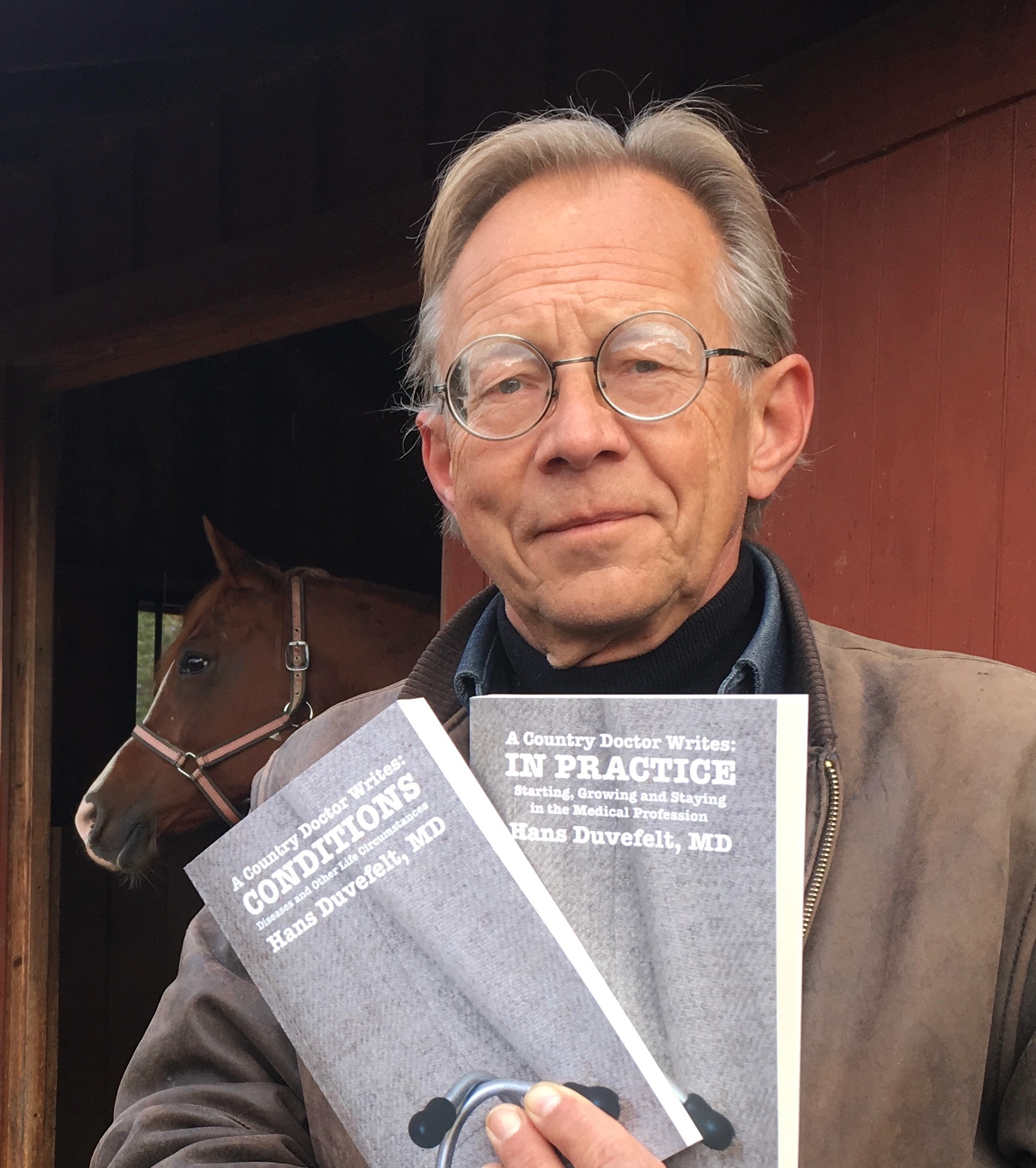
BOOKS BY HANS DUVEFELT, MD

CONDITIONS, Chapter 1: An Old, New Diagnosis

Top 25 Doctor Blogs Award

Doctor Blogs

Enter your email address to subscribe to this blog and receive notifications of new posts by email.

Mailbox

contact @ acountrydoctorwrites.com
Bookmark and Share
© A Country Doctor Writes, LLC 2008-2022 Unauthorized use and/or duplication of this material without express and written permission is strictly prohibited. Excerpts and links may be used, provided that full and clear credit is given.