Archive Page 201

My Most Expensive Instrument

Doctors in other specialties treat their patients with exotic and expensive instruments to peer inside their bodies or rearrange minute and delicate body parts. Not so Family Practitioners. When I think about it, I am convinced that my most expensive, or, shall we say costly, instrument is my pen. Not the Montblanc my wife gave me for Christmas one year, but the disposable rollerball pen I buy by the box and use when I order tests and prescribe medications.

How often does a doctor reach for the prescription pad as a quick solution to a problem that really should be dealt with in a meeting of the minds between healer and patient? How often does a doctor order a test to document what is already evident through the history and physical exam?

I often hear patients ask for an MRI “just to know what’s going on in there”, and unless they have managed care that requires “prior authorization” for expensive tests, how much faster isn’t it to order the test than it is to explain to the patient that the test serves little purpose in a case of low back pain, for example, since science still hasn’t sorted out what causes most cases of that particular ailment.

We are constantly bombarded with advertisements and promotions for expensive medications that offer theoretical advantages over older, less expensive, drugs. And all the studies backing up the effectiveness claims of these new wonder drugs are double blind comparisons with placebos. How polite, not to compare them with the well established treatments they are hoping to replace.

We as physicians have an obligation to our patients to watch over their health, but also to help them get reasonable value for their health care dollars (or Francs, kronor, Pounds or Marks). One of our duties is to test and prescribe responsibly, and to strive for achieving a fair balance between protecting the individual patient’s interest and the collective interest of all our patients.

I often find myself comparing physicians’ work with that of other professionals, particularly lawyers. I imagine a lawyer, hired by one client to protect that client’s interests, can devote just about any amount of time that the client is willing to pay for, and that ultimately someone else within the legal system, be that a jury or a judge, will balance, arbitrate or adjudicate the claims of the opposing parties. As physicians, we usually can’t give a disproportionate amount of attention to a single patient, at least if we expect the insurance companies to pay us for our work. We also cannot usually practice with complete disregard for the greater common good. We need to be the ones to say “If I did this for all of my patients, what would happen?”

If I prescribe broad spectrum, expensive antibiotics for one patient who doesn’t need them, I need to ask myself what would happen if I did that for most of my patients. This is why we have multidrug resistance today. If I order unnecessary tests “just to be sure” in a few cases, what would the impact be if I extended that behavior to most similar situations?

Doctors in the United States often think that ordering more tests is a way of avoiding criticism or even malpractice litigation. Time and time again, we see that the biggest danger of such events is practicing in a hurried fashion without really stopping to listen to our patients.

Sometimes I reflect on the irony that even one month’s worth of any one of the new maintenance drugs I am asked to prescribe for restless legs, overactive bladder, migraine prevention or prostate trouble costs more and is less regulated than my fee for the time, effort and expertise required in choosing, prescribing and monitoring the treatment.

Unfortunately, my simple rollerball pen is a more expensive instrument than the diagnostic and therapeutic acumen I have developed over the years, at least in this economy.

Thicker Than Water

Tamara Zwyck changed her name to Samantha when the Millers adopted her at age six. She was tired of being a foster child and was eager for a new life and a new identity with her new mother and father. A lively brunette with dark eyes, a broad smile and a boyish haircut, she started to fuss with her hair and loved going through her adoptive mothers custom jewelry boxes. She liked school and joined the Sunday school and youth choir of her parents’ Methodist Church.

Bill and Barbara Miller were a childless couple in their early forties when Samantha came into their life. They values were old-fashioned and they were quiet, orderly people. They always seemed to be looking out for Samantha’s welfare and development, and seemed to be a very happy little family.

Samantha’s old foster mother kept in touch with the Millers, but the State social workers soon withdrew from Samantha’s case, since everything about this adoption seemed to go exceptionally smoothly.

Last summer I saw Barbara Miller for a routine visit, and she looked tired and sad.

“It’s Sam”, she said. “She’s rebelling against everything we say, and I’m afraid we’re losing her.” Samantha was almost sixteen then, and I hadn’t seen her for about a year.

“She’s skipping school and I think she’s doing drugs,” Barbara added. We talked about her options.

It wasn’t long before I got the first Emergency Room report on Samantha. Then there was a records release soon after she turned sixteen. She was in a shelter, and they needed her medical information.

When I saw Bill Miller a short while later, he told me Samantha was back with them, but still fighting them about their house rules and expectations. He told me Sam had been in contact with a biological aunt in the same town.

“Sam is playing her aunt against us,” he said, “and her aunt is telling her that if Sam goes to live with her, she will have the freedom to smoke, go out with boys, and anything else she wants.”

“She is saying things like we’re not her real family, and we don’t respect her for who she really is. We love her so much and we don’t want to lose her, but we don’t want to condone what we think is wrong just out of fear that she will run away again.”

I could literally feel his desperation. In our state you cannot prevent a sixteen year old from running away and living with someone else.

“I think all you can do is tell her you love her and explain what you want for her,” I started. “You can’t threaten her, because the law gives you no options to control her, and you know threats don’t work anyway.”

Bill’s blood pressure was too high and we started him on a new medication. He came back for a recheck a month later and told me Samantha had left the Millers to live with her aunt.

“She’s the only daughter we’ll ever have,” he said somberly, adding, “I never wanted to believe that blood is thicker than water.”

An Imaginary Mentor

I have a picture in one of my exam rooms that has been with me since I first graduated from my residency. It looks a little like a Norman Rockwell painting. In it an older woman and a fortysomething physician sit on a brown leather couch, facing each other, engaged in conversation. Behind them is a picture of a scenic spot in the southern part of our state. An inscription underneath says: “A shared commitment to good health”. In some way this artist’s rendering of a doctor has been a source of inspiration for me over the years. I used to think of him as an imaginary mentor when I was a young country doctor far away from medical school and my residency faculty. I had older, more experienced doctors nearby I could ask for advice now and then, but nobody to monitor my work on a daily basis, and nobody to emulate as I matured in my career.

The mentors I have been fortunate to have over the years have been Scout leaders, teachers, professors in medical school, faculty from my residency I long ago lost contact with, a couple of pastors, an editor and writing teacher and a demanding octogenarian ballroom dance instructor. I never really had an older practicing physician as a mentor, so I found myself often glancing at the doctor in the picture on my exam room wall, imagining that he was listening in on my conversations with my patients. I tried hard to live up to his standards.

In recent years it has become increasingly obvious that I am now older than my imaginary mentor, and that perhaps I need to evolve in terms of what standards I set for myself.

People in our society often grow up without mentors, and many of us live far enough from our parents that we don’t get their advice on how to handle difficulties in our path. We are left to find many things out for ourselves, sometimes the hard way. Yet as physicians we need to be there for our patients, even when we don’t know what ails them or when we are unable to provide good solutions to the problems they bring us. Who do we as physicians turn to? I read about Balint groups in Europe, but not around here, and I don’t know if a group of colleagues can do what a more senior mentor can do.

At this point in my life as a physician I would like to grow not only as a clinician, but also as a teacher; I need a mentor who will help me develop my voice as a teacher of what I have learned during my thirty years as a doctor.

I have a new picture, not yet framed. It is a black and white photograph of Sir William Osler teaching at a patient’s bedside. He is wearing a three-piece suit with a watch chain and a stethoscope. If I can’t find a real-live mentor, I may find myself imagining for a while that Sir William is looking over my shoulder.

One Strike, You’re Out!

We buried my wife’s cousin Ruth last week. She had a strange mole on her arm a couple of years ago. The doctor told her it wasn’t anything to worry about, but he was wrong. By the time she got to the cancer clinic in Chicago, her melanoma had spread to her lungs, and in spite of chemotherapy and radiation, it continued to spread through her spine and, finally, her brain. The somewhat tired looking Ruth we saw at Christmas died last weekend in a nursing home, where, in the end, she had been unable to speak or feed herself. This seems such a horrible and unnecessary tragedy, and Ruth’s family is still in shock. As we sat around her parents’ living room the night after the funeral, some bitter thoughts were voiced about the doctor who misdiagnosed her melanoma. Someone said he should be sued, but Walter and Ellen said they wouldn’t consider it; that would not bring Ruth back. Someone else said he should be stopped from ever practicing medicine again, so he wouldn’t be able to make any more serious mistakes. That’s where I found myself having to defend him. Of course we need ways to monitor the quality of medical care, and to discipline negligent physicians, but “one strike, you’re out” is three times stricter than the controversial laws that impose life sentences on habitual offenders in California and some other states.

To watch over your fellow human beings’ health is a tremendous responsibility, especially on the front lines of Primary Care. Every bellyache is a possible appendicitis, every headache a possible brain tumor, every case of indigestion a fatal heart attack, and every mole a potential melanoma. We have the technology to correctly diagnose these conditions, but can we use all of it in every situation? Does every bellyache require an exposure to the high doses of radiation of a CT scan or the risks involved in an exploratory laparotomy? Does every headache justify an MRI, and does every case of indigestion warrant an admission to the cardiac intensive care unit to rule out a myocardial infarction?

Is it humanly possible to never ever be wrong? And if we punish mistakes by barring doctors from practicing medicine, will there be enough doctors left to treat us? Is it possible to learn and gain experience without ever making a mistake in judgement? I have 63 small “birth marks” on my upper body. They all look harmless, but think of all the spots on all the people out there.

The only way I can think about these questions, without wishing I were already retired, is in the context of a healthy doctor-patient relationship, where the doctor shares knowledge and information with the patient, and every clinical decision is explained in such a way that the patient knows what to expect if all goes well, signs of trouble to be on the lookout for, and when to come back for reevaluation. An authoritarian doctor who gives a categorical answer without explaining his or her diagnosis, and a patient who doesn’t question the doctor’s assessment when things seem to be getting worse are a dangerous combination. We need to communicate better with our patients, and that is where Ruth’s doctor failed her.

After talking about it some more, Ruth’s family agreed that the doctor deserved a chance to learn from his mistake. I hope he does.

Proof of Chickenpox

Every now and then a patient visit prompts me to look back over my almost 25 years at this clinic.

Bill Maloney is applying for a job in the mental health field. He came in yesterday for an immunization update. He needed to start his Hepatitis B series, get a two-step tuberculosis test, and also needed proof that he has had chicken pox, either through a blood test or a note from a medical provider.

Bill brought his daughter, Brandy, a petite, four-year-old brunette with serious, blue eyes. She is the apple of her father’s eyes, and he calls her his miracle baby. He has chronic health problems, was in and out of the hospital as a child, and was not easy for his single mother to raise. I met Bill and his mother Sheila shortly after I came to town in 1985. Her health was poor, and Bill was orphaned in his late teens.

“I know I had the chicken pox when I was about six. I still have a scar on my leg”, he said. I turned back the pages of his chart. There, a note from 1986 in my own handwriting, but much neater than my current scribble, indeed documented that Sheila had brought little Billy to the office with a typical case of varicellae. It was with a sense of both sadness and satisfaction I pulled out my prescription pad and wrote:

“I diagnosed William Maloney with chickenpox in August, 1986.”


I just realized none of the posts show on an iPad or a computer, but they do show on an iPhone. WordPress is working on this. In the meantime, please visit my Substack.


Osler said “Listen to your patient, he is telling you the diagnosis”. Duvefelt says “Listen to your patient, he is telling you what kind of doctor he needs you to be”.


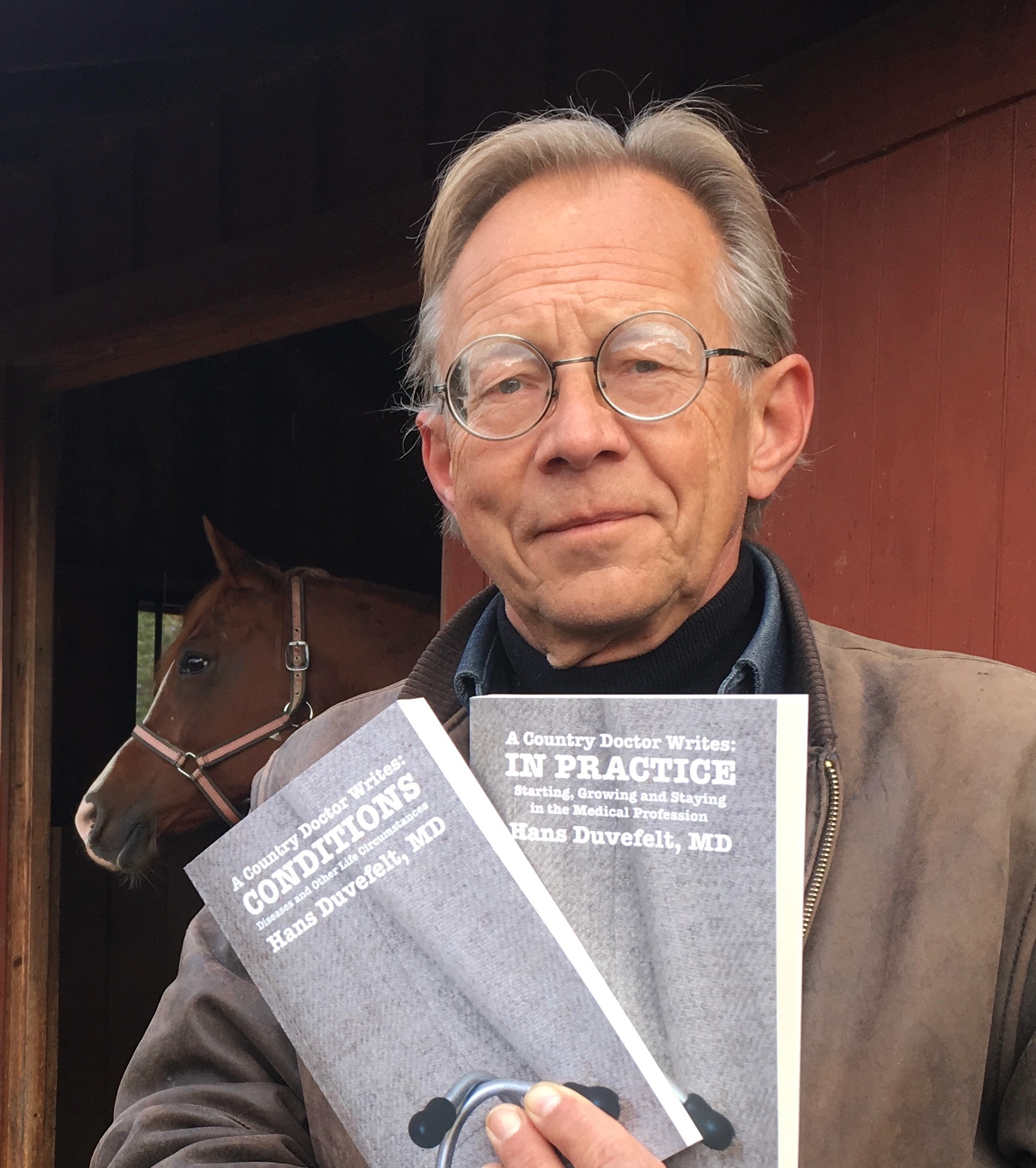
BOOKS BY HANS DUVEFELT, MD

CONDITIONS, Chapter 1: An Old, New Diagnosis

Top 25 Doctor Blogs Award

Doctor Blogs

Enter your email address to subscribe to this blog and receive notifications of new posts by email.

Mailbox

contact @ acountrydoctorwrites.com
Bookmark and Share
© A Country Doctor Writes, LLC 2008-2022 Unauthorized use and/or duplication of this material without express and written permission is strictly prohibited. Excerpts and links may be used, provided that full and clear credit is given.