Archive Page 200

Who Wants To Know?

Last week’s New England Journal of Medicine reports on a study of 162 people with one parent affected by Alzheimer’s disease. Half the study participants were told the results of genetics testing that indicates a person’s risk of developing Alzheimer’s disease, and the other half were not told the results. People with depression or intellectual difficulties were excluded from the study. 

After one year of follow-up there was no difference in anxiety or depression scores between the two groups. One interpretation of this study is that it doesn’t hurt people to know they are at risk for developing Alzheimer’s disease.

That may or may not be the case – only the most solid citizens were allowed to remain in the study – but I still don’t see the point in looking for potential Alzheimer victims before any symptoms develop.

Both doctors and patients in this country seem to have an insatiable thirst for information, even when there is not yet an understanding of how to use it.

One of my professors in medical school proclaimed something that has echoed in my head through my years of practice: “Don’t order the test if the result won’t change your treatment.”

Until we have an effective treatment for early Alzheimer’s disease, testing asymptomatic individuals just doesn’t make any sense to me. It clutters our minds with unnecessary worries and may prevent us from taking full advantage of the remaining days of our lives.

Who wants to know that a dreadful and unrelentingly progressive disease will rob them of their faculties? The New England Journal study may have proven that some of us can handle that kind of information, but why should we have to? What should we do with it?

I am reminded of a story about a man, who tries to escape his destiny, as told by W. Somerset Maugham and John O’Hara – “Appointment in Samarra”, quoted here from another blog:

A rich man sends a servant to the marketplace to buy provisions, but instead, he returns pale and trembling. “Master,” he says, “I saw Death in the marketplace, and he looked at me a long time, with a strange expression on his face. I am so afraid. Please, can I take a horse and go visit my relatives in Samarra?”
The master lets him go—he has been a good servant, and now he is so shaken that he wouldn’t be able to do much anyway. Off the servant gallops toward Samarra.
Then the rich man goes to the marketplace to see if there is any truth to what his servant said. Sure enough, there is Death, waiting in the shadows and watching.
The rich man comes to him and says, “O Death, my servant says that when he came here, you looked at him very strangely, for a long time. Is this true?
 “Yes,” says Death, “but only because he was here. I have an appointment with him tomorrow in Samarra.”

Dear Doctor D,

Just a quick note to wish you a Happy Birthday.

I appreciate all you have done for me over the past fifteen months. I remember thinking I was just run down and fighting mono or something similar when I came to see you last spring. Little did I know then that I had Stage 3B non-Hodgkin lymphoma.

I remember last summer, kayaking down the river in front of your house between chemotherapy sessions, my port-a-cath smarting with every paddle stroke.

This summer I have my old stamina back, and Dr. Schwartz told me last week that my CT scans look excellent!

I know my lymphoma will likely come back some day, but right now I feel great. Life is good at the moment, and I am grateful.

Thanks for being there,

Jane W.

An Empty Stall

Twenty-four hours ago, as my wife and I finished supper, I told her I wanted to change from my work clothes into my barn clothes and join her as she fed the horses their evening meal. We had spent a rainy but still relaxing three-day Fourth of July weekend, and by Monday night I was already missing our new barn and the horses.

Caleb and our newly adopted Arabian princess nickered as we entered with their grain mash. We watched them eat with obvious pleasure, said goodnight and returned to the house to make it an early night.

As I got in bed, my wife asked if I could hear a noise. There was a clanging and a thumping outside somewhere.

I stepped outside and immediately heard that the noise was coming from the barn. Caleb was down, thrashing around in his stall. I ran in to get my wife and we called the large-animal veterinarian and a neighbor up the road who also owns horses.

It looked like a case of colic, and we administered the Banamine after speaking to the veterinarian on his cell phone. We walked Caleb around his paddock. He went down a couple of times, but we managed to get him up each time.

By ten o’clock the vet was there and puzzled over the situation. He has been at it a few more years than the twenty-eight I have been in Family Medicine, but he is limited to the technology he can fit in his Dodge van.

We went over our options. Caleb looked like he had colic, but his pulse was slow and strong. He also had a long history of unexplained neurological and constitutional symptoms. Exploratory surgery three hundred or more miles down the road on a twenty-year-old horse isn’t undertaken lightly.

We listened to the vet as he shared his assessment. We agreed to treat Caleb’s pain and observe him for a while. The vet left, and we stayed with Caleb for several cold and windy hours in the pasture as a thunderstorm passed in the distance. Now and then he would get up and walk around, but there wasn’t much improvement in how he seemed to feel.

As the vet returned at dawn, we could see that Caleb was giving up. He lost his battle right there in his brand new pasture this morning as the first birds began to sing. I cut a few strands of hair from his mane for a keepsake, and we removed his leather halter.

It was only two weeks ago we all moved into our little red farmhouse with ten acres of land and a brand new Amish-built horse barn right outside the kitchen window. We left our house in the village partly so Caleb could be with us, instead of being boarded. We also adopted our little Arabian princess as a companion for Caleb.

After the cold, sleepless night out there in the pasture, we buried Caleb at the highest spot, overlooking our miniature farm. I stripped his stall and covered the orthopedic floor mat with new shavings.

As we stood there in his empty stall and walked through his empty paddock, we talked of what a big presence he was – a gregarious horse with a sense of humor and a taste for mischief, a thousand pound teddy bear, who loved to cuddle. It is humbling to have earned the affection of such an animal. In just a few hours we lost our biggest pet. We now have his empty stall right outside our kitchen window. We also have our new little Arabian princess, who just lost her new companion. We all feel a little lost.

Yesterday’s Children

Ethel Bray was in for her annual ear wash Friday. Ninety years old next month, she is one of the spunkiest, funniest women I know. Her youngest sister accompanied her to the office. Somehow we came to talk about Ethel’s remarkable vitality.

“You know the doctor didn’t think she’d make it,” her sister told me. “She couldn’t tolerate her mother’s milk, so she was raised on barley water.”

Ethel does all her own housework and credits her long staircase for her remarkable physical health.

“I get all my exercise going up and down those stairs half a dozen times a day,” she announced.

I know I cannot take any credit here; she takes no prescription medications and she hasn’t had any blood tests in the last decade. She never had a mammogram or a colonoscopy. If it weren’t for her recurring earwax buildup, I wouldn’t have the privilege of knowing her.

The day before I had seen another child nobody expected to live. Jonathan Buck is only seventy-five, a stocky, muscular man with a can-do attitude. His daughter, Wendy, told me last year that the doctor who delivered him advised his mother to put him in a dresser drawer and keep him warm, but not to get attached to him, because he probably wouldn’t live through the night, since his brain was bulging out through a soft spot in the back of his head. Mr. Buck still has an unusual looking bulge in the back of his head, but is a bear of a man in every other respect.

We must never underestimate what a child can overcome.

A Tale of Two Sisters

Jane Barker and Judy Swift didn’t look like sisters, and from what I understand, they didn’t spend much time in each other’s company. They had both been my patients for years by the time I learned that they were sisters.

The one thing they had in common was their smoking history. Jane was discreet about it, but Judy’s struggles to quit were obvious. She had tried every available smoking cessation drug. She had COPD and saw a pulmonologist regularly to help manage her chronic cough and shortness of breath.

Jane’s most pressing medical problem was always her touchy digestive symptom, and Judy came in a couple of times last fall for fatigue. Then just before Christmas, Jane developed a severe cough. Her chest x-ray was negative and the cough was non-productive. I told her it was probably viral, and prescribed inhalers for her. She called back asking for antibiotics and cough suppressants. I tested her for influenza and prescribed empiric antibiotics for mycoplasma, but she continued to be plagued by her dry cough. A repeat x-ray suggested a lesion in her right lung, and it looked malignant on CT scanning. I referred her to a pulmonologist and a thoracic surgeon.

Jane’s cough made the thoracic surgeon nervous, and her surgery was delayed several times because of the severity of her cough. Finally, in mid-February, she had her surgery. I saw her for a couple of postoperative visits, and although she felt terrible and continued to cough, her surgery seemed to have been a success. We spoke of her stubborn cough and how it probably saved her life.

In late February I saw her sister Judy again. She looked terrible, and she had lost weight. I had done all kinds of tests on her just before Christmas when she came in for fatigue. She had seen her pulmonologist not that long ago, but I sent her for a CT scan of her chest, even though her x-ray didn’t show anything new. The scan showed a plum-sized irregularly shaped tumor deep inside her right lung. She also had several enlarged lymph nodes.

I called Barry Wolf, her pulmonologist. I could hear him sigh when I told him what I had found.

“I’ll get her right in,” Barry said.

I received a couple of courtesy copies of her test results in the mail that told the rest of the story. Her pulmonary function tests were very poor, and she wasn’t a surgical candidate. There was a consultation note from a radiation oncologist, then nothing more.

Her obituary was printed in Saturday’s paper.


I just realized none of the posts show on an iPad or a computer, but they do show on an iPhone. WordPress is working on this. In the meantime, please visit my Substack.


Osler said “Listen to your patient, he is telling you the diagnosis”. Duvefelt says “Listen to your patient, he is telling you what kind of doctor he needs you to be”.


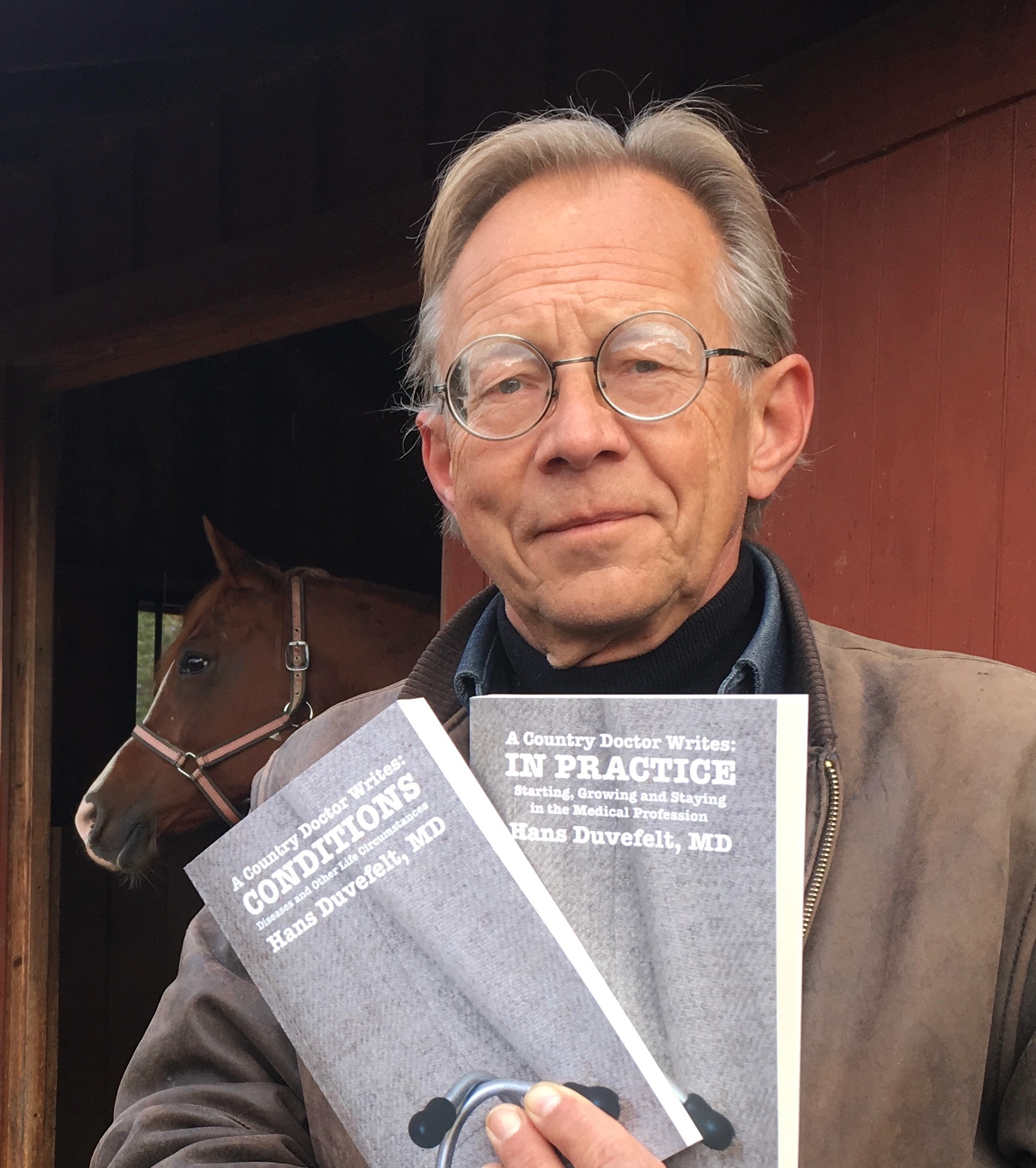
BOOKS BY HANS DUVEFELT, MD

CONDITIONS, Chapter 1: An Old, New Diagnosis

Top 25 Doctor Blogs Award

Doctor Blogs

Enter your email address to subscribe to this blog and receive notifications of new posts by email.

Mailbox

contact @ acountrydoctorwrites.com
Bookmark and Share
© A Country Doctor Writes, LLC 2008-2022 Unauthorized use and/or duplication of this material without express and written permission is strictly prohibited. Excerpts and links may be used, provided that full and clear credit is given.