Archive Page 199

Trouble at 6 O’clock

Emily Green knew there was a lump in her right breast. She was a new patient I saw a few weeks ago. Her previous doctor had sent her for a mammogram last year, but she had not come in for a clinical breast exam. She was a busy professional, who admitted she sometimes cut a few corners with her own health care.

I remember signing the order for her annual mammogram even before I met her. At that point in time, she had not made an appointment to see me, but I signed the order anyway.

In years past I used to stick to my guns and not order a mammogram for patients who had no intention to come and see me for a breast exam.

We all know that a mammogram is best done after a clinical breast exam, so that women with abnormalities on their exam can have a more comprehensive, or diagnostic, mammography study with an ultrasound examination to distinguish between solid and cystic masses.

Purist that I was, I insisted on doing the job right, and on my terms – exam first, then mammogram. I don’t know how many patients ended up having nothing at all done because of my stubbornness. After a lot of thought I decided to authorize mammograms for any woman who wanted one, whether she came in for a breast exam or not, since doing something seems better than possibly doing nothing to screen for cancer.

When I finally met Emily Green for her first appointment, she told me she was concerned about a small lump in the lower portion of her right breast. I agreed with her – the lump was a little larger than a pea, nontender and freely movable against the overlying and underlying tissue. Another, larger, irregular cluster of lumps toward her breast­bone in the 3 o’clock position seemed like typical fibrocystic disease.

At the end of her appointment we agreed on getting a diagnostic mammogram followed immediately by an ultrasound. Whether these tests showed anything or not, we also agreed to have her see a breast surgeon in consultation because of the suspicious nature of the lump at 6 o’clock. We also decided to get some updated blood tests and change her blood pressure medication.

I signed off on her normal radiology reports and added “cc: Dr. Fowler” at the bottom of each page.

When I saw Emily Friday to follow up on her blood tests and new medication, she had already seen the breast surgeon the day before. She was quite animated when she said:

“I can’t believe the tests didn’t show anything. I mean, I felt the lump, you felt it, and Dr. Fowler found it instantly. She’s set me up for a biopsy in less than two weeks! I never realized doctors might disagree with an x-ray.”

“A test is only a test” I mused. “Mammograms are probably best at finding little microcalcifications we can’t feel with our hands.”

“I guess so, but I still feel like I had a near miss”, she said. “What if I had just trusted the mammogram and not bothered to come and see you until the lump had grown some more?”

I reminded her that the biopsy may still come out negative, but agreed that it was very good she had taken the time to come in with her concern.

I still wonder, which is the better thing to do, authorizing screening mammograms to any and all or start insisting again on seeing patients for a clinical breast exam first.

The Power of Words

Yesterday afternoon I sat in a dark room with a couple of doctors and several mental health professionals and participated in a video conference about integration of primary care and behavioral health. Outside, the late summer sun shone brightly just like it did September 11 eight years ago.

The case for integration is obvious; 85% of the time the ten most common symptoms brought to the attention of primary care doctors (chest pain, dizziness, fatigue, back pain and so on) have no known somatic explanation – the cause for the symptom appears to be psychological.

Yet, the words we use to interview patients, to document the history and physical examination findings, and to present our thoughts to our patients and to our behavioral health consultants are often extremely unhelpful and sometimes downright insulting to the patient.

It seems the place to start integrating primary care and behavioral health is with our everyday choices of words we use to describe the patients we see in our offices.

The days are essentially gone when doctors spoke in technical terms to each other and other medical professionals with the purpose of keeping the patient in the dark. For example, very few of the old prescription-related Latin phrases are still being understood and used by doctors and pharmacists, and most preprinted prescription pads no longer feature the optional “label” box, which in a bygone era gave the prescribing physician the option of not revealing the name of the drug to the patient.

We are nowadays cautioned to clear our vocabulary of words which we as physicians have used and understood to mean something perfectly neutral in clinical language, yet can be offensive to patients, who increasingly often end up reading their own medical records.

In my years as a physician I have read many chart entries that read something like this:

“This pathetic 57 year-old woman returns with a litany of complaints, and seems to completely lack insight into the real cause of her misery…”

Those are words that, perhaps, may insulate a doctor from bad feelings about his/her inability to help such a patient, but they aren’t likely to help the patient manage their symptoms or psychological issues, and they ultimately don’t belong in a therapeutic relationship.

This is not Orwellian Newspeak; our words can heal, and they can hurt. These are some examples of conventional doctorspeak and suggested alternatives from the video presentation by Alexander Blount, Ed. D.:

Chief Complaint = Main Concern

Suffers from = Struggles with

Refused to take = Decided against

Was noncompliant with = Didn’t see the value of

Didn’t keep appointment = Wasn’t able to be here

Arrived late = Was determined not to miss

There is a lot of talk these days in the U.S. about the Patient-Centered Medical Home. It begins here; with the way we see our patients as the center of the clinical work we do, indeed the justification for our own existence as doctors in our communities.

“Thank You, Father”

Mrs. McCann greeted me at the door. “Thank you for coming”, she said in a hushed voice. “Gerry thinks I’m a worry-wart, but I’d feel better if you looked him over again. He sounds a little congested and I’d like you to see his wounds again.”

Gerry McCann sat in his favorite chair in the sunny living room. His wife handed me a piece of paper with his recent weights, blood sugars and blood pressure readings.

I checked his heart and lungs without finding anything unusual, and then Mrs. McCann proceeded to expertly change his dressings, so I could inspect his diabetic ulcers.

“They’re coming along great”, I said, and added, “You are doing a superb job”.

“I do my best”, she answered, beaming.

I wrote some new prescriptions and we agreed on the timing of my next house call. She followed me to the door.

“Thank you, Father”, she said, and then quickly corrected herself.

“I mean, thank you, Doctor. Father Harris was here yesterday to see him.”

It struck me that Father Harris and I had come on similar errands, giving our blessing to the care and commitment we see in that house, neither one of us delivering much more than reassurance that the McCanns are doing their part and whatever happens next is in God’s hands.

A Thirty Year Anniversary, And I Missed It

This summer I have been a doctor for thirty years, and I just realized I missed the anniversary of my medical school graduation. Actually, it almost seems fitting that I did, because of how it all happened.

I had one of the best medical educations you can get, but there was a total lack of pomp and circumstance at Uppsala University. Any form of celebration of academic achievement occurred after hours and off campus, usually within the highly regulated social clubs called “Nations”. They were started hundreds of years ago when students from all over Sweden came to Uppsala to study and needed ways to stay in touch with people from their own provinces. Students traditionally found room and board with private families in Uppsala, and the “Nations” were meeting places and social support providers for them.

As far as I know, students still have to register with one of the “Nations” when they enroll at Uppsala University.

When I started medical school I was a very serious young man – too serious, I have since realized. When it came time for me to choose which “Nation” to register with, I chose the one that was only perfunctory, charged only a nominal fee and never had any events. Instead of spending my free time with other students, I sat in my one bedroom apartment and read books from the “Doctor in the house” series, which follows a zany group of British medical students through school and internship.

At the end of my last semester, a hot summer day in 1979, I remember putting the contents of my locker in a plastic grocery store bag and riding my bicycle home to my apartment at the outskirts of town. Instead of the kind of diploma my American colleagues proudly display on their office walls, a brief letter arrived in the mail a few weeks later, stating that it was proof of my medical license. In one corner was a red stamp, certifying that the three-dollar administrative fee had also been collected.

It wasn’t much of a ceremony, so it never stuck in my mind. I’m not even sure how to answer when I occasionally get asked for my medical school graduation date – the day I emptied my locker or the day I got the certificate in the mail?

I guess the glory in my case comes from doing what I set out to do when I was about four years old. I never counted the days or the years. I just carry on.

Basic Knowledge


My mother, who lives in Sweden, has been suffering from gout again. It has been a few years since her last attack. She told me on the phone this morning that the medicine her family doctor prescribed didn’t seem to be working. Last time she had an attack a covering physician had given her an anti-inflammatory medication, naproxen. When she saw her regular doctor the other day, he read her chart and voiced his disapproval of his colleague’s choice of treatment that time.

“You should not be taking naproxen when you are also taking a blood thinner”, he declared. “I’ll give you something else.” 

Four days later there was no sign of improvement. I asked what medication her doctor had put her on. “A-L-L-O-P-U-R-I-N-O-L 100 mg”, she spelled from the bottle.

I advised her to stop taking it and explained that allopurinol isn’t indicated for acute gout, but instead is used to prevent attacks. It can often precipitate an attack when first started.

Her doctor is a board certified generalist, who works part time at her neighborhood clinic and does research part time. From what I have heard, he is a decent fellow, who generally takes good care of my mother’s health issues. In this case, however, I felt compelled to intervene.

“Why don’t you call tomorrow and ask for some prednisone,” I suggested. “That’ll stop the attack fast and it won’t upset your blood thinner. Then, when everything has settled down, you might be able to start the allopurinol.”

I don’t remember how nervous Swedish doctors are about short-term use of steroids, but not using allopurinol for acute gout is fairly basic.

I did some more thinking this afternoon. One does need to be careful judging others with regards to what is basic knowledge as opposed to esoteric. I don’t know quite how old my mother’s physician is, and I know the diseases he encounters in my mother’s urban clinic in Sweden are vastly different from what I see in rural America.

I went to medical school before AIDS/HIV, hepatitis C, fibromyalgia and many of the diseases that now fill the workdays of many of my colleagues, and I work in an area without much ethnic diversity. I have only had one patient with AIDS, and I haven’t seen a gun shot wound in a decade. I remember thinking when I took the test to renew my Family Medicine board certification a few weeks ago that the choice of questions was not representative of what I see most days in my practice.

Perhaps we have arrived at a point where physicians’ knowledge base even in primary care isn’t universal.


I just realized none of the posts show on an iPad or a computer, but they do show on an iPhone. WordPress is working on this. In the meantime, please visit my Substack.


Osler said “Listen to your patient, he is telling you the diagnosis”. Duvefelt says “Listen to your patient, he is telling you what kind of doctor he needs you to be”.


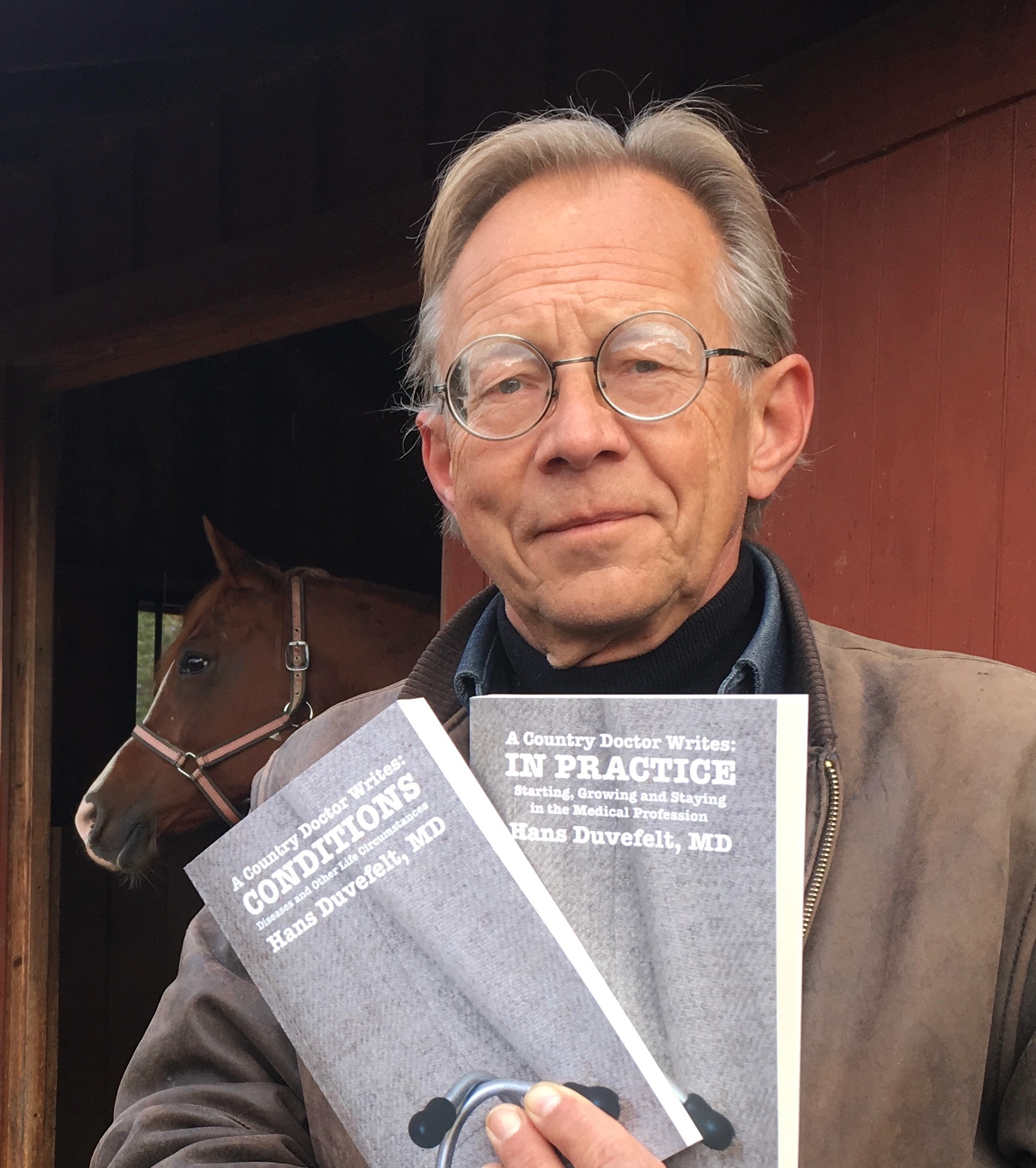
BOOKS BY HANS DUVEFELT, MD

CONDITIONS, Chapter 1: An Old, New Diagnosis

Top 25 Doctor Blogs Award

Doctor Blogs

Enter your email address to subscribe to this blog and receive notifications of new posts by email.

Mailbox

contact @ acountrydoctorwrites.com
Bookmark and Share
© A Country Doctor Writes, LLC 2008-2022 Unauthorized use and/or duplication of this material without express and written permission is strictly prohibited. Excerpts and links may be used, provided that full and clear credit is given.