Archive Page 198

Who Needs a Physical?

Last week I saw an elderly woman whose daughter brought her in with a long list of symptoms, including palpitations, chest pain, fatigue, forgetfulness, dizziness, headaches, chronic leg swelling, abdominal pain and irregular bowels.

“She needs a complete physical,” the daughter said.

I disagreed. In my opinion, she needed a thorough evaluation of her symptoms and concerns, starting with her most urgent symptom of chest pain. She was simply not well enough for a routine physical.

This is no joke: A routine exam is essentially for healthy people. Patients with alarming symptoms need to have them evaluated promptly in a focused way, and not wait until their next routine physical, where the urgent issues would have to be dealt with in conjunction with immunization advice and all kinds of health maintenance issues.

Not everybody believes in the annual physical. Medicare doesn’t cover it, and most of the things doctors do during such an exam are of little or no proven benefit, as the proponents of evidence-based medicine remind us.

Those routine tests that are supported by the evidence are not usually recommended on an annual basis, but rather at different intervals for different age groups.

As far as the old-fashioned head-to-toe physical, there is simply no scientific support for it if you listen to the U.S. Public Health Task Force or the big insurance companies.

I have always shied away from the term “complete physical”, because there really is no such thing in clinical practice. There are always more things you could do, but don’t – we all have to budget our time as well as all other resources in our profession.

For many years now I have preferred the term “Annual Review”, because, in preventive medicine as in clinical diagnosis, you can usually accomplish more by simply talking to your patient than by delving into examinations and procedures right away.

In my practice, I see the Annual Review as my opportunity to ask patients things that they may not have thought of bringing to my attention. It is my opportunity, just like in the “well child visit,” to offer what we call anticipatory guidance – addressing things that might become problems in the future, and how to avoid that happening.

I am more likely to find a patient with angina by asking him how he feels when he splits and stacks firewood than by auscultating his heart or doing an annual resting EKG in my office. I also think I am more likely to spot a depressed patient if I have a chance to ask a few open-ended questions about how things are going than if I only rely on questionnaires.

There is no doubt that certain parts of the routine physical exam are valuable. I tend to talk my way through the exam, asking questions while I touch the patient, explaining what I am looking for, and encouraging the patient to do their own breast exam, lymph node or testicular exam. 

And, getting back to auscultating the heart, it is necessary to do. A physical without listening to the heart is like a dinner without a main course. People expect it, and you never know what you’ll hear if you stop and listen for half a minute or so.

I didn’t need an EKG to diagnose my elderly chest pain patient with atrial fibrillation.

A Hero’s Pain

“I don’t know if you understand, Doc, what kind of man this is.”

The man who spoke appeared to be a few years my junior. He was speaking of his father, who is one of my patients at the local Veteran’s Home, where I am a relative newcomer.

“This man fought in two wars and earned two Medals of Honor. He is not going to tell you how much pain he is in, even when you ask him, because he isn’t even going to admit to himself how much he hurts.”

He made a point I actually hadn’t considered before during my tenure at the Veteran’s Home. My patient has metastatic cancer, and the nursing staff asks him every day to rate his pain. His answer is always 2 on a scale from 0 to 10.

As doctors and nurses we estimate our patients’ discomfort through their words and also through their vital signs, facial expressions, posture and other nonverbal clues. But when it comes to treating war heroes, do our usual instruments fall short?

I remember thinking when I admitted the ailing veteran that he seemed so humble and plain spoken. The words “true hero” came across my mind then. I didn’t consider that I might not be able to accurately assess his cancer pain or his level of distress over his terminal diagnosis.

There is a lot of talk about cultural competency in this country. Today I even read in one of the publications of the American Medical Association that several states are mandating that physicians take courses to improve their skills in dealing with patients from cultural and ethnic minorities.

Somehow I think we oversimplify the issue of cultural competency if we focus on only those we think of as minority groups. Our challenge in caring for all our patients is to meet them where they are, to step out of our own world long enough to at least get a glimpse of theirs. We must first meet as human beings before we can begin our medical assessment.

War heroes are a minority, too.

A Real Pain

Why would a toothache bring Ted Larson to the emergency room when he already takes half a dozen morphine tablets per day for his chronic back pain?

Why did Bridget Hall’s fibromyalgia pain seem to escalate after her last doctor gave her long-acting oxycodone?

Is Bob Bachman really in that much pain from his arthritis, or is he sharing or even selling his pills?

Taking care of patients with chronic pain is difficult. Physicians are at the same time told to recognize and treat pain better, and also to be more stringent with pain prescriptions to avoid drug diversion. Our understanding of the physiology and psychology of pain is evolving, as well as our knowledge of the science behind addiction.

As often before I see that some of the things I learned from my clinical professors in medical school were forgotten or even dismissed, only to come back into focus years later.

Thirty years ago I was taught that patients with ordinary low back pain would get better pain relief from modest doses of conventional pain medications if they were also prescribed a low dose of the antidepressant amitriptylene. The reason, as I remember it, was thought to be that amitriptylene made the brain interpret incoming pain signals differently.

Later, other authorities made a big distinction between mechanical low back pain and neuropathic or radicular pain, commonly referred to as sciatica. The focus shifted away from the brain’s interpretation of pain signals in general to whether a pain originated in the musculoskeletal system, like low back pain or arthritis, or in the peripheral nervous system, like sciatica.

When fibromyalgia was first recognized as a disease, there was a lot of confusion about where the pain came from. The name itself suggested that the pain originated in the musculoskeletal system. With the understanding at the time that such pains could be treated with narcotics, many fibromyalgia patients ended up on strong pain medications. We still used medications like amitriptylene and the more modern antidepressants with success, but the thinking was that these drugs worked mostly by improving sleep or treating unrecognized depression. Today we recognize fibromyalgia as a disease involving increased pain sensitivity of the nervous system, and we now have several medications targeting this mechanism.

We have also learned that patients who receive opiates for any kind of pain can develop a fibromyalgia-like intensification of nerve pain associated with ordinary touch, allodynia, or otherwise moderately painful stimuli. This phenomenon is called opioid-induced hyperalgesia. Paradoxically, decreasing such a patient’s pain medication dosage reduces their pain level.

More recently, even chronic musculoskeletal pain of arthritis has been shown to cause a nerve-mediated general pain sensitivity of a similar type. Patients with severe arthritis often experience aching and pain in areas without joint disease, such as skin or muscle tissue.

The practice of my early teachers, who treated most chronic pain as if it were at least in part nerve pain has found new respect and acceptance after many years of neglect as science has finally caught up with their clinical wisdom.

So when Ted Larson, already on chronic narcotics, complains of severe, nerve-mediated tooth pain, his pain is real and may actually be more severe than the same toothache in a person not on narcotics.

Bridget Hall’s fibromyalgia pain may actually have been made worse by the narcotics she was prescribed.

And Bob Bachman’s long-standing arthritis may indeed have made him increasingly pain sensitive. He has never failed a random urine drug screen or pill count. With the new data on neuropathic pain sensitization in patients with longstanding arthritis, it may be time to try him on something specifically for nerve pain, rather than increasing his regular pain medications.

The Shadow of the Object

Dinner conversations in medical families can be less than ordinary. Tonight we were talking about how to choose antidepressants for different types of patients. My wife, who worked side by side with me for many years as a Nurse Practitioner, is now doing other things, and her time away from practice has heightened her awareness of how clinicians often reach for their prescription pads very quickly when faced with patients, whose lives have presented them with more losses or sorrows than they can handle in the moment.

As we talked more, we realized that it was this very weekend – Columbus Day – eight or nine years ago that we attended probably the most profound Continuing Medical Education event of our careers. It was one of several parallel seminars offered by Harvard Medical School and Massachusetts General Hospital’s Department of Psychiatry.

The title of the course was “The Shadow of the Object”, which is a quote from an enigmatic passage in “Mourning and Melancholia” by Freud. It was held in an old, slightly run-down family resort in the Catskills in upstate New York, very similar to the setting of the movie “Dirty Dancing”. In its heyday, this resort was a summer haven for middle class families from New York City – a chance to experience nature and participate in organized activities while mingling with people of their own kind.

The central idea of the conference was that we never “get over” loss or trauma – we just have to find ways to carry it with us in a fashion that makes sense for us. It is a simple notion, but it has profoundly affected how I have counseled patients from that moment on. There is such a tendency in our society to focus on the “positive”, to downplay the importance of sadness in a healthy and balanced life.

One particular thought we brought with us from “The Shadow of the Object” is the concept of moving through grief by finding ways to honor the legacy of the lost loved one. I have found that to be one of the most healing things you can teach those left behind after someone they respect and love passes away.

On our way home from the course, we spent one night at the Equinox Mountain Inn in Manchester, Vermont. It was another magical experience, dining and sleeping high above the clouds in a quirky 1960’s building at the site of an old charterhouse, or Carthusian monastery. It only seemed fitting that we ended our Continuing Medical Education weekend there – high above the ordinary places we usually frequent for such affairs, a place for quiet contemplation before stepping back into the normal practice routine, albeit a little bit changed.

If You Find It, You Own It

Working with students always makes you think about why you do certain things the way you do them and why you may feel more strongly about some things than others.

Today, in talking with one of my students about how to do a history and physical exam, I admitted for the first time something that has plagued me for most of my career:

As an intern in Sweden during one of my first surgical subspecialty rotations I had to do the admissions of patients who came to the hospital the afternoon before elective procedures. Those were the days when nobody had to get up before the birds in order to check into the hospital at seven a.m. for same-day major operations and procedures.

I remember dutifully documenting the history of a man who mentioned in passing as I went through a Review of Systems that his bowel movements were getting narrower in diameter – a possible sign of colon cancer.

My attending physician was the head of his subspecialty department and a very busy surgeon. I must have had five or six admissions to do that afternoon.

I remember thinking that this patient’s altered bowel movements were significant and needed some type of follow-up. The attending was not on the ward, but doing a clinic at the other end of the hospital and the resident was seeing patients in the emergency room, so with several more admissions to take care of, I did what I thought was the best I could do and carefully documented the patients symptoms for the attending physician to read and presumably act on the next day before surgery.

The next morning when I arrived at the hospital he had already been in the O.R. for almost an hour and I didn’t get around to asking what he thought we should do about the patient, whose name I didn’t even remember by then.

It could not have been long afterward that I realized that attending physicians with busy surgical or clinic schedules don’t necessarily read their interns’ charts closely enough to find pearls of information deep inside paragraphs that document mostly normal findings.

I realized today why I feel so strongly about making clinical notes clearly distinguish between normal and abnormal findings. This has become an even bigger challenge with the seemingly ever-increasing need, at least in my adopted homeland, to document even perfectly normal exams in great detail for the sake of higher reimbursement and protection from lawsuits.

A macabre example of documentation just for the sake of documentation came to me a couple of years ago in the form of a four page printout of a cardiologist’s office note, which must have involved all of ten minutes of face-to-face time between doctor and patient. Most of the information in the office note was repeated Past, Family and Social History. The exam followed a template, and the Review of Systems had been imported from a patient questionnaire on an optical reader form, similar to ones we used for tests in school – I have seen that particular electronic health record in use.

Deep inside the four page document was a notation that the patient admitted to suicidal and homicidal thoughts. The busy cardiologist didn’t comment on it, and I dare say he never noticed it was there.

Ultimately, whether we are nurses, interns or Board Certified specialists, if we are the first or only ones to know about something important in a patient’s history or physical exam, we own it, at least until someone better suited can take over.


I just realized none of the posts show on an iPad or a computer, but they do show on an iPhone. WordPress is working on this. In the meantime, please visit my Substack.


Osler said “Listen to your patient, he is telling you the diagnosis”. Duvefelt says “Listen to your patient, he is telling you what kind of doctor he needs you to be”.


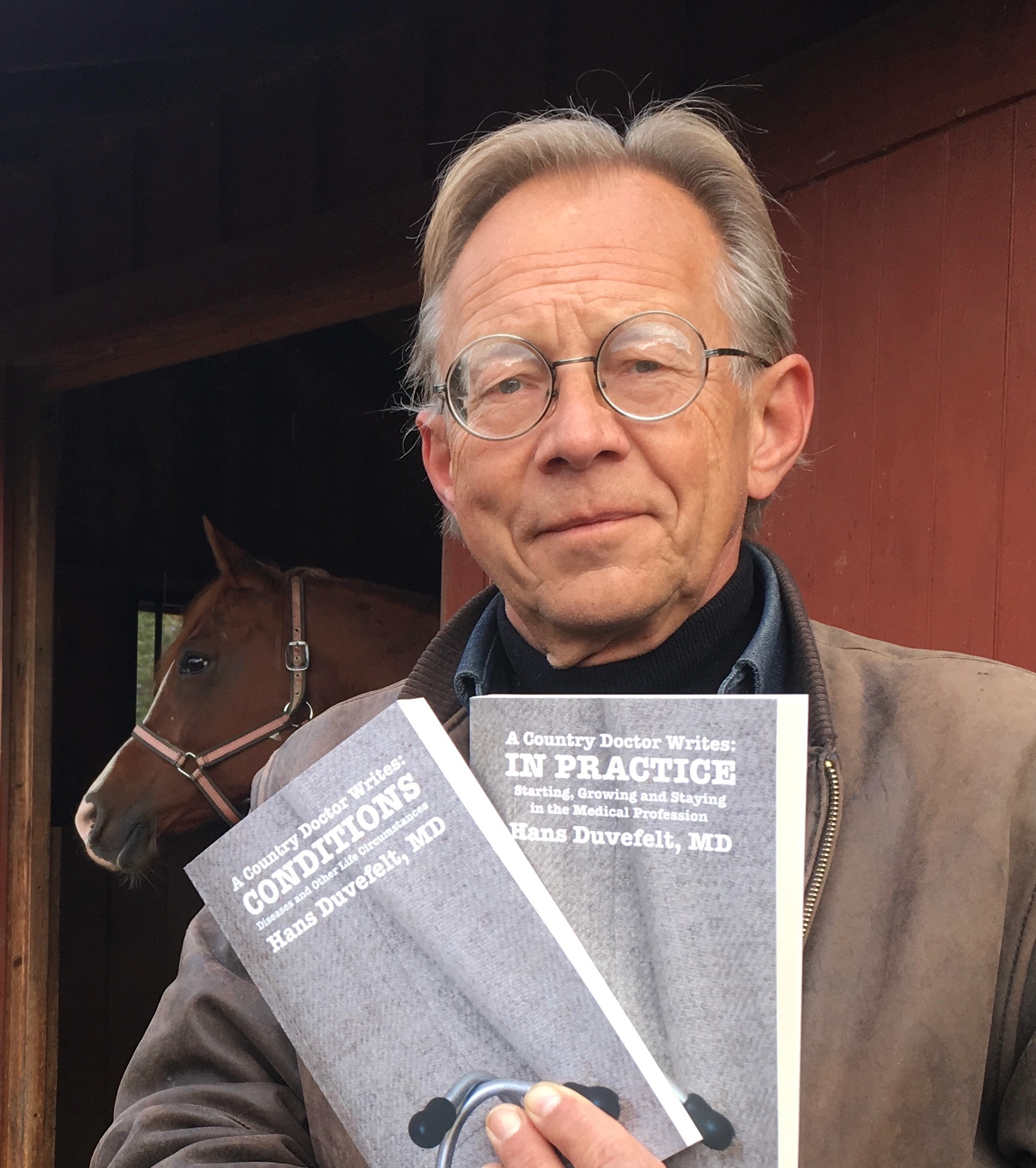
BOOKS BY HANS DUVEFELT, MD

CONDITIONS, Chapter 1: An Old, New Diagnosis

Top 25 Doctor Blogs Award

Doctor Blogs

Enter your email address to subscribe to this blog and receive notifications of new posts by email.

Mailbox

contact @ acountrydoctorwrites.com
Bookmark and Share
© A Country Doctor Writes, LLC 2008-2022 Unauthorized use and/or duplication of this material without express and written permission is strictly prohibited. Excerpts and links may be used, provided that full and clear credit is given.