Archive Page 197

Quality or Conformity?

Yesterday I received something in the mail about how I might be judged by certain “Quality Indicators”, such as my patients’ mammography rate. This struck me as very odd, since just a few weeks ago the U.S. Public Health Service Taskforce reversed their longstanding recommendation that all women should have annual mammograms from age 40.

This is a striking example of how yesterday’s truths are tomorrow’s fallacies in modern medicine. A doctor who orders annual mammograms this month could be viewed as practicing poor quality medicine, even though the same behavior might have earned him or her bonus payments and honorable mentions last month.  

I think it is time we speak honestly about what the agenda really is here. If we, or those who pay us or regulate us, choose quality indicators that are not based on solid scientific principles, but instead on expert opinions that could – and do – change at any moment, we are not measuring quality at all. What we are measuring and rewarding in that case is conformity. How fast and how consistently today’s physicians can implement new guidelines is certainly easier to measure than how well their patients are feeling.

We aren’t measuring how often doctors make the correct diagnosis on the first visit or how well they handle difficult clinical situations. We aren’t measuring how often we are able to reassure or comfort another human being who would otherwise keep circling within the health care system at great expense in search of peace of mind.

No, the things we measure are only the underpinnings of quality in health care. It is fine to measure doctors’ compliance with official guidelines, but we need to look well beyond such low hanging fruit if we want to be serious about quality. 

Frankly, there are ways we can let our office staff, our disease registries or Electronic Medical Records handle a lot of the housekeeping items people think of as quality indicators. The quality measures of physicians’ work would then reflect how we practice the art and science of medicine. We need to look more to clinical results (outcomes) and appropriateness of care.

Just like in school, we can strive to master the subject or just pass the test. If we just want to pass the test, we can change the subject when our patients bare their souls to us, fumble with the chart or peer into the EMR and start talking about tetanus shots and cholesterol and mammograms (or perhaps why we won’t order a mammogram), or we can push the paper chart or computer screen aside, look them straight in the eyes and say:

“We’ll let the system catch up with you about those things. Tell me what’s bothering you…”

Saying No

I said no when Nora Williams asked me to order a CA 125 blood test the other day. She is worried about ovarian cancer, not because of any family history, but because she, in her own words, just has the worst luck. She is an anxious woman, and I would have loved to help relieve her anxiety, but I couldn’t.

I said no when Mark Michaud asked for an antibiotic, even though he was miserable after several days of cold symptoms which had by now turned into a severe and productive cough with thick, yellow sputum.

I even said no when Jim Westerdahl asked for an MRI of his back after his sciatica attack cleared on prednisone. “I just want to know what’s going on in there”, he said, “so I know what to expect.”

I seem to be saying no a lot lately. More and more often, patients present with requests for specific tests or treatments, sometimes as a direct result of searching online for ways to screen for, diagnose or treat disease.

Nora Williams’ fears of ovarian cancer cannot be allayed by a CA 125 test. Women often ask for it, but the sad truth is that for an average risk woman without a family history of the disease, a positive test means ovarian cancer only 20% of the time, and only 50% of early ovarian cancers cause a rise in this particular tumor marker. The real usefulness of this test is to follow an already advanced ovarian cancer for recurrence after treatment.

Mark Michaud, like many other people, wishes antibiotics would work on viral infections, but they don’t. Twenty years ago I might have treated his type of bronchitis with an antibiotic, but now we know that colored phlegm does not necessarily mean an infection is bacterial.

Poor Jim Westerdahl. Whether an MRI showed a herniated disc or not, that would not help predict his risk of recurrence. It has been said that 10% of healthy people have MRI evidence of significant disc disease, but no symptoms. His symptoms were already gone, so he didn’t need any treatment, and a $1500 MRI would not help predict future symptoms any more than flipping a coin.

Sometimes I say no when patients want disability parking placards, electric scooters or narcotic pain medications when it really is in their best interest to push themselves a little harder.

I say no when patients ask me to write prescriptions in their name for an uninsured family member, and I say no when patients ask for expensive, new medications they have seen advertised on TV when there are effective, tried-and-true generics that work just as well.

I also say no when patients call in with a request for a prescription when they have self-diagnosed something I haven’t seen them for many times in the past.

Saying yes is often faster in the moment, since a no requires a thoughtful explanation, but my job is to consider the long-term consequences of every clinical decision. As a physician I have the freedom to ignore the guidelines and the scientific evidence that’s out there when I think my patient doesn’t fit the usual pattern. We need to be careful with that power if we want to keep it.

Thanksgiving Potpourri

Several patients Wednesday made me reflect on how fortunate I am to be doing what I do for a living.

There was the young man with chest pain, skin problems and unusually long fingers. Could it be that he had a syndrome I have never diagnosed before?

There was the woman with a platelet disorder and new onset atrial fibrillation. The cardiologist had recommended against using blood thinners because of the woman’s low risk for stroke based on her CHADS score, but had deferred to her hematologist and me because of her thrombocytosis. The hematologist couldn’t be sure that her hydroxyurea treatment completely neutralized her risk for blood clots, and wanted to defer to the cardiologist and me. I was able to pull it all together for her by showing her the NNT, or number needed to treat, for patients with her CHADS score. She chose to go with aspirin alone and left the office visibly relieved that nobody was trying to make her take warfarin.

There was also the young mother who wept about the loss of her grandmother a few days earlier. “Gram was my best friend”, she said, adding “I need to keep it together for my two-year-old daughter”. The woman’s presenting complaint of cough and shortness of breath didn’t seem to be a sign of anything dangerous. At the end of our visit I pointed out how fortunate she was to have been that close to her grandmother while growing up. I encouraged her to help her little girl know the importance of family the way she did.

My last two patients were a husband and wife, both around eighty years old. He had almost crushed his lower leg in a farming accident, and came in for a wound check and some pain pills, which he had declined on his first visit.

“I’m too stoved up to wrestle with my cows now. The shape I’m in, I couldn’t even wrestle the rooster”, he muttered in his thick local accent.

His wife’s blood pressure checked out okay, and I asked her to come back in the spring for a recheck. She looked me square in the eye and said:

“I’ll call you if I need you”.

There was enough time left to take care of all the incoming laboratory and x-ray reports, prescription refills and other chores well before five o’clock.

I wished my nurse, Autumn, “Happy Thanksgiving” before calling my wife to tell her I was on my way. I turned out the office lights and locked the clinic door behind me. My Thanksgiving was already well under way.

See You Next Time

Can you imagine a doctor telling a heart attack survivor:

“That was a close call, but I’m glad you made it. I’ll see you next time you have one. Oh, by the way, you might want to watch that cholesterol.”

I thought not. Yet, that is how most of the one million kidney stone cases are handled every year in the United States at a cost reported to exceed four billion dollars.

Kidney stone pain is said to be one of the worst pains a person can experience. In medical school we were taught that patients with a ruptured appendix are likely to lie perfectly still on the exam table whereas kidney stone patients are in such agony that they are unable to stay long enough on the table for you to examine them.

We have all kinds of technologies available for kidney stone removal, all of them expensive. Prevention, on the other hand, is cheap but seldom done. Cynics may say that there are no incentives in this country to prevent diseases that provide steady work for physicians who treat them.

Over the years I have seen public awareness and special interest groups crop up for just about every disease, even rare ones like SCID, Asperger’s and Rett Syndrome. Common things like avoiding recurrent kidney stones seem to get less media attention.

Kidney stones are made up of uric acid (the same compound responsible for gout) or salts containing calcium and another ingredient like oxalate, phosphate or struvite. Regardless of stone composition, recurrences can be partly prevented by simply drinking more water, which dilutes the stone-forming chemicals. Interestingly, there is a “kidney stone belt” in the southern part of the United States that is said to be expanding northward as a result of global warming, with projections of a 25% increase in kidney stone cases by the year 2050.

The Calcium Paradox

Depending on the chemical composition of kidney stones and levels of urinary excretion of key ingredients, specific dietary interventions and medications can help reduce a patient’s risk for recurrent stones. Doctors, like everyone else, however sometimes jump to conclusions. Some things seem so obvious that nobody questions them. Then, when scientific research proves our assumptions to be wrong, we refuse to believe, or perhaps we just forget what we have learned. This is at the core of what we call Evidence Based Medicine.

It was long assumed that if you restricted a person’s intake of calcium, the risk for kidney stones would decrease. The New England Journal of Medicine reported in 1993 that the opposite was true; a low calcium diet increases kidney stone risk. I seem to remember hearing the same thing during my training in Sweden long before then.

The reason for this calcium paradox seems to be that a low calcium diet causes more ingested oxalate in the intestine to exist in a free form, rather than attached to calcium. The free intestinal oxalate is more easily absorbed, leading to more oxalate in the urine, where it can combine with even small amounts of calcium to form a kidney stone.

Yet, I often hear that kidney stone patients are told by their doctors to restrict their calcium intake. I also hear both doctors and patients make general statements about the effects of fluid pills (diuretics) and vitamin C. Without knowing what type of stone a patient has, such generalizations are simply not helpful. 

Physicians have an obligation to help patients avoid illness when there is good evidence available to guide us. Kidney stone prevention is not as glamorous as blasting stones with lithotripsy. As with any disease prevention, the way you know it works is that nothing happens. Any physician who has faced a kidney stone patient writhing with excruciating pain can appreciate that nothing happening is more humane than “See you next time”.

Starting Over

Mrs. Jarvis seemed almost exasperated with my questions. She had told me all her symptoms a couple of times and I had asked several follow-up questions. Between our first and second visit she had gone for several tests, but I could not make a unified diagnosis. I was beginning to think she had several things going on, but I couldn’t make sense of her nausea.

“I am stuck,” I said. She sighed as I continued: “I must be missing something in your story.” Then, in a moment of inspiration, I got up from my stool and walked over to the exam room door as she followed my movements with suspicion and disbelief in her eyes.

With one hand on the doorknob I turned toward her and explained what I was doing:

“Pretend I’m an amnesiac and you never met me or told me what you are feeling. I need to hear your story again from the beginning and without interruptions.”

She giggled as I walked back across the room, shook her hand and introduced myself. Her husband grinned from his chair in the corner.

Nausea is a lot like dizziness. I remembered the lecture on dizziness Dr. Martin Samuels had given at a Continuing Medcal  Education course I attended years ago. Dr. Samuels is Professor of Neurology at Harvard Medical School and one of the most captivating lecturers I know.

Don’t ask a dizzy patient any questions, because with that particular symptom, all questions are leading questions. If you ask a dizzy patient a single thing, they’ll say: “yes, that’s what it’s like” and you are doomed, Dr. Samuels cautions.

In order to evaluate a dizzy patient, you need to lean back in your chair, touch your chin, take some deep breaths and look out the window, not at the patient. Then you need to just sit there for a while and finally say: “Dizzy…?” You then must wait as long as it takes for the patient to tell you more.

Mrs. Jarvis smiled as I did my Marty Samuels impression. Her husband leaned forward from his chair.

With renewed resolve to avoid any leading questions that might derail her story, I said in a reflective tone of voice:

“Nauseous…?”

Five minutes later, without asking a single further question, I knew what to do.


I just realized none of the posts show on an iPad or a computer, but they do show on an iPhone. WordPress is working on this. In the meantime, please visit my Substack.


Osler said “Listen to your patient, he is telling you the diagnosis”. Duvefelt says “Listen to your patient, he is telling you what kind of doctor he needs you to be”.


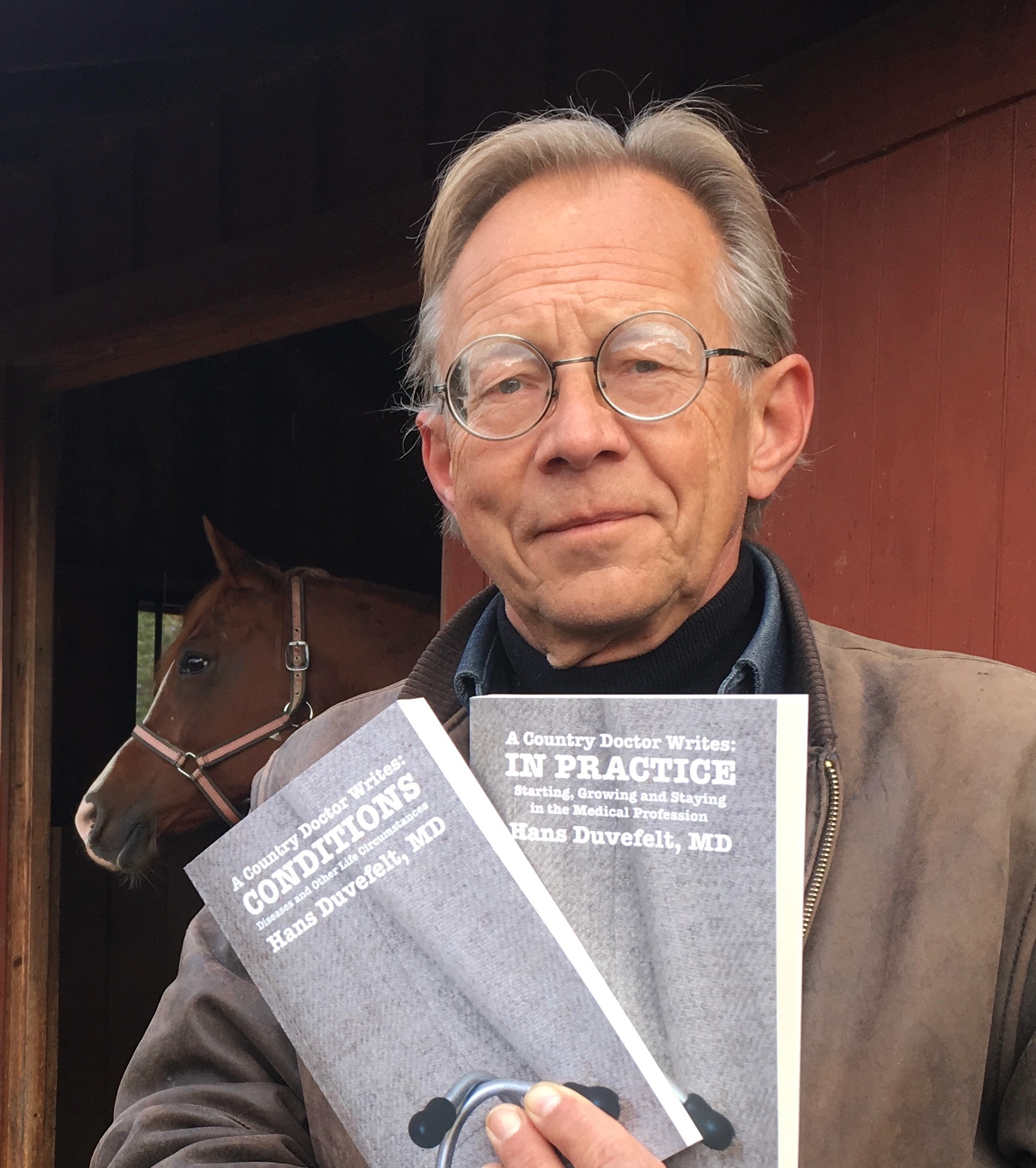
BOOKS BY HANS DUVEFELT, MD

CONDITIONS, Chapter 1: An Old, New Diagnosis

Top 25 Doctor Blogs Award

Doctor Blogs

Enter your email address to subscribe to this blog and receive notifications of new posts by email.

Mailbox

contact @ acountrydoctorwrites.com
Bookmark and Share
© A Country Doctor Writes, LLC 2008-2022 Unauthorized use and/or duplication of this material without express and written permission is strictly prohibited. Excerpts and links may be used, provided that full and clear credit is given.