Archive Page 196

“Choices, Gentlemen”

Lorraine Walker saw her daughter get married and her son finish high school. Not long afterward she was at it again. She and her husband, Ted, adopted two young boys.

Six-year-old Sam and his four-year-old brother Tobias had been in foster homes for two years when Ted and Lorraine adopted them. Sam has a low IQ and is generally a quiet, introverted boy, except when he gets into it with little Tobias, who has a genetic mosaic with several minor physical abnormalities along with attention deficit–hyperactivity disorder and some anxiety.

Tobias had gone through a comprehensive evaluation at a child development clinic just before I became the boys’ family doctor about a year ago. Reading between the lines of the massive report, you could sense the reviewer’s concern for his future; Tobias seemed to have challenges in every sphere, yet being around him you couldn’t help being smitten by his exuberant personality.

I remember the exam room was bedlam the first few times I saw the two boys, but Lorraine was calm and dispassionate. She made it perfectly clear what was acceptable behavior and what was not. With admirable consistency she made Sam and Tobias take the consequences of their actions.

Tobias’ most visible physical abnormality consists of a flexion deformity of his fifth finger on both hands. The child development clinic reviewer thought he would need surgery and recommended an evaluation by a pediatric orthopedic surgeon. Fortunately, the hospital we refer our patients to has a very seasoned specialist, who was wonderful with Tobias. He reassured Lorraine that Tobias would have enough dexterity, in spite of his deformity, that it wouldn’t limit his career options, even if he wanted to be a concert pianist or a pediatric orthopedic surgeon.

We once got chatting about how common it is for parents not to follow through on their threats, like “we won’t go for ice cream if you tease your brother again”. Watching Lorraine Walker, you know she means every word she says, and the boys don’t take very long to mend their ways when she reminds them.

Just about old enough to be their grandmother, she is secure enough in her role as an adult and a parent that she doesn’t take responsibility for things the boys themselves are old enough to be accountable for.

“I made a lot of mistakes with the first two that I’m not about to make again”, she once confided. “Anne and Jeremy are turning out okay, even though Ted and I were a little too lax with them. Sam and Tobias have enough challenges that we need to help them develop their character and their common sense so they can reach their highest potential. I’m not helping them by compensating for them – I need to help them grow up to be solid citizens.”

The last time they were in, little Tobias started to spin out of control, egged on by Sam, who sat in a corner and made faces at him. Lorraine had been talking to me. With a quick turn of her head she caught their attention. It took three little words in a quiet voice for her to change the energy in the exam room into one of peace and order:

“Choices, gentlemen – choices…”

Scrubs, Ties and Stethoscopes

There is a debate going on about whether doctors’ neckties can and do transmit resistant bacteria to unsuspecting patients. Some people are trying to prohibit doctors from wearing them. So far, the evidence has not supported the notion that ties actually spread disease, but this is an emotionally charged issue. 

In my part of the country you see maybe half the doctors wearing a tie and they often also wear a lab coat. The other half tends to wear open-collared plaid shirts and no lab coat. From an infection control point of view, wearing your street clothes without a lab coat when seeing patients all day in the office seems like a more questionable practice than sporting a tie tucked inside a white lab coat.

A fellow Swedish physician doing his residency in New York pointed something out in his Swedish language blog that I also found striking when I first got here: A lot of nursing personnel wear their scrubs not only in the office or hospital, but they wear them on their way home in the family car or on the subway. They wear them when they stop at the grocery store, and they wear them when they greet their children after work. That is probably a bigger infection control problem than physicians’ neckties.

One thing that even the plaid-wearing country doctors carry around the neck is quite possibly a real infection hazard, but I seldom hear anybody worry about it: Our trusted stethoscopes go everywhere we go, dangling from our necks or tucked into our lab coats and our sport jackets. We use them on people’s chests and abdomens and also when we listen to arteries on their necks and in their groins.

When did you last see a doctor sanitize his or her stethoscope?

More important than physicians’ choice of clothing is the alarmingly low rate of hand washing among physicians – 40% to 60% of the instances when they should, depending on which study you read.

The benefit of hand washing isn’t exactly breaking news. One of the earliest stories of medical discoveries I read in medical school was about hand washing. Semmelweiss noticed that midwives seemed to have fewer cases of postpartum womb infections among their patients than the physicians-in-training at his hospital. The difference seemed to be that the midwives and their hands stayed on the labor wards, while the residents went back and forth between anatomical dissections of corpses and the delivery room. Vinyl gloves weren’t invented, and hand washing was until then entirely optional.

In my office we have alcohol hand gel dispensers in every room and in the hallway. I use them on my hands and my stethoscope. I wear a lab coat that stays at the office, and, yes, I always wear a tie. So did Sir William Osler.


Attitude!

Arsène Voisine, my first patient this morning, rose from his chair as I entered the exam room. At 89, he has a strikingly energetic way of moving and speaking. His eyes squinted as he vigorously shook my hand and said “Good Morning, Doctor”.

“How are you?” I inquired.

He flashed a grin that quickly reverted to a frown, shrugged and turned his forearms outward, exposing the palms of both hands in a Gallic-looking gesture.

“I stayed up all night trying to think of something I could complain to you about, but I couldn’t think of anything. I am quite well, thank you. I feel like forty-five.” His pretended frown turned into his usual grin again.

Arsène is a slender man with deep facial wrinkles and large, knotty hands. I see him often in the office; he is a Senior Volunteer, who brings other, less mobile seniors to appointments and helps them with their shopping, banking and other errands.

He is an informed health care consumer, who always reads up on any concern or symptom he might have before deciding to contact our office. His favorite reference is the Mayo Clinic.

There is no mistake, this man is proud of his vigor and good health. He often points out how he lives well and practices moderation, although I sometimes think he expends more energy than I do. He thinks nothing of driving on snow-covered roads an hour each way through moose country to go ballroom dancing on a Saturday night. As he talks about his favorite dances, his shoulders rise, his elbows and knees bend and he looks like he is getting ready to jump.

He never did seem to retire; a master plumber and electrician, he still seems to be the one people around here call on to fix things, and he revels in telling me about his diagnostic triumphs.

“I could have been a doctor”, he sometimes tells me. “I love solving problems.”

He may not be a colleague in the classic sense of the word, but when I hear him talk I do think of him as a mentor and role model. He loves his life, is grateful for his good health, enjoys fixing things and helping those less able-bodied than himself, and he still does the cha-cha at 89.

Arsène – I want to be like you when I’m 89; I’d like some of that attitude!

A Posthumous Blessing

Mitch Tapley was not your ordinary preacher. He was a burly man in his late sixties with massive, tattoo-covered arms, a stubbly, broad face and hair that always looked like he might have arrived by motorcycle. He smelled of cigarette smoke and his powerful baritone voice had a gravelly edge to it that reminded me of Johnny Cash.

He became my patient just a few months ago after he ended up in the hospital and almost died from a respiratory illness. Mitch had worked hard to get back in the pulpit and out among his congregation, and every time I had seen him he had spoken of trying to find a balance between helping others and taking care of his own health.

Our last visit, the day before yesterday, seemed particularly profound. He spoke of his walk with his Lord by his side, and a new level of clarity he had experienced since facing his own mortality, then interrupted himself and said:

“I don’t even know if you are a believer, but I think you know what I mean.”

I responded by telling him what my father had said about my choice of medicine as a career many years ago – that I could have been a lawyer but I was too honest, or a preacher but my faith was too weak.

He laughed heartily and said:

“God bless you, man, you are a healer and a friend.”

I asked him again about his smoking, and he said he was almost ready to quit.

Early this morning the shrill sound of an ambulance tore through our little village and the news reached me as I walked through the clinic door: Pastor Mitch had suffered a massive heart attack and died from cardiac arrest.

This afternoon I dialed his home number to give my condolences to his wife. The phone rang four or five times, then there was a click, followed by his familiar, powerful, resonant voice. A chill went up my spine as the recording played:

“I am not here to take your call,

Please try again later, and

May the Lord always be with you.

May He bless you and protect you.

May His face smile on you and be gracious to you.

May the Lord show you His favor and give you His peace.”

The Art of the Intramuscular Injection

We had a “farm call” by the local horse veterinarian today – they call it that even if you don’t have a real farm.

Our white Arabian princess suddenly stopped eating this afternoon. She acted distant and uncomfortable, even to the point of lying down in the snow on such a humid and raw day. After she got up again, she just stood still in one corner of her pasture, refusing to come in.

By the time I made it home, the vet was on his way. Between the two of us, my wife and I were able to get the horse inside her stall. The vet arrived and she greeted him with suspicion; the last time he had been here was when we lost Caleb, her stall mate. The vet quickly determined that the horse had a temperature, and we had noticed a yellow nasal discharge. Soon the horse was sedated and the exam continued in more detail.

The decision was made to start her on antibiotics. The veterinarian filled a syringe the size of a regular flashlight with penicillin, which was the color and consistency of heavy cream. He injected it slowly against some apparent tissue resistance into the neck muscles of the still sedated 1000 lb animal.

“You could give her these shots, right?” he said, obviously aware of my profession. He thought for a while, then added: “But she won’t be your friend after a few days of doing that”.

After some more thought, he suggested I give her sulfa orally twice a day instead. I gratefully accepted his second suggestion as I imagined giving 60 ml of penicillin IM several times a day to a crankier and crankier horse.

Suddenly, in my mind I was nine years old again, admitted with pneumonia to the isolation ward at our local hospital in Sweden. I was sick, lonely and afraid, and four times a day one of the nurses would come into my private room and give me a penicillin shot.

The first nurse was soft-spoken, kind and sweet. She hated to cause me pain. She inserted the needle slowly and I screamed inside every time.

The second nurse chewed gum and seemed to have an attitude not quite compatible with consoling frightened nine-year-old sissies. She commanded me to roll over, and by twisting my neck I could see her hold the syringe just like a dart. She pulled her arm back and then almost flung the syringe at my bare bottom. The needle pierced my skin in a fraction of a second and, to my amazement, I didn’t feel a thing. I could feel the tension as the medication entered my muscle, but there was no pain whatsoever.

By the time I got to medical school nobody had to teach me how to give intramuscular injections. I had enough of them myself to know how to give them painlessly. To humans, that is.


I just realized none of the posts show on an iPad or a computer, but they do show on an iPhone. WordPress is working on this. In the meantime, please visit my Substack.


Osler said “Listen to your patient, he is telling you the diagnosis”. Duvefelt says “Listen to your patient, he is telling you what kind of doctor he needs you to be”.


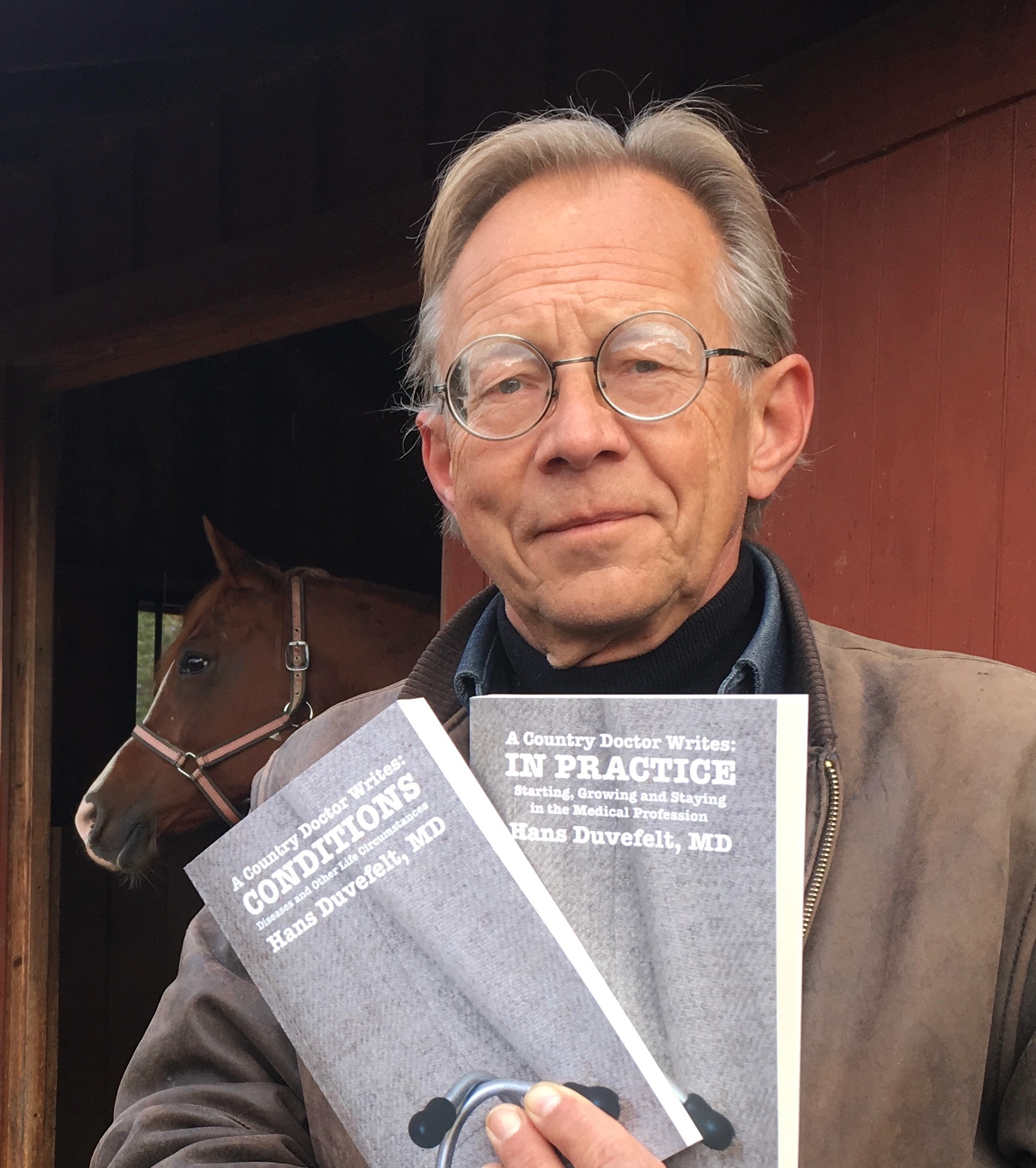
BOOKS BY HANS DUVEFELT, MD

CONDITIONS, Chapter 1: An Old, New Diagnosis

Top 25 Doctor Blogs Award

Doctor Blogs

Enter your email address to subscribe to this blog and receive notifications of new posts by email.

Mailbox

contact @ acountrydoctorwrites.com
Bookmark and Share
© A Country Doctor Writes, LLC 2008-2022 Unauthorized use and/or duplication of this material without express and written permission is strictly prohibited. Excerpts and links may be used, provided that full and clear credit is given.