Archive Page 195

Noah’s Journey

John and Elizabeth Tuttle had only one son. Noah was born with pneumonia and he didn’t look like other babies. His nose was thin and his ears were pointed. He was very small and he didn’t cry the way other babies do.

Noah never learned to speak in full sentences and he never grew up to find his own way in the world. He stays at home with his mother and father and spends most of his time playing quietly with his toy animal collection, his sticker books and his View Master 3-D pictures. He always seems happy and always has hugs and kisses for his parents.

A few years ago he developed pancreatitis and had to stay in the hospital for almost two weeks. He cried for his parents, who, both in their eighties, were too exhausted to stay with him in the hospital all the time.

I visited Noah on the surgical ward during that time, and I can still vividly see the image of the small, elderly-looking man with a plush zebra in bed with him, his hands without wrinkles or calluses, his face without beard growth and his eyes so deep and sad.

“You my doctor!” He smiled when he recognized me.

“How are you feeling, Noah?” I asked.

“Noah’s sick” was all he said.

“You’ll be okay soon; you’ll be home soon”, I promised.

John Tuttle is a soft-spoken man with a thick Yankee accent, who never wastes his words. He hates to take pills, and he is on several. He should be on more because his blood pressure is still too high. He blames it on stress and I agree that his plate is full. Once, about a year ago, he spoke to me of his biggest fear:

“I worry about Elizabeth’s heart and I worry about Noah. What will happen to him after we’re gone? I hate to think of him in an institution. He’s always been with us.”

A few months ago Noah suddenly gained weight. His legs swelled and he became short of breath. His chest x-ray showed only a mild enlargement of his heart, but his echocardiogram showed a severe weakness of his heart muscle and a critical aortic stenosis. The main valve of his heart was closing and choking his entire circulation.

After a few days in the hospital he was breathing comfortably again, but he was homesick and cried when his parents weren’t there.

There had been no warning. There was no heart murmur. Noah had always lived a very sedentary life. His aortic valve had calcified without causing the usual symptoms until he became short of breath just playing in his room.

The chief of cardiology, Dr. Thomas Wentworth, said that an aortic valve replacement could be done, but because Noah’s heart was so weak there was little hope that it would recover. It was not likely his symptoms would go away by just replacing the valve.

I met with John and Elizabeth shortly thereafter. They had made up their minds not to put Noah through open-heart surgery with such an uncertain outcome. They wanted us to manage Noah’s heart failure with medications.

Noah is out of the hospital. He takes several new medications and is breathing comfortably. Noah talks about not liking the hospital. He stays at home with his mother and father and spends most of his time playing quietly with his toy animal collection, his sticker books and his View Master 3-D pictures. He always seems happy and always has hugs and kisses for his parents. 

John and Elizabeth wonder quietly whose journey will end first.

The Jig Is Up

Jeremy Jones’ back surgery didn’t seem to have done much for his pain. He came to me on long-acting narcotics and generous doses of short-acting painkillers to take as needed.

His spine surgeon had nothing more to offer, and it was up to me to prescribe and monitor his medications.

Last month he produced the right number of pills for his random pill count. He didn’t seem surprised when Autumn, my nurse, called him in for a pill count; it is part of the narcotic contract he signed when he first came to our office.

Some doctors don’t accept new patients with pain issues, even if they are in dire need of care for diabetes and other medical problems. Our office doesn’t discriminate like that, but we try to be firm and fair in our enforcement of the office’s narcotics policy.

The random urine drug screens sometimes reveal that a patient isn’t taking the pain medicines we prescribe. The “street value” of these drugs is ten dollars per pill and up.

Other times we find medications not prescribed by us or illegal substances like cocaine – all reasons to stop prescribing pain medications or to discharge the patient from our practice.

Jeremy’s first random urine drug screen didn’t happen.

“I just went before I left the house”, he explained. Several cups of water and an hour later it was almost closing time.

“We’ll catch you another time”, I said casually, not realizing how prophetic that sounded until after I had said it.

Several weeks went by. Then, last week, Jeremy had a morning appointment.

“Let’s have you do that urine drug screen today”, I insisted.

“Oh, I just went while I was waiting to see you. I couldn’t hold it”, Jeremy explained.

“No problem”, I reassured him. “We’ve got all day.”

“But I have an appointment with Dr. Anderson over at the hospital in an hour.”

A quick call confirmed this was true.

“No problem”, I told Jeremy. “I’ll write you a lab order and you can just go to the hospital lab after your appointment with Dr. Anderson. After all, that’s where your sample would be going anyway.”

“Great, I’ll just stop in there, then”, Jeremy smiled nervously.

“Fine”, I said.

I got busy and a couple of days went by. Then Dr. Anderson’s report from Jeremy’s appointment arrived. That reminded me – I had not seen Jeremy’s urine drug screen yet.

Two minutes later I knew that there was no record of a urine sample on Jeremy Jones at the hospital.

I reached over to the keyboard and started typing: 

Dear Jeremy…

Snap Diagnosis

At the nursing home the other day I saw a young man in blue scrubs push a laundry cart up the hall. He must be new, I thought, trying to catch a glimpse of his name tag. As he approached the nurse’s desk he made a sudden noise.

“Bless you”, one of the nurses said.

The young man smiled briefly. “I didn’t sneeze, but thank you. I am probably the most blessed person around.”

I wasn’t sure what that little exchange was all about and continued reading the hospital discharge summary of my new admission. In the periphery of my visual field I saw the young man starting to sort through the items on his cart.

Suddenly he made the same unusual sound, kinked his head and snorted twice again before picking up a pile of clean towels.

Tourette’s syndrome, I thought to myself. Naturally, people must mistake his verbal tics for sneezes all the time and say “Bless you”.

I remembered the day I made that diagnosis for the first time.

It was a bitterly cold Tuesday morning in early December. I was doing a rural rotation six months into my residency, back in my hometown in Sweden. One of my assignments was to hold a weekly clinic for the inmates at a remote prison in a wind-battered coastal town twenty miles from our hospital.

Five miles into my commute the heater in my second-hand Volvo wagon was still blowing cold air, and the base model didn’t come with heated seats. Shivering, I turned the radio on for some distraction from the cold. Just then, the announcer came on the air and said that John Lennon had been shot.

I drove the remaining fifteen miles in a daze, unaware of the temperature or the scenery. I walked up the stairs to the prison clinic and settled into the sparse consultation room. Through the surprisingly thin walls I could hear the clinic nurse escort my first patient of the morning down the hall and into the adjoining exam room.

My daily schedule listed each patient’s name, birth date and chief complaint. As I glanced down the list I heard strange sounds coming from the exam room. By now the inmate was alone in the room – the nurse’s clogs had echoed down the corridor moments before.

Through the wall to my right I heard muttering and a series of coughs and snorts, each punctuated by a sudden, unintelligible monosyllabic outburst.

I began to worry. I was about to enter the room with this individual, and I didn’t know how safe that might be. Was this a violent, uncontrollable person I was hearing, tormented by horrific hallucinations and delusions, likely to snap at any moment? I looked at the patient roster, where his chief complaint was listed as “tics”, which I knew very little about.

I looked around the office. There were only two books on the blond government issue office desk – a Swedish drug reference and the Merck manual, in English.

I searched the index of the Merck Manual and hurried to the section about tics. There, I quickly found exactly what I was hearing through the wall to my right: Gilles de la Tourette Syndrome. I vaguely remembered hearing something about it in medical school, but I had never seen a case of it, and in 1980 there wasn’t the public awareness of this condition that there is today.

Armed with my newly found knowledge about the condition and its treatment, I entered the room, facing only my fear of getting hurt.

The young man seemed gentle and soft-spoken. He greeted me politely and I introduced myself. He told me he had these tics that nobody seemed able to help him with. Suddenly he snorted, kinked his neck and swore under his breath.

“I know what you’ve got”, I said. “I think I can help you.”

“Really?” he said and smiled with tears in his eyes.

A Bad Case of Nerves

George Dutton walked in again yesterday. He never calls for an appointment. He asks politely if I have time to see him and never demands to be seen right away. Cindy at the front desk always works him in. He doesn’t drive and never seems to have a ride. Driving around town and the nearby countryside, I always see him out walking.

George is a man of few words. Most of his medical issues are straightforward – a chronic hand eczema, an occasional cut that gets infected, some arthritis. His walk-in visits usually run all of five minutes. He always seems eager to leave, almost in a rush.

More often than not, once we have covered the problem that brought George to the clinic, he asks me the same question:

“Hey, Doc, can you give me something for my nerves?”

George has a terrible case of Benign Essential Tremor, a hereditary condition that causes his hands and neck to vibrate with a high frequency. He has seen two neurologists and tried all the appropriate medications, at least for a few days, but nothing has seemed to help him.

When I first met him, I took his question literally. I started asking him all kinds of questions about how he was feeling. He gave me a blank stare.

“I feel fine,” he insisted. “It’s just my nerves, see?” He held his trembling hands out in front of him.

No matter how many times I tried to explain that the root cause of his tremor is not “nerves” in the sense most people refer to them, George remained steadfast in his belief that deep down, his nerves must be real bad for him to shake like that.

During one of my vacations a colleague prescribed an anxiety medication for him, and George insisted it helped his shaking quite a bit. If I sometimes smell his noontime beer on his breath, I have noticed that his tremor seems better than usual.

Yesterday I had my usual impulse to contradict him and explain again that bad shakes don’t necessarily mean bad nerves, but I caught myself and instead asked him if he thought people ever shake when their nerves are okay. He didn’t think so.

That got me thinking. George is such a laconic man, that perhaps his deepest emotions are non-verbal. I often see patients who struggle to find the right words to describe their feelings, but what if he feels something that he never even imagined finding words for? What if he is grappling with feelings so strong that they make him shake? Benign Essential Tremor certainly can get worse with anxiety.

Prescribing a tranquilizer for George always seemed like treating a symptom without the proper diagnosis, and the only one I had for him was Essential Tremor. Tranquilizers aren’t really the best treatment for that diagnosis. George had told me his nerves are bad, but I had demanded explanations and elaborations about his feelings to me.

How fair is it to insist on hearing just the right words to fit my diagnostic template for generalized anxiety disorder? If George had been a child I would not have done that. If he suffered from dementia or a stroke, I would have had to go on what I have seen for myself – a hurried man who seldom speaks, plagued by terrible tremors, helped by tranquilizers or beer.

I hadn’t listened all those times when he literally spelled out his diagnosis for me:

“Hey, Doc, can you give me something for my nerves?”

Face-to-Face

As Family Physicians today we each take responsibility for a panel of patients. Some of them are healthy and only come to see us for physicals and episodic illnesses, but more and more of our patients have chronic illnesses like diabetes, heart disease, depression, fibromyalgia and chronic lung disease. Such problems don’t go away between visits, and as primary care doctors, our involvement with these patients doesn’t stop when their office visits are over.

We track these patients’ care in our disease registries in order to ensure that recommended testing and follow-up is offered at timely intervals.

As clinical reports and test results from specialists and emergency rooms trickle in, we review them to see if we need to make any changes in each patient’s care plan.

When lab results come in before a scheduled visit, we look them over to make sure they are normal enough that any needed action can wait until we meet with the patient.

We answer questions, verify and refill prescriptions, and we file countless reports with insurance companies and Quality watchdog organizations that grade us and probably some day will pay us for our patients’ blood pressures, cholesterol and blood sugar values.

Still, we – or in most cases our employers – essentially only get paid for the time we spend face-to-face with the patient, even though medicine these days involves a lot more work behind the scenes and in between visits. This mismatch between payment system and patient needs has made it harder for doctors to be generous with their time.

Health Maintenance Organizations (HMO’s) were supposed to revolutionize health care in the U.S. through capitation – paying doctors a monthly fee per member, based on the expected cost of taking care of various age groups. Today, almost none of our patients have this type of insurance.

What, then, do doctors get paid for in the office? Most get paid according to how many questions they ask patients, how many organ systems are reviewed and examined, and how complex or risk-filled the clinical situation is. Under that system, a doctor who needs to ask a lot of questions and do a detailed general exam gets paid more than a doctor who quickly reaches a diagnosis.

Some clinics get paid a fixed rate, so that a five-minute visit for a sore throat brings in as much money as 45 minutes spent with a complex, very ill patient. There, the temptation is to keep visits short in order to see as many patients as possible.

Face-to-Face time is what we get paid for, but it is part of a package where the other pieces may seem undervalued. We always have to watch how we spend our time. The challenge for all of us is to make the time we have with our patients, be it five minutes or forty-five, productive and therapeutic.

We can’t blame our patients for our lack of time. They didn’t create the system. They come to us for help with their fears and their ailments. They don’t generally ask for a certain number of minutes. They want and deserve technical competency, caring and compassion.  Those things aren’t measured in minutes. 

Neither is Quality.


I just realized none of the posts show on an iPad or a computer, but they do show on an iPhone. WordPress is working on this. In the meantime, please visit my Substack.


Osler said “Listen to your patient, he is telling you the diagnosis”. Duvefelt says “Listen to your patient, he is telling you what kind of doctor he needs you to be”.


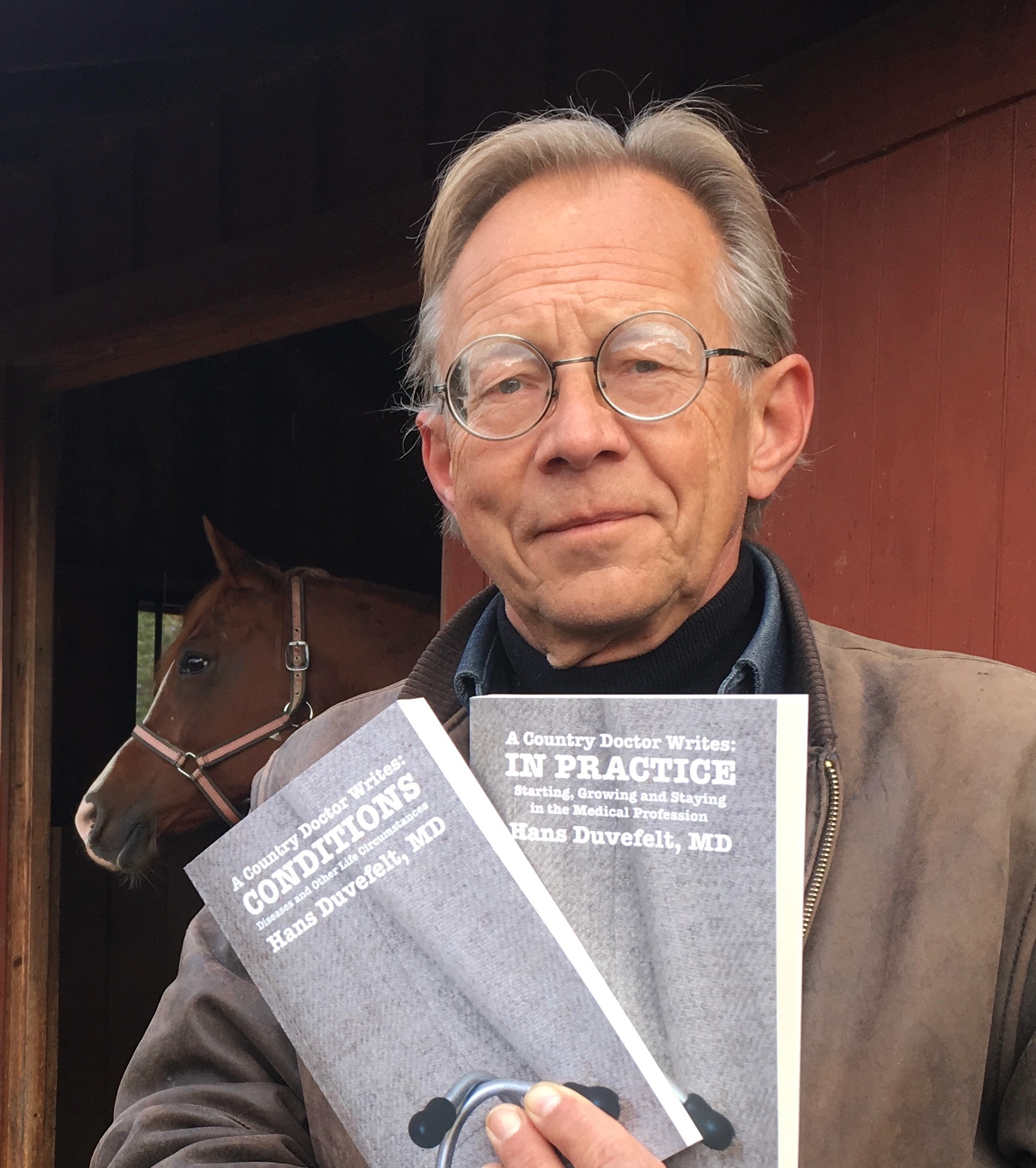
BOOKS BY HANS DUVEFELT, MD

CONDITIONS, Chapter 1: An Old, New Diagnosis

Top 25 Doctor Blogs Award

Doctor Blogs

Enter your email address to subscribe to this blog and receive notifications of new posts by email.

Mailbox

contact @ acountrydoctorwrites.com
Bookmark and Share
© A Country Doctor Writes, LLC 2008-2022 Unauthorized use and/or duplication of this material without express and written permission is strictly prohibited. Excerpts and links may be used, provided that full and clear credit is given.