Archive Page 166

Practicing Medicine Requires a Patient Relationship

Talking with an insurance doctor, who denied a vertebroplasty for my patient with a spontaneous compression fracture, I started thinking about the dilemma of defining what a doctor-patient relationship is.

A couple of years ago a local doctor with a dwindling private practice joined an Internet medical site that promoted drugs like Viagra and offered online consultations with physicians who prescribed the medications when they felt it was appropriate. The State Medical Board disciplined the doctor with a warning, a stiff fine and a permanent blemish on his record.

The charge was “prescribing without a physician-patient relationship”.

It struck me as ironic that providing a treatment long distance gets you in trouble with the Medical Board, but denying treatment to patients you have never met or communicated with in any way is perfectly acceptable. It might even qualify you for a bonus?

The managed care industry, on its own, redefined the doctor-patient relationship many years ago, and now the Internet and the Government are continuing the transformation.

In 1999, writing about the inherent conflict between being someone’s doctor and in reality also working for the insurance companies, Goold and Lipkin conceded that the doctor-patient relationship is still something very personal:

“The doctor–patient relationship has been and remains a keystone of care: the medium in which data are gathered, diagnoses and plans are made, compliance is accomplished, and healing, patient activation, and support are provided.”

Curiously, they then went on to create a breakdown of how doctors build trust during the medical interview, as if they might somehow be able to replicate it without the doctors’ involvement.

Today, of course, medicine has become less personal. Teams of doctors, PA’s, NP’s, nurses, medical assistants and health educators are engaging with patients during and in between visits. Patients are trying to get used to this kind of group health care, and are often expected to quickly open up and establish trust in these new “team members”.

Sometimes the teams are introduced as being physician-led, sometimes as being part of a trusted health care organization. The problem with some of the newly created entities, like Accountable Care Organizations, is that they are still completely unfamiliar to patients.

Many patients are worried that either too much or too little is shared between the members of the health care team: Too much and they feel their privacy threatened, too little and they worry their diagnosis or care will be incomplete.

In my opinion, each patient’s personal physician really needs to be the glue that holds together these new teams of health care workers. If physicians are not promoted as team leaders in this reorganization of patient care, patients will be tossed around in a haphazard fashion, where the care will be tangential – focused on what each team member needs to document for their own job security, but with no one to sit down and work through the hard decisions that inevitably arise when you are treating people, not numbers.

This role requires physician confidence and enthusiasm. It requires trust between doctors and their employers that they are working with the same vision. It requires a new view of the physician as more than a revenue producer; very soon we will not be bringing in more revenue simply by seeing more patients and charging correctly for our work.

Private practice physicians were once each at their own epicenter of a very fragmented, individualized health care system. The American insurance system reduced us to line workers in the big health care machine. Costs went up, quality went down, and now the Government is asking for Accountability.

The role of physicians is set to evolve again, from well paid widget makers to managers – of care, of staff, of resources.

Are we up for this new role? Do we also remember the ancient role of the physician? And can we bring it with us into the future?

The principles behind the physician’s role haven’t, or shouldn’t have, changed. Even the AMA, in its Code of Medical Ethics, speaks of the moral imperative in the doctor-patient relationship this way:

“The practice of medicine, and its embodiment in the clinical encounter between a patient and a physician, is fundamentally a moral activity that arises from the imperative to care for patients and to alleviate suffering.”

Accountability implies a moral or ethical foundation. If today’s doctors, working in today’s evolving health care system, are to retain the moral and ethical principles of our profession, the organizations they work within must adhere to similar principles. If the implied message is that health care wasn’t living up to the highest possible standards before, can an entire industry be made ethical?

“Aaah, it’s Good to be Back!”

I have just brought back a good message from the land of 102°:
God exists.
I had severely doubted it before:
but the bedposts spoke of it with utmost confidence,
the threads in my blanket took it for granted,
the tree outside the window dismissed all complaints,
and I have not slept so justly for years.
It is hard now to convey
how emblematically appearances sat
upon the membranes of my consciousness;
but it is a truth long known
that some secrets are hidden from health.

John Updike, “Fever”, 1963

Dustin Pelletier is an extremely busy and engaging eight-year old. He wasn’t at all his usual self when I saw him a few Mondays ago. He had been hospitalized while he and Holly, his mother, were Downstate visiting his grandparents. He seemed to come down with a headache and stomach flu and proceeded to pass out three times within the span of an hour. The doctors pulled out all the stops; CAT scan of his head, spinal tap, and all kinds of lab tests – all normal.

Dustin seemed unengaged in the visit. He barely answered my questions. He still had a bad headache. He seemed to look somewhere over my left shoulder as I examined him. Dustin hadn’t had an EEG, so I ordered one, and he had a heart murmur I hadn’t noticed before. I decided to schedule an echocardiogram and repeat his labwork.

I told Holly to bring him right back in if he seemed to get any worse. That she did, at 4:45 the very next day. This time Dustin was somnolent, barely rousable.

“Could he have gotten into something?” I asked.

“I can’t imagine”, Holly answered.

“We’ve got to get him to the hospital”, I said.

I told the ER doctor about my observations, mentioned my worries about something inhaled or ingested.

The next morning Holly called. She described all the normal tests Dustin had had and how he was discharged with strict orders to call me for a follow-up appointment the very next day.

“But, you know”, Holly said, “the instant we got into the car, Dustin shook his head and looked all around. Then he said ‘Aaah, it’s good to be back’. And from that moment he’s been himself again!”

Driving home Friday night, my adjustable leather seats seemed strangely stiff and uncomfortable. Stepping out of the car, the ground seemed further down from the running boards than usual, and my knees creaked and seemed to have a slight extension deficit. The house seemed cold to me, and I asked Emma if she minded me turning off the air conditioning.

The next seventy-two hours have been a jumbled blur of chills, sweats, bodyaches and stomach rumblings. At one point I remember lying on the floor, waking up, and staring at the claw foot of a chair leg right in front of me. Once, I woke up and couldn’t figure out where I was.

I remembered a poem by John Updike, Fever, but couldn’t muster enough strength to get up and find it, so I retrieved it online with my iPhone. That, too, exhausted me. I slept most of today, too.

If I have what my young patient had, I hope the moment will come soon when I, too, will shake my head and say:

“Aaah, it’s good to be back”.

But, first, I’ve got to lie down for a while.

Saturday’s Child: A Country Doctor Reads Hillman and Chopra

“Saturday’s child works hard for a living”, the saying goes. I was born on a Saturday afternoon in July. My father had to work, so he missed my birth. My mother always told me that working hard was the only way one could ever achieve anything in this world. I was also raised to believe that I was special, although still not quite living up to my potential.

Needless to say, I grew up to be a hard-driving perfectionist. I chose to become a doctor, not because my mother wanted me to, but out of my own experiences being a somewhat sickly child, even hospitalized at an early age with belly pains.

Like many doctors, I have always pushed myself to deliver the best care I can to my patients, modeled after what medicine was like when I first fell in love with the role of the doctor. My ingrained work ethic, steel trap memory, knack for finding polite words in difficult situations and my ability to switch between hyperfocusing and pulling back to see the big picture have helped me in my career. These qualities have also to some degree kept me from living my personal life to the fullest. My perfectionism and my tendency to want things “my way” have caused me to miss noticing many of life’s small pleasures.

What I didn’t learn early on was how to play and how to listen to my own needs, or how to “go with the flow”. My ability to forge – force, if you will – a positive outcome out of a chaotic situation that others might have called impossible has been my burnout skill.

There was a time when all my appointments ran exactly on time, sometimes causing both me and my patients undue stress. There have been countless situations where I have wasted minutes and hours of my allotted lifetime fretting about why things aren’t the way I want them to be, instead of just figuring out how to deal with what is.

Two books I recently came across have illustrated this phenomenon. One book is about finding the unique purpose we have in life, where our parents are vehicles but not drivers of our evolution toward fulfilling our calling. The other book is about the active role our parents can or should play.

The Jungian therapist James Hillman, in “The Soul’s Code, In search of character and calling”, writes about the Acorn Theory. He believes in the notion that we are all born with a specific purpose or calling that works to find a way to express itself naturally in our lives.

I have certainly felt as if moved by a force other than my own through my education, emigration and into my professional career, as a physician and a writer. The Acorn analogy fit my life until a few years ago, but now I think I would be better served by learning how to be less driven and by not always resisting the inevitable changes happening all around me.

New Age and Ayurvedic physician Deepak Chopra’s book, “The Seven Spiritual Laws for Parents” describes how we as children need to learn how to “go with the flow” and not resist Nature’s way.

Chopra’s advice to parents rang in my ears as words this middle-aged physician needed to hear as a young child. I also need to repeat them to myself today as I watch the kind of medicine I first fell in love with fade further and further away into the distance, ever again succeeded by one reincarnation after another.

Chopra says of The Law of Least Resistance:

“The biggest obstacle is our work ethic, which holds that more work reaps greater rewards. There are two flaws in this. First, Nature herself operates through least effort – the laws of physics dictate that any process, from the spin of an electron to the spin of a galaxy, must function according to the most efficient expenditure of energy, with the least drag. Second, human advancement always comes through ideas, inspiration and desire. These occur spontaneously; there is no amount of work that can force inspiration, or desire, or even consistently good ideas….

When you assume that other people exist to block you from achieving what you want, you have no choice but to constantly defend yourself….

Each of us is responsible for how we feel, what we wish for and how we decide to approach life’s challenges. The highest responsibility is fulfilled not by doing a huge amount of work but by doing the work of spirit in an attitude of joy and creativity. This is the only way that life without struggle becomes possible.”

I need to remind myself often: My calling is to be a doctor, a healer. I need to always view my work in a larger perspective than this season’s medicopolitical fashion trends. I need to not feel paralyzed by what the healthcare system is like or what tools are not immediately at my disposal, be it medications, medical supplies, or technological tools. I am a doctor with more resources than most fellow physicians on this planet. I have patients who trust me with their illnesses, their stories, their hopes and their fears.

And this is how it flows, through me, effortlessly: After a day of really engaging with my patients instead of thinking about the flaws in the health care system, I feel good about my work, if not always energized. And I have time and space for the other parts of my life.

I firmly believe that my acorn, in Hillman’s analogy, contained the seed for me to be fulfilled all my days as a doctor. Curiously, shortly after I was born, my parents planted an acorn at our camp. Every year they took a picture of me standing next to the young oak. After all these years, it still doesn’t look like much of an oak tree, shadowed by an older, large pine standing much too close.

My own acorn has done better, and I intend to nurture it and give it the space it needs to continue to grow the way Nature intended it. I have arrived. I need to cultivate joy and creativity. I need to go with the flow.

What is Osteoporosis?

Sonya was no stranger to hard labor and the occasional back pain, but the pain that brought her to our clinic was like no other backache she had experienced before. It was sharp, focused in the middle of her upper back and it had appeared instantly as she leaned over to pick up her grandson, Ivan.
Her x-rays showed a compression fracture and her bloodwork was normal. Her bone density had been borderline about four years ago, so it seemed this probably was “just” an osteoporotic fracture and not a sign of anything more ominous. The MRI did not suggest cancer. Reassured, she took pain pills and limited her activities for the next several weeks, but the pain was unrelenting.
Sonya seemed to be a good candidate for a vertebroplasty, a procedure where a type of cement is injected into the collapsed vertebra. I referred her to Joe Dugan, an affable orthopedist with a special interest in vertebroplasties. Joe agreed and went on to schedule the procedure.
A week went by and Sonya didn’t hear anything. Then yesterday I got a message that I needed to speak with a physician reviewer about her procedure.
After several minutes of phone tree tribulations, it was clear that I would not be able to get anywhere with Consolidated Insurance, since I did not have access to Sonya’s policy number. All I had in my message was the case number, but the automated telephone attendant wouldn’t accept that number.
Finally I gave up and asked Autumn to get me a better number for the physician reviewer, which she did,  effortlessly.
The ensuing conversation made me nauseous. The jargon-swinging doctor at the other end of the line (actually, he faded in and out, and might have been on a cell phone) asked me if Sonya had osteoporosis.
“Well, she suffered a compression fracture picking up her grandson”, I answered.
“Has she had a bone density?” he asked.
“A couple of years ago”, I answered, “showing osteopenia”.
“Unless she has osteoporosis on a bone density test or cancer, her policy doesn’t cover vertebroplasty”, he said.
“But why else would she get the fracture, not skydiving or anything, but just picking up her grandson?” I asked, my head spinning. “Is a picture of her hip and lumbar spine really going to prove to you she doesn’t have osteoporosis in her upper back when she has had a spontaneous fracture?”
“I’m sorry, without a bone density to prove it, we cannot cover the procedure”, he said again.
The man was not acting or thinking like a doctor. There was no empathy, wisdom or compassion. I felt like I had watched a court room television drama, where the bad guy got off on a technicality.
Sonya’s insurance company is a large national for-profit conglomerate.
She will have a new bone density test, but the bigger question remains: What is osteoporosis? Bones that break easily or bones that appear thin in pictures? Are we treating patients or pictures of patients?

“Examine Thoroughly, Explain Simply”

.

“Fear is more pain than is the pain it fears.”

Sir Philip Sidney

“In our specialist age it has, in fact, become a major function of the general physician to examine thoroughly, to explain simply, to reassure as far as may be, and to protect his patients from unnecessary medical or surgical interventions.”

John A Ryle, MD, 1948 in The Journal of Mental Science, published by The Royal Medico-Psychological Association

.

Re-reading my post about Morbus Propedeuticus, Medical Students’ Disease, I realized I had inadvertently used the word “gracefully” in my account of how my instructor examined my enlarged lymph nodes and reassured me that they were not suspicious. My intention had been to say “graciously”. For a moment I thought I should correct my slip-up, but then I realized that what Dr Bruun did wasn’t just gracious, but actually quite graceful. His whole demeanor conveyed sincerity, kindness and patience. He made me feel completely reassured and relieved of my fears.

Every day, I encounter fear of some degree in patients, often unfounded; it is not the patients with cancer or heart disease or poorly controlled diabetes that share their fear behind my closed exam room door, but the patients with ill-defined symptoms or no symptoms at all.

I have a few patients who always seem to be concerned about one bodily sensation or another, but then there are some that have only one disease they are worried about getting. This predicament is different from hypochondriasis. It goes by the name nosophobia, literally “fear of disease”.

Nosophobia can be triggered by learning about a disease affecting someone we know, by reading or watching accounts of dreadful diseases, or by receiving inadequate information or reassurance when we do seek medical evaluation of a symptom.

In our “information age” patients often look up their symptoms on the Internet, and come across endless possible explanations, or differential diagnoses. The problem with random searches is that the results also tend to be randomly arranged and not ranked according to the person’s specific presentation or risk factors, and not at all according to how common or rare each disease is.

When we as physicians evaluate patients with undiagnosed symptoms or concerns over a specific disease, our thoroughness, thoughtfulness and demeanor can feed or quell nosophobia.

John A. Ryle, MD, in his Maudsley Lecture, quoted at the beginning of this post, writes about physicians inadvertently causing nosophobia in their patients:

“Again and again patients discharged from hospital, when asked what the doctors have told them, say, “ Oh, they didn’t tell me anything”. Often they have spent long periods in the ward and been elaborately investigated, all the time waiting and wondering and uninformed. Could anything be more conducive to the initiation or aggravation of anxiety than experience of this kind? Probably the divided responsibilities…..in institutions and the inexperience of house-officers are partly to blame, but the mechanistic, objective character of modern investigations also tends to distract the doctor’s from the patients’ thought and to direct attention away from private sensibilities and present needs. I have even watched air-raid victims being admitted, examined, X-rayed and transfused without a word of comfort or reassurance being given to them by those concerned.”

Ryle’s lecture was published in an obscure journal dedicated to what we now call Mind-Body Medicine. Today, even large mainstream institutions like Harvard Medical School have entire Mind-Body Medicine departments. But before thinking we have come a long way since 1948, we should remember that Mind-Body Medicine isn’t something separate from everyday primary medicine; it is possibly the biggest part of primary care. That doesn’t mean every primary care physician needs to practice full-fledged psychiatry. It does, however, require us not to be mere body technicians, but real doctors; human, humane, humanistic.

Ryle puts it this way:

“As a profession we are losing, in the process of developing our technologies, something of the philosophy, humanism and courage of the older physicians.

Our loss of philosophy is shown in our inability to piece together the components of an illness or an individual, to assess the roles of mind and body in morbid experience and to balance the needs of both –  in brief, in our inability to see things “whole”. Our loss of humanism appears in our too partial success in assessing the psychological needs of the individual and the social needs of the community. Our loss of courage is chiefly manifest in our present-day unwillingness to make pronouncements without subjecting our patients to elaborate investigations. These, while often necessary and valuable, can also prolong anxiety, and leave our own doubts and questions still unanswered.

Without courage to accept clinical responsibilities we cannot impart courage to our patients. Without a reasoned clarity in diagnosis and a reasoned hopefulness in prognosis we cannot properly counter fear. In the majority of cases it is possible to give to patients a simple interpretation of symptoms; a simple idea as to how they should be regarded; a set of sound reasons should further inquiry become necessary; a provisional prognosis, in which the emphasis should be on the better chance whenever possible; and an intelligent plan of action. For the busy practitioner or hospital surgeon or physician, it may well be impossible to devote time and thought to the more profound psychiatric methods, but there should always be time to examine carefully, to explain clearly, and to reassure as fully as the circumstances allow.”

I think it is easy for us doctors of today to lose our courage with all the scrutiny and second-guessing we are subjected to. I also think it has become more difficult to find the time to “examine thoroughly” and “explain simply”, as Dr Ryle puts it, and to take a good history. But without those ingredients our reassurance carries no weight. Without them the health care squirrel wheel keeps turning faster and faster at ever greater cost as insecure and worried patients churn around and around.

Ryle’s call to protect our patients from “unnecessary medical or surgical interventions” is, of course, another way of saying “first, do no harm”. In our continuing efforts to never leave any stones unturned, tests undone or cautions undelivered, we are probably causing more harm, at least in the form of fear and anxiety, than we would ever like to admit.


I just realized none of the posts show on an iPad or a computer, but they do show on an iPhone. WordPress is working on this. In the meantime, please visit my Substack.


Osler said “Listen to your patient, he is telling you the diagnosis”. Duvefelt says “Listen to your patient, he is telling you what kind of doctor he needs you to be”.


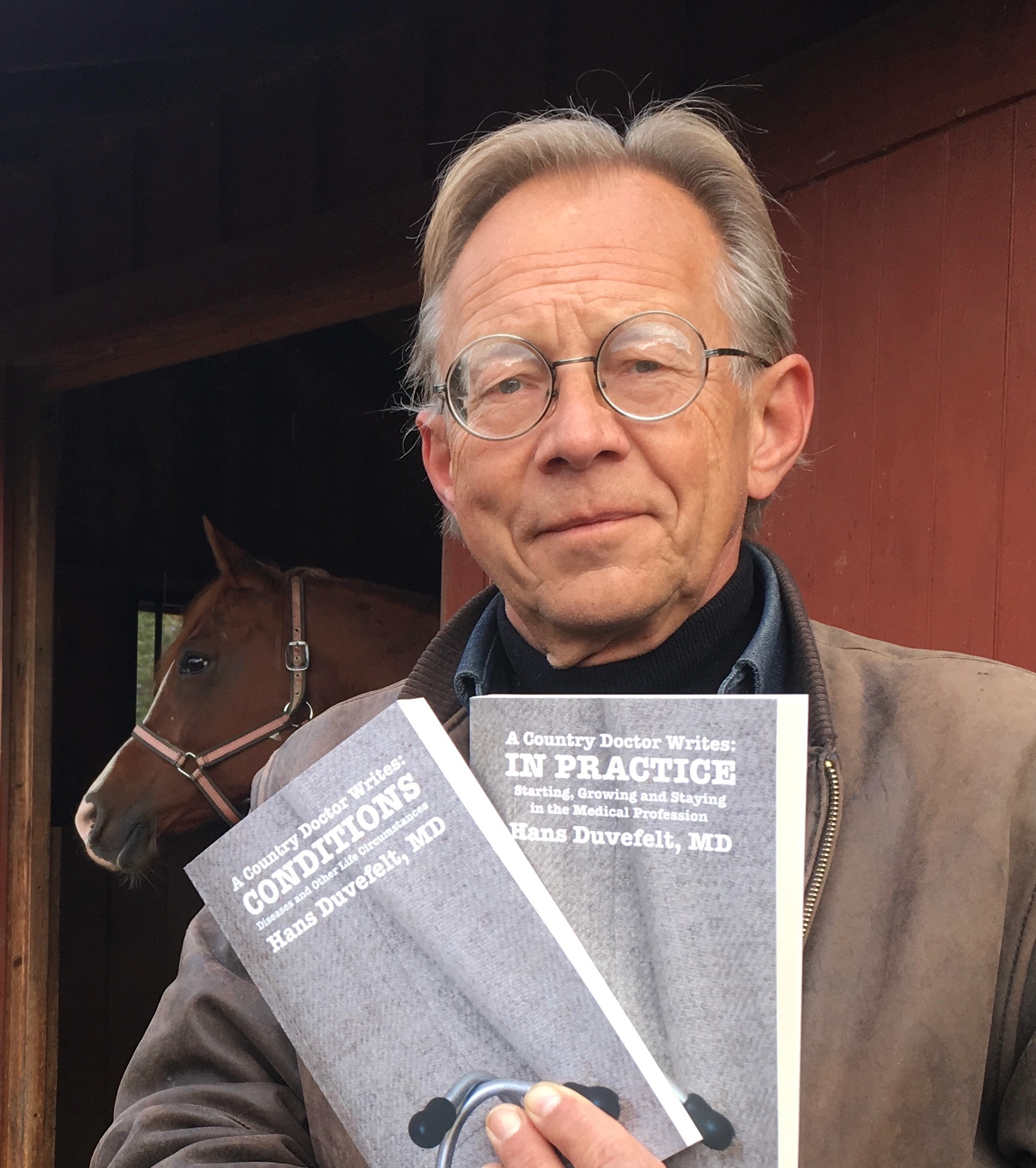
BOOKS BY HANS DUVEFELT, MD

CONDITIONS, Chapter 1: An Old, New Diagnosis

Top 25 Doctor Blogs Award

Doctor Blogs

Enter your email address to subscribe to this blog and receive notifications of new posts by email.

Mailbox

contact @ acountrydoctorwrites.com
Bookmark and Share
© A Country Doctor Writes, LLC 2008-2022 Unauthorized use and/or duplication of this material without express and written permission is strictly prohibited. Excerpts and links may be used, provided that full and clear credit is given.