Archive Page 167

Morbus Propedeuticus

It was spring. My medical school class, two years along in our five-and-a-half year endeavor, had earned the “medicinae kandidat” degree. We were now worthy of leaving the basic sciences and research center on the outskirts of town and starting our preparatory clinical, “propedeutic” semester at the University Hospital. In Sweden, at that time, we used a lot of Latin words and phrases. Crohn’s disease was  Morbus Crohn, chart notes listed physical exam findings by Latin names for the bodily organs: Cor for the heart, Pulm(ones) for the lungs, Hepar for the liver, etc.

Uppsala Academic Hospital was an imposing campus, with several tall, white towers, housing the most modern wards, laboratories and operating theaters. We were relegated to a pink stucco building that housed the old tuberculosis clinic.

The physical exam course was taught by a couple of older pulmonologists. At first they struck many of us as relics from a bygone era, but as the course went on, our respect grew. These unassuming physicians could percuss a patient’s chest wall and describe in detail what the x-ray would look like, they made us feel the tip of the spleen by turning the patient on his right side, they measured jugular venous pulsations and pedal pulses.

Sometimes we had real patients with remarkably abnormal findings to examine, but we often were charged with examining each other for assessment of normal physical exam findings.

My partner for the Lymphatic System module was Sven Björk, a slow-talking kid from the very north of Sweden. He had jet black, completely straight hair and a broad face with eyes set wide apart. He was part Same, the native, reindeer-herding nomadic population from north of the Arctic Circle.

Sven was a bright young man. He had memorized the anatomy quicker than I had, well ahead of the exercise. Yet he seemed nervous. I soon found out why: he had noticed several enlarged submandibular and anterior cervical glands on himself. We compared each other’s necks and jaw lines, but found to our surprise that our lymph nodes were about the same size.

My glands had been big as long as I could remember; I had gone through repeated strep infections. In second grade I missed 42 days in just one semester. Sven had never had strep throat, and he didn’t remember feeling any enlarged lymph nodes before, but he had never checked himself quite like this before.

Our instructor came over to see how we were doing. Sven cleared his throat and started telling Doctor Bruun what both Sven and I had noticed on his neck.

The fifty-something doctor put his hands on Sven’s neck. Methodically, he worked his way up, down and around the neck and down into the armpits. He had Sven lie down on the exam table, supine for the liver, on his right side for the spleen, then reached for the lymph nodes in Sven’s groin. His face was serious as he whisked Sven off to his office, leaving me standing, feeling my own cervical lymph nodes, bigger than Sven’s.

Sven was diagnosed with Hodgkin’s Disease, a type of lymphoma that wasn’t quite as easily cured then as it is now, but Sven responded well to the treatment and didn’t miss much school.

The rest of our class, me included, went through a prolonged case of what our instructors called Morbus Propedeuticus, Medical Student’s Disease. It is natural to worry that you might have some of the bad diseases you learn about in medical school. Seeing one of your classmates develop cancer sets the stage for more than the normal amount of hypochondriasis.

I realized that even though Sven’s and my lymph nodes were similar, his had developed quickly without reasonable explanation and mine had been there for years and had their origin in my recurrent episodes of tonsillitis. I did ask my instructor to check me over, which he gracefully did. He was not worried, and I accepted his assessment. I never again worried about having a dreadful disease, but I often thought of Sven and me during that physical exam class; there but for the grace of God go I.

Around the time of my birthday a couple of weeks ago, I suddenly thought of Sven again: I know he was declared cured from his Hodgkin’s, but what about freak recurrences, late cancer treatment effects or other tricks of the Grim Reaper?

Google gave me the answer: Sven is head internal medicine physician at a medium sized hospital. He has published several scientific articles, and was interviewed recently about differences in heart attack survival between northern and southern Sweden. I even found a couple of pictures. Wouldn’t you know it, he doesn’t have a gray hair on his head or wrinkle in his face; he looks younger than I do.

Bless you, Sven. I wonder if you know how often my thoughts have gone back to those weeks we spent together way back then.

Avoiding Retirement

Marc Lachance is the perfect consultant. Ten years my senior, he had more than mastered his specialty by the time I came to the area. He had also established himself as a mentor to Cityside Hospital’s residents and many young physicians who sent him referrals or called him for curbside consultations.

Marc used to live in a rambling farmhouse not far from where I live. But then his elderly father, widowed and suffering from macular degeneration, needed more help in order to stay in his own home. Marc moved to the opposite side of the city to be closer to his father. Marc’s wife was able to look after her father-in-law while Marc commuted to his office downtown. When his father passed away, Marc and Elaine stayed put, even though Marc’s commute was long.

Marc would follow some patients through the decades, but more often he would do a consultation and perhaps a follow-up. Then he would dictate a letter, right in front of the patient, to the referring physician with a detailed care plan. Marc welcomed follow-up calls from his colleagues and he insisted on getting continued updates on patients he had seen in consultation.

Unlike many specialists, he prided himself in his broad knowledge of medicine. I often ran into patients who had seen Marc for a consultation pertaining to his specialty, but had been diagnosed with cancer, hepatitis C and other conditions by Marc.

Whenever I called Marc for curbside advice, he told me exactly what I needed to know in order to move forward with my case. He never put me down if my call was disorganized and less than well prepared. But his own clarity of reasoning and exquisite mind for detail always made me feel I had been to school or a motivational seminar: “This is how a physician should be”, was the thought that lingered after getting off the phone with Marc.

Marc’s partner, whom I had fewer dealings with, retired a year ago. Many of us primary care physicians quietly wondered what was going to happen now.

Yesterday, a patient I shared with Marc brought in a letter she had just received. It was a printed letter that read:

“Dear Patient,

After more than 35 years, I will be closing my practice on December 30, 2013. For many years I have commuted a great distance to my office. As I am soon turning 70, and hoping to avoid retirement, I have made the decision to relocate my practice to Meadowview Hospital in Cornish, which is closer to my home. I will be an employee of Meadowview Hospital without the concerns of managing the business of a medical practice. By making this move, I am hoping to be able to practice medicine well into my eighties if I continue to enjoy the good health I have been blessed with.

I would be happy to continue seeing any patients who wish to transfer to my new location, but understand if most of you will want to find a specialist closer to where you are. Drs Jonathan Bard, Sheldon Mintz and Ravinder Pran all accept new patients in their Cityside Hospital Clinic.

I appreciate the confidence you have placed in me and wish you the best future health. Your primary care doctor has always received copies of my notes and your complete medical records are available for transfer by contacting my office at the above telephone number….”

I slowly handed the letter back to my patient.

Marc, I thought, you are teaching me something every time: How to be an up and coming young doctor, how to conduct yourself when you are in the prime of your career, and how to stay in the most fascinating job in the world as long as you possibly can. I know you love medicine, possibly even more than I do. I also know that you are at least ten years wiser than I am about being a human being, a son, husband and citizen of the world.

Bonne chance, mon ami, and may you never retire.

The Night Before Surgery

On a hot afternoon in July Harold “Junior” Bray walked around his small farmhouse one last time before it was time to leave for the hospital. Everything was in order – the coffee maker was unplugged, the windows secure and the message on his brand new answering machine informed callers that he would return their call as soon as his health permitted.

Every step was deliberate, slow and painful. Whenever he could, he leaned on something close by to redistribute his weight away from his arthritic left hip.

Harold Bray Jr’s place was neat as a pin. Widowed for fifteen years, he ran his one-person household just the way he had run his little store. Everything was always well organized, clean and fresh. Even now, he rotated the dry goods in the kitchen cupboards, so that nothing ever went out of date.

At precisely one fifteen he locked his front door and hobbled across the gravel front yard to the car. As he turned the ignition, the gas gauge rose to FULL and the small motor started obediently. He drove exactly the speed limit all the way to Cityside Hospital and arrived promptly at three o’clock.

The woman at Central Registration had his paperwork, a plastic card with his personalized information embossed and a bracelet with his name, birthdate and his orthopedic surgeon’s name.

Up on the orthopedic floor, a nurse and a young doctor, an intern, assigned to Dr Oberlin’s service, greeted him. He answered questions, signed some papers and underwent a detailed and lengthy physical exam by the young doctor, who was obviously very nervous, but Harold could tell how sincere and enthusiastic he was about being an intern.

After dinner, which was actually better than he had expected after hearing his neighbors’ and friends’ accounts of their hospital stays, Dr. Oberlin stopped by. He wore a wrinkled summer blazer and a white button-down shirt with a loud, wide paisley tie. He spoke confidently about how routine this operation would be and wished Harold a good night.

“See you in pre-op at seven tomorrow”, he waved on his way out of Harold’s room.

Harold watched some TV until a night nurse came in and announced it was time to start preparing him for tomorrow’s surgery. A Nurse’s Aide arrived and he was id-checked and sent to the bathroom with special soap to shower. After he had dried off, the nurse came in with a sleeping pill. He wasn’t sure he needed one, but accepted it to be sure he had a good night’s sleep. By nine o’clock he was sleeping peacefully and when an orderly rolled his gurney into pre-op at six forty-five, he really didn’t feel nervous. He figured he was ready, and he had waited long enough for his new hip.

.

On a hot afternoon in July, Harry Bray paced the floors of his run-down little farmhouse. Opening cupboards, closets, desk and kitchen drawers, he searched for the letter with pre-op instructions Dr. Gleeson’s office had sent him. What time was he supposed to stop eating? When was it he was supposed to shower with that special soap? When did he need to be at Cityside to check in in the morning? Was it really five thirty?

He finally found the instructions and threw himself, as much as his a sixty-eight year old arthritis-ridden body allowed any sudden movements, down in his blue velour recliner. He had managed to swing by the refrigerator and now he popped open a cold beer – after all, the sun was over the yardarm, and he definitely needed something to steady his nerves.

Harold Bray, III’s house was the same one his father had spent most of his life in, the one he had died in at the ripe old age of 88. Harry inherited it, just like he inherited his father’s crippling arthritis. He looked around from where he sat – the place was a mess, even he admitted it: Overfilled ashtrays everywhere, piles of magazines, clothing strewn about, and now drawers left open from his panic-stricken search a few minutes ago.

He lived alone, always had, and he seldom left the house. He was nervous about driving through the woods to town all by himself at four in the morning, the worst time for wildlife.

The afternoon passed slowly. He had a couple more beers, tried to watch TV, tried to get his cousin Ned on the phone and actually managed to take a short nap after his three o’clock pain pills kicked in. At five thirty he opened a can of beef stew and ate it cold – it was too hot to bother warming it up.

After he ate, he watched some TV, ate a bag of chips and finished off the beer in the refrigerator.

All night he tossed and turned, catching fifteen minutes of fretful sleep here and there. He dreamt about hospitals, about something going wrong with the anesthesia or surgery, about hitting a moose driving through the woods at four in the morning.

At three o’clock he gave up. He got dressed and almost drank a cup of coffee before catching himself – he wasn’t supposed to eat or drink anything before the surgery.

Route One was dark. One of his headlights was dimmer than the other; the plastic lens was all scratched and fogged up. His eyes kept fogging over, too as he tried to watch the edge of the woods and the yellow centerline at the same time.

Suddenly, rounding a curve, there he was – the big bull moose from his nightmare. Harry slammed the brakes and swerved to the right. The moose froze and the car slid in slow motion toward the steep ditch. Suddenly the moose turned to the left and ran. Harry turned the wheel sharply to the left. The old pickup truck groaned and bounced back in position in the road again but with an unmistakable grinding in the right front end; he was driving on the wheel rim.

At exactly five thirty Harry hobbled through the hospital pneumatic doors, drenched in sweat, dirty to his elbows and with black rubber stains even on his forehead.

He cleared his throat as the receptionist raised her eyebrows and looked him over:

“I’m Harold Bray, III and I’m here to have my hip operated.”

Fifty-Fifty Propositions

Lately, my virtual inbox in our electronic medical record has seen a surge in requests for prescriptions for the vaccine against Herpes Zoster, shingles. This has made me think a lot about our responsibility as physicians to inform patients about the evidence behind our recommendations – but who informs the patients when doctors are kept out of the loop or put under pressure to prescribe without seeing the patient?

What has happened is that our local Rite-Aid Pharmacy started to give these shots, covered by many insurers, but still requiring a doctor’s prescription.

I cannot give the shots in my clinic, because as a Federally Qualified Health Center, we are reimbursed at a fixed rate. The shingles vaccine costs more for us to buy than we charge for an entire office visit. I used to have the discussion about the shot, and would give patients a prescription to take to the pharmacy if they wanted it.

The pharmacy can give the shot at a profit, because it is considered a medication, just like a bottle of Lipitor.

The new system creates a bit of a dilemma for me. I get a message through the pharmacy that the patient wants the shot, and I don’t have the opportunity to sit down and review the effectiveness, side effects and long-term efficacy according to the available evidence with the patient.

For example, the shingles vaccine only cuts the risk of getting shingles in half. This is about the same effectiveness as the flu vaccine, but far less than, say, the vaccine against smallpox, which has now been eradicated.

Most patients are very surprised to hear about the 50% efficacy when I catch up with them at some later date; so many health care interventions are portrayed as both completely effective and absolutely necessary.

I see my role as a primary care physician as a guide and resource for patients, who are bombarded with overly optimistic claims and recommendations by mass media, drug companies and retailers.

Many patients believe that since we can effectively cure some previously deadly diseases, like Hodgkin’s lymphoma, and control others, like AIDS, we probably have even better success rates when dealing with more ordinary diseases.

True, many conditions we see in primary care do go away – sore throats, coughs, sinus infections and rashes – but not necessarily thanks to our treatment, since they usually go away even without a visit to the doctor. No, sadly, a 50% success rate is considered very good for most of the interventions we do in primary care.

The same 50% effect is seen in many clinical scenarios, that are often misrepresented, even by doctors, as much more effective:

Lipitor, mentioned above, and all the other statin drugs, can reduce heart attack risk by at most 50%.

Tight blood pressure control in diabetics only reduces cardiovascular risk by 50%.

Quitting smoking only reduces heart disease risk by 50%. (And, no, these three interventions are not additive; nobody gets a 150% reduction in risk by doing all of them.)

Early detection and treatment of lung cancer can reduce mortality, but only by 50%.

Mammography screening, according to one recent study, reduces death rates from breast cancer by only 50%.

And the list goes on. Patients are encouraged to take shots or pills to protect themselves from bad diseases, but do they know how effective the intervention is, or how long it will last? In the case of shingles shots, nobody actually knows yet.

As if 50% success rates weren’t bad enough, there are other interventions that have an even lower likelihood of being helpful, for example taking antidepressants when you are depressed: 30-40% is the commonly cited success rate here. Yet, how many patients want only the pill and not also the counseling that can bring the success rate to 60%?

That is still a surer bet than having cardiac stenting or coronary bypass surgery in an effort to cut the risk of cardiac death. There is no convincing evidence that either of these common and costly interventions saves lives. They often improve quality of life, but most patients and many doctors believe they are essential, life-saving procedures in most instances.

Something as seemingly straightforward as surgery for a torn meniscus of the knee, if you are old enough to also have some arthritis, is no better than physical therapy in relieving pain and restoring function over a six month period.

Who else, but the primary care provider will have these discussions with patients? I don’t hear the cardiologists explaining the evidence impartially to patients, and how many orthopedists are that reluctant to do surgery? They make their living doing the procedures that patients assume are necessary.

We seem to be caught in two opposing currents. One is the idea of primary care providers directing and coordinating patients’ health care in “Patient-Centered Medical Homes”, helping patients navigate today’s complex health systems. The other current is to give pharmacies, retail clinics and specialists who aren’t trained or experienced in whole-patient care direct access to patients or populations of patients and having primary care doctors only gathering and storing the information after the fact.

I worry about where the fragmentation in the second scenario could take us. Who will help patients see the big picture, and who will support them in making decisions that take their entire health status into account? In a world where 50% success is considered good, there are a lot of judgment calls. And the more you carve up the care of the patient, the more random those judgment calls will be.

50% success rate doesn’t mean a half cure for everyone; it means half the patients get the desired outcome and half don’t. If we think of it that way, it might be clearer what this is all about: It is about knowing the patient, and having the kind of relationship with them that supports and empowers them in choosing between many different fifty-fifty propositions, some of them conflicting and most of them changing very fast.

What a Country Doctor Should Write

It’s been five years since I started this blog. Looking back at what my posts were like in the beginning, I can see that I have gradually found a style of writing that goes deeper and touches on subjects that are more challenging for me.

Over the years I have seen which topics seem to get the most pageviews, and which ones seem to interest fewer readers. I have been flattered by links and re-postings by more famous websites than mine and by primary care and teaching sites.

Generally speaking, postings like “What if Physicians Worked for Free” get the most attention in the short run, but medical topics like “The Art of Measuring Blood Pressure…” have had consistent interest over time.

Clinical vignettes like “Snap Diagnosis” are generally well received but never blockbusters.

From time to time I have posted interesting articles and excerpts from my inconsistent and eclectic reading list on a sister blog, “A Country Doctor Reads“. I didn’t want to put things that were tongue-in-cheek or “newsy” on “A Country Doctor Writes”. Just recently, I created custom tabs that link between the two blogs.

Some older pieces that I have, also very recently, collected under the category “Short Stories” have had relatively little attention, but I feel especially accomplished in having put a few medically related glimpses of life in a form that goes beyond personal essays or blog posts.

As I think about what the rest of my years as a doctor might look like, I also think about what I want to write about and how my voice or style should evolve.

It seems tempting to ride the wave of recognition I have gained with pieces about the time pressures, financial constraints, conflicting demands and administrative burdens of primary care doctors in this country, but I don’t want that to be the main focus of my writing.

I hope to be able to continue adding to the body of work that captures the timelessness and essence of doctoring, because that, more than what is happening today (good or bad) is what anchors me in my profession and calling.

In my practice, I have consciously let go of some of my obsessive tendencies for efficiency, and I have allowed myself to be more and more sensitive to what the situation requires when patients seem to drop a hint that they need to tell me something or when there seems to be a crack in their armor.

Years from now, I imagine people will remember if I helped them get through a difficult time or if I made a difficult diagnosis more than whether I was perfectly punctual.

I also imagine that years from now what I write today about a technicality in the practice of medicine will have less value than something that isn’t sensitive to time, place, party in power or healthcare budget priorities. I am not expecting to be in the history books, but I will confess my deepest hope:

I hope I can write about my life in medicine in a way that inspires some to follow the same path and helps a few doubting younger colleagues keep the faith in their chosen profession. I have seen and practiced medicine on two continents and under several very different systems, and it really isn’t that different if you manage to keep the focus not on the tools you have available, but on the patient.

We are the pilots, not the designers, mechanics or flight controllers. We may not always like the equipment or the traffic situation, but we still have to get our passengers safely to their destination.

I guess this was the first time I wrote about writing, rather than doctoring. I’ll get back on topic next time.

Thanks for listening.

(Midsummer’s Eve, North America 2013)


I just realized none of the posts show on an iPad or a computer, but they do show on an iPhone. WordPress is working on this. In the meantime, please visit my Substack.


Osler said “Listen to your patient, he is telling you the diagnosis”. Duvefelt says “Listen to your patient, he is telling you what kind of doctor he needs you to be”.


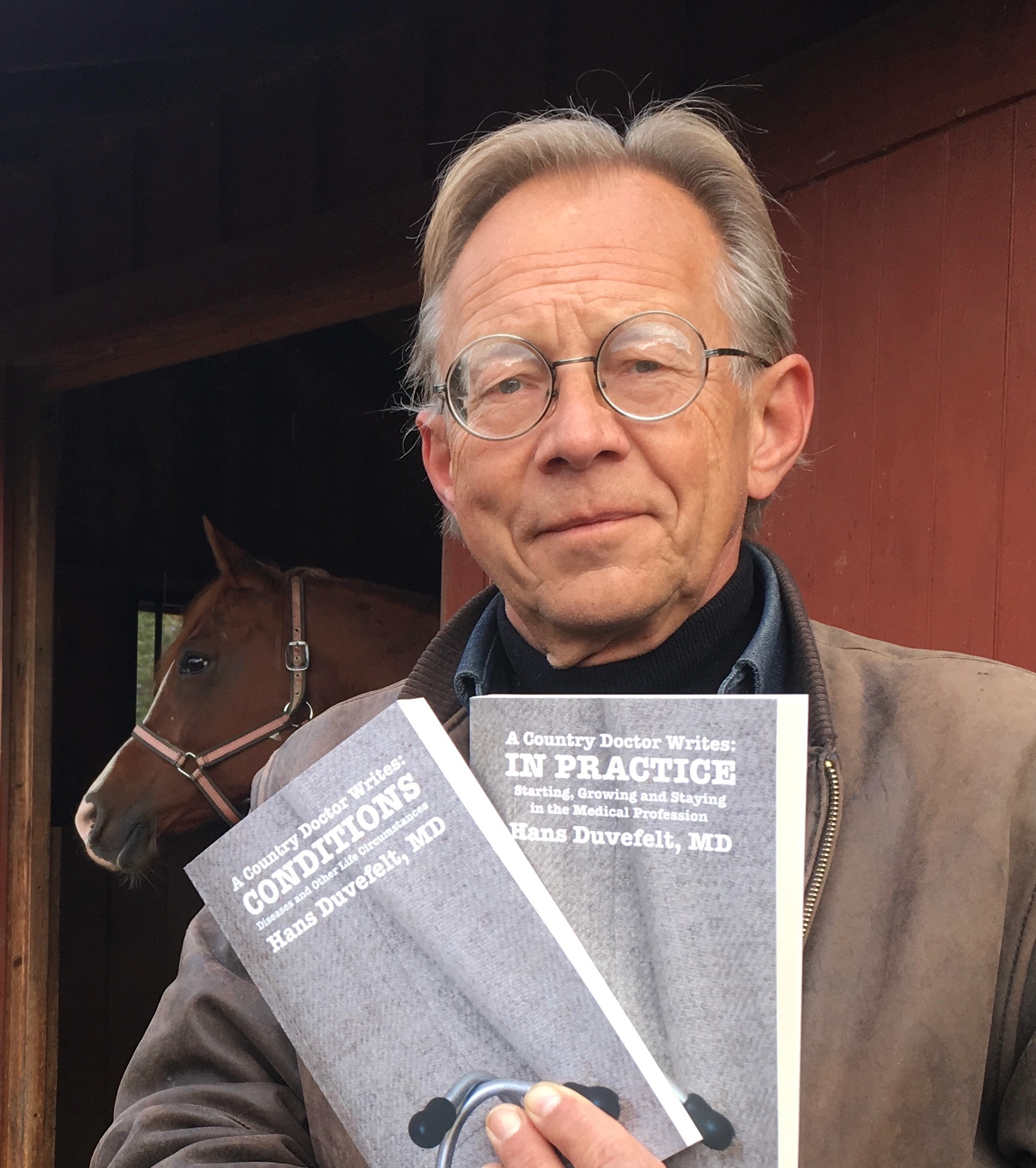
BOOKS BY HANS DUVEFELT, MD

CONDITIONS, Chapter 1: An Old, New Diagnosis

Top 25 Doctor Blogs Award

Doctor Blogs

Enter your email address to subscribe to this blog and receive notifications of new posts by email.

Mailbox

contact @ acountrydoctorwrites.com
Bookmark and Share
© A Country Doctor Writes, LLC 2008-2022 Unauthorized use and/or duplication of this material without express and written permission is strictly prohibited. Excerpts and links may be used, provided that full and clear credit is given.