Archive Page 81

Post Covid Healthcare is Becoming Like Buying from Amazon Instead of Going to the Mall or Reading an eBook Instead of a Paperback – My Latest Post on The Health Care Blog

Now that we are seeing patients via telemedicine or even getting reimbursed for handling their issues over the phone, our existing healthcare institutions are more and more starting to look like shopping malls.

They were once traffic magnets, so large that they created new developments far away from where people lived or worked and big and complex enough that going there became an all day affair for many people…

— Read on
https://thehealthcareblog.com/blog/2020/08/05/post-covid-healthcare-is-becoming-like-buying-from-amazon-instead-of-going-to-the-mall-or-reading-an-ebook-instead-of-a-paperback/

Driving With James Taylor

(A Personal Reflection I put on my LinkedIn profile in 2018, which now seems like a lifetime ago; not a medical topic but a piece about who I am.)

Saturday morning, Memorial Day weekend: I pat the barn animals as I leave our 1790 farmhouse through the attached barn and garage. The air smells salty as I close the garage door and glance at my Swedish vanity place. I climb into my big, white European SUV, built in America, start the V8 engine and let the wipers clear the mist off the windshield. 

National Public Radio doesn’t have a news program on Saturdays, so I decide to play a James Taylor album from 1971. I have it on LP, CD and now also on my iPhone and iPad. The music starts belting out through the Harman-Kardon speakers: “Don’t come to me with your sorrows anymore…”, the first song on “Mud Slide Slim and the Blue Horizon”.

I still remember the first time I heard this album. I was at my girlfriend’s house back in Sweden. It was the spring of the year I later went to the U.S. as an exchange student. Her older brother came storming into the living room and said “You’ve got to hear this album”. I had never heard of James Taylor. I had dropped out of violin lessons a few years earlier and taught myself to play guitar, and I was all into folk music like Peter, Paul and Mary. My renditions of “If I Had a Hammer”, “Where Have All the Flowers Gone?” and “Leaving on a Jet Plane” were starting to earn me a place beyond the mere bookworms, but the music I now heard was way beyond anything I had tried to copy before.

My girlfriend listened with approval, if not enthusiasm, but when her brother and I turned the record over again to Side One to start playing it a second time, she left the room and joined her sister. Her brother and I settled back and listened again. I was mesmerized by the melancholy melodies, the almost-bossa-nova strumming rhythm and the conga-like percussion. This music was contemporary America, the country I already knew I was in love with, a country full of individuality and both optimism and soulfulness.

The winding country road I drive to work is empty of traffic. There is a faint morning sunshine filtering through a light haze. The mountains of Mount Desert Island create a jagged blue horizon across the water. As I listen to “You’ve Got a Friend” I reflect on how I don’t feel 47 years older than when I first heard that song and figured out the chords to it. And the next song, “Places in My Past”, sums up a few sentiments from my own life as it has evolved since then.

I think of how strange and yet natural it is that this introverted boy from Sweden ended up living in America. I have lived here much longer than I lived in Sweden. My Swedish passport expired a couple of years ago, and I can go months without uttering, or even thinking, a word in Swedish. 

My home is here in America, in two places, an old white farmhouse in Downeast Maine and a little red cottage in Caribou, not far from the 1870’s colony of New Sweden, within hiking distance of Canada and right next to Amish country in Fort Fairfield. 

I drive past Noel (Paul) Stookey’s house. How odd, my teen musical hero before James Taylor, right on my way to work. I even see him in the hardware or grocery store sometimes. 

On the album’s hypnotic title track, James Taylor sings “Now the reason I’m smiling is over on an island, on a hillside in the woods where I belong”. I am at home on a narrow peninsula and on the edge of the northern woods, both places reminiscent of Sweden but very much American. 

The road winds a bit inland and my thoughts and emotions keep jumping back and forth between me at eighteen and now about to turn Medicare age. I have read that the music you hear between the ages of 17 and 23 stays with you the rest of your life. It has indeed. When I was 23, he released “In the Pocket”, and, if I have to be honest, maybe after “JT” when I was 24, I didn’t feel quite the same tug in my heart every time I listened to one of his new albums, but I always bought them and enjoyed them, because we grew up together and he sang quite eloquently about so much of what I felt. 

As I pull into the staff parking lot, the short last song, “Isn’t it Nice to Be Home Again” is playing. I turn off the engine and leave the music on until it ends. I have driven 30 miles, listened to 13 songs in 37 minutes and in my mind traversed 3,500 miles and 47 very short years.

Take the Poll: Should I Narrate My Book for Audible?

A couple of people have already asked me if there will be an audiobook and if I will narrate it myself. Now that book number two is compiled with only editing left to do, I’ll have some spare time in my self imposed publication schedule. So, I’ll ask for more opinions on this. The first essay is a two minute recording. Please vote (not possible on all devices) or post a comment below on whether you would prefer my voice and faint(?) Swedish accent or a professional voice artist…

CHAPTER 1: AN OLD, NEW DIAGNOSIS

UPDATE July 30, 9:20 pm. Votes received:

A Country Doctor is in Australia – Medical Observer

I knew the Australian Journal Medical Observer, a “leading publication of headlines and medical and political news for Australian General Practitioners” sometimes republishes my posts. I happened to notice that my 7/26 post was up on their website within 48 hours. They will soon be featuring chapters from my new book with an Amazon.com.au link to give my Australian readers the incentive to buy it and binge read A Country Doctor Writes.
https://www.ausdoc.com.au/author/dr-hans-duvefelt

I Cured My Patient, But What Was His Diagnosis?

He cancelled his followup appointment because he was feeling fine. He didn’t see the point in wasting a Saturday to come to my clinic when he had lawns to mow and chores to do.

Less than two weeks before that he was sitting on the exam table in my office, again and again nodding off, waking up surprised every time his wife prodded him. The stack of printouts from the emergency room illustrated all the normal testing they had done.

He had experienced a brief episode of numbness in the left side of his face and felt tired with just a slight headache. When I saw him the headache was a bit more severe in the back of his head and down the right side of his neck. But his neck wasn’t stiff.

His blood sugar was 87, normal for most people, but this man had a history of diabetes although his blood sugars had steadily improved over the past year. I told him to stop all his diabetic medications although I don’t think he took notice. His wife said she would make sure he stopped them.

He had had all kinds of bloodwork and both a CT scan and an MRI of his brain. I couldn’t help worrying that he might have an aneurysm so we ordered an MRA as well. Until then my only hope of making him feel better was to make sure he wasn’t in relative hypoglycemia.

A few days later he was back, not the least bit drowsy and with a blood sugar of 138. His MRA was scheduled for the following day.

This time he had swelling, redness and extreme pain around his lower right jaw. It was an oblong, one inch induration (“bump”) and next to it, closer to his neck, there was an area of redness with a few small papules (“pimples”), none of them an actual blister. On his neck there were several small, tender lymph nodes just where I listened to his carotid artery. There was no bruit (“swishing”) to indicate a partial blockage.

The headache on the right side of the back of his head was now severe and he said his right arm hurt and felt heavy, although he didn’t have decreased sensation or strength in it – just pain when he used it.

“The right sided arm pain probably has nothing to do with the left sided facial weakness”, I explained. “The right carotid artery feeds the right side of the brain which controls the left side of the body.”

Testing his sensitivity to light touch, he winced when I touched the lowest portion of his skull and upper neck on the right and also the reddened areas on the right neck and jaw.

I minimized my EMR and pulled up a picture of the nerve supply to the face, neck and arms. I showed them that C2 and C3, the second and third cervical nerves, supply both the back of the head and lower jaw area.

“I see three or four things going on”, I started. “I’m thinking out loud here. You’re not so drowsy and your blood sugar is higher, so that could mean something. The redness and swelling by your jaw could be a bacterial infection. I don’t see where it would come from in your mouth or on your skin, but I want to give you an antibiotic. The pimples we see could be the very beginning of shingles, which can be extremely painful even before the rash and sometimes also without any blisters, so I’m going to give you an antiviral medication. And the pain in the C2-C3 region could either be shingles pain or a pinched nerve in your neck, so I’ll give you some prednisone, which could make you hungry or hyper and raise your blood sugar. Then, tomorrow, call me after the MRA, okay?”

They thanked me and left.

The following day I was busy as usual and never got a call asking for the MRA, but later I saw that the results were normal and that they had made a Saturday followup appointment, so maybe he was feeling better, I presumed.

Then, Saturday, his wife called to cancel and told me how he was feeling completely back to normal without any kind of pain, rash, redness, fatigue or drowsiness, too busy to come in.

I was left wondering exactly what was what, not an unusual situation in primary care. Was there a cellulitis? Did he have shingles with a mild encephalitis? Does he have a disc problem in his neck that might flare up again when he is off the prednisone? And did his blood sugar play any part in his altered mentation? I’ll probably never really know.

I keep coming back to the famous quote by Sir Willam Osler, “Medicine is a science of uncertainty and an art of probability”.


I just realized none of the posts show on an iPad or a computer, but they do show on an iPhone. WordPress is working on this. In the meantime, please visit my Substack.


Osler said “Listen to your patient, he is telling you the diagnosis”. Duvefelt says “Listen to your patient, he is telling you what kind of doctor he needs you to be”.


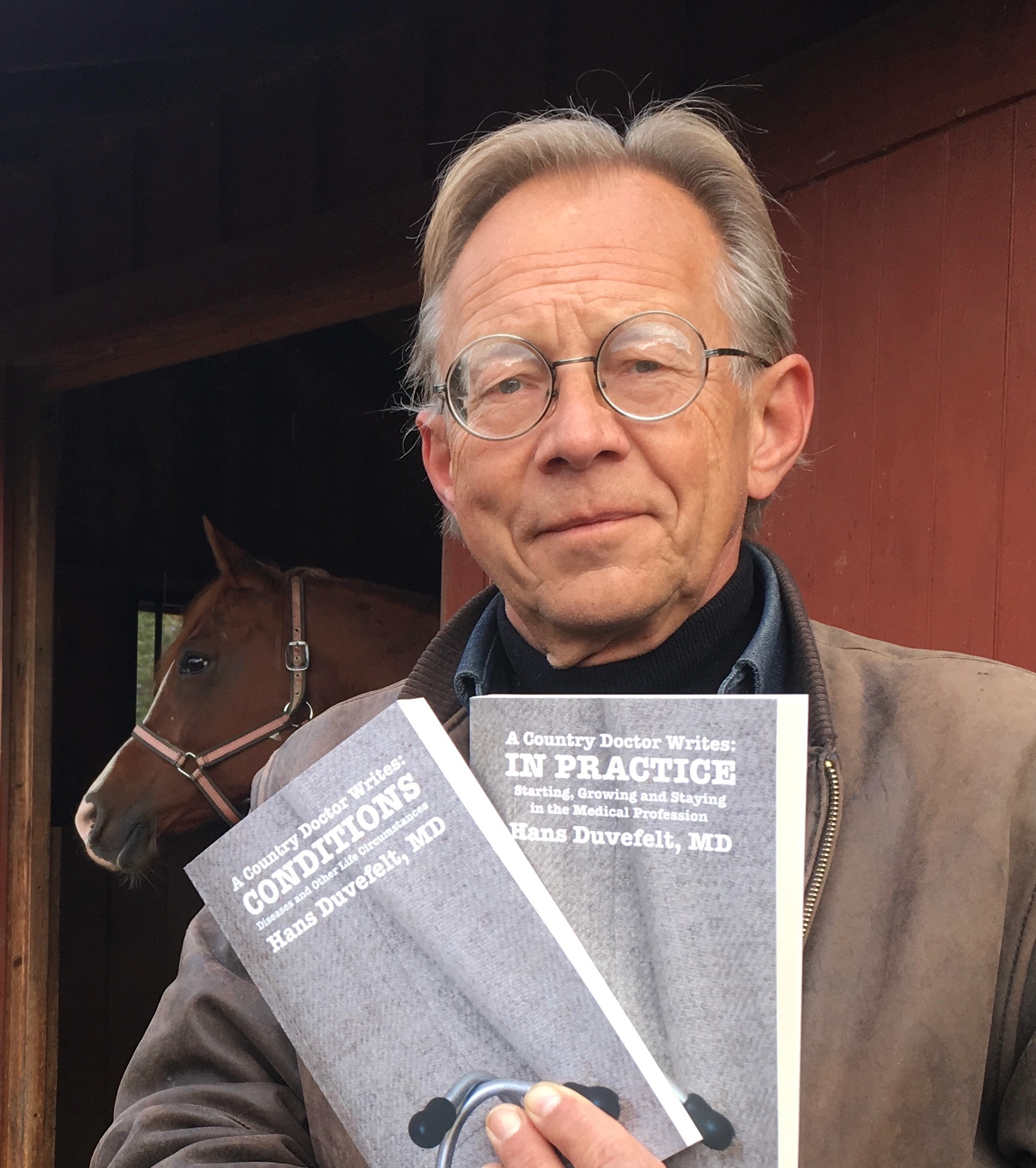
BOOKS BY HANS DUVEFELT, MD

CONDITIONS, Chapter 1: An Old, New Diagnosis

Top 25 Doctor Blogs Award

Doctor Blogs

Enter your email address to subscribe to this blog and receive notifications of new posts by email.

Mailbox

contact @ acountrydoctorwrites.com
Bookmark and Share
© A Country Doctor Writes, LLC 2008-2022 Unauthorized use and/or duplication of this material without express and written permission is strictly prohibited. Excerpts and links may be used, provided that full and clear credit is given.