Archive Page 52

We Are Living in the Dark Ages, and Night May Soon Fall

The Enlightenment, or the Age of Reason, was that time in the 1700s, quoting Wikipedia, that “included a range of ideas centered on the pursuit of happiness, sovereignty of reason, and the evidence of the senses as the primary sources of knowledge and advanced ideals such as liberty, progress, toleration, fraternity, constitutional government, and separation of church and state”.

And here we are: Much of the world is struggling too much just to survive to worry a great deal about happiness. Sovereignty of reason has given way to “alternate truths”; the evidence of the senses no longer informs almost half of the US population; the ideals of liberty, progress, toleration and fraternity are not at all shared – not in this country, and nowhere else that I can think of. And our constitutional government was within a few feet and a couple of gunshots from crumbling just over six months ago. As far as the separation of church and state, this country has never truly done that. Their constitutional powers were certainly separated, but Protestant ideology has always influenced American politics. And now the Bible, at least briefly, has been used as a prop by a President who very successfully folded fundamentalist Christians into his antisocial, anti-science, intolerant mob campaigning against the principles this country was built on.

As we face a pandemic of a rapidly mutating virus, almost half our population is more afraid of the vaccine than the disease that has killed 637,000 Americans as of this writing. And a small, however imperfect measure, of wearing a mask in public has become a matter of pride and a symbol of individual freedom by selfish people who won’t even try not to be spreaders of disease.

The conspiracy theories suggest vaccinations and vaccination identifiers will be the actual manifestation of the biblical Sign of the beast, part of a grand scheme to annihilate scores of people.

This did not happen with smallpox, and nobody I’ve talked to harbors such grand delusions about flu shots, even if they don’t like them.

Just a few years ago we marveled at a pill, albeit an expensive one, that cures hepatitis C. Before that, we got drug cocktails that stopped HIV from killing its victims. We have, during my career, seen cancer cure rates thought impossible in the 1970s. Genetic deadly diseases like Phenylketonuria (PKU) don’t exist anymore, except in very small numbers of surviving patients born in the years before screening was introduced.

I am no friend of the drug companies’ business tactics, but I acknowledge and respect the cures they have brought us.

Indeed, here we are: We live in a country where a sizable minority is going backward, rejecting science and common sense. They drive their motorcycles to tightly packed rallies; they harass store owners who ask patrons to wear masks; they lock themselves out from the “established” sources of news – to be sure they hear only what they want to hear.

Things are looking pretty dark. Because science has become a dirty word in the minds of almost half our population. Because more people than necessary will die from this disease. And because we are more openly divided than we were just a few years ago.

There are many cultures in this country who “do their own thing”, but when we face the biggest threat to mankind in generations, half of our citizens are not finding enough common ground with the rest of us to do even the basics.

God help America, God help us all. Raised Protestant, I write these words, because we as a nation are clearly not united in helping ourselves. And that is what it would have taken to avert what I’m afraid is likely to happen in the coming months.

I am not worried about myself. I am worried about our larger community and our nation. If things go better than my worst fears, it will be in spite of the naysayers; it will be due to dumb luck or divine intervention, not because everybody did their part.

Burnout? Not Even Close!

I am a 68 year old family physician in rural Maine. This morning I read yet another article about physician burnout, this time in The New York Times. (I’m not linking to it, because they have a “paywall”.)

I did not end up exactly where and how I expected to be at the end of my career, or life in general to be brutally honest. But I am the happiest I have been since the beginning of my journey in medicine.

I have a balance in my life I didn’t have, or even seek, for many years as I juggled patient care, administration, raising a family and pursuing interests that often brought me away from home.

My days in the clinic are a bit shorter than they used to be, but in the past several years I have had to do much more work from home – even more so in the last two. The “half-empty glass” way to look at this is that work has intruded more into my personal life and my home. The “half-full” view is that I can do my computer work when it suits me the best. For one of my clinic positions, I can do charting on an iPad mini in bed, coffe on my nightstand and sleeping dogs at my feet. The clumsier EMR requires a laptop (which in my view can’t be used the way its name might suggest) I sometimes work on in the barn and sometimes on a picnic table in the grass outside.

Ironically, the pandemic has brought me a peace and clarity I probably wouldn’t have achieved otherwise.

I had thought moving back to Caribou for a position with no administrative responsibilities would open up social opportunities I hadn’t allowed myself for the last few years. I expected to become involved with the Swedish community here, connecting more with neighbors and other horse owners, and so on.

But the lockdown forced me to sit more with my own thoughts, my own feelings and memories. It forced me to consider, not for the first time but again, that in this unpredictable life, the only sure thing is that I am me and I am where I am.

When I, as many other people, realized that this pandemic could wipe out countless people including myself, and completely change the living conditions for those who survived, it completely freed me from worrying about the small stuff. Or, rather, from considering the small stuff, because I’m not really a worrier. I just used to run a lot of what-if scenarios through my head. I used to be several steps ahead in my mind and have not only Plan B figured out. I would have backups to my backups.

Now I fully accept the unpredictability of life and that has freed up a lot of mental capacity and even time for me.

I have published three books and my blog has continued to grow. At this writing I have posted every single day for the last three weeks. The more I write, the more ideas I have. And my writing is inspired by my engagement with patients and the thinking about medicine they provoke in me. My clinic work informs my writing and my writing makes me a more curious clinician. I go to work thinking “what interesting things will I see today?”

How could I feel burnout when every clinic day is where I go for writing inspiration?

The pandemic has also, ironically, brought me closer to friends and family. Pre-pandemic, I felt too busy to connect, especially in person, never liked to talk on the phone, and I was not into social media. Now I text, call or chat often with my children. I FaceTime biweekly with my exchange student year brother from 50 years ago. I email and chat with cousins in Sweden and some of their children are in my Facebook feeds.

I am also more connected to my home. I take greater joy in doing the little fix-ups. In years past, my home improvements were on a grander scale. Now I do the little, low key things with just as much pride.

I only leave the property to work in my clinic (my second job is via telemedicine from my kitchen island) and to go shopping. The animals thrive on being all together and mild summer nights we all sleep in the barn with the top doors open. I love falling asleep to the sounds of summer, the snoozing of dogs and the chomping of hay.

I am so content with my life as a country doctor.

https://hansduvefeltmd.com/2021/08/28/burnout-not-even-close-video/amp/

Wading Through Unsorted Requests: I Don’t Care If You Call Them “Tasks” Or “Jellybeans”, It’s the Stupidest Thing About EMRs

Today, I had a medical assistant covering for Autumn. Near the end of the day, she handed me one report from our emergency room and one from the competing healthcare system’s walk-in clinic.

A patient of mine had gone to the walk-in clinic for a toothache.

“I wonder why he went to the walk-in clinic for a toothache”, I said.

“I sent you a Task about it this morning”, she said.

That’s the workflow In Greenway’s Intergy. In eClinicalWorks, my other clinic’s EMR, “task” is called “Jellybean”, because the icon with the number of messages is one of several different color ovals on top of the computer screen. But it’s the same flawed idea: Pass messages to the clinician in the order they came in instead of according to urgency.

“Oh well”, I said. “I saw the task about a note for the landlord about a cat and the one about wanting a backdated referral and a hundred other non-urgent messages. Listen, I’m drowning in messages while I’m busy seeing patients. What Autumn does is put a stickie on my computer monitor about important or time sensitive messages. I would have sent in an antibiotic for that guy.”

“No problem, I can do that”, she answered.

I can think of lots of posts I have written about this before, but it needs to be said again:

There is a real danger that providers and patients will waste time doing the wrong thing at the wrong time when nobody directs and prioritizes the inflow of information.

Computer people, who sit at their screens all day, don’t acknowledge that providers are looking into patients eyes, ears and other orifices, listening to convoluted histories and solving clinical problems in the exam room most of our working day. The patients in the office are our priority unless someone with the appropriate triage savvy declares that a not-present patient’s issue should be prioritized.

Where else is the decision maker for a million-plus-dollar-revenue operation surrounded by helpers who dump everything on the boss’s desk without even trying to sort it?

I’m not the president, would not want to be – or even compared with one – but think about how ridiculous my workflow would be if applied to other arenas besides primary care (posted in 2015):

All the President’s Mail

Speaking of Bile: We Should Consider It More Often

Yesterday I wrote about Sphincter of Oddi dysfunction, SOD, a problem where bile accumulates temporarily in the common bile duct.

Burt’s case reminded me of how often I’ve hit the nail on the head suspecting a bile problem to be the cause of a patient’s symptoms.

We certainly have an epidemic of gastroesophageal reflux, in part related to our dietary habits and obesity. So many fast foods can aggravate it, like pizza with red sauce, sweetened and carbonated beverages. Eating late at night and going to bed on a full stomach can also trigger reflux. A big belly, whether from pregnancy or obesity, is also a major trigger.

We have developed more and more acid blockers, yet I see more and more people with reflux symptoms not controlled by these fancy drugs. Surgeons seem to be looking for even small hiatal hernias to operate, and I see many patients who don’t feel much better after their Nissen fundoplications.

So consider this: Endoscopies often show bile reflux. Bile is alkaline, but locally irritating just the way acid is. If we suppress production of stomach acid, is unopposed alkaline bile then more important than if it is present in the stomach along with stomach acid – in a way neutralizing each other? I don’t know, but I wonder.

Following up on my recent case of giardia in the stomach of a patient with stubborn reflux symptoms (skip the inserted post if you read and remember it), this is what happened after the antiparasitic treatment:

When I Escalated His GERD Treatment, My Patient Got Worse. Now I Know Why

Pierre Patenaud was heartburn free when I saw him in followup. Killing the giardia seemed to have done that. But he had developed another problem: Yellow, loose stools that caused him anal pain. He seemed like he had a case of post cholecystectomy bilious diarrhea, except he didn’t just have a cholecystectomy. I prescribed my usual treatment, colestipol. One tablet per day took care of his problem.

My second quiet consideration is: If you bind the bile with colestipol (wherever the two might meet, in the stomach, duodenum, jejunum, ileum or colon), can you control bile reflux, bile gastritis and bilious diarrhea as well as what Pierre called his “burning butt”?

Before statins became available, we used colestipol pills or powder to lower serum cholesterol; by binding to our bile, colestipol prevents reabsorption of cholesterol, a major component of bile, thereby lowering serum cholesterol. So there is plenty of experience giving it to patients even if they don’t have post cholecystectomy diarrhea, its major remaining indication.

I will not hesitate trying it in people with treatment resistant heartburn. I will refer people for endoscopy, but even if there is no bile reflux during a procedure done in the morning, fasting, how do we know it doesn’t happen after pizza and a six pack shortly before bed?

Revitalizing the U.S. Primary Care Infrastructure | NEJM

High-quality primary care is vital but undersupported in the United States. In communities with more primary care resources, people live longer, health care costs are lower, and there is greater health equity than in areas with less primary care infrastructure.2 More than half of office visits in the United States are to primary care clinicians, yet primary care physicians make up only 30% of the physician workforce and are supported by only 5.4% of national health expenditures, and research on primary care garners just 1% of federal agency research awards.2 One in five Americans live in a federally designated primary care Health Professional Shortage Area. Primary care physicians earn 30% less than other physicians, on average, and they have among the highest rates of physician burnout.3
— Read on www.nejm.org/doi/full/10.1056/NEJMp2109700


I just realized none of the posts show on an iPad or a computer, but they do show on an iPhone. WordPress is working on this. In the meantime, please visit my Substack.


Osler said “Listen to your patient, he is telling you the diagnosis”. Duvefelt says “Listen to your patient, he is telling you what kind of doctor he needs you to be”.


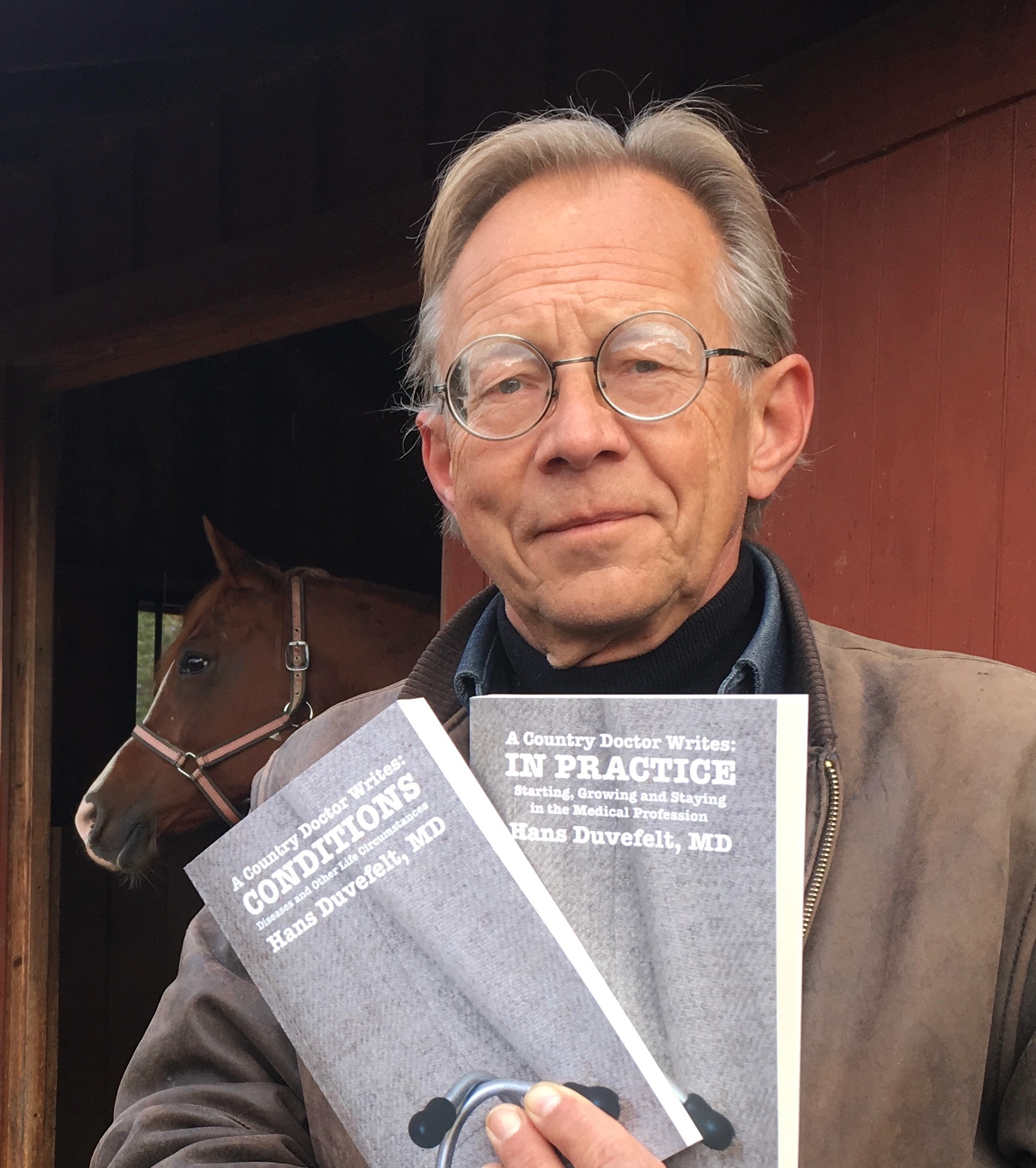
BOOKS BY HANS DUVEFELT, MD

CONDITIONS, Chapter 1: An Old, New Diagnosis

Top 25 Doctor Blogs Award

Doctor Blogs

Enter your email address to subscribe to this blog and receive notifications of new posts by email.

Mailbox

contact @ acountrydoctorwrites.com
Bookmark and Share
© A Country Doctor Writes, LLC 2008-2022 Unauthorized use and/or duplication of this material without express and written permission is strictly prohibited. Excerpts and links may be used, provided that full and clear credit is given.