Archive Page 48

“Has a Bad Cold, Please Call”

The other day I happened to talk with a colleague about our respective electronic inboxes. Office workers in other trades often spend their entire workday at their computers and sometimes the bulk of that time reading and answering emails that arrive in their inboxes. They do that because that is what they are getting paid to do.

Doctors and their employers basically get paid only when there is an encounter – face to face or via telemedicine, hardly ever when the exchange happens over the phone. Consequently, doctors, PAs and NPs are scheduled to see patients (generate revenue) all day long. Unlike office workers, we have no time set aside for managing our inboxes. Except for past payment models like HMOs and future reiterations of capitated care not yet in place, inbox management occurs at the expense of the employer or the medical provider. The general tendency is the latter – “between patients” (a post where I suggest the opposite – protected time for the inbox and then two MAs, more exam rooms and more efficient visits to make up for that computer time) or after hours without overtime or even regular pay because we are salaried.

Electronic inboxes are definitely burnout factors. I have found that medical organizations don’t have systems in place to manage this aspect of healthcare delivery. So it is typically up to each of us to figure out how we would want the flow to go. And we must then work with our support staff, whom we don’t supervise, to meet our patients needs without causing undue stress, interruptions, delays and confusion in our respective workdays.

A natural support staff response is to simply pass on questions and messages to the provider, like the title message. As a physician who generates the revenue that pays both me and my support staff, plus my bosses, I try to create a sense that my time on the phone or in the inbox needs to be as efficient as it possibly can, not because I am lazy but because I want to be efficient.
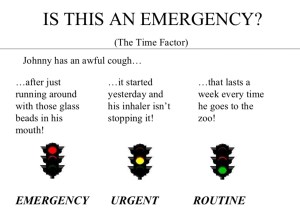
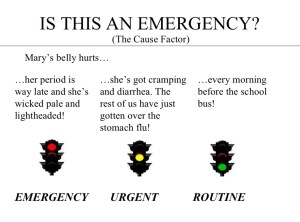
A lot of people in management are nervous about having unlicensed staff give medical advice. These are my thoughts on this: We need our staff to ask common sense questions and we need them to know when it is an obvious emergency. We can’t bottleneck everything by passing every request unfiltered to the provider – or we would have them answer every incoming call themselves already. (Or imagine a president with no admin support opening his own mail.)

We must allow and encourage all staff to use common sense. A person who has made it to adulthood, raised children or cared for a sick family member should and does know pretty well what basic self care is and what the doctor might need to know when you need advice. In the example above, why should the doctor be the first one to ask how long, what symptoms, getting worse or dragging on, what self care measures have you tried etc. See my post THE ART OF THE MESSAGE and the PowerPoint staff talk about common sense telephone triage I created a decade ago (where these slides are from).

When it comes to the most common requests, we have options: Websites, recorded messages on common topics, hyperlinks and things like that with generic advice on colds, sprains, allergies, child rearing and so on. The days are over when the family doctor was the ONLY source of medical information. 

My philosophy is that I need to mentor and support the people I work with to make them more than robot message takers. I explain what I need in order to make good decisions. If I get a good message I can give a simple answer that makes their job easier. If I get a sloppy or vague message, it will just be returned with my request for common sense information.

But I also encourage bypassing the back and forth messaging by having a running conversation: In my Van Buren clinic, my medical assistant/LPN and I share an office. This is a mixed blessing, but it allows exchanges like “Mrs. X left a message asking…” and I can say “If she says this, we’ll tell her to do A but if she says that, she needs to go to the ER”. I may still get a message about the outcome of that callback, but that is just to sign off, not to tie me up on the phone.

My support staff knows I don’t want to end up conducting visits on the phone that belong in the exam room or at least in a telemedicine session. If someone has an upcoming appointment and calls with requests for a new referral or a random blood test they’ve read about, I don’t even get a message – the patient is advised to bring it up in the next visit, or they can come in sooner.

Phone medicine isn’t just bad for the practice’s bottom line. It can also be bad medicine. A patient’s medical history is definitely the most important factor in making a diagnosis. But, very often, even the briefest of clinical exams can alert the physician to a patient’s over- or underestimation of the cause or significance of their symptoms.

It can be false economy for both the clinic and the patient.
An Anxious Man With Coronary Plaque

John Roe has plaque but no symptoms. He ended up getting an angiogram a few years ago for chest pain that ultimately turned out to be acid reflux. But somebody put him on 80 mg of atorvastatin.

He had wanted to know what his lipid numbers were, so we checked them. They were quite low. His LDL was 42. For people who believe in target numbers, under 70 is the desired target for patients with known heart disease. Would John qualify as a member of that population?

“My daughter thinks that’s too high a dose for me”, he said. Amanda, his forty something daughter, is a psychiatric nurse practitioner. “I’m worried about my liver and my kidney numbers were off last year and what if they get worse again?”

This is a conversation I find myself in very often.

“It’s all a question of how much risk you tolerate, how worried you are about having a heart attack. How much insurance, or assurance, you want. The more you take, the more protected you are. And atorvastatin does more than lower cholesterol – I’m sure we have talked about that before. It stabilizes plaque and prevents plaque rupture. And 85% of all heart attacks happen not because of plaque growth but because of plaque rupture – sometimes of plaque that are too small to make you flunk a stress test.”

“I remember you saying that”, he admitted.

“It also prevents plaque buildup, and high doses can make plaque shrink – both in the carotid and coronary arteries, we have lots of proof of that. It also has a blood thinning effect that is different from aspirin, plus it relaxes the little muscles in the walls of the coronary arteries that clamp down when you get that letter from the IRS that you’re being audited (my standard joke..).”

I continued “I’ll print a couple of articles about all this for Amanda. And also, the FDA long ago stopped recommending routine checking of liver enzymes because liver damage from atorvastatin is very rare. And it has been shown to actually protect the kidneys.”

I clicked PRINT a couple of times and went back to my office for the printouts.

When I came back to the exam room, I undid everything I had said.

“But, some people have muscle aches or joint pains, some get higher blood sugars and some get brain fog or pseudo dementia. And there are other ways to avoid heart attacks. Without drugs.”

He looked up from the papers I had given him.

“I’ll print up one more thing for you. The Hale study, many years ago, showed that people aged 70-90 who followed a healthy lifestyle and a Mediterranean diet had half the heart attack and stroke rate, half the cancer rate and half the overall death rate of people with more typical western diets and habits. That’s the same reduction you can get with atorvastatin.”

John sighed. “So what am I supposed to do?”

“Only you can decide”, I answered. “It depends on how much risk you tolerate, how many hoops you are willing to jump through to avoid a heart attack. That’s a very personal choice.”

I know he wished I would tell him what to do. If he had had a heart attack, it would be simpler – there is a “party line” for that. But primary prevention isn’t that straightforward or universally agreed on. So I only provide the evidence and the options.

I don’t babysit. I want to empower.

Don’t Take an Aspirin and Call Me in the Morning

People are asking about the latest US Public Health Service Taskforce on Prevention (USPSTF) recommendation about the use of aspirin to prevent heart disease. It has been a long-standing recommendation for people who already have heart disease.

When I turned 50, I started taking a “baby” aspirin. That was their recommendation then. I stopped taking mine because I had several nosebleeds. “It’s not worth it for me”, I told my patients. Some time later, they changed their recommendation to men over 50 but only women over 50 with diabetes (because their risk for heart disease is four times that of non-diabetic women).

The reason their recommendation keeps changing (negative view) or evolving (positive view) is that studying what happens to large groups of people who do this, that or the other over periods of many years is difficult, expensive and fraught with technical and procedural problems.

It boils down to two numbers: the number needed to treat in order to avoid one bad event, NNT, and the number needed to harm one person. When I wrote about aspirin for heart disease prevention in 2017, the number of aspirin recommendations needed to avoid one cardiac event was about 200. I didn’t know the number needed to harm then.

The harm can be a lot worse than the nosebleeds I had. Some people get bleeding ulcers or even cerebral hemorrhages that may be partly due to their aspirin use.

So last week their recommendation was revised based on more recent data. It seems the risk is greater than the benefit for people over 60 – again, we are talking about primary prevention, people who do not yet have heart disease.

Patients often worry when we change our advice because of new scientific evidence. I understand their confusion and their calls, but I don’t worry much about this change: It doesn’t keep me up at night or on the phone with patients after hours. We need to remember the NNT. It takes 200 aspirin recommendations to prevent one heart attack. That means that roughly 0.5% of people taking aspirin will be helped by it and the rest will not – but in some subgroups the benefit is greater and in some subgroups of people there will be more harm than good.

The latest recommendation includes the patient’s ten year cardiovascular risk, so the USPSTF no longer treats all men over 50 the same. The ten year risk can be calculated from a person’s sex, age, blood pressure, smoking status, presence of diabetes and diagnosis of hypertension. The American Heart Association and the American College of Cardiology created this risk calculator/smartphone app in 2013.

Here is their latest recommendation:

The USPSTF concludes with moderate certainty that aspirin use for the primary prevention of CVD events in adults ages 40 to 59 years who have a 10% or greater 10-year CVD risk has a small net benefit.

The USPSTF concludes with moderate certainty that initiating aspirin use for the primary prevention of CVD events in adults age 60 years or older has no net benefit.

So, remember that a lot of people will still be taking aspirin for nothing. But think of it like wearing your seatbelt: as long as it doesn’t hurt you, what do you have to lose – even if you never get in an accident? But the big concern with recommendations about primary prevention is that our recommendations could end up hurting people who never had a big risk of getting the disease we are trying to prevent. Then our advice could hurt innocent people. And that is what the USPSTF is now saying about seemingly healthy 60-year olds. (More people are hurt by aspirin than by seatbelts.)

Dear Uncle Marcus (Welby):

You never knew me as a doctor. I was just a teenager when you were at the peak of your career. You would be 114 if you were alive today. But you represent something lasting, something archetypal, to me and to many of my colleagues – and also to patients who met you or heard about you.


You were passionate, caring, creative and daring.

Your were passionate about your calling as a doctor and about your principles. There was never any doubt about where you stood. Sometimes you had to process things, and many times your understanding and thinking evolved. But it was always a process grounded in your heart and soul, true to your nature.

You cared deeply for your patients. You often extended, gave of yourself, invested in them. They were not just clients or consumers of healthcare. They were your people.

Your creativity showed when you adopted new technologies to unique clinical scenarios, in your finding ways to reach closed minds or break through stalemates. Medicine was never cookbook in your practice, but an exploration of what you could do with whatever tools were available for you and your patients.

You were daring enough to speak up against injustice, closed mindedness, self pity or abuse. You took on hospital administrators and community leaders. You claimed and used the authority American physicians had in your day.

In some ways it seems being a doctor was easier in your era, but I’m not sure. Every age has its challenges. We have more treatments today to offer our patients. But I believe there is one tool we use much less than you did – ourselves.

You were fully engaged, fully invested. A doctor is what you were, who you were, through and through.

I don’t like to go to doctors, but if I had to, I’d want someone like you.

My wish is that I can be at least a little bit like you for the patients who choose me as their personal physician.

We Use Too Many Medications: Be Very Afraid of Interactions

I happened to read about the pharmacodynamics of parenteral versus oral furosemide when I came across a unique interaction between this commonest of diuretics and risperidone: Elderly dementia patients on risperidone have twice their expected mortality if also given furosemide. I knew that all atypical antipsychotics can double mortality in elderly dementia patients, but was unaware of the additional risperidone-furosemide risk. Epocrates only has a nonspecific warning to monitor blood pressure when prescribing both drugs.

This is only today’s example of an interaction I didn’t have at my fingertips. I very often check Epocrates on my iPhone for interactions before prescribing, because – quite frankly – my EMR always gives me an entire screen of fine print idiotic kindergarten warnings nobody ever has time to read in a real clinical situation. (In my case provided by the otherwise decent makers of UpToDate.)

I keep coming back in my thoughts to, and blogging about, drug interactions. And every time I run into one that surprised me or caused harm, I think of the inherent, exponential risks of polypharmacy and the virtues of oligopharmacy.

One conclusion I have come to is that too often the benefit of our prescribed medication is actually too small to justify the drug. The way drugs are approved today is pretty much that they have to bring a 20% or so advantage over placebo for a certain outcome. Other than the drug versus placebo, all other factors are ignored or “controlled for”, which is easier said than done.

But this whole premise seems wrong to me: If pill A is 20% better than placebo at lowering blood pressure, but salt restriction, weight loss, exercise and stress reduction are twice as powerful as pill A, why are we so stuck on prescribing pill A? If a Mediterranean diet lowers cardiovascular risk as much as atorvastatin, why isn’t that a blockbuster/no-brainer intervention?

The health of our nation is not great, in spite of all the pills at our disposal. And the more pills we prescribe, the more we risk interactions: antidepressants and cholesterol pills with blood thinners, gout medicines with cholesterol pills, mood stabilizers with cardiac medications and on and on and on.

May we all take a step back and look at the big picture of what we are doing and where we are heading.

Donald W Light from the Harvard Center of Ethics wrote in 2014:

Few people know that new prescription drugs have a 1 in 5 chance of causing serious reactions after they have been approved. That is why expert physicians recommend not taking new drugs for at least five years unless patients have first tried better-established options, and have the need to do so.

Few know that systematic reviews of hospital charts found that even properly prescribed drugs (aside from misprescribing, overdosing, or self-prescribing) cause about 1.9 million hospitalizations a year. Another 840,000 hospitalized patients are given drugs that cause serious adverse reactions for a total of 2.74 million serious adverse drug reactions. About 128,000 people die from drugs prescribed to them. This makes prescription drugs a major health risk, ranking 4th with stroke as a leading cause of death. The European Commission estimates that adverse reactions from prescription drugs cause 200,000 deaths; so together, about 328,000 patients in the U.S. and Europe die from prescription drugs each year. The FDA does not acknowledge these facts and instead gathers a small fraction of the cases.

There are obviously more recent statistics out there, but this piece struck me because it was published in a forum about ethics. Think about that for a moment: We are subjecting our patients to known and unknown risks of harm with every prescription we issue.


I just realized none of the posts show on an iPad or a computer, but they do show on an iPhone. WordPress is working on this. In the meantime, please visit my Substack.


Osler said “Listen to your patient, he is telling you the diagnosis”. Duvefelt says “Listen to your patient, he is telling you what kind of doctor he needs you to be”.


BOOKS BY HANS DUVEFELT, MD

CONDITIONS, Chapter 1: An Old, New Diagnosis

Top 25 Doctor Blogs Award

Doctor Blogs

Enter your email address to subscribe to this blog and receive notifications of new posts by email.

Mailbox

contact @ acountrydoctorwrites.com
Bookmark and Share
© A Country Doctor Writes, LLC 2008-2022 Unauthorized use and/or duplication of this material without express and written permission is strictly prohibited. Excerpts and links may be used, provided that full and clear credit is given.

