Archive Page 45

There is Comfort in a Name

It is human nature to name things. Even babies do it. They point at or grab a new object and say “Da” or some other one syllable word as they discover and claim the world around them.

People who don’t feel well search for answers. It is bewildering for them to hear “We don’t know what’s wrong with you”.

Nobody wants to be dizzy. It feels more substantial to have vertigo, even though in reality both terms are equally specific.

Every era has its diagnostic terminology, influenced by larger trends in science and sociology. People who are searching to name their symptoms tend to latch on to the diseases that get publicity and there are usually practitioners who feed into that. Many times diagnostic criteria are undeveloped or controversial. We call these entities syndromes, just like clinicians have done over the centuries before us. We describe constellations of symptoms and speculate about their cause. Only much later do we understand their pathophysiology and become able to sharpen their definitions. This tends to exclude some people who self diagnosed their way into something nameable.

Right now, there is the emerging concept of “Long Covid”. Before that it was chronic Lyme. It was neurasthenia in the early 1900’s. In between, we saw the emergence of fibromyalgia, chronic fatigue syndrome and many others.

Different cultures have different diagnostic frameworks. In Sweden there are 300,000 people with nonspecific symptoms who are diagnosed with sensitivity to electromagnetic fields. They move into super insulated homes off the power grid. I never hear of that here.

Wikipedia and many other sources, including Science Direct, list such “Culture-Bound Syndromes”. For example, Premenstrual Syndrome, Anorexia Nervosa and Morgellons aren’t universally recognized conditions, but fairly specific to Western cultures.

I am torn about using labels that may not fit exactly. They can help as concepts, but can also predispose patients to magnifying their illness experience and thus be self-fulfilling prophecies. I tend toward the concept of shadow syndromes and disease spectrums.

For example, I’m not hung up on how many fibromyalgia tender points a patient has. As long as they don’t meet the criteria for inflammatory rheumatic diseases, I often introduce the concept early on by saying “you have many features of what we call fibromyalgia, so these are some things that may help you feel better, even if you don’t have the full-blown condition…” (See more on my thoughts on the spectrum of disease here.)

This Time, it’s Different: The Man Who Cried Wolf and the Doctor Who Listened

Andrew White had a long history of non-cardiac chest pain, usually fitting the definition of costochondritis, or Tietze’s syndrome. His pain was sharp, localized high up to the left, not far from his collar bone. He was always tender to the touch there and his EKG and bloodwork were always normal.

Between his recurring chest pain and other symptoms, like belly pain and swelling with pain in his legs, Andrew had logged half a dozen emergency room visits in the first 9 months of this year. Each time, he had called the ambulance to get there.

Then one day, during a regular office visit, he told me about a new pain he’d been having. Because he doesn’t drive, he usually walks to the store. For the past two weeks, he had noticed some shortness of breath on the way back up the hill to his apartment. Also, he had felt a pressure more in the middle of his chest.

Was this the power of suggestion after being asked about such symptoms every time he had been to the emergency room? Or was it the real thing this time?

His exam and EKG were normal.

I did not take any chances. I put him on a long acting nitroglycerin plus PRN sublingual tablets with careful instructions on how to use them. I also prescribed atorvastatin and ordered an ASAP nuclear, chemical, stress test and told him under which circumstances to call 911, even though I had discouraged him from doing so for other symptoms before. I didn’t start a betablocker because his blood pressure was on the low side, but I scheduled an early followup.

His stress test was only mildly abnormal, but his cardiac cath showed a near total occlusion of his left anterior descending coronary artery. This is the big one that has been called the “widow maker”.

The lesson here is obvious. Even worriers and hypochondriacs get bad diseases sometimes. We must never dismiss or underestimate that possibility.

Is This Really a Time to Give Thanks?

The sentimentalist in me tends to pen reflections at Thanksgiving, Christmas and New Year.

It’s perhaps not an obvious thing to be thankful right now, but I still think we should be.

We didn’t all die. Most of us are still alive and well. There is food in the supermarket, electricity in the outlets and gasoline at the pumps. Medical clinics and hospitals are mostly open for business and now there are vaccines, medications and infusions to combat the virus that threatened to wipe us all out.

This pandemic is certainly a reminder not to take ANYTHING for granted. And, unfortunately, it has reminded us that adults can be just like children, throwing temper tantrums when they don’t get their way. And just like two year olds, these adults act out their frustration against the bearers of bad news, rather than the cause of it.

As I write this, there is news about riots in Europe against common sense precautions and restrictions. There are countless reports about hostilities and violence in this country over simple things like mask mandates.

At the same time, Covid case rates are climbing. And here we are, with holiday travel picking up and predictions of new surges as a result.

This is a time to hunker down, a time to not be greedy. It is a time, still, for delayed gratification, adult and responsible thinking. It is a time for taking stock in what we have and what has been accomplished in securing a way through and out of this natural disaster.

I read about an experiment that plans to cause a space collision with an asteroid to see how much we can alter its trajectory. This could pave the way for saving the planet some day if a more threatening space ball should appear. A small nudge, the article said, could have a major effect on the course of this astral body.

Kind of like small changes in human behavior.

I am thankful for the tools and the power we all now have that can alter the trajectory of the pandemic.

Dumbing Down Doctors: A Profession Without a Language

We are being robbed: Robbed of the tools of language our profession has used and shared with the world at large. Popular culture has embraced our language and incorporated it in other areas: Who hasn’t seen a bill hit the senate floor DOA or STAT communications in non-medical contexts, for example? But now, we – the first users of our language – are restricted from using it.

For over a hundred years, prescriptions have used abbreviations, like PRN, PO and QID. Those are now slated to disappear. Even the Joint Commission says so.

Every area of life has a rapidly evolving vernacular, full of newly minted abbreviations for concepts that didn’t exist until yesterday. NFTs, non-fungible tokens, for the first rendition of a ubiquitous internet image, is the latest one that comes to mind.

First, the argument was that we needed to issue prescriptions via computer because our handwriting was sloppy. Now, even neat, digital prescriptions and office notes are unwelcome because lay people or lazy or inattentive readers might misread our electronic communications.

Why does this apply only to us? Why are there USB connectors, when the real term is Universal Serial Bus? How come online chats are allowed to use terms like LOL and ROFL? What if a newcomer doesn’t understand those abbreviations? And what about finance? Why can they use terms that even their customers don’t understand.

Should we level the playing field and simply outlaw all abbreviations in this country? Or, should we allow rapid communication between technical experts in their own language? Lower the bar or maintain and protect it?

Old Information

“Did you ever take a betablocker, like atenolol, or Topamax for your migraines”, I asked.

“I think so, and something didn’t agree with me”, she said. “It was, like, ten years ago.”

We got our first EMR in 2011. Neither drug had been prescribed for her since then.

“Let me get your paper chart”, I said and left the exam room. Walking past the reception desk, I grabbed the pink “necklace” with the key to the “chart closet” down an empty hallway of the old hospital building that is now our clinic.

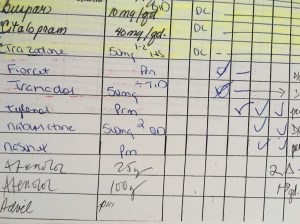
Her paper record consisted of four volumes and measured about 6” in thickness. Once back in the exam room, it took me less than a minute, leafing through the medication flowsheets to the left inside each folder, to find the pages where atenolol and Topamax were listed in my own and Autumn’s handwriting.

Checking the dates on the flowsheet, I quickly found the office notes, stacked in reverse chronological order to the right in the same volume of her chart. And there it was, the story of her atenolol, which relieved anxiety related tremors but did little for her migraines. We kept that drug for those benefits and added low dose topiramate. Shortly thereafter she had a spell of low blood pressure and stopped both drugs on her own.

I had the information I needed. The walk down the old hospital corridors took longer than the chart research itself.

I told my new colleague, who is much younger than my children, how easily I found the information in the paper chart.

“Let me look, I’ve never seen a paper chart”, she said. Neither had her medical assistant.

Later, I told the story to my office manager, who remembered the admin staff’s frustration back in the day with locating the records themselves. I do remember occasionally having to see a patient without their paper chart. But, of course, that happens with electronic records too all those times when our EMR is down.

At least in my current system (me again, Greenway), it is exceedingly difficult to imagine timelines that the system fails to display in logical fashion – of medication starts, dose changes and discontinuations, as in my patient’s case, or with clumsy EMR warfarin “flowsheets” that take much longer to work with than the old paper version.

There is so much more that could be done with the User Interfaces in today’s systems. We still work with what feels like MS-DOS while my grandson’s X-box is so intuitive that, literally, a child can work the system.

EMRs: It’s the Interface, Stupid*


I just realized none of the posts show on an iPad or a computer, but they do show on an iPhone. WordPress is working on this. In the meantime, please visit my Substack.


Osler said “Listen to your patient, he is telling you the diagnosis”. Duvefelt says “Listen to your patient, he is telling you what kind of doctor he needs you to be”.


BOOKS BY HANS DUVEFELT, MD

CONDITIONS, Chapter 1: An Old, New Diagnosis

Top 25 Doctor Blogs Award

Doctor Blogs

Enter your email address to subscribe to this blog and receive notifications of new posts by email.

Mailbox

contact @ acountrydoctorwrites.com
Bookmark and Share
© A Country Doctor Writes, LLC 2008-2022 Unauthorized use and/or duplication of this material without express and written permission is strictly prohibited. Excerpts and links may be used, provided that full and clear credit is given.


