Archive Page 46

Is This Really a Time to Give Thanks?

The sentimentalist in me tends to pen reflections at Thanksgiving, Christmas and New Year.

It’s perhaps not an obvious thing to be thankful right now, but I still think we should be.

We didn’t all die. Most of us are still alive and well. There is food in the supermarket, electricity in the outlets and gasoline at the pumps. Medical clinics and hospitals are mostly open for business and now there are vaccines, medications and infusions to combat the virus that threatened to wipe us all out.

This pandemic is certainly a reminder not to take ANYTHING for granted. And, unfortunately, it has reminded us that adults can be just like children, throwing temper tantrums when they don’t get their way. And just like two year olds, these adults act out their frustration against the bearers of bad news, rather than the cause of it.

As I write this, there is news about riots in Europe against common sense precautions and restrictions. There are countless reports about hostilities and violence in this country over simple things like mask mandates.

At the same time, Covid case rates are climbing. And here we are, with holiday travel picking up and predictions of new surges as a result.

This is a time to hunker down, a time to not be greedy. It is a time, still, for delayed gratification, adult and responsible thinking. It is a time for taking stock in what we have and what has been accomplished in securing a way through and out of this natural disaster.

I read about an experiment that plans to cause a space collision with an asteroid to see how much we can alter its trajectory. This could pave the way for saving the planet some day if a more threatening space ball should appear. A small nudge, the article said, could have a major effect on the course of this astral body.

Kind of like small changes in human behavior.

I am thankful for the tools and the power we all now have that can alter the trajectory of the pandemic.

Dumbing Down Doctors: A Profession Without a Language

We are being robbed: Robbed of the tools of language our profession has used and shared with the world at large. Popular culture has embraced our language and incorporated it in other areas: Who hasn’t seen a bill hit the senate floor DOA or STAT communications in non-medical contexts, for example? But now, we – the first users of our language – are restricted from using it.

For over a hundred years, prescriptions have used abbreviations, like PRN, PO and QID. Those are now slated to disappear. Even the Joint Commission says so.

Every area of life has a rapidly evolving vernacular, full of newly minted abbreviations for concepts that didn’t exist until yesterday. NFTs, non-fungible tokens, for the first rendition of a ubiquitous internet image, is the latest one that comes to mind.

First, the argument was that we needed to issue prescriptions via computer because our handwriting was sloppy. Now, even neat, digital prescriptions and office notes are unwelcome because lay people or lazy or inattentive readers might misread our electronic communications.

Why does this apply only to us? Why are there USB connectors, when the real term is Universal Serial Bus? How come online chats are allowed to use terms like LOL and ROFL? What if a newcomer doesn’t understand those abbreviations? And what about finance? Why can they use terms that even their customers don’t understand.

Should we level the playing field and simply outlaw all abbreviations in this country? Or, should we allow rapid communication between technical experts in their own language? Lower the bar or maintain and protect it?

Old Information

“Did you ever take a betablocker, like atenolol, or Topamax for your migraines”, I asked.

“I think so, and something didn’t agree with me”, she said. “It was, like, ten years ago.”

We got our first EMR in 2011. Neither drug had been prescribed for her since then.

“Let me get your paper chart”, I said and left the exam room. Walking past the reception desk, I grabbed the pink “necklace” with the key to the “chart closet” down an empty hallway of the old hospital building that is now our clinic.

Her paper record consisted of four volumes and measured about 6” in thickness. Once back in the exam room, it took me less than a minute, leafing through the medication flowsheets to the left inside each folder, to find the pages where atenolol and Topamax were listed in my own and Autumn’s handwriting.

Checking the dates on the flowsheet, I quickly found the office notes, stacked in reverse chronological order to the right in the same volume of her chart. And there it was, the story of her atenolol, which relieved anxiety related tremors but did little for her migraines. We kept that drug for those benefits and added low dose topiramate. Shortly thereafter she had a spell of low blood pressure and stopped both drugs on her own.

I had the information I needed. The walk down the old hospital corridors took longer than the chart research itself.

I told my new colleague, who is much younger than my children, how easily I found the information in the paper chart.

“Let me look, I’ve never seen a paper chart”, she said. Neither had her medical assistant.

Later, I told the story to my office manager, who remembered the admin staff’s frustration back in the day with locating the records themselves. I do remember occasionally having to see a patient without their paper chart. But, of course, that happens with electronic records too all those times when our EMR is down.

At least in my current system (me again, Greenway), it is exceedingly difficult to imagine timelines that the system fails to display in logical fashion – of medication starts, dose changes and discontinuations, as in my patient’s case, or with clumsy EMR warfarin “flowsheets” that take much longer to work with than the old paper version.

There is so much more that could be done with the User Interfaces in today’s systems. We still work with what feels like MS-DOS while my grandson’s X-box is so intuitive that, literally, a child can work the system.

EMRs: It’s the Interface, Stupid*

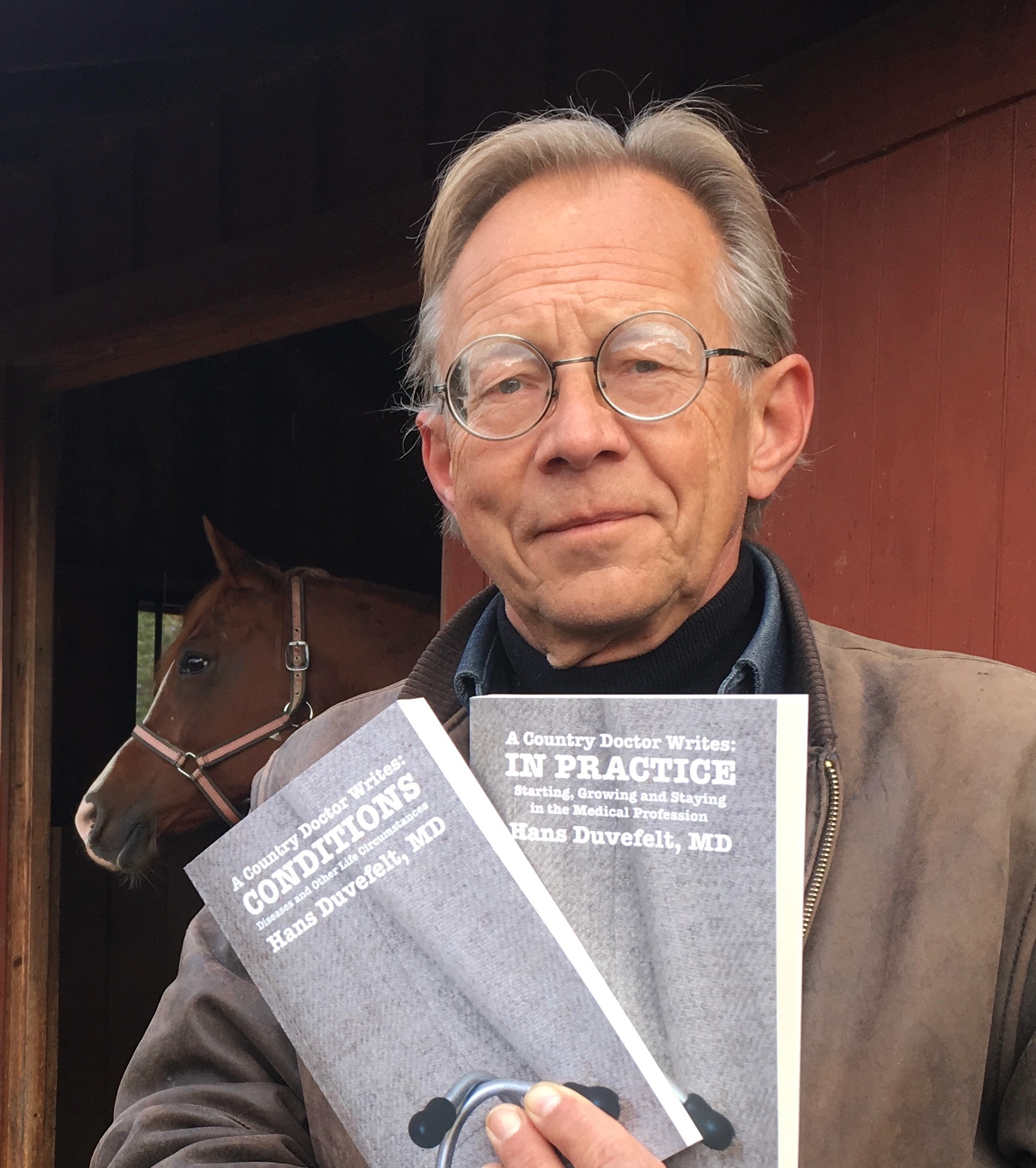
A Kind Review of My Books in FAMILY MEDICINE

I found out today that my books are reviewed in the December issue of Family Medicine:

“Originally from Sweden, Hans Duvefelt, MD, trained at Central Maine Medical Center 40 years ago and has practiced in rural Maine ever since. In 2008, he began writing a reflective blog to document his medical experiences, and that writing ultimately became the basis for these collections of brief vignettes. The topics range from his initial impressions of medical school to meaningful personal connections with patients, difficult diagnoses, exciting patient encounters, and even his own experiences as a patient.”

“Through his words as a seasoned and experienced generalist, Duvefelt reminds us all to examine why we practice medicine and to reflect on our experiences in a way that encourages not only learning, but also gratitude for the ability to participate in the many moments of our patients’ lives.”

https://journals.stfm.org/familymedicine/2021/november-december/br-nadkarni-nov-dec21/

Behind the Mask

Today I saw a patient I have known for years. He suddenly pulled his mask down and said, “I’d like to know what you think I should do about this”.

On his nose was an 8 mm (1/3”) brownish red flat spot with a crack or scrape through it.

“How long have you had it”, I asked.

“Oh, a while now” he answered. That is about the least helpful time measurement I know of. I asked him to pin it down a bit more precisely. He settled for about a year. I prescribed a cream and made a two week followup appointment for either cryo or a biopsy. It’s probably just an excoriated, premalignant, actinic keratosis.

Back when life was different, this would not have gone unnoticed. But, of course, we’ve been wearing masks for over a year and a half now, so no wonder I wouldn’t have noticed it just talking to the man.

I walked down the hall and told my new partner what just happened.

“Oh, yeah”, she said. “Same thing happened to me – a basal cell cancer. And I find it difficult sometimes to assess things like state of emotion with no facial expressions. And, even worse, I’ve got a lot of patients that are new to me that I don’t even know what they look like.”

“Of course, you started here six months before the pandemic”, I registered. “That really must feel weird.”

Telemedicine is considered better than telephone medicine just because you can judge demeanor, facial expressions and so many other things better visually than with your hearing only. So where do masked in-person visits fall on that spectrum? Of course we can see head shaking and shoulder shrugging, so masked visits win over telephonic, but my next thought here is that maybe I should reconsider my scepticism about a former colleague I heard about just the other day.

This doctor will now have a patient sit in the exam room while she herself sits in her office. In front of the patient is a computer and the two of them basically do the first part of the visit as if they had a “regular” telemedicine consultation. Then, the doctor may or may not step into the office in order to do whatever physical exam the clinical situation requires.

I suddenly see at least a little bit of logic in that approach. Because that way they can both talk without masks on. (Or should you, with what we now know about aerosol transmission in the exam room and all…)


I just realized none of the posts show on an iPad or a computer, but they do show on an iPhone. WordPress is working on this. In the meantime, please visit my Substack.


Osler said “Listen to your patient, he is telling you the diagnosis”. Duvefelt says “Listen to your patient, he is telling you what kind of doctor he needs you to be”.


BOOKS BY HANS DUVEFELT, MD

CONDITIONS, Chapter 1: An Old, New Diagnosis

Top 25 Doctor Blogs Award

Doctor Blogs

Enter your email address to subscribe to this blog and receive notifications of new posts by email.

Mailbox

contact @ acountrydoctorwrites.com
Bookmark and Share
© A Country Doctor Writes, LLC 2008-2022 Unauthorized use and/or duplication of this material without express and written permission is strictly prohibited. Excerpts and links may be used, provided that full and clear credit is given.