Archive Page 36

Delivering Health Care is Like Practicing a Religion

A former brother-in-law was a chiropractor. We never talked shop. But the longer I am in this business, the more I believe in our bodies ability to heal. If hypnosis can cure warts, we can’t be too rigid about how our patients tap into their own ability to feel better.

Scientific American writes:

For centuries, the idea of “healing thoughts” has held sway over the faithful. In recent decades it’s fascinated the followers of all manner of self-help movements, including those whose main purpose seems to be separating the sick from their money. Now, though, a growing body of scientific research suggests that our mind can play an important role in healing our body — or in staying healthy in the first place.

I wrote about this in 2008 and I am even more relaxed now about patient seeking alternative methods to tap into their inherent abilities to heal:

You wouldn’t ask your rabbi how often you should go to confession, would you? Chiropractic and allopathic medicine are like two religions. We don’t speak the same language and we use different tools. But even though our practices are different, we ultimately work for the same higher purpose, and it may be that our differences are smaller than we were taught. We don’t know enough about each other’s practices to make specific recommendations, but support you, our patients, in your pursuit of better health and wellbeing.

So, still, while I support my patients pursuit of alternative ways of healing and gladly sign insurance authorizations for that, I have to admit that I feel uncomfortable choosing such practitioners. I just don’t know who is good and who is a good fit because we come from such different cultures, or different religions, for lack of a better word.

Make it So

A year ago today, from a different galaxy (EMR) I wrote a piece that is equally relevant in my new galaxy (Epic). In fact, even more so. Epic is even more click and encounter heavy than I could imagine.

I wish I could be like Captain Jean-Luc Picard and just say “make it so”. Instead, be it Epic, Intergy or eClinicalworks, I have to do a lot of things that are not medical in order to basically say yes to a request from a colleague or support staffer.

This is what I wrote:

In my EMR, when I get a message (also called “TASK” – ugh) from the surgical department that reads “patient is due for 5-year repeat colonoscopy and needs [insurance] referral”, things are a lot more complicated, WHICH THEY SHOULDN’T HAVE TO BE! For this routine task, I can’t just click a “yes” or “authorize” button (which I am absolutely sure is a trackable event in the innards of “logs” all EMRs have).

Instead, (as I often lament), I have to go through a slow and cumbersome process of creating a non-billable encounter, finding the diagnostic code for colon cancer screening, clicking on REFERRAL, then SURGEON – COLONOSCOPY, then freetexting “5 year colonoscopy recall”, then choosing where to send this “TASK”, namely the referral coordinator and , finally, getting back to the original request in order to respond “DONE”.

This is a basic, binary, programming issue as far as I understand. Yes or no, 1 or 0, stop or go, scope or nope.

I really think EMR programmers have something against doctors.

Your Doctor Remembers Most Things About Medicine, But Not Everything About You

I often get calls requesting a medication for a recurrent problem, like a sinus or urinary tract infection. And sometimes, after I send something in and my nurse calls the patient to tell them I did, they say “that never works” or “it took two rounds to lick it last time”.

I wish patients didn’t expect me to remember such things, or that – between my old EMR and my new EMR – I have enough slack in my clinic schedule to research those things.

Everyone should know that phone calls and messages are not given specific time in doctors schedules. They are handled on the fly, shortchanging patients with appointments, cutting into lunch hours and quitting time in today’s healthcare environment.

Calling your doctor, if you know what you need, please say so. Whether you get sulfa or ciprofloxacin or nitrofurantoin makes little difference to me, so just tell me – they’re all good choices. Now, hydrochloroquine for Covid would be a different story.

And, I need specifics. If somebody says “what you gave me last time worked really well” it would help me immensely if they also said a month ago or three years ago. Because searching for things in EMRs is not as easy as it should be.

I also need clinical specifics. A call like “What can I take for a headache” is too open ended, just like “I have a cough and I’m raising green phlegm”. Three days of coughing, no treatment as it’s probably viral, much longer and getting worse, that might be bacterial and deserving an antibiotic. Daily headaches for 20 years or headaches with menstruation, make an appointment. The worst headache of your life, started 10 minutes ago, call 911.

And “That salve the dermatologist gave me worked well, can you get me some more” would be much easier to deal with if my patient had the old tube in front of them.

Good clinical decision making requires specifics: how long has it been going on, what are the symptoms, what makes it better or worse, is it stable or getting worse as time passes? There is a lot of intuition in how we work, but first we need basic information. In today’s hectic clinical environment, it helps a lot if people volunteer the specifics when they call for advice.

Twenty questions is a fun game, but not an effective way of practicing medicine. Volunteer the information, don’t withhold it.

Twenty Questions

Five Plain Truths About Gout

1) Gout is no longer the disease of kings, or even of the affluent. It is hitting harder in lower socioeconomic groups.
2) A low purine diet is no longer a strongly recommended intervention. Cutting back on organ meats and alcohol is. Purine rich vegetables, once viewed as triggers, may be safe because of their fiber content.
3) Uric acid crystals are involved in gout, but it is primarily an inflammatory condition. So not everyone with high uric acid gets gout. This is just like how high cholesterol and low inflammatory markers seems safer than average cholesterol and high inflammatory markers. And, heart attacks and strokes are more likely to happen in the months following a gout attack.
4) Colchicine, one of the treatment options for both acute and chronic gout, works without lowering uric acid levels at all. It treats inflammation, just like the commonly used attack medicine indomethacin and my personal choice, prednisone.
5) Allopurinol, which we use to prevent gout attacks by lowering blood uric acid levels, can also cause them. It should never be started during a gout attack. If attacks happen in the beginning of treatment, I give short prednisone bursts to get patients through the initiation phase.

I Do Fewer Elective Procedures Now Than When I Started Out. This is Why:

Access is a big problem in primary care. We must be available. We are the first point of contact, the gatekeepers who sort the chaff from the wheat. We are the ones who want to see people early in order to decide how serious their symptoms are. If it takes three weeks to get in to see us, people will come to harm.

Maybe this is more essential in a rural area where there are no walk-in clinics and where many people hesitate going to the emergency room even when they ought to, because of traveling distance and fear of hospitals.

I will double book a swollen elbow because it could either be a medical emergency like a septic joint that needs quick triage or a benign but bothersome olecranon bursitis which takes me only a few minutes to drain and instill some methylprednisolone into. But a large sebaceous cyst that needs a delicate removal so as not to rupture its capsule is something I don’t want to take up the time to do. First, the consistency of equipment available is variable and, second, I could see three other patients in the time it takes to prepare for and perform that procedure. The surgeons at the hospital down the road are better set up to do that quickly than I am and even if there’s a wait to see them, nobody will come to harm.

This choice that I have made is in some ways causing me to lose skills; I am no longer very good at injecting “dry” knees, for example. But on the other hand, for every year that I am in practice, I believe I am becoming a better diagnostician, teacher and therapist. I guess my circumstances and my personal interests are moving me in the same direction: The doctor who will see you now and the doctor who will stick with you over time, not necessarily the doctor who will do it all, even if he could do it in a pinch. I think I am putting my abilities to the best possible use, given where I am practicing.


I just realized none of the posts show on an iPad or a computer, but they do show on an iPhone. WordPress is working on this. In the meantime, please visit my Substack.


Osler said “Listen to your patient, he is telling you the diagnosis”. Duvefelt says “Listen to your patient, he is telling you what kind of doctor he needs you to be”.


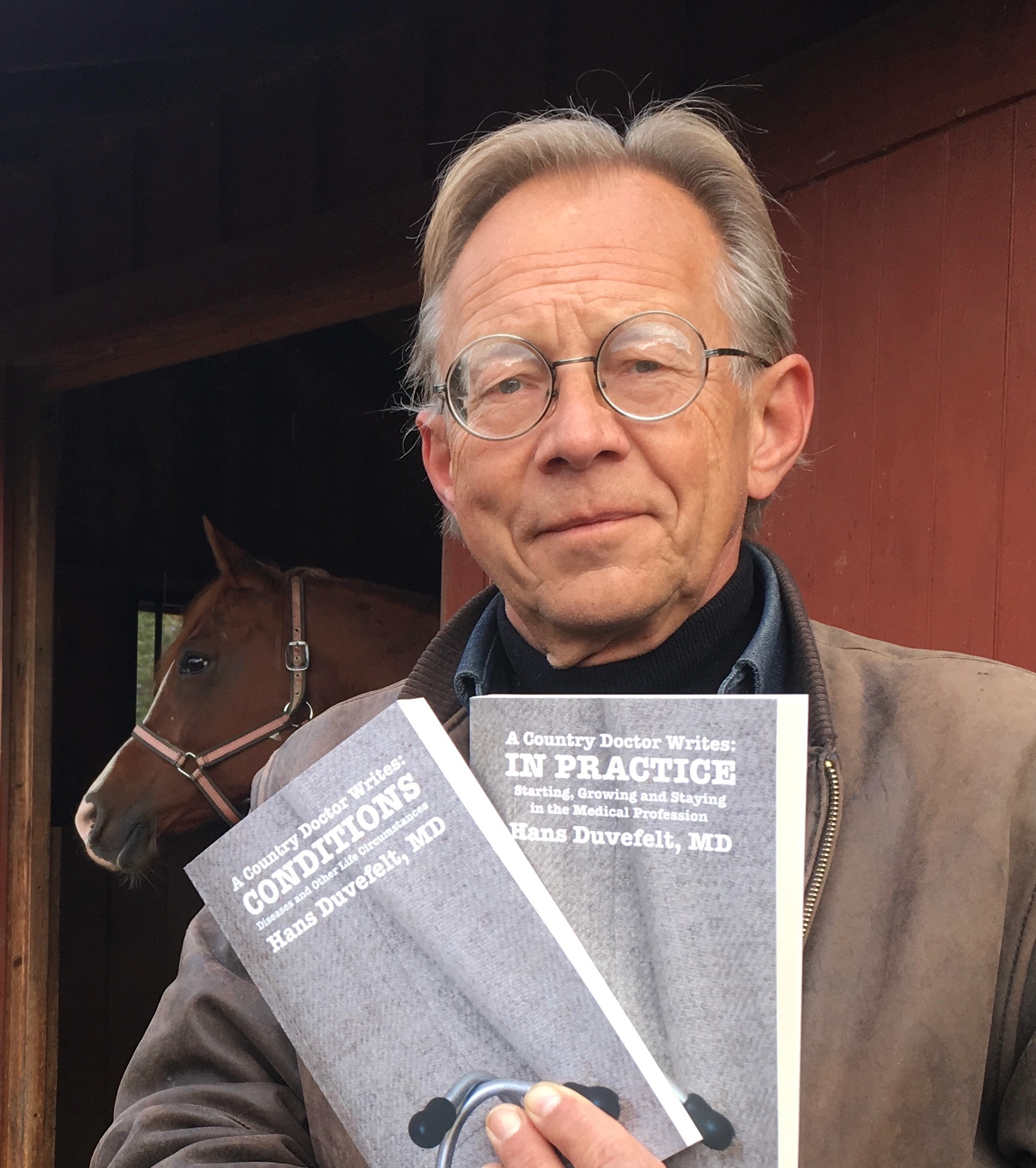
BOOKS BY HANS DUVEFELT, MD

CONDITIONS, Chapter 1: An Old, New Diagnosis

Top 25 Doctor Blogs Award

Doctor Blogs

Enter your email address to subscribe to this blog and receive notifications of new posts by email.

Mailbox

contact @ acountrydoctorwrites.com
Bookmark and Share
© A Country Doctor Writes, LLC 2008-2022 Unauthorized use and/or duplication of this material without express and written permission is strictly prohibited. Excerpts and links may be used, provided that full and clear credit is given.