Archive Page 30

Ask Not What Your Next #EMR Can Do for You, Ask What You Won’t Have to Do for It

Computers can do wonderful things. In many industries the people who analyze the data are a small, well payed elite and the people who enter the data are lineworkers.

Health care, a few decades ago, was something done by professionals, which is what we called physicians in those days.

Today, healthcare is a place where physicians are increasingly tasked with data entry and, as much as they may be analyzing the data for individual patients under their care, a much bigger purpose of the Electronic Record is the statistical analysis done by administrators, insurance companies, quality ranking institutions and others. Their needs supersede the needs of physicians caring for patients, but it is the physicians who are still tasked with entering the data that those other forces require.

Hippocrates had a word for all those people, long before he even knew who they would be in our era. He called them “the Externals”.

Today, the “externals” are running the show and we are pawns in their game. They don’t want us to even make clinical decisions – they have pre-programmed prompts in our #EMRs to order or initiate things that, generically speaking, might theoretically benefit our patients.

But people are complex and we do not have the technology to let computers decide what to do with individual patients. We still need well trained and experienced clinicians to make sense of all the data out there and apply it to our individual patients.

I think we, the physicians, need to reclaim the medical record. Its primary purpose absolutely must be to document what we do, how we think and what our patients tell us about their symptoms.

And I think the increasingly clever artificial intelligence systems could harvest what the bean counters need from the notes that we create for our purposes. We could even imagine a concept like metadata, background statistical stuff that clinical readers don’t need but nerds might need.

The other day a hospital outside my service area admitted one of my patients and needed our information. I faxed over my two most recent office notes that included important information about who this patient’s different specialists around the state were. But the hospital didn’t see that important nugget among the s***tload of mostly irrelevant data that printed out.

So let us put in the note what we need and make the computers harvest what the externals need – and make somebody else, besides the clinicians, responsible for entering that data.

All Body Parts are Not Created Equal

You would think simple atomic particles like sodium, magnesium and iron would be evenly distributed throughout the body and that their blood levels would tell us whether we have enough of them in our bodies.

I already knew that that was not the case with sodium or magnesium. Tonight I learned that the same situation exists with iron.

Low sodium can be associated with swelling of the brain and rapid neurological deterioration, but if it develops slowly, the brain may not suffer as much as if it happens acutely.

Magnesium is shuffled from our tissues into the blood stream if our serum levels drop, which means even people with normal serum levels can have severe intracellular magnesium deficiency.

Tonight at 9:51 pm, the EMR still open on my laptop computer, I was in a Facebook messenger video with my lady friend. A patient who I’m not friends with socially sent me a video link to a neurology talk by a neurologist in Spain speaking with an Italian accent about restless leg syndrome. This is a condition that didn’t get much attention in my 5 1/2 year medical school curriculum at Uppsala University in Sweden, even though this disease is also called Ekbom’s disease and named after an Uppsala neurology professor before my time.

It is well known that iron deficiency can play a role in restless leg syndrome. The video stressed the point that brain levels of iron and serum levels of iron and ferritin don’t correlate very well. In this case, just as with magnesium, other bodily functions may be prioritized – If we are trying to overcome anemia we may sacrifice the brain iron levels to make more red blood cells and when we do that both the blood count and the serum iron and ferritin levels may look pretty good while the brain is suffering.

Tonight’s lesson is, once again, that blood tests don’t always tell you what’s going on in the part of the body where the symptoms are. And, by the way, in case anybody thought restless leg syndrome is a disease of the legs, it’s all happening in the brain!

Old Habits Die Hard in Medicine

My hospital’s mammogram reports have a space for “Date of last breast exam”. That is a relic from the past. How many women, and how many doctors, know that clinical breast exams are no longer recommended?

And how many men, and their doctors, know that DREs, digital rectal exams, are not recommended as a screening test for prostate cancer – or colorectal cancer, for that matter?

And testicular exams have no proven value as a screening for testicular cancer.

And never mind the annual “routine blood tests”, or even the “routine physical”.

I have seen three cases of testicular cancer in my 44 years since medical school. All three found the lump by chance on their own. The message we should give our patients is “Know Your Body”, but don’t be obsessive.

I know, this is hard. I mean, it makes such intuitive sense: Early detection ought to pay off. But once you know the sensitivity and specificity of a certain screening strategy, you often realize that even a positive screening result is much, much more likely a false alarm than a chance for early cure. And what is the expense and worry worth in all those false alarm cases?

It has been said that it takes 17 years for new scientific evidence to become standard medical practice. I believe it sometimes takes a generation to eliminate debunked practice routines.

But, do I myself follow the evidence? Mostly. But I can’t stop listening for carotid artery bruits – because I still believe I saved a few patients from a devastating stroke by doing that.

A Quick Listen

A Country Doctor Writes is Now Also on Substack

https://acdw.substack.com/

There’s an alternative blog/essay/newsletter platform out there called Substack, where writers post their work and have the option to ask for monthly or yearly subscription fees. The participating writers are categorized by topic. My writing is in the category “Health & Wellness” and also in “Literature” (perhaps a pretentious word for personal essays). This creates the possibility that people interested in medical topics would find me more easily on that large platform than on my own little website in one small corner of the Internet.

I am mostly interested in growing my readership. I make good money as a physician. The format I am honing for my Substack blog/newsletter is a little bit like the now retired A Country Doctor Reads. What feels logical and comfortable to me is a three part post/newsletter format with a mention/quote and link to an outside article, my personal/practice experience (similar to a column I used to read early in my career, called “Diary from a week in practice”), and something I have written on the topic in one of my previous almost 1,000 blog posts.

People may choose to support me but I don’t need the money unless/until I’m unable to continue working at the pace I currently maintain. But I will be 70 this summer so I’m obviously thinking that I may be able to write longer than I can practice medicine.

Because of the format I am developing, I think this will be an opportunity for the most regular and loyal readers of this blog to see behind the curtain, what made me write a certain piece – the backstory, if you will.

And readers of my Substack pieces may click the link and visit this blog/website, which I have nurtured since 2008.

There is a free app to download, a free sign-in and I’m not requiring anybody to pay a penny at this point for reading my stuff. I just love to write about what I do.

What Healthcare Needs Today is Professional Grandmothers to Offload Burned-Out Doctors by Delivering Common Sense Advice that Medical Assistants aren’t Allowed to Give.

(I briefly considered not writing this post and letting the headline speak for itself. But, you know me, I couldn’t resist elaborating a little bit.)

We are drowning in calls for treatment or advice. Many are too nonspecific to make any sense at all, like “can you send something in for a headache”. I mean, there are subspecialist doctors who ONLY treat headaches, and somebody wants me to treat theirs with no information whatsoever.

And many calls are about things most adults should know the answer to, if they had learned anything from their mothers and grandmothers growing up. But the way the world works today, families don’t usually support each other the way they used to.

And in today’s healthcare climate, barely even registered nurses are allowed to give general, commonsensical advice because of liability concerns.

If we can’t hire wise and experienced grandmothers, maybe Artificial intelligence could be of some use here???


I just realized none of the posts show on an iPad or a computer, but they do show on an iPhone. WordPress is working on this. In the meantime, please visit my Substack.


Osler said “Listen to your patient, he is telling you the diagnosis”. Duvefelt says “Listen to your patient, he is telling you what kind of doctor he needs you to be”.


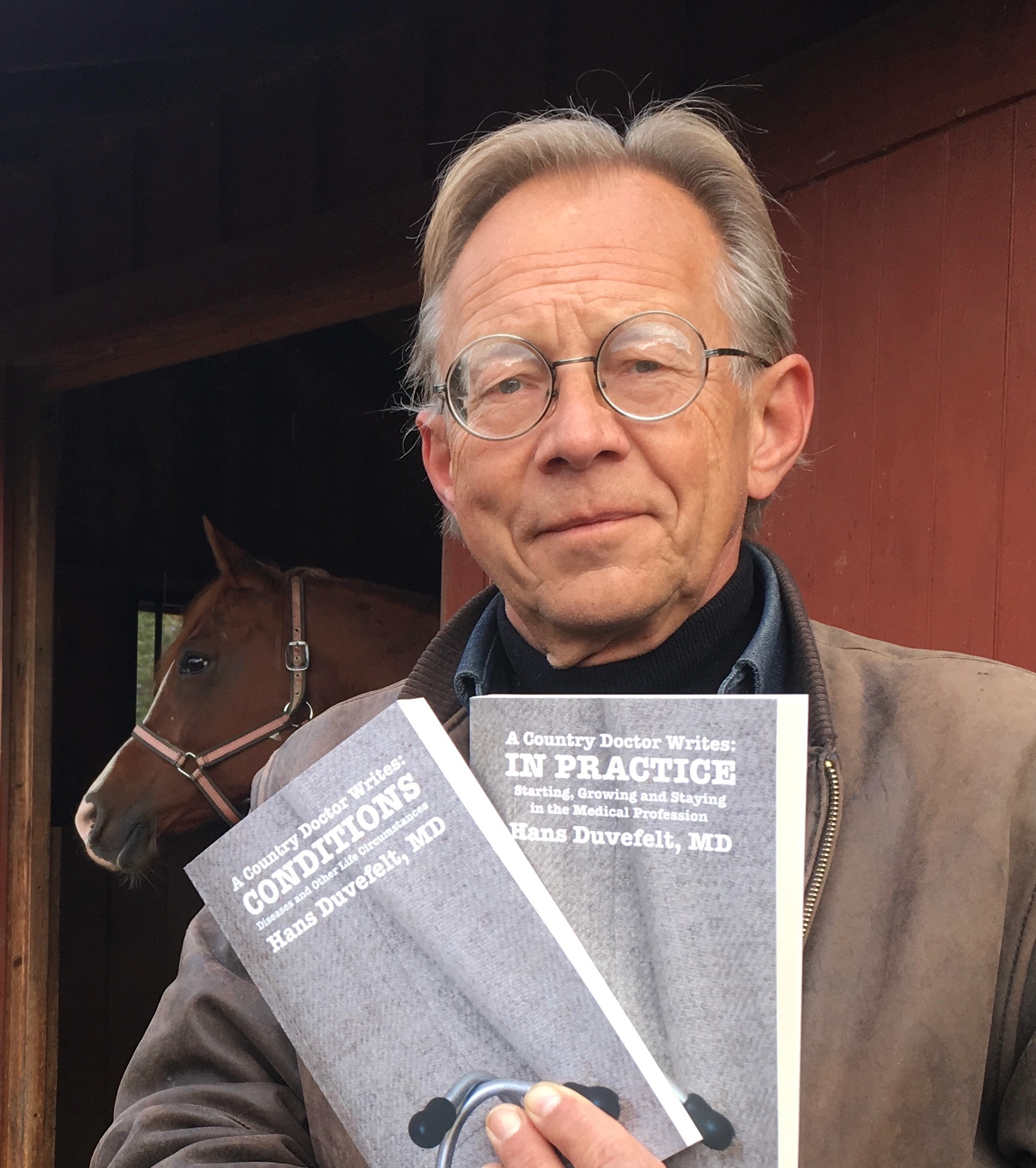
BOOKS BY HANS DUVEFELT, MD

CONDITIONS, Chapter 1: An Old, New Diagnosis

Top 25 Doctor Blogs Award

Doctor Blogs

Enter your email address to subscribe to this blog and receive notifications of new posts by email.

Mailbox

contact @ acountrydoctorwrites.com
Bookmark and Share
© A Country Doctor Writes, LLC 2008-2022 Unauthorized use and/or duplication of this material without express and written permission is strictly prohibited. Excerpts and links may be used, provided that full and clear credit is given.