Archive Page 29

Why My EMR Report Card Contains Mostly Metadata

I graduated near the top of my class from the second oldest university in the world, and one of the best medical schools on the planet. I have 44 years of post graduate experience in a part of the United States, where there is a severe lack of specialists and where a small cadre of primary care doctors see more and do more than in many other parts of this country.

If and when I look at my personal report card in my new Epic EMR I find that I am average or worse. What that means is that I’m not real quick in responding to routine messages and other such things.

I almost get the feeling that clinical competency in primary care doctors is so much taken for granted and so commoditized that the only thing that matters is how fast we are at getting patients out the door and clerical tasks completed.

Metadata, as I call the majority of items in my EMR report card, is the typically invisible information on a CD, for example: Recording date, copyright holder, maybe the album cover photo for displaying on your device. But imagine if this was all you got, if the piece of music wasn’t there. That’s what it feels like sometimes in primary care: The clinical work we do is invisible while the metadata blocks the view of what really matters.

Would you pick a brain surgeon, if you needed one, based on their speed in the operating room or at the computer? I suspect neither.

There are a few clinical measures also in these report cards, but they are set as if they are absolute, immutable laws. And do they really reflect the quality of our care?

Quality measures in medicine are basically substitutes for the real information we wish we had.

We measure surrogate outcomes, like hemoglobin A1c and blood pressures. But the person with perfect numbers could suffer a fall one day from hypoglycemia or hypotension and break a hip. The diabetic could get urosepsis from their Jardiance pill that causes them to excrete more glucose in their urine. And the perfect blood pressure person could develop kidney failure or a life threatening arrhythmia from spironolactone or valsartan, or lupus from their hydralazine. In studies, such things are tracked and judgements are made that, for a majority of patients, the benefit of a particular treatment outweighs the risk. But, in practice, we don’t know who they are. If our patient is almost “at target” and the next drug we add could be the one that will harm that particular patient, is it worth doing? Polypharmacy is a dirty word some of the time, except when patients have several medical problems and are supposed to meet several numeric targets.

There is nothing in my report card about whether my diagnoses are correct, whether my workups are appropriate, whether my patients trust me or even like me, and what my clinical batting average is when it comes to actual outcomes.

Medicine is full of decisions, judgement calls, that should be made together by physicians and informed patients. The word patient-centered has become meaningless, because doctors who let their patients in on clinical decisions and respect their refusal to do certain tests risk getting bad quality scores.

Practicing at the Top of Your License is Not an Option for Primary Care Physicians

Originally posted on my Substack.

https://open.substack.com/pub/acdw/p/practicing-at-the-top-of-your-license?r=254ice&utm_medium=ios&utm_campaign=post

You don’t really need a medical degree to know how to follow an immunization schedule, to recommend a colonoscopy, or order a screening mammogram (as long as, in this country, there is a standing order – in some places, mass screenings are done outside the primary care system).

You also don’t really need a medical degree to enter data into an EMR.

And when you decide to order a test, how many of the EMR “workflow” steps really require your expertise? I mean, borrowing from my iPhone, you could say “order a CBC” and facial recognition could document that you are the ordering physician. Really!

And you don’t really need a medical degree to, as I put it, open and sort the (electronic) mail; an eye doctor’s report comes in and if the patient is a diabetic, I have to forward it to my nurse for logging, and if not a diabetic, just sign off on it. And don’t imagine there is time in our day, evening or weekend to actually read the whole report. Patient A saw their eye doctor – check. Next…

Primary care in this country is pathetically arcane and inefficient. And we have a shortage of primary care physicians, they say. If we could all practice at the top of our license, perhaps not. It’s time to reimagine, reinvent, reinvigorate!

A Blast from the Past in My Blog Stats:

It is always interesting to see how old pieces suddenly show up in the stats.
Today, a 2012 piece, published around the time my clinic adopted its first EMR, suddenly got a dozen views. Rereading it, and being reminded of the old days, I felt a twang of nostalgia:

The Art of the Referral Letter

One of the journals I skimmed through this weekend had a piece about Meaningful Use, which is Newspeak for what electronic medical records need to do in order to satisfy Federal requirements.
One of the requirements we must satisfy in the next round of Meaningful Use is to “send summary of care records in certain referral and transition of care situations”.
The Archives of Internal Medicine reported a year ago that 70% of primary care physicians claimed to inform specialists of patients’ medical history and the reason for consultation, while only about 35% of specialists reported to be getting this information.
I remember the eloquent referral letters I used to dictate years ago, when the administrative burden of a rural family practitioner was a fraction of what it is now:
“Dear Mike,
This is to introduce Mary Calderon, a 53-year-old Gravida 3, Para 2 with a BMI of 30 and a recent onset of postmenopausal bleeding 18 months after a seemingly normal menopause. Her ultrasound shows endometrial thickening….”
“Dear Ned,
Thanks for seeing Bella Beaupre, an otherwise healthy 68-yar-old with six months of migratory polyarthralgias and an inconsistent laboratory profile. Clinically, she appears to have new onset of Rheumatoid Arthritis, but I would appreciate your help….”
After each consult, there would be an elegantly worded, impeccably typed letter on deliciously thick linen stationery, blue from Mike, cream colored from Ned, running a page or possibly two, signed with flair in ink with each one’s favorite fountain pen.
Just as my referral letter would state whether I wanted my specialist colleague to see the patient for a consultation so I could take it from there or simply take over and manage the patient, the consultation report would succinctly outline their thoughts and proposed treatment plan.
A few years ago, Mike’s group adopted an EMR and the two-page reports on blue linen stationery were replaced by five-page boilerplate reports that all tended to look very similar, to the point of making it hard to see what Mike really thought of the problem I had referred to him. The reports, even though he is a specialist, had smoking status, last pneumonia vaccination and all kinds of “primary care” information. Because Mike never learned to type worth a darn, his thoughts about each case I sent him were often reduced to just a line or two somewhere in the middle of each report.
My own referral letters have also lost some of their flair over the years. Instead of thoroughly summarizing each patient’s past medical history, somewhere along the line I started to focus on the problem for which I was referring the patient. I would have a catch phrase somewhat like “please see enclosed records for additional background information”. It was less satisfying, but it seemed there was never quite enough time to dictate one of those old, delicious doctor-to-doctor notes.
Now, with my own transition to electronic records, I can’t just pick up my handheld recorder and dictate a referral letter anymore. Anything written is the product of my own point-and-click or hunt-and-peck. By necessity, I now type a brief, yet to-the-point paragraph at the end of the office note about why I am requesting a consultation for my patient. It doesn’t say “Dear Mike” or “Dear Ned” anymore, and, just like Mike’s and Ned’s office notes, it has a lot of information that looks the same from patient to patient and visit to visit. But, after all, smoking status as a vital sign and all those other items are necessary to meet our current “Meaningful Use” requirements.
I haven’t asked either one of my colleagues how they feel about my referrals these days.
I, for one, really miss Mike’s thick, blue stationery and his wisely worded reports that always taught me something new or confirmed my own thoughts, signed with that broad nib fountain pen of his.
That was Meaningful Use, too.

Bucksport Recovery Community

Bucksport Regional Health Center, where I used to be Medical Director, has a “Friends and Family” support group for family members of our patients in opiate recovery. On Friday March 24, 6-8 pm, we will host a meeting for anyone interested in understanding or helping a loved one who is in or could use a Suboxone program like ours. Our remote main speaker, Dr. Paul Updike, pain and addiction specialist in Buffalo, N.Y., is an adviser to our program and helped start our “Friends and Family” group, which meets every two weeks in person and via Zoom. If you can’t attend our informational meeting in person, here’s the link:

Join Zoom Meeting 3/24 @ 6 pm

https://us02web.zoom.us/j/81788535330?pwd=MDh6dHlaSGJJVjNMSjhkRFNQWDBnQT09

I Love Explaining Medical Things

A lot of people don’t know much about how the body works. One of my jobs as a physician is to explain how things work in order to empower my patient to choose how to deal with it when the body isn’t working right.

On my blog I have written about this many times, for example in the 2010 post GUY TALK:

Guy Talk

One of the first challenges I faced as a foreign doctor from an urban background practicing in a small town in this country was finding the right way to explain medical issues to my male patients. They were farmers and fishermen without much experience with illness, medications or medical procedures. Most of them came to see me reluctantly at their wives’ insistence.

Gradually, I found my voice and a style that has served me well over the years. As a Boy Scout and grandson of a farmer with more than an average interest in automobiles, I have found enough analogies from my own experience to be able to cross the cultural barriers I have encountered in my new homeland.

I may explain risk aversion by talking about why some men wear both a belt and suspenders. Heart attacks and angina are, obviously, related to plugged fuel lines. Beta blocker therapy is similar to shifting your manual transmission into fifth gear. Sudden discontinuation of beta blocker therapy is like releasing an inadvertently engaged emergency brake while driving with your gas pedal fully depressed. Untreated hypertension is like driving down the highway in third gear, and orthostatic hypotension is a lot like getting poor water pressure in an attic apartment.

Other, perhaps less obvious, analogies I have perfected over the years include the following:

Finasteride to slow progression of benign prostatic hypertrophy:

You buy a new car and the dealer sells you a rust proofing job. Five years later, your car is rust free. Is it because you paid extra for the rust proofing, or would the car have been OK anyway?

Why carotid artery stenosis up to 80% can be asymptomatic:

If you water your plants with a garden hose and compress the hose by 80%, the water will actually squirt faster and further than if you just stand there with a soft grip on the hose.

What to do when a test result and your judgment conflict:

When the terrain and the map disagree, follow the terrain.

Why some people with high cholesterol escape heart disease while others get more atherosclerosis than expected because of inflammation, as measured by C-reactive protein (CRP):

Some people’s arteries are like Teflon, nothing sticks, and other people’s arteries are like a scratched-up aluminum pan, everything sticks to the bottom.

Why skipping just one dose of your antihistamine can cause a major allergy flare-up:

If your townspeople are trying to discourage out-of-towners from stopping in and causing trouble at your local hangout and your strategy is to make the place look filled to capacity, be sure you get there as soon as they open, and don’t you all take a break at the same time, or the place will look empty and they’ll be sure to stop in.

Why some people can take an antibiotic several times before they get a rash from it:

Just because your neighbor’s pit bull doesn’t bite you the first time you see it, do you really know it won’t bite you the second time?

Our job as doctors is to meet our patients “where they’re at”, as people say around here. That’s not the English I learned in school, just like the explanations and analogies I use with my patients aren’t exactly the ones I learned at Europe’s second oldest university. But all the book knowledge in the world won’t help you be a better doctor if people don’t like or understand the way you speak.

Today, a nurse I work with at the nursing home gave me the nicest compliment. Her husband had, reluctantly, been in to see me a few weeks ago. She told me that her husband thought that now, for the first time ever, he had a doctor he could talk to – one that talked the way he did and laid things out plain and simple without putting on airs or making things complicated.

Comments like that always make my day, just like hearing that people forget I am a foreigner and “from away”.

Two years ago I made a bunch of videos where I explain medical things. I’m gearing up to do that again and I would love to hear if my readers have topics they would want me to cover. I welcome comments and ideas.


I just realized none of the posts show on an iPad or a computer, but they do show on an iPhone. WordPress is working on this. In the meantime, please visit my Substack.


Osler said “Listen to your patient, he is telling you the diagnosis”. Duvefelt says “Listen to your patient, he is telling you what kind of doctor he needs you to be”.


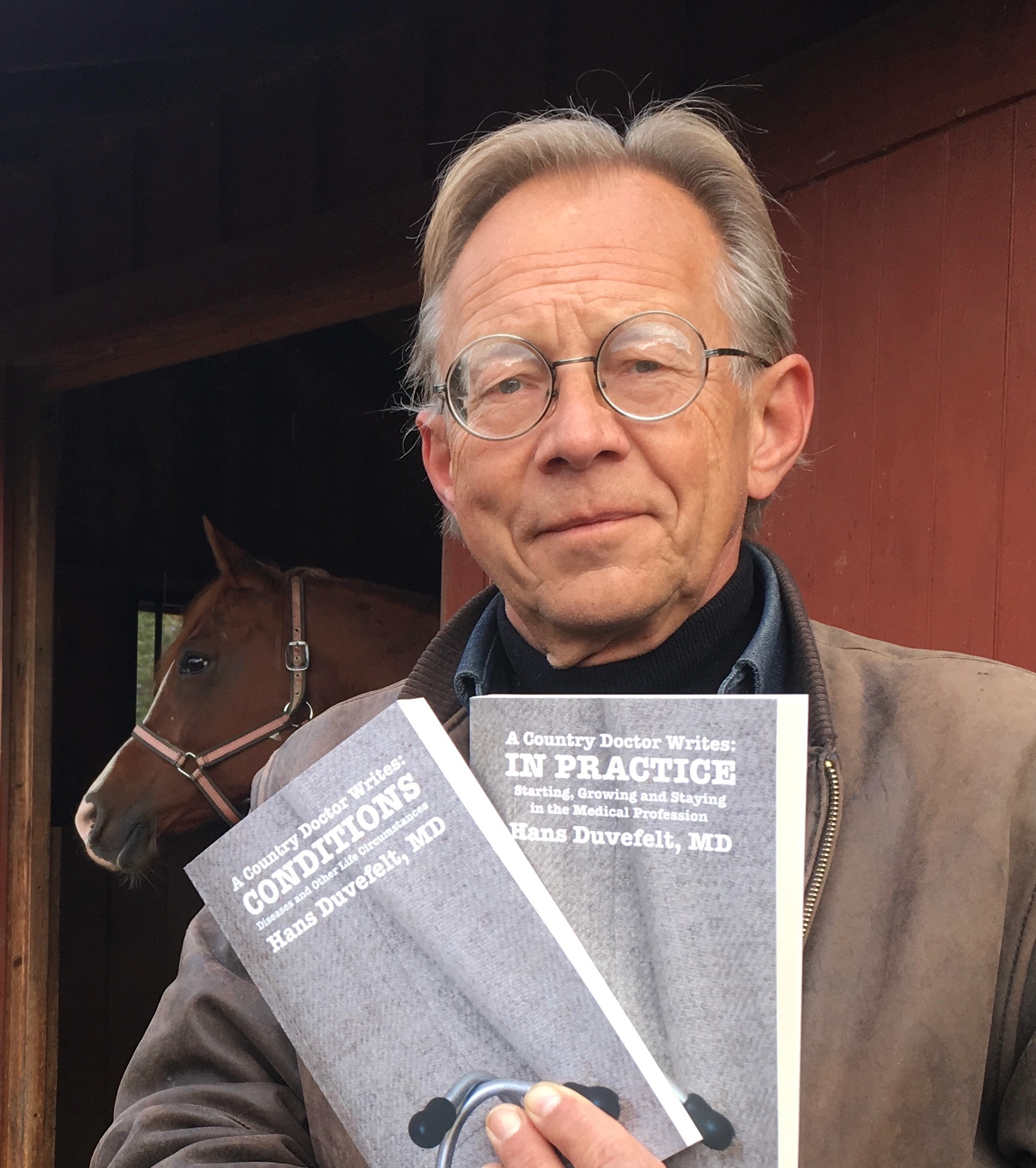
BOOKS BY HANS DUVEFELT, MD

CONDITIONS, Chapter 1: An Old, New Diagnosis

Top 25 Doctor Blogs Award

Doctor Blogs

Enter your email address to subscribe to this blog and receive notifications of new posts by email.

Mailbox

contact @ acountrydoctorwrites.com
Bookmark and Share
© A Country Doctor Writes, LLC 2008-2022 Unauthorized use and/or duplication of this material without express and written permission is strictly prohibited. Excerpts and links may be used, provided that full and clear credit is given.