Archive Page 25

Truthfully, the Physician Shortage Doesn’t Exist!

Conclusion: For every hour physicians provide direct clinical face time to patients, nearly 2 additional hours is spent on EHR and desk work within the clinic day. Outside office hours, physicians spend another 1 to 2 hours of personal time each night doing additional computer and other clerical work. (Sinsky et al, 2016)

If we only had the tools and the administrative support that just about every one of us has been asking for, there wouldn’t be a doctor shortage.

The quote here is from 7 years ago and things have gotten even worse since then.

Major league baseball players don’t handle the scoring and the statistics of their games. They just play ball.

Somehow, when the practice of medicine became a corporate and government business, more data was needed in order to measure productivity and quality (or at least compliance with guidelines). And somehow, for reasons I don’t completely understand and most definitely don’t agree with, the doctors were asked not only to continue treating our patients, but also to more than double our workload by documenting more things than we ourselves actually needed in order to care for our patients. Even though we were therefore becoming data collectors for research, public health and public policy, we were not given either the tools or the time to make this possible – at least not without shortchanging our patients or burning ourselves out.

We didn’t sign up to do all this, we signed up to care for our patients. And we were given awkward tools to work with that in many ways have made it harder to document and share with our colleagues what our clinical impressions and thinking are.

It takes a lot of years to become a doctor, and sometimes many more years to become a good one. I don’t know whose harebrained idea it was to require us to do all the data entry to serve those other purposes that were never part of practicing medicine before. It has been said that seeing two more patients per day will pay for an assistant/scribe or whatever is needed.

So… Why is this not happening? In my own personal experience, we survived 15 minute visits with a previous EMR. With our new one (Epic, the probable industry leader), that is simply not possible. What’s wrong with this picture?

With clerical support, there wouldn’t be a doctor shortage and the burnout epidemic would not have the proportions it now has.

Let the doctors do the doctoring and leave the bookkeeping to someone else, at least until the EMR technology catches up and speeds us up instead of slowing us down!

The Official Medical Websites are Sometimes Less Informative than Dr. Google

I have a patient who lives in a house with black mold. He had modest symptoms but wanted to know if they were related to the mold in his home.

I cultured his nose and some skin lesions he had. The skin scrapings showed nothing, but the nasal culture showed growth of penicillium.

Up-to-date, which I spend $500 a year of my own money on, is usually a reliable source of medical information. They stated that people with systemic penicillium infection have a 97% mortality rate or something crazy like that. There was no comment on what to do if you find it in a nasal culture. My patient is feeling fine. He did his own Internet search and came to the conclusion that penicillium is one of the common black molds. A regular Google search tells you that penicillium is harmless to people with intact immune systems.

Good thing I didn’t trust up-to-date blindly in this particular case.

I worry about over-reliance on computers (and especially not-yet-ready-for-prime-time AI) and under-reliance on common sense.

Yours Truly with GF at the 6/27 James Taylor Concert in Bangor, Maine

Words and Stories in the Practice of Medicine

(After a whole month of radio silence, I am writing here again. I have built my Substack site and I have taken care of some things in my life, most recently the task of making room for the last of my furniture from Sweden. I feel like I am starting a new chapter of my life in a few weeks when I turn 70, still hard at work doing what I set out to do at age four, but looking at it a little differently.)

This week’s JAMA has an essay in its series, A Piece of My Mind, titled The Stories We Tell Ourselves. The author, palliative care physician Danielle Chammas, MD, writes about the importance of the words we choose when we speak and our task as physicians to help our patients view their circumstances in the best possible light and to rewrite their stories.

She Writes:

Stories allow for the integration of loss, fear, and suffering into one’s life. They become the vehicle through which clinicians can help patients redefine what it is they are hoping for (rather than lose touch with hope all together).

Is somebody a patient, a victim, a survivor, a burden? What does it mean to be a fighter? To do everything? Did we give up on a loved one, or did we honor their dignity? Did we choose to not resuscitate, or did we choose to allow a natural death? Whether intentional or not, clinicians are often an important source of vocabulary that these writers draw from. With each choice of words, clinicians affect narratives, and some words wield particular power. Just, for example, has the power to diminish. How boxed in does one feel when their identity slips into just a patient, just a diagnosis; when hospice becomes just about dying rather than living one’s final days to the fullest?

Dr. Chammas’ essay touches at the essence of being a healer. Our duty as clinicians is not only to treat the disease but also the patient — to ease suffering and help our patients move beyond the present, to wherever their abilities and circumstances allow them to go. We don’t “get over” losses, be that the death of a loved one or the loss of our own health or abilities, we will always remember and live with our losses. We must integrate them in a way that somehow makes sense in order to be able to carry on. This really sank in with me when I attended a Harvard course in the Catskills titled The shadow of the Object, which I blogged about back in 2009:

The title of the course was “The Shadow of the Object”, which is a quote from an enigmatic passage in “Mourning and Melancholia” by Freud. It was held in an old, slightly run-down family resort in the Catskills in upstate New York, very similar to the setting of the movie “Dirty Dancing”. In its heyday, this resort was a summer haven for middle class families from New York City – a chance to experience nature and participate in organized activities while mingling with people of their own kind.

The central idea of the conference was that we never “get over” loss or trauma – we just have to find ways to carry it with us in a fashion that makes sense for us. It is a simple notion, but it has profoundly affected how I have counseled patients from that moment on. There is such a tendency in our society to focus on the “positive”, to downplay the importance of sadness in a healthy and balanced life.

One particular thought we brought with us from “The Shadow of the Object” is the concept of moving through grief by finding ways to honor the legacy of the lost loved one. I have found that to be one of the most healing things you can teach those left behind after someone they respect and love passes away.

Helping patients rewrite their stories, which don’t have to be written, I just mean how they explain things to themselves (and perhaps others), is a big task that can take time over several encounters. But choosing our own words very carefully is something we do, or should do, in every visit, every day.

I wrote about this, too, in 2009:

The Power of Words

Of Mites and Men

Lately. I’ve had several patients come in with itching and rashes and reports of feeling and seeing parasites. All of them swear they’re not doing methamphetamine, which is notorious for causing delusional parasitosis.

Most people know about head lice, pubic lice, scabies and bed bugs, maybe even chiggers. A few search the web and know of other conditions, like Morgellons (whatever they really are) and demodex, which is a much more common mite than I would have guessed.

I’m trying to formulate a strategy for helping those who know more and will not accept the possibility that they just have dry, itchy skin. But, I’m thinking I might just make them worse if I tell them what my own research is telling me.

I think I’ll have to start with a reminder about everybody’s intestinal flora, our biome. There are many trillions of organisms living inside us.

Obviously, the bacteria in our intestines help us digest our food. We couldn’t live without them. Minor troubles caused by them might be our moods and appetite or cravings. Major troubles from unwanted intestinal bacteria includes diarrhea and death from dysentery or clostridium difficile.

Having said that, I guess I’ll go on to say that a lot of people have mites, but they’re too small to be what they’re seeing. And when it comes to some mites, they’re impossible to eradicate.

Demodex, also called face mites, live in our hair follicles and some sources say most people have them. Usually they cause no trouble. They may have a role in skin conditions like blepharitis, conjunctivitis, chalazions and also rosacea, sometimes referred to as adult acne. Treatment, when someone has many of these mites and bothersome symptoms, is usually only topical. Cliradex may be the best one but ordinary Tea Tree Oil, which it is derived from, is also effective.

As I’ve been reading up on face mites, I haven’t come across anything good they do for us. So I think I may be speaking for most of us when I say that I’m grateful for my intestinal flora for helping me get the nutrition out of the food I eat. And, those bacteria are, well, in my gut and not in my face, which is where my demodex freeloaders are literally hanging out.


I just realized none of the posts show on an iPad or a computer, but they do show on an iPhone. WordPress is working on this. In the meantime, please visit my Substack.


Osler said “Listen to your patient, he is telling you the diagnosis”. Duvefelt says “Listen to your patient, he is telling you what kind of doctor he needs you to be”.


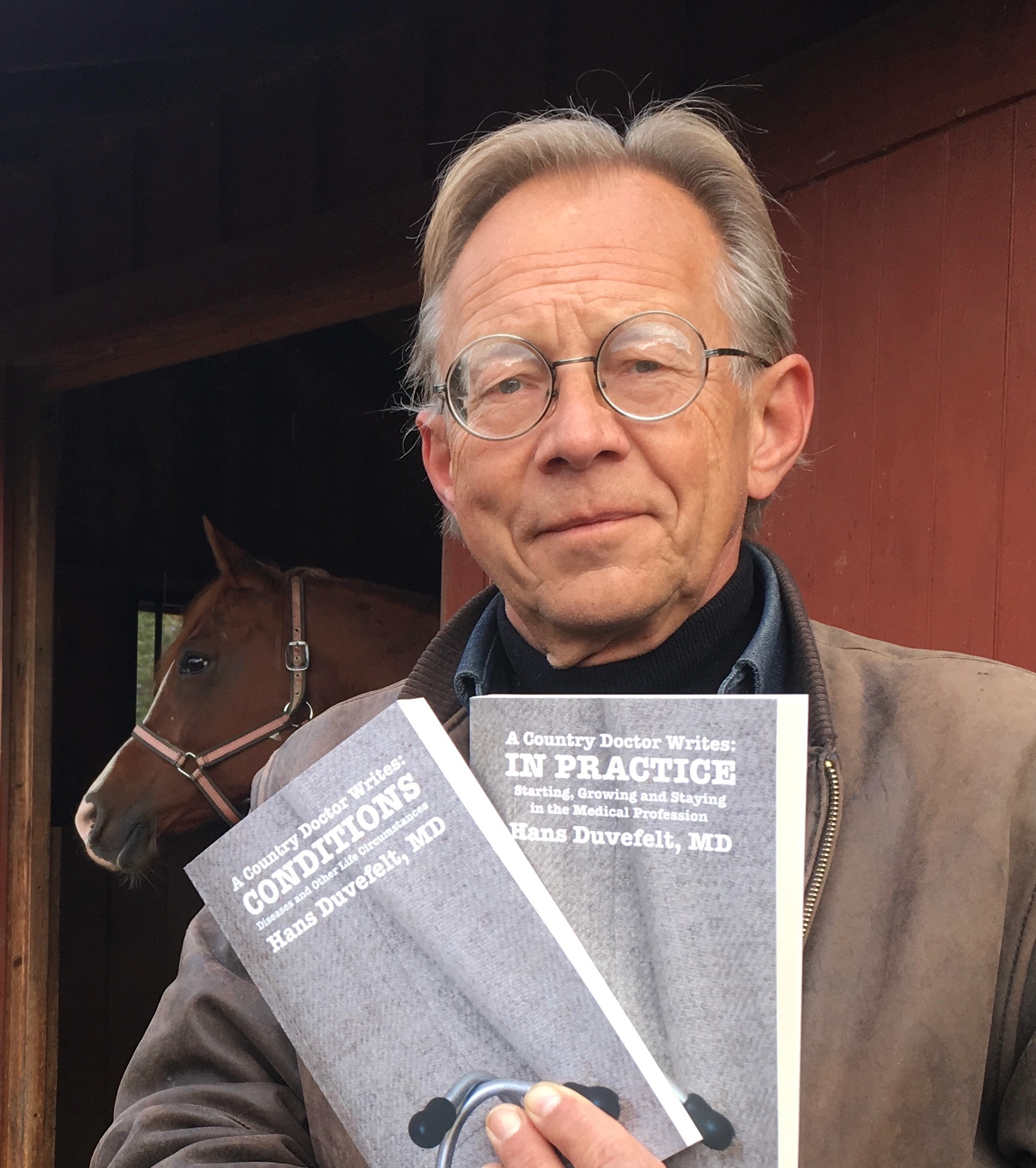
BOOKS BY HANS DUVEFELT, MD

CONDITIONS, Chapter 1: An Old, New Diagnosis

Top 25 Doctor Blogs Award

Doctor Blogs

Enter your email address to subscribe to this blog and receive notifications of new posts by email.

Mailbox

contact @ acountrydoctorwrites.com
Bookmark and Share
© A Country Doctor Writes, LLC 2008-2022 Unauthorized use and/or duplication of this material without express and written permission is strictly prohibited. Excerpts and links may be used, provided that full and clear credit is given.