Archive Page 215

Chocolate – Good or Bad?

My sister-in-law makes chocolate. She and her husband, my wife’s younger brother, make chocolate in a small house and café at the end of a dirt road on an island off the coast of Maine. Kate writes a blog about chocolate, and she has linked her blog to mine.

How do I handle this? Do I want to be associated with chocolate – isn’t it bad for you? 

Chocolate, or cocoa, was first found around 2000 BC in the Amazon, was used by the Mayas and the Azteks, and brought to Spain in small amounts by Columbus, who didn’t see much value in it, even though it was used as currency in South America. 

During Louis XIV’s reign, cocoa was viewed as an aphrodisiac. We now know cocoa contains phenylethylamine, PEA, which is associated with euphoria. Curiously, pickled herring contains more PEA than chocolate. (Did I mention I’m Swedish?)

Actually, there is a growing body of evidence about the real health benefits of cocoa and dark chocolate:

It contains flavonols, powerful antioxidants; dark chocolate has more antioxidant power than blueberries. 40 grams of dark chocolate is comparable to a glass of red wine. 

Dark chocolate contains stearic acid, a neutral type of fat, which does not raise levels of harmful LDL; it contains mono-unsaturated oleic acid, which raises levels of the good HDL cholesterol.

Cocoa has blood thinning and circulation enhancing properties similar to aspirin, and it has mild antibacterial properties. It has been said that people who eat chocolate regularly live a year longer!

So, I have no problem being associated with the making and eating of chocolate; we often get samples, and we eat them without guilt. I’ll even link back to Kate’s blog!      http://blackdinah.wordpress.com/

Caleb, Our Horse with a Limp

Caleb is nineteen years old, but very youthful. He is an Arab gelding, and from what I understand, Arabs are more compact than most horses and very intelligent. Apparently they used to sleep in their owners’ tents in the desert, and they were used to guard the tents as well as for transportation. Emma has owned him since he was born; her face was the first thing he saw. She rode him until he was nine. Then, when her career and marriage to a man without much acreage got in the way, she boarded Caleb at a farm six miles from here. For many years, Caleb was used in their riding school, but he was retired a couple of years ago when, for some reason, he developed a limp.

Now we have moved him to a place less than two miles from our house. We can see him twice a day, and we have started to think about what he might do next. He may be rehabilitable; an expert veterinarian will see him next week. But even if he cannot be ridden again, he might find a career as a therapy horse of some kind. We have read about horses used as therapy animals for children with autism or ADHD. It is obvious to us that Caleb is not ready to retire completely. He needs a job. He is so full of it, that already after a couple of days in his new home, he tossed toys our from his stall, and one day he ran around the yard with a piece of plastic that the wind had carried from the lumberyard across the street.

Emma has collected a couple of books on clicker training, which is being used for dolphins and many other animals. Our puppy, Moses, had some clicker training, but got a little too wound up by it. It does sound like an interesting option for the horse, though. Clicker training is based on rewards that are linked to the clicking of a small hand held device. This sound allows you to control the behavior of an animal across a distance.

One exercise we did in Moses’ puppy class involved one dog owner clicking when another dog owner did the right thing. The subject didn’t know what the desired behavior was – to sit down on the floor.

I happened to be the leader. When the subject looked at the floor, I clicked. She looked at the floor again. I clicked. She stretched her hand out toward the floor, and I clicked. She reached toward the floor and bent her knees; I clicked, and so on, until she sat down on the floor.

As I write this, Emma is reading a book that came in the mail today from amazon.com about a full blood horse with symptoms a lot like Caleb’s, who was clicker trained, and as a result became more or less rehabilitated.

All of this reminds me of Clarine, a patient who came to mean a lot to Emma and me; she married us. Clarine was bed bound for the last several years of her life. She was an English teacher, writing coach, editor, writer and an ordained minister. Even though she lost many of her physical abilities, she lived a rich life, in part because of the power of the computer at her bedside and the internet. People have a tendency to view physical handicaps as bigger and more insurmountable than they need to be. If Clarine could write and edit books from her bed in our little village, I am sure Caleb can find a new purpose in his life.


My Nurse’s Mother

My office nurse, Autumn, is a sweet kid, not much older than my own daughter. She grew up right here, and most of my patients know her from when she was little. The head nurse at our clinic gave Autumn her baby shots, and one time Autumn bit her afterwards. Now Autumn has her own two year old, so life is getting back at her.

Autumn has a way of making patients feel comfortable that I feel is a real gift. She’s still green in some respects, only a few years out of school, but she makes up for it with her great personality, her sense of who she is, and her knowledge of everyone in our community. After twenty-three years, I’m still figuring out who’s related to whom. Autumn already knows, because she’s related in some way to most of them.

The other day I ran into a patient who wasn’t at all feeling comfortable having Autumn check her in – her own mother, Brenda. Until recently, Brenda had been seeing another doctor in the area, who retired a few months ago. Brenda chose me to take over her care, knowing full well she’d have to deal with her daughter in her capacity as a nurse, instead of as her daughter.

Brenda and Autumn are very close, I can tell from the way Autumn talks about her. When Brenda was diagnosed with cancer a few years ago, Autumn was right there for her, and I overlooked the personal phone calls and the glassy eyed stare – I remember my own mother’s breast cancer scare when I was in medical school.

This closeness between mother and daughter turned out to be a problem the other day. Because Brenda has had some heart problems, her blood pressure has to be tightly controlled. I knew from her old records that she hadn’t been out of range for a long time, but the first day I saw her Autumn recorded a near-panic value for her mother’s blood pressure. Ten minutes later I recorded something more in the less than ideal range. Brenda had the answer; ever since her cancer, Autumn’s concern for her mother’s health has made Brenda in turn worry about her daughter’s reactions. If Brenda doesn’t take perfect care of herself, Autumn is all over her with worry. Suddenly, I have two new patients instead of one.

Sure enough, today I had Brenda stop in for a blood pressure check by another nurse, and it was normal!

A Cobbler’s Mistake

I saw Billy G. yesterday afternoon on his way home from work. He was thrilled to be back to work again. A cobbler’s mistake cost Billy two weeks’ pay, and it could have cost him his foot.

Billy has had diabetes since he was a teenager, and he has such severe diabetic neuropathy (nerve damage) that he has no feeling at all in his feet. He needs special diabetic shoes, which his insurance company will only replace every several years. They will help him pay to have his work boots re-soled, however, and this got done a month or so ago. Our local cobbler did the job for him while he waited. Billy didn’t notice that a week after he got the boots back, the nails used to attach the new soles started to work their way through the sole of his left work boot and the sole of his left foot. 

Billy’s wife, Theresa, checks his feet for him every night because he isn’t quite limber enough to see the bottoms of his feet; some people use a mirror in order to see their feet better, but Billy’s diabetes has affected his eyesight too much for him to do the job himself. If Theresa hadn’t spotted the wound the first day, who knows what could have happened to Billy’s foot. It took two weeks to heal the damage, two weeks without a paycheck, and two weeks of worrying.

Billy went back to the cobbler and told him what happened. Theresa had told me “I suppose we could have sued him, but we just wanted him to know so nobody else got hurt like Billy”. 

Theresa does one more thing for Billy every day now: Every morning, she checks the inside of his work boots for nails before he puts them on. Then, as she has had to since he started to lose the feeling in his fingertips, she ties his boots for him, and she makes sure they’re not tied too tight.

Billy can’t feel pain in his feet, but I know he can feel the love in the countless little things Theresa does so that the two of them can carry on day after day.

New Doctors: Too Few, Too Many or Too Late?

There are too many doctors in the U.S according to Dartmouth’s Goodman and Fishers commentary of the Association of American Medical Colleges’ Center for Workforce Studies report. The AAMC recently made the proud announcement that 85% of medical schools have or are in the process of increasing first year medical school student enrollment by a total of 30% by 2015. In my view, the real issue here isn’t quantity at all.

This country already has just about the world’s highest ratio of doctors per capita. As a group, U.S. physicians deliver more expensive care with no better outcomes than our colleagues in other countries. American patients are not going overseas for elective surgery because they don’t have access to surgeons here – they fly halfway around the world at their insurance companies’ expense to save money. Now, if the strategy behind increasing physician supply is to drive health care costs (read: doctor salaries) down, it might make more sense, but I believe that even if physician reimbursement is ratcheted down even more, prices will have a way of staying up there anyway because of the tremendous overhead in health care.

There are enough studies showing that greater physician supply, particularly at the specialist level, correlates more with increased cost than improved quality. And where do most medical school graduates today end up? They choose specialties with higher incomes and better  life styles than Primary Care offers in today’s climate. Right now our little community is trying to recruit one or two new Family Physicians, so I know first hand how few new graduates want my kind of job. At the same time, I read advertisements in the City paper, where Family Doctors are offering laser skin jobs (for cash) instead of accepting new Primary Care patients – and they certainly don’t do house calls. Yes, house calls are good medicine and they can save health care dollars! We have plenty of examples in our community of elderly, homebound people we have kept out of the hospital with the help of weekly or biweekly home visits. One Emergency Room visit via ambulance costs more than a dozen house calls!

One of the hot topics in medicine, Primary Care and Health Care Policy these days is “The (Advanced) Medical Home”, which basically means having a technologically astute old-fashioned Family Doctor, who keeps track of your whole medical situation, actually reads your different specialists’ reports, and makes everything happen. If all of us working in primary care don’t claim the authority that goes with this concept, health care will continue to fragment and become more and more inefficient. In my practice I see patients every week who have been discharged after a very brief hospitalization, with lots of loose ends that I have to pull together in order to keep the patient safe. Only if I have the time and resources to do this well will the hospitalization have been worth the time and money it cost.

What will the first year medical students of 2015 have to look forward to when they graduate from their residencies in 2022 or 2023, especially if nothing is done to strengthen Primary Care? They may have hopped on the band wagon too late to find the destination they expected, particularly in the shortage area of Primary care. By then we may have a lot more clinics within drug stores staffed by Nurse Practitioners and Physician Assistants, pharmacists may be prescribing for common ailments, psychologists will be doling out Prozac®, and RN’s will deliver telemedicine services backed by off-shore corporations with Medical Directors in other time zones.

We must learn from the Europeans and not prioritize specialty care over primary care so heavily. Only then can we provide enough preventive and basic health care to affect the ultimate cost of treating the chronic diseases that now drain so many of our healthcare dollars.

So, don’t give us more specialists! Give us well trained generalists, and pay them enough to make it worth their effort to work in the small towns and Community Health Centers where the underserved patients can get their health care needs met!


I just realized none of the posts show on an iPad or a computer, but they do show on an iPhone. WordPress is working on this. In the meantime, please visit my Substack.


Osler said “Listen to your patient, he is telling you the diagnosis”. Duvefelt says “Listen to your patient, he is telling you what kind of doctor he needs you to be”.


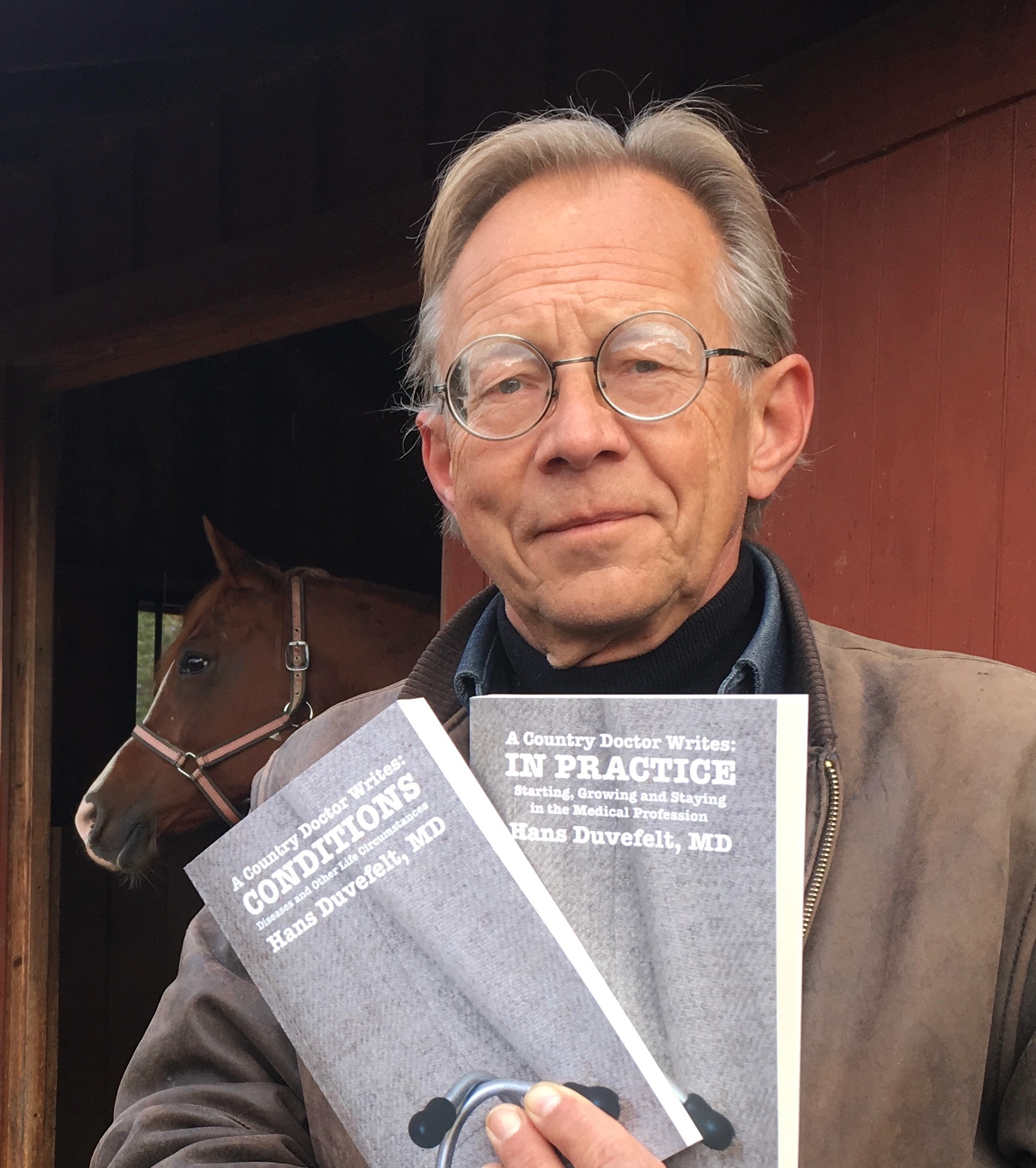
BOOKS BY HANS DUVEFELT, MD

CONDITIONS, Chapter 1: An Old, New Diagnosis

Top 25 Doctor Blogs Award

Doctor Blogs

Enter your email address to subscribe to this blog and receive notifications of new posts by email.

Mailbox

contact @ acountrydoctorwrites.com
Bookmark and Share
© A Country Doctor Writes, LLC 2008-2022 Unauthorized use and/or duplication of this material without express and written permission is strictly prohibited. Excerpts and links may be used, provided that full and clear credit is given.