Archive Page 214

Losing a Patient Twice

I had some down time in New York this past weekend and spent some of it looking at what Swedish physicians are writing in their blogs. (I am a Swedish physician, too, but I have lived most of my professional life in the U.S.)

I came across a brief little piece by a 25-year-old Swedish resident. She connected with a patient on her ward in his fifties (her father’s age), who seemed to be doing OK, but died overnight while she was off duty.

I tried to remember the first patient I lost, but I couldn’t. There have been so many in my 29 years as a doctor, some lost prematurely, but most in their old age and after a long illness.

A few months ago, a former patient who no longer lived in our town, died. He was only a few years older than my own children and the news of his death affected me deeply, even though I hadn’t seen him for years.

Bobby Smith was a normal, rambunctious, ten year-old until one day, my second winter in town, when we got a radio call from the ambulance. In those days we had all volunteer EMT’s, and none had any advanced training, so the doctors at our clinic would get called to go on ambulance runs.

It had snowed heavily that morning and school was cancelled. By noon the snowfall had stopped, and the sun came out.  Bobby went sledding right in front of his house. At first, the new powder slowed him down, but every time Bobby followed the same path down the hill he went faster and farther. The last time, he ended up in the middle of the road.

Samuel Trumbull, the town selectman, didn’t have a chance to avoid hitting Bobby as he lay on his sled in the middle of the road.

The ambulance had twenty miles to go on the winding, slippery road to the hospital. Bobby was unconscious, not breathing, but with a good pulse and blood pressure. I maintained his airway and bagged him the whole way.

He pulled through, but with severe brain damage. He never spoke again. He would make grimaces and smile or poke at you. He was bed bound and incontinent. I did house calls there for a few years. Eventually they wheeled him into his old classroom, mainstreaming him, as they called it.

His parents split up, and Bobby ended up moving away from town. I would still often think of Bobby, and poor selectman Trumbull – his life was never the same after that day, either.

Suddenly, one day this spring, a patient whose maiden name was Smith – something I never reflected on – cancelled an appointment because her brother had died. When I saw her a week later, she mentioned who her brother was. All of a sudden I was back in that ambulance, bagging this little boy, who could have been my son. I lost Bobby all over again, but this time I lost him forever.

A Country Doctor Stops In Brookline

The other night we stayed in Brookline on our way to New York.

Boston and Brookline are reference points for this country doctor. I go to Harvard courses for updated knowledge and continuing education credits, and I occasionally refer patients to specialists at Massachusetts General, The Brigham, or Mass. Eye and Ear Infirmary.

When down there, we often stay in Brookline, down the street from the Longwood medical area. There is a row of inns that offer housing for families and patients undergoing treatments at the major hospitals. We ended up there once ourselves, referred by Angell Memorial Hospital, when we took our sick dog there, first for a consult, and then for an extended period of radiation therapy.

Angell referred us to the Bertram Inn, which allows dogs (and our Persian cats). Since those first two stays, we have been back to stay at least half a dozen times.  Walking the tree lined streets just a few blocks from Beacon Street and Coolidge Corner, I feel like I am in a small town, yet minutes away by car or taxi, we can be at the Symphony or a downtown course or restaurant.

On our early morning dog walks we see residents and medical students hurrying to work with stethoscopes around their necks. There are joggers everywhere. We pass the Lown Cardiovascular Center, named after Dr. Bernard Lown, who pioneered cardioversion for atrial fibrillation. His book “The Lost Art of Healing” from a dozen years ago is a must-read for doctors, particularly now. My patient and mentor, Clarine, who told me from her sick bed to write, and who gave me Thomas Moore’s “Care of the Soul“, also gave me a copy of “The Lost Art of Healing”.

Actually, Thomas Moore himself – a humble man – has said that even titles of books you haven’t read yet can be an inspiration. We attended his seminar on Cape Cod last summer, entitled “Care of the Soul”.  We missed a day of that course because of our dog’s illness. That was the summer our dog died, and what we learned from her passing paralleled what we learned from the course.

Sometimes, just spending one night in Brookline gives me a sense that I, living and working in New England, am connected to the Boston medical community. Doing the work we do, day in and day out, especially in a rural community, can make us feel isolated. A night in Brookline is like glancing at the titles of the books on my shelf. You are quickly reminded of what’s inside and it changes you a little every time you reconnect with it.

Sally’s Dilemma

Sally is about sixty. She was widowed a couple of years ago. I usually only see her once a year for her routine physical. She and her spry eighty-four year old mother always go together for their annual mammogram.

When Sally came in for her physical a while ago, her blood pressure was up. I didn’t act on it then, but did some blood work and brought her back a few weeks later for a recheck. Her pressure was still up. I made the judgment call to pursue this further instead of just treating her pressure, and ordered an ultrasound of her kidneys with an office follow-up. A blood pressure that suddenly goes up can be a sign of an underlying problem such as poor circulation to the kidneys. We often look for “secondary hypertension” when the clinical picture isn’t typical for “essential hypertension”.

Sally’s renal ultrasound showed normal size of both kidneys, but one kidney had two suspicious areas in it, which could be either benign or malignant. The radiologist recommended a CAT scan. Sally wasn’t thrilled when I called her to let her know the results; she generally doesn’t like to have a lot of tests done, but now we had the possibility of kidney cancer versus something harmless. She agreed to the CAT scan, which required intravenous contrast.

A few days later the report came in. My heart sank. The larger of the two kidney lesions was benign looking, but the smaller one looked suspicious and was too small to completely characterize on the scan – follow-up was suggested (how soon, I wondered…). But there was more: The head of the pancreas looked a little enlarged, and the bile ducts were a hair wider than usual. A dedicated pancreas CAT scan was suggested in order to rule out pancreatic cancer.

The follow-up appointment we had scheduled at the beginning of this process was three days after the CAT scan. I looked her straight in her eyes and told her about the small suspicious area in her kidney and the suspicious looking area in her pancreas. She moved her head back in slow motion and moved her hands up toward the ceiling and said:

“You know my husband died from pancreas cancer? I watched him go from a big, strong man to nothing in five months, and his sister died from the same thing! If this could be pancreatic cancer, I don’t think I want to know!”

“And if it isn’t, wouldn’t you want to know if you have a small, curable kidney cancer?” I asked.

“I don’t know,” she said, “what would I tell my mother? I don’t know if she can handle this.”

“Would you be OK with getting an opinion from an oncology surgeon before you say no to the pancreas scan?” I asked. She agreed, reluctantly. I have a call in to Dr. G.

Sally needs more answers than I can give her right now.

Caleb Didn’t Limp Yesterday!

I had planned to write a slightly humorous post about how Caleb, our horse with a limp, has introduced me to alternative treatments, to which I, as an allopathic physician, normally don’t give much credit. However, recent clinical developments have made me write with a seriousness I had not intended.

The first veterinarian we took our horse to diagnosed bilateral knee problems. The treatment included steroid injections to both knee joints, which was costly but ineffective. Emma enlisted the help of a couple of alternative practitioners and designed a rehabilitation program, which started with Caleb walking over sticks in the indoor ring, while looking for treats we scatter all around, and now consists of him being led up and down hills and through tall grass while grazing, so he doesn’t feel like he is working.

Two days in a row Caleb walked normally, with no sign of a limp; he took out his full stride, albeit a little gingerly, with his right hind leg, and completely normally with the left one. After a while he became tired, and started to limp just a little.

Thus we know that the horse doesn’t have stiff joints, muscle contractures or permanent misalignment of his pelvis; he has sciatica. The horse chiropractor, , acupuncturist, SHEN practitioner, masseuse, the Bach Flower Essences, craniosacral therapy, yucca, glucosamine and the cautious exercise have already started helping  – physically and emotionally.

If my patients only knew…

Time’s Up!

I am very particular about time. My office visits start and end with near certainty on time, which isn’t common in my profession in this area. You might say I take pride in my punctuality. I even have a radio controlled wall clock, since it has always bothered me that different clocks in our office could be several minutes apart.

One day last week I noticed around four o’clock that my wrist watch ran late. I suspected correctly that the battery was giving out; the next morning my watch stood still.

I have three wristwatches. My everyday watch is made of a dull metal, aptly named Skagen Titanium. For more formal occasions I have a thin, Swiss watch with a black leather band. I also have a rectangular Skagen with a brown watch band for variety and matching brown shoes and belt.

My fancy watch had not been used for a while and also turned out to have stopped. Thus I picked brown clothes and the rectangular watch. Some upcoming Saturday I thought I’d take a trip in to town for two new watch batteries, but today I worked. We are open 8 – 12 on Saturdays. This afternoon I did chores around the house, and I marveled at my efficiency; I got so much done in just a couple of hours.

Then I realized suddenly that it had been three-thirty an awfully long time. Sure enough – my third wristwatch had also stopped! So Monday morning I’ll be going to work without a watch for the first time in my life.


I just realized none of the posts show on an iPad or a computer, but they do show on an iPhone. WordPress is working on this. In the meantime, please visit my Substack.


Osler said “Listen to your patient, he is telling you the diagnosis”. Duvefelt says “Listen to your patient, he is telling you what kind of doctor he needs you to be”.


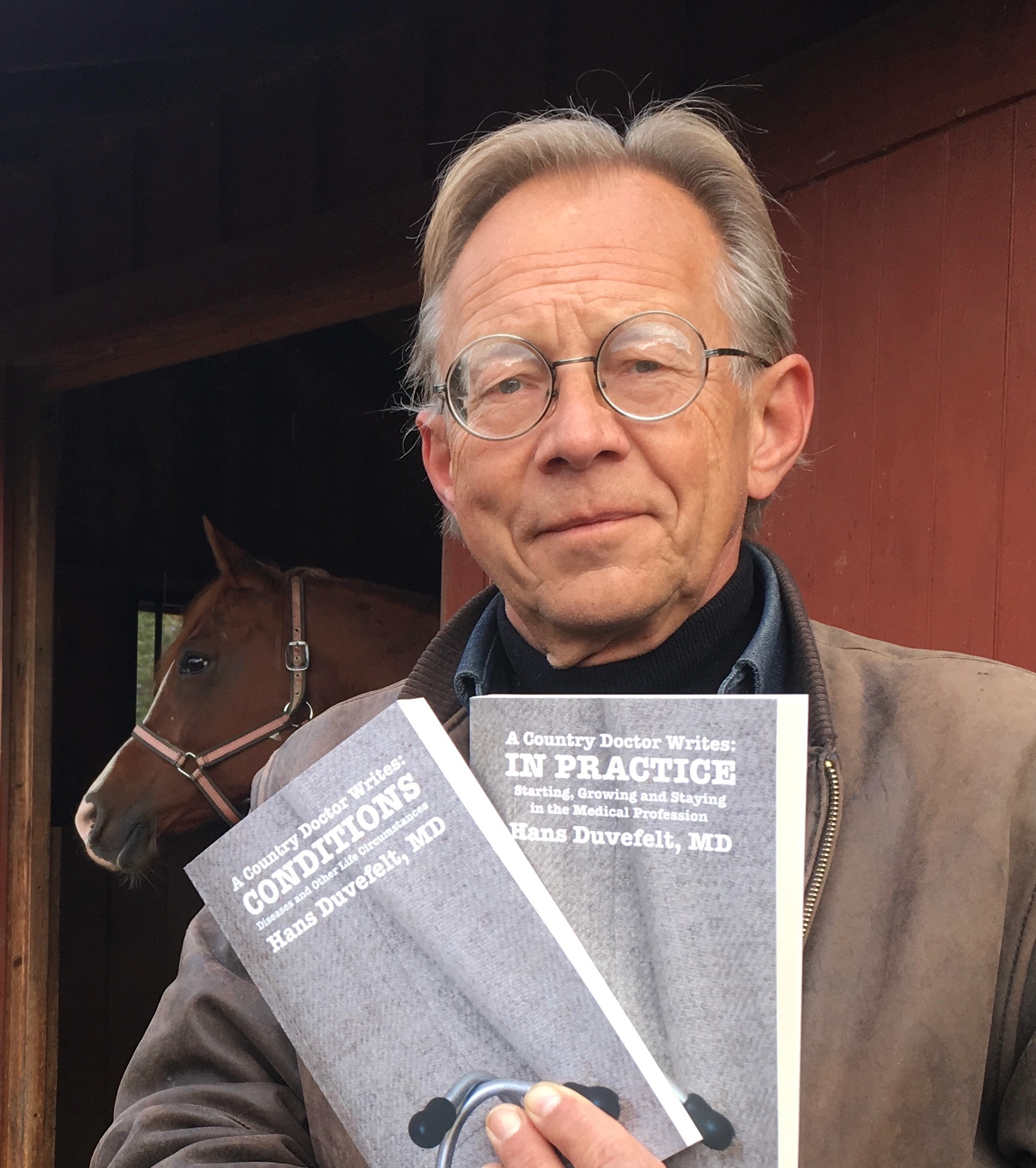
BOOKS BY HANS DUVEFELT, MD

CONDITIONS, Chapter 1: An Old, New Diagnosis

Top 25 Doctor Blogs Award

Doctor Blogs

Enter your email address to subscribe to this blog and receive notifications of new posts by email.

Mailbox

contact @ acountrydoctorwrites.com
Bookmark and Share
© A Country Doctor Writes, LLC 2008-2022 Unauthorized use and/or duplication of this material without express and written permission is strictly prohibited. Excerpts and links may be used, provided that full and clear credit is given.