Archive Page 209

A Concurring Second Opinion

My senior colleague, Dr. Wilford Brown, was waiting for me at the nurse’s station yesterday with a funny look on his face.

“Oh, Esteemed Colleague” he started, cleared his throat, and continued:
“May I bother you for a second opinion and reassurance for this patient that two capsules of doxycycline is more than adequate to protect her from Lyme disease?”

I glanced at the chart he was holding in his hand. It belonged to Laura Leonard, a very ladylike woman with a tendency to worry about bad diseases.

I agreed, and we entered her exam room together.

Mrs. Leonard showed me her ankles, which were covered with small, red dots of an unmistakeable nature: Flea bites. She preferred to think of them as tick bites, because some of them had a slight red ring around them. ” I know these are not flea bites”, she stated very firmly as I kneeled down to examine her ankles.

I explained that I grew up and trained in Sweden near where Arvid Afzelius first described Erythema Chronicum Migrans in 1909, the rash that later came to be associated with Lyme disease.

“I agree with Dr. Brown”, I said. “This is a low risk situation.” He glanced at me from the corner of the room.

“Between the appearance of these spots and the two doxycycline capsules, you can be quite sure you won’t develop Lyme disease”, I said.

She thanked me profusely, then she turned to Dr. Brown and thanked him, too, with the comment: “I didn’t question your judgement or anything…”

He looked her squarely in the eyes and answered in a serious voice but with that funny little look on his face again:

“Oh, I won’t lose any sleep over it!”

I’m sure he didn’t, either.

The Dreaded Visit with Priscilla Pye

The past two weeks have been unusually hectic. My clinic schedule has been overbooked and poor Autumn, my sleep deprived nurse-and-mother-of-an-insomniac-three-year-old, seemed to be drowning in triage telephone calls.

Priscilla Pye, a longtime patient, called our clinic six times one day. It was clear that we were not meeting her needs, and yet with every call she made, our therapeutic relationship deteriorated exponentially.

It started a few weeks ago.

Priscilla Pye is normally a very bright, articulate and self-assured woman, who has made quite a name for herself in the art world. She owns two galleries, and recently started another business promoting local craftspeople to a bigger audience.

Priscilla, over the years, has been both a fan and a critic. She has often lamented the fact that I seem so much busier now than twenty years ago. She also hasn’t had much sympathy for my choice to eliminate some more complex and high-risk procedures from my clinical repertoire; when I first came to town there were fewer specialists in the nearby cities, and primary care doctors in general did more procedures than they do now.

This spring Priscilla developed back trouble and this summer she fractured her ankle. She didn’t do well physically or emotionally, ended up firing her back specialist and usually would double check with me everything her orthopedist told her about her ankle.

Her pain medication made her constipated and she started to have attacks of abdominal pain. Then her legs started to swell and she put on weight. One day two weeks ago her asthma seemed to be bothering her more than ever before, and when she called with such a constellation of serious symptoms, we gave her a 30-minute appointment.

She arrived twenty minutes after her scheduled appointment time, which in a practice that runs on time is a major problem. From my hurried history and physical exam it was clear that Priscilla needed further testing of her heart as well as lots of laboratory testing and CT scans to make sure she didn’t have malignant lymph nodes or tumors compressing the veins in her chest and abdomen. I also started her on fluid pills and stool softeners.

Priscilla’s appointment had been mid-day Friday. The way my day was going there was no way I would get her chart note dictated and the necessary forms over to the outside appointment scheduling staff before the end of the day.

Priscilla was frantic. Her symptoms didn’t justify an acute hospitalization and she didn’t seem to have much sympathy for the fact that I had fifteen more appointments that day after hers, and all of them expected my undivided attention and punctuality. She called twice that afternoon to check on the status of her referrals. Autumn could not calm her down. Pressed for time, I grabbed the telephone receiver and told her: 

“I’m working as fast as I can!”

At 5:30, with our staff gone, and more than an hour’s worth of paperwork left to do, I called the scheduling center of one of the hospitals we use. Miraculously, I was able to get all her tests scheduled for the following Monday.

I called Priscilla to tell her about all the appointments I had made for her; she seemed calm, perhaps even a bit touched that I went through this trouble for her. I warned her that I wouldn’t have any results until a day or two later.

The day after her tests she called first with a request for results, which were not in, then with a concern that she was having dizzy spells. She demanded I order a STAT MRI because she was sure she was dying from a stroke. At that point in time our clinic was like a labor room during a full moon. Autumn appropriately told her that ordering an MRI without evaluating her was bad medicine, and if she really thought she was dying and/or having a stroke, she needed to be evaluated at the hospital emergency room. Priscilla was unimpressed, and her next several calls that day were to the clinic administration.

All the tests I had ordered on Priscilla were negative. She called a few more times, lamenting to Autumn how little I must care about her. Autumn was so disturbed by the tone of these calls that she forgot to ask how the fluid pills were working.

This Friday, we had a cancellation of a 30-minute slot, so I asked Autumn to call Priscilla and offer the time slot to her. Autumn’s look made it clear what she thought of that idea. Priscilla was very nice on the phone and thanked Autumn for thinking of her.

So it came to be that my last appointment Friday was The Dreaded Visit with Priscilla Pye. I expected that her dissatisfaction with my busy schedule and my decreased appetite for medical heroics and risk-taking would get me a raking-over-the-coals, maybe get me fired from her case, or she might even have succeeded in getting me into trouble with the clinic administration. I fantasized about walking into the room and telling her that I was already doing the best I could, and if that wasn’t good enough, she could take her business elsewhere.

As usual, I walked into the room, greeted the tired and fearful looking patient, sat down and recapped what had transpired from a medical point of view. I told her I wasn’t smart enough to know yet exactly what was going on.

She interrupted me by saying she thought I was the smartest doctor around, and the only one she trusted, because I had common sense. She said:

“I’m a businesswoman – I know you don’t have the administrative support you need. You need your own secretary and more nursing support, and…”

We reviewed what needed to be done next, including another blood test to check what the powerful diuretics had done to her potassium level. I opened the door to the hallway and as I left the room, Autumn’s eyes met mine as if to ask:
“How bad was it?”

I revealed nothing. Then Priscilla emerged from the room and said:

“Autumn, I brought something for you and your little boy…”

My Father’s Eyes – The Song

In 1971, the year I turned 18, I was dating a Swedish twin.  We lived in a small city near the Baltic Sea.  One day, her older brother came rushing in with a new album he had just bought: James Taylor’s Mud Slide Slim and the Blue Horizon, the one with “You’ve Got a Friend”.

I was mesmerized.  I had applied to be an exchange student in America, and James Taylor’s music and lyrics were the sounds of the country I felt an inexplicable longing for.

In America, it seemed, you could create your own happiness:

“I’m gonna cash in my hand

And pick up on a piece of land

I’m gonna build myself a cabin in the woods

And it’s there I’m gonna stay

Until there comes a day

When this old world starts changing for the good.”

Through all my years of medical school, residency, fatherhood and life as a married man, I have found James Taylor’s songs to somehow speak directly to me: I even made a PowerPoint presentation last year about diabetic neuropathy, juxtaposing James Taylor quotes with imaginary quotes from Harvard’s top neurologist, Dr. Martin Samuels.

James Taylor’s brother, Livingston, is also a singer-songwriter.  I have heard him play at much smaller venues than his brother, including a nearby middle school. While James has always spoken to me, Livingston has come to touch me more and more in recent years.

Livingston Taylor wrote a song in 1991, the year I turned thirty-eight, ten years after I emigrated to America.  It moved me to tears then, but now, almost twenty years after that, I’m not sure how deeply I understood then what it would mean to me years later in 2008.

My trip to Sweden last month was divided between spending time with my elderly mother in her new apartment and joining her for her daily visits to the dementia ward where my father is.

When I arrived, my father was asleep in his wheelchair.  He was hard to rouse, but when he finally opened his eyes the recognition was instant and unmistakable as he laughed and cried at the same time.  He never spoke a word, but his fingers rubbed mine while I held his hand, and although his eyes drifted, they locked on to mine every so often, and sometimes his lips started working as if he tried to form words. 

Since that moment, Livingston Taylor’s song “My Father’s Eyes” has been echoing in my mind almost constantly:


“My father stands before me

In a place that’s his alone.

I’m guided to the future

I have the world to roam.

I stand up and I’m counted

A million miles from home

I can see forever

In my father’s eyes


My father’s eyes

My father’s hands

Oh daddy quickly pick me up

When will I be a man

When will I live long enough

To make somebody fly?

When will the mirror show me

My father’s eyes?

An Anxious Daughter

Jeremy Doyle’s daughter, Sandy, was in for a sad visit yesterday. Jeremy is still holding on to the quality of life he has remaining, battling end-stage lymphoma and throat cancer. Sandy and my daughter were best friends for many years. At this point Sandy is holding down a full time job and helping out with the care of her father so that he never has to be alone.

Last weekend, after a rough night with her dad, Sandy was pulled over by the local police as her car swerved. She was actually talking on her cell phone (which is still legal while driving in our state) and dropped the phone. She reached for the phone on the floor, swerved the car, and was pulled over by a rookie police officer one year her junior.

Sandy suffers from chronic anxiety made worse by what is happening to her father. The young police officer asked her if she was “on anything”. Assuming he was referring to illegal drugs, she answered “no”, and the officer asked her to step out of her car while he searched it. Her bottle of Xanax was in the glove compartment.

The officer demanded an on-the-spot sobriety test. Sandy’s anxiety got the best of her, and she developed a tremor, heart palpitations, chest pain and shortness of breath – essentially a panic attack. She got all shaky and didn’t walk straight enough, so she failed her sobriety test. The officer handcuffed her and hauled her off to the police station for a urine drug screen, the results of which are still pending. It will show the Xanax she had taken, but won’t show how much of the medication she had in her system or if she was impaired by it. She was summonsed for operating under the influence of drugs based on her anxiety during the field sobriety test.

She was more than worried. Her arrest had been made public in our local newspaper. “I could lose my job just for that”, she declared. Her court date is in December. I promised to write a strong letter to the District Attorney explaining the circumstances.

I think this will all go away, but it made me think. Something most of us think of as simple, like a field sobriety test, can be too much to handle for a twentysomething girl with chronic anxiety and a father dying from a cruel and unjust disease.

My Senior Colleague

I have been a physician for more than half my life now, and not since the early nineties have I had any comments about looking too young to be a doctor. In fact, for the last ten years I have been the oldest doctor in town. That changed recently, and it has been a delightful experience.

I have mentioned Dr. Wilford Brown before. I chose him as my doctor when I turned 50, then he retired from his practice and chose me as his doctor earlier this year. Our paths became even more intertwined this summer when our clinic needed to hire a locum tenens, a part-time doctor to help out during summer vacations. Dr. Brown heard we were in the market for such a doctor, expressed his interest, and came out of retirement.

I now have the privilege of working with my former personal physician, a man twenty years my senior. I have worked alongside the same small group of doctors for several years now, and we seldom surprise each other. Having some fresh blood in the form of Dr. Brown has been very interesting. I have come to respect him even more than I did when he was my personal physician.

There is a wonderful sense of economy in how Dr. Brown works. He says just enough to handle the issue at hand, yet he connects with patients very quickly and his decision-making is quick and to the point. His office notes are concise, and he gets his dictation done immediately after each patient visit. His desk is always clear, and he seldom stays more than fifteen minutes after the last appointment ends at five. He never seems to get upset; if a patient tries to manipulate or bully him, he just calls it like he sees it and doesn’t seem to waste his energy fretting about it. At seventy-five, he sees patients every fifteen minutes with greater ease than most doctors I have observed.

Dr. Brown asks me now and then how I would handle a case and occasionally when he sees a patient of mine he will think of something I hadn’t thought of. He uses his extensive professional network to “curbside” (consult) specialists over the phone, and is razor-sharp about where his competence begins and ends. I am sure he sleeps like a baby at night. He also has a keen sense for the stories and human dramas we encounter as physicians. I have found a soul brother in him when it comes to finding the stepping-stones for personal and professional growth that practicing medicine provides. For the first time in many years I have a colleague who is both a friend and a mentor. 

He has accepted our offer to stay on as a part-time physician after the summer. I hope he doesn’t retire on me again too soon.


I just realized none of the posts show on an iPad or a computer, but they do show on an iPhone. WordPress is working on this. In the meantime, please visit my Substack.


Osler said “Listen to your patient, he is telling you the diagnosis”. Duvefelt says “Listen to your patient, he is telling you what kind of doctor he needs you to be”.


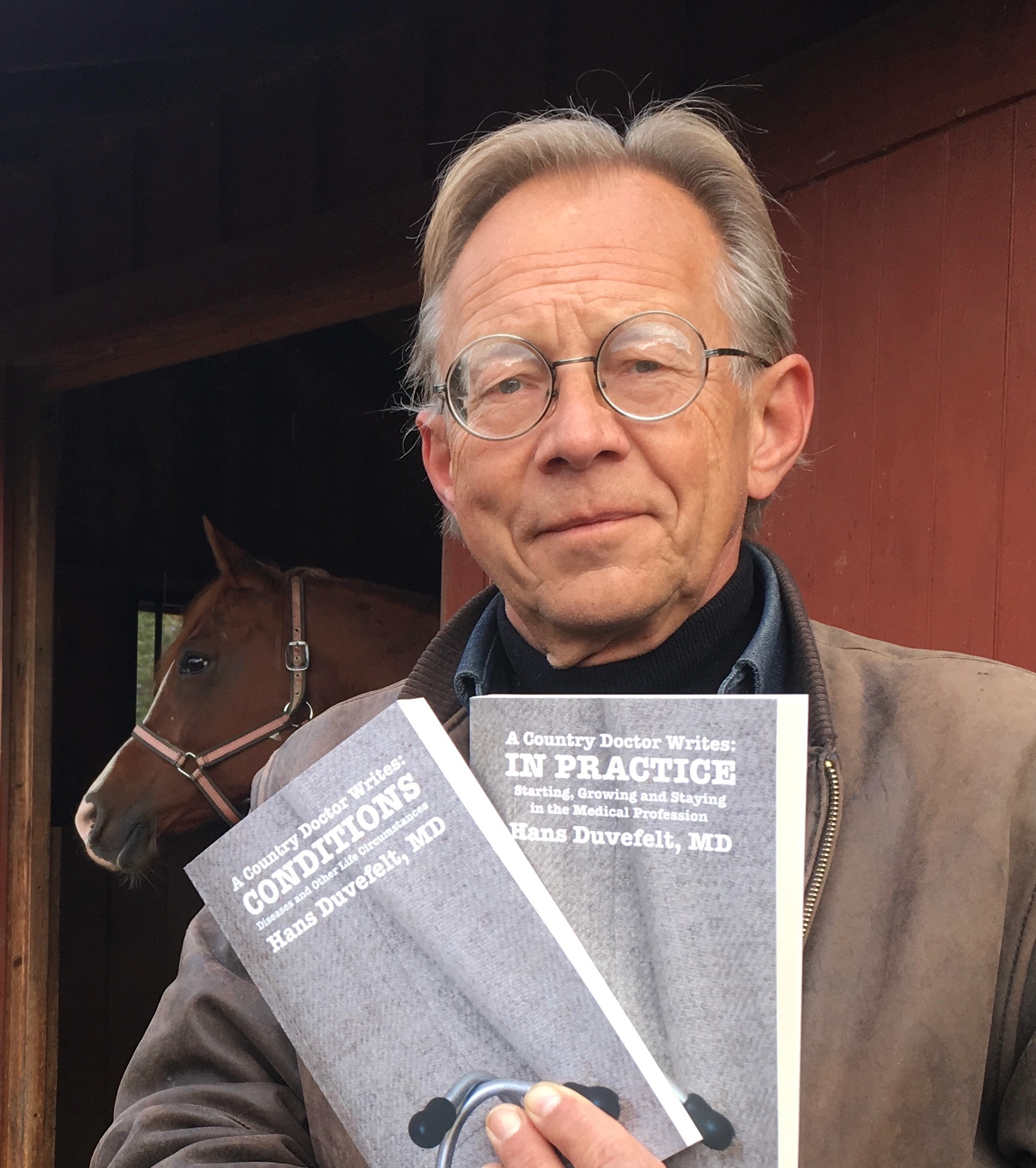
BOOKS BY HANS DUVEFELT, MD

CONDITIONS, Chapter 1: An Old, New Diagnosis

Top 25 Doctor Blogs Award

Doctor Blogs

Enter your email address to subscribe to this blog and receive notifications of new posts by email.

Mailbox

contact @ acountrydoctorwrites.com
Bookmark and Share
© A Country Doctor Writes, LLC 2008-2022 Unauthorized use and/or duplication of this material without express and written permission is strictly prohibited. Excerpts and links may be used, provided that full and clear credit is given.