Archive Page 208

One Last Signature

Benjamin “Bip” Alderton died yesterday morning. The Hospice nurse called a few minutes after eight, but I already knew; in a small town everyone always knows these things. I recorded the telephone call on our usual sticky-form:

Date:                           10/3/08
Time:                          08:22
Patient’s name:           “Bip” Alderton
Caller’s name:             Heather Snow, RN
Problem:                     Patient passed away peacefully at 05:30.
Plan:                           (I left this blank)
Physician’s Signature: (Signed)

Within two hours the funeral parlor’s typical glossy brown marble-like document folder appeared at my desk with his death certificate. I paused for a few moments before I opened it.

I moved to this area in 1985. The clinic had located a house for rent just a few miles away, a lovely early 1800’s center-chimney cape with crooked wide pine floors, original wainscoting and a nice yard for their newly recruited 32 year old doctor’s young family.

“Bip” Alderton was my next-door neighbor. I never did learn why people called him “Bip”. He was 55, the age I am now, worked at the mill and did some lobstering on the side. He became my patient, and although we were never close, we saw each other often enough that our lives intertwined when things happened to each of us.

His wife died from heart disease, and then when he was about seventy, he was severely injured in a car accident. Always a stubborn man, he learned to walk again, and within a couple of years you had to look hard to notice his limp and the pain he was in – he never complained, and never took anything for it after the first few months.

He developed atrial fibrillation, and had to take a blood thinner, so I saw him often as he came in for his blood tests to have his warfarin dose regulated.

Then, suddenly this summer, his prothrombin times started to fluctuate wildly. He hadn’t changed his diet, didn’t seem to have mixed up his pill bottles, and hadn’t taken any new medications or supplements. We both scratched our heads.

The explanation didn’t take long to reveal itself. Over just a couple of days, he developed jaundice and lost his appetite. His CT scan demonstrated widening of his bile ducts and the head of his pancreas looked enlarged.

A gastroenterologist did an ERCP procedure and was able to place a stent that opened his bile duct where it passed through the tumor, and a cancer surgeon offered “Bip” an operation called a Whipple procedure, which at age 78 is an almost heroic thing to do.

“Bip” thought about it for a few days, but decided against it. He had some pain and lost weight, but the stent worked for a couple of months. We got Hospice involved, and they kept him comfortable. Periodically they called for updates and new medication orders, all properly documented and signed in his thick medical record.

I opened the brown document folder and read the entries filled in by the funeral parlor: Place of birth, ethnicity and so on. Then I completed my part, in black ink:

Cause of death:                               Pancreas cancer.
Time between onset and death:       4 months.
Other contributing diagnoses:        (I thought about losing a wife and almost being killed in a car accident, but left this field blank.)
Did you view the body after death: No.
Certifier’s name and address:         (done)
Signature:                                   I put my signature on the last piece of paperwork in the medical history of my friend and neighbor, and carefully closed the document folder.

I was still thinking about how comfortable it had been to have “Bip” and Ellen right next door that first year here when Autumn startled me by tapping me on the arm:

“Mrs. Pye’s lab work is back!”

Left Behind (In the Dust)

I have enjoyed reading Family Practice Management for several years. Even though I work at a Federally Qualified Health Center (FQHC), which operates by different rules than private offices, somewhat like the Socialized Medicine of Sweden, I like reading management/business books and magazines.

The issue I received a few days ago had a sheet glued to its front page stating in bold letters: “This is your last issue – unless you act NOW!”

These are my options: I can get the digital (online) version for free, starting in November, if I give them an e-mail address to send it to, or I can continue to get the print version for an undisclosed fee; I have to log on to their website to find out what it would cost me. Hmmm… where does that leave unconnected physicians?

Don’t get me wrong – I’m not against the Internet; I own six domain names, six blogs and even more e-mail accounts. I just don’t prefer to read journals and magazines online; it seems cozier to fall asleep with a magazine than with a laptop. I also feel forced to switch e-mail accounts every several months due to the sheer volume of junk mail I get. I just can’t trust that I’ll receive important communications through e-mail.

A while ago the American Board of Family Medicine sent me a newsletter that stated that the next notification of my upcoming Board Certification would ONLY be sent via e-mail.

I called them up to protest; the best they could do for me was to give me the e-mail address of their President. Hah! I know a trap when I see one.

There is a religious bestselling book series called “Left Behind”, about those left behind after the Apocalypse. In a sense, this is what’s happening now with the Internet as the predominant and sometimes only way of communication.

Playing Doctor

Being middle aged is not very glamorous. For months now, I have had to work extra hard to take blood pressures. I always pump the sphygmomanometer up higher than the nurses and release the pressure slower, and consequently have a reputation of finding more hypertension cases than most…

In simple conversations at home, I have had to ask my wife to repeat things a lot lately. I haven’t heard the crickets or the frogs on the river from our bedroom for a couple of years now, and my tinnitus once had me worry that the screech in the sound system at the symphony was an exacerbation of my own medical problem.

Today, I resolved to do something about it, and brought home my housecall bag. After dinner, which we in usual fashion had in the sunroom with a kerosene lamp on the table and a nice bottle of Cotes du Rhone, I asked my wife, who is a medical provider no longer doing the work I do, to check me for ear wax.

I had not anticipated the reaction I got. She broke down in hysterical laughter. In between paroxysms of giggling I heard her utter the words “middle aged” and “playing doctor”.

So, after our romantic dinner and her giggling spell, she checked my ears. The verdict was not what I wanted: No wax. So now I have to weigh my options. I am thinking I might get one of those fancy stethoscopes with built-in amplification. So far I can handle conversations if I pay close attention, and I don’t think I need a hearing aid just yet.

After all, I hear a lot of men during their annual physical exams say: “My wife says I don’t hear too well.”

I always reassure them: “They all say that!”

My Father’s Eyes – The Photographs

I only have two photographs of my father and me where we are both looking straight enough into the camera to study our eyes.

In the first one he is about 33 and I am about 3 years old. He is sitting down and I am standing next to him. The picture is in a small album he once put together for my great-grandfather. After my great-grandfather passed away, I got the small photo album with hand-written captions. The one under the picture of my father and me reads (in Swedish): “What’s mommy doing with the camera?” In this picture, he is a thin, slightly balding big-eared young man with a point collar shirt and a hand knitted sweater. I am a toe head with a similar outfit, but with chubbier cheeks. He looks a little sad or perhaps just plain tired, and I look calm and well fed.

This picture reminds me of Livingston Taylor‘s words:

“My father’s eyes
My father’s hands
Oh daddy quickly pick me up
When will I be a man
When will I live long enough
To make somebody fly?
When will the mirror show me
My father’s eyes?”

The second picture of my father and me was taken shortly after he moved into the dementia ward where I visited him last month. He is seated in the center, thin again after years of being overweight, and my mother and I are standing, scooching slightly, behind him on either side. My wife took the picture when my father was 83 and I 53. In this picture he again looks a little sad or perhaps just tired. I remember that he wasn’t quite sure what this was all about. When my mother told him she was leaving at the end of each afternoon visit, he would try to get up to follow her, or sometimes offer to drive her home.

My own eyes look a little bit tired, too, maybe from jet lag, and perhaps also in response to my father’s decline.

These two photographs, taken fifty years apart, frame the story of two men who each left their home to make themselves a new life somewhere else; my father left the farm and his birthright to find work in a factory, then earned an engineering degree in night school. I went to medical school and left Sweden to make a new life in America. I never then, at age 28, reflected on what it might mean to have children and grandchildren on one continent and parents on another.

My visit to Sweden last month was a whirlwind trip. I only spent three days there this time. Each day I spent much of the afternoon with my father at the nursing home.

Each visit passed quickly with breaks for obligatory coffee and cookies, which he eagerly devoured with minimal help.

His room is spacious with a peaceful view of the grassy yard behind the building, the bed is a hospital-type unit and there is a Hoyer lift. The armchairs and table are from camp, and he has his own TV. Tall trees shade the front of the three-story building, and there is a balcony off the homey kitchen. Next to the kitchen is a dining room with seats for all seven residents. Beyond the dining room is the living room, dominated by a large color TV. The exit doors have electronic combination locks.

The staff is wonderful; hugs are shared freely, hair cuts and manicures are provided, and the staff even picks up personal items for residents downtown. The care is subsidized and fees are based on income. As my father has a good pension, his monthly fee is somewhere around $1400.

His dementia was evident many years ago, and his decline has worn on my mother. She finally has peace in her heart with his living in a dementia unit, and she visits him five or six days a week. I talk to her on the phone every week, but I see my father usually only once a year. Even before he developed his dementia, he never talked on the phone; he would answer and then get my mother on the line.

I read somewhere that we lose our parents little by little over many years. The daddy that picked me up the way Livingston Taylor describes has been gone a very long time, the father I discussed politics with has been gone for fifteen years, and the father who beat me at cards has been gone for a decade.

Like my hometown in Sweden, I can still visit my father, and the memories well up inside of me, but his dementia is like the ravage of time on the streets where I played as a child. Much of him is simply gone; it is only because I love him and remember him that I still find all of him there. A stranger would not see in him what I see when I look at my father.

I don’t know if he’ll be there when I visit Sweden next. I know I’ll never hear him speak again. I’ll never walk down to the lake with him again, and he’ll ever beat me at cards again, but when I look into my father’s eyes I see my past and maybe also my future:

Out of six siblings born in the 1920’s and 30’s, all are still alive, but the three oldest have been diagnosed with dementia. Livingston Taylor’s words echo in my mind:

“When will the mirror show me
My father’s eyes?”

Visions of Little People

Richard Westman was a fine-boned, soft-spoken eighty year old retired accountant, who prided himself of his sharp intellect and excellent memory. I had known him for a few years, but didn’t see him often as he was relatively healthy. Then a myocardial infarction robbed him of his physical stamina, and he started to develop heart failure. He also developed heart rhythm problems, and ended up with a pacemaker and on a blood thinner. We saw a lot of each other during the last two years of his life – or I saw more of him than he saw of me, as he suffered from advancing macular degeneration.

He was familiar enough with our office layout that a casual observer might not have noticed how visually impaired he was. He needed help managing his medication bottles, and he had long before lost his ability to read and watch television. He listened to books on tape, and he followed the news with great interest; there was nothing wrong with his mind, or so I thought.

Then one day he confided in me that he saw things – children, sometimes groups of them, playing in the yard outside his kitchen window in broad daylight. They always seemed friendly and happy, never threatening. They never spoke, never made a mess and never pulled any pranks.

At first he was unnerved by seeing them, but gradually he came to enjoy their presence. He confided in me:

“I don’t really think they are there, but I don’t know why I see them.”

“Do you want them to go away?” I asked.

“No, they just puzzle me” was his answer.

I had at first thought of offering him a trial of a mild antipsychotic, but it was clear that he didn’t need that, since the visions didn’t frighten him in any way.

We talked about the children now and then, but I soon forgot about his visions. Then one day his wife called the office and said their daughter had found something on the Internet they wanted me to read. The had figured out that Mr. Westman suffered from Charles Bonnet Syndrome, CBS.

Most of the time it isn’t a thrill when patients or their families bring in articles they have found online. We all know that more information is not the same as better information. But this time I was fascinated by what they brought to my attention, and I soon found myself digging deeper into the subject on my own:

First described in 1760 by a Swiss philosopher, who noticed that his grandfather, who was almost blind, saw birds and other figures that weren’t there, Charles Bonnet Syndrome (CBS) typically affects older people with severe vision loss. CBS often only exists for a year or two as vision deteriorates, and can involve geometric patterns or little creatures, often elf-like, usually friendly looking and often with hats. The visions are rarely threatening and they are common – at least 10% of people with worse than 20/60 vision are said to have this syndrome.

CBS is not a psychological condition. It is believed to be something similar to phantom pains, where a person even after an amputation can “feel” a missing extremity, even though they know perfectly well that it isn’t there. The visual cortex of our brains is always “filling in the blanks” when we look at something quickly or when we cannot see things quite clearly. Any type of visual impairment, such as cataracts, diabetic retinopathy or macular degeneration, can create more “blanks”, which are automatically “filled in” by the brain. Antipsychotics don’t seem to be of any help.

Some writers like to think of Charles Bonnet Syndrome as a portal to paranormal experiences or parallel universes. For me it was a portal to being more willing to see what patients and their families drag into the office after surfing around the Internet!


I just realized none of the posts show on an iPad or a computer, but they do show on an iPhone. WordPress is working on this. In the meantime, please visit my Substack.


Osler said “Listen to your patient, he is telling you the diagnosis”. Duvefelt says “Listen to your patient, he is telling you what kind of doctor he needs you to be”.


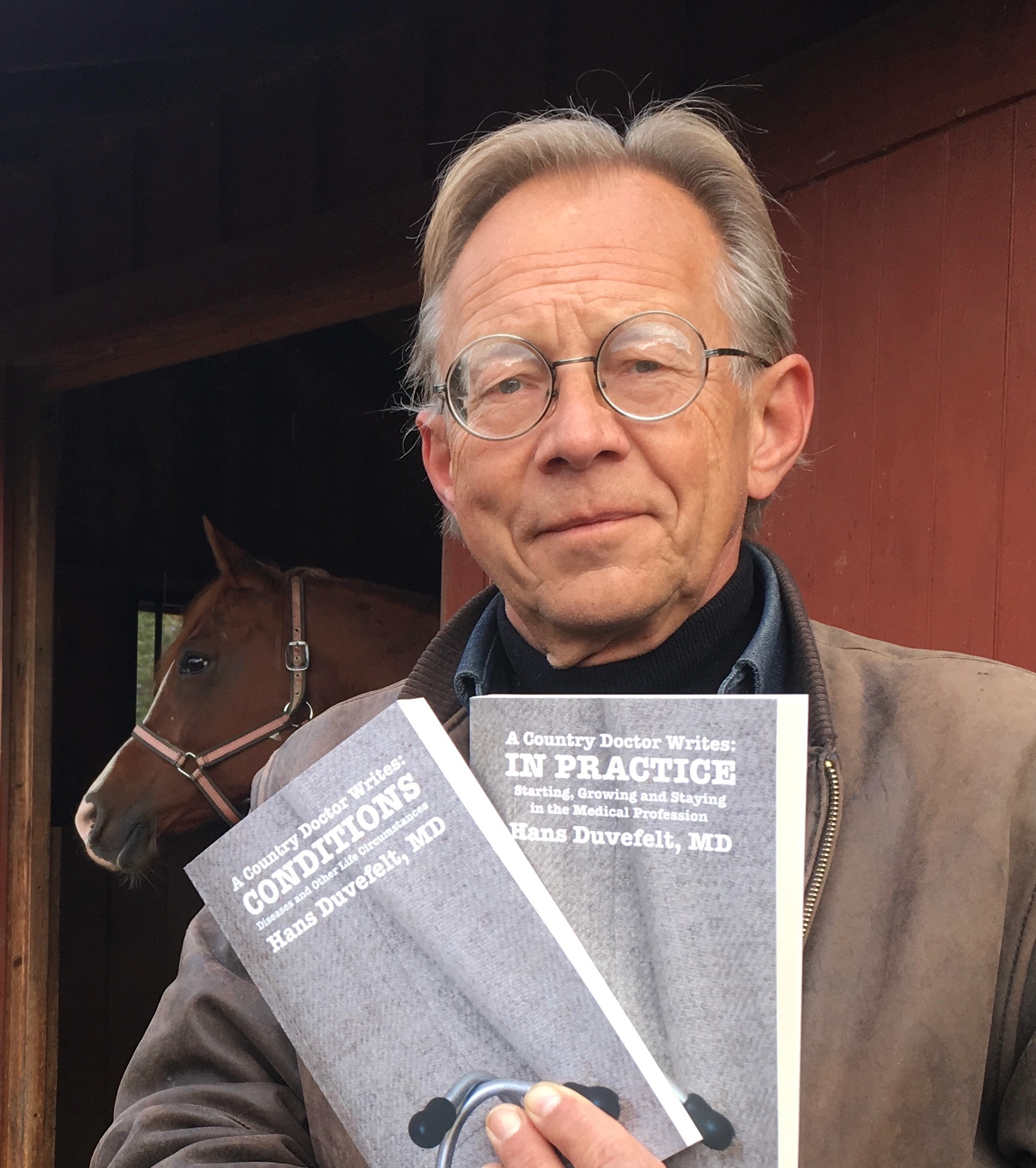
BOOKS BY HANS DUVEFELT, MD

CONDITIONS, Chapter 1: An Old, New Diagnosis

Top 25 Doctor Blogs Award

Doctor Blogs

Enter your email address to subscribe to this blog and receive notifications of new posts by email.

Mailbox

contact @ acountrydoctorwrites.com
Bookmark and Share
© A Country Doctor Writes, LLC 2008-2022 Unauthorized use and/or duplication of this material without express and written permission is strictly prohibited. Excerpts and links may be used, provided that full and clear credit is given.