Archive Page 172

Negative Expectations

Andrea Smythe needed something for her depression, but she was leery of medications. Her counselor had recommended trying an antidepressant, and I agreed.

Andrea told me nobody in her family ever took an antidepressant, and none of her friends ever did.

By the time I had dutifully explained about initial nausea, the risk for suicidal ideation and the possibility of inducing a manic episode in undiagnosed bipolar patients, Andrea was squirming in her chair. I didn’t even get to the risk of weight gain and sexual dysfunction before she told me she’d rather do something “natural”.

“Who wouldn’t, after that introduction”, I thought to myself. So we talked about St John’s Wort and other nonprescription alternatives, all less studied but without foreboding government-mandated warnings.

This is the age of informed consent. Anything you don’t say about possible adverse effects can be used against you. That’s why most lawsuits against cigarette manufacturers fail – after all, they warned smokers about the dangers of using their product.

Even when patients agree to take the medication suggested by their physician, the negative expectations can be a hindrance to the beneficial action of the medication – a real nocebo effect. This is the opposite of the placebo effect that some people tend to dismiss as imaginary. Ancient physicians, the fathers of modern medicine and cutting-edge neuro-immunologists all tell us the human body’s ability to heal is helped or hindered by the patient’s state of mind. In many psychiatric diseases this is axiomatic.

I, for one, always look to align my treatment plan with any potentially available placebo force, for lack of a better word.

“Did you ever know anyone who took an antidepressant?” I usually ask. If the answer is yes, I ask which one and how it worked. If the other person is a family member, I not only have a chance for insight into my patient’s positive or negative expectations but also into their genetic predisposition for response or non-response to certain medications.

If the patient believes one medication is more likely to work than another, I would have to feel very strongly about any other medication I might want to suggest in order to pass up all the positive expectations – call it placebo effect if you want – that the patient just offered to the therapeutic situation.

This is where all the practitioners of non-allopathic medicine have several advantages in today’s health care climate; they are not required to warn patients about rare side effects of their treatment, and they are sometimes more able to listen to their patients’ beliefs and preferences without worrying about what insurance companies, managed care organizations or treatment guidelines tell them to do.

The other day I saw a dramatic example of the nocebo effect; Rachel Ruel had been plagued by horrendous attacks of abdominal pain for several years until I started her on a very low dose of metoclopramide, taken only as needed during these attacks. The medication controlled all her dysmotility symptoms and she was finally able to live a normal life. This was long before the 2009 “black box warning” issued by the Food and Drug Administration about the risk for tardive dyskinesia. We talked about the risk for this rare facial movement disorder and Rachel always felt the relief she got from the medication was so significant that she was willing to take the small risk of side effects.

When I last saw Rachel, she had a tooth infection and secondary jaw pain. She had been sure this was the beginning of tardive dyskinesia, so she had not taken metoclopramide at the beginning of her latest attack two days earlier. She was still miserable with abdominal pain. Her unrelated jaw symptoms had escalated her fear of developing tardive dyskinesia, and I was in no position to talk her out of that fear. I had nothing to offer her, except a referral to a university gastroenterologist.

She left my office still fearful and in pain, but she made the least frightening choice she could make in that moment. I am still wondering if I could have handled our visit differently.

Cell Phones Welcome

Many doctors’ offices have little signs discouraging the use of cell phones. Personally, I find them useful more often than annoying or disruptive.

The other day I saw Mrs. Jonah for a sinus infection. She had lost her private insurance and ended up on Medicaid, the insurance for low-income Americans. When her insurance changed, we had to change several of her medications, because Medicaid didn’t cover what she used to take. Mrs. Jonah told me that one of her new medications wasn’t working for her and the step care on the Medicaid website was confusing. I pulled out my cell phone – not a smart phone for this country doctor, but a waterproof one suitable for working around our little farm.

I know our state’s Medicaid office doesn’t keep you on hold forever, and the people who answer the phone actually have the answers to your questions. Within a couple of minutes I had e-prescribed a new medication to her pharmacy along with an antibiotic for her sinusitis and Mrs. Jonah left the office with a smile and the words “you make things happen”.

I also pulled out my cell phone when Mrs. Gordon’s blood pressure was higher than I had ever seen it and she seemed confused about how many blood pressure medications she was actually taking. The pharmacy told me she hadn’t picked up her lisinopril since February.

Bud Swensen told me his little red pills made him itch, so he stopped taking them. I couldn’t figure out which medication he was referring to. He called his wife on his cell phone and we settled the issue right then and there.

Frank Garr always gives me a hard time if I happen to be running late. That is what happened when I last saw him. He said he was running out of his sleeping pills. According to my records, he should have had a refill left. I called his pharmacy to verify this. He looked demonstratively at his watch and said “I’m deducting this from our fifteen minutes”.

“I’m making this call for you”, I replied.

“Fair enough”, he said.

Norm Parsons was having a terrible time with his rapid atrial fibrillation. His cardiologist in the state capital had really wanted him on a beta blocker because of his mild heart failure. Norm had tried them before and had to stop because of side effects. He was beet red, huffing and puffing, and said “this is exactly what happened last time I tried metoprolol”.

A quick cell phone call to his cardiologist gave me permission to switch Norm to diltiazem, even though it theoretically is less ideal for rapid atrial fibrillation with heart failure. Norm’s e-prescrition for the new medication, my office note and the cardiologist’s documentation of the medication change happened quickly and in real-time.

One thing I don’t do with my cell phone is take incoming calls. I have my phone on “vibrate” and check for missed calls or messages between patient visits. But for straightening things out with pharmacists and colleagues, I wouldn’t want to be without my cell phone.

A Doctor By Any Other Name?

(A reflection for Doctors’ Day)

I am used to being called a “medical provider” instead of a doctor or a physician these days, but it makes me think about the implications of our choices of words. The word “provider” was first used in non-medical contexts over 500 years ago. It is derived from the Latin providere, which means look ahead, prepare, supply.

“Medical provider” is part of the Newspeak of America’s industrialized medical machine. It implies, as Hartzband and Groopman wrote in The New England Journal of Medicine, that:

“…care is fundamentally a prepackaged commodity on a shelf that is “provided” to the “consumer,” rather than something personalized and dynamic, crafted by skilled professionals and tailored to the individual patient”.

The 800-year-old word “doctor” is Latin for Church father, teacher, adviser and scholar. It infers more closely the Hippocratic and Oslerian ideal of what a physician should be like. “Doctor” is used as a title for physicians in many languages, even if other words – like physician – are used to describe the professional role of a medical doctor.

Those other words are often less than flattering in their derivation or usage. Physician, for example, comes from physic, the Latin word for natural science and art of healing, which is noble enough. Less noble is the use of the word physic for a laxative due to the common practice of purging by physicians of the past.

In Medieval times, both physicians and their commonly used blood-sucking worms were called leeches. The Middle English word leche has lived on in many languages’ words for doctors: Läkare (Swedish), læge (Danish) and lääkärit (Finnish). These words are similar to the Indo-European lepagi. It means talk, whisper and incantation and is thought by some to be the true origin of the Scandinavian words for physician.

The Russian word for physician, врач (pronounced vratch), is uncannily similar to врать, which means talk nonsense or lie, and ворчать, mutter. These similarities also harken back to ancient and mysterious rituals of physicians of the past.

The German Arzt is perhaps the most flattering of the words I know for physician; it is derived from the Late Latin word archiater (Chief physician or physician to the Court) and the Greek arch-iatros, where iatros is the familiar word for physician we use in “iatrogenic”.

Personally, if someone asks what I do, I answer “I’m a doctor”, but I never insist on what people should call me.

The language, as it changes, may accurately reflect one very powerful view of what medicine is, but neither the words nor the business model can change what patients need when they are ill or frightened. They need more than generic providers; they each need a human being with knowledge, wisdom and compassion.

Ultimately, whether others call us physicians or medical providers, it is still up to us to define our professionalism and to defend our personal standards. These things are neither generic among providers nor, as some are hinting these days, almost replaceable by technology or treatment protocols.

Star Trek’s fictional United Federation of Planets Starfleet did have a technologic replacement for their flesh-and-blood ships doctors, still nick-named “The Doctor”; installed in most Starfleet ships’ sick-bay was an Emergency Medical Hologram, EMH for short. When its transmitter was activated, it mechanically said: “Please state the nature of the medical emergency”. The EMH eventually evolved into a sort of sentient being, but it is unclear to me how patients really felt about this contraption.

What, then, is a physician? A sixty-year-old answer still says it well:

“The value of the physician is derived far more from what may be called his general qualities than from his special knowledge. A sound knowledge of the aetiology, pathology, and natural history of the commoner diseases is a necessary attribute of any competent clinician. But such qualities as good judgement, the ability to see the patient as a whole, the ability to see all aspects of a problem in the right perspective, and the ability to weigh up evidence are far more important than the detailed knowledge of some rare syndrome, or even the possession of an excellent memory and a profound desire for learning”

Dr John W. Todd, The Lancet, 1951

Life and Death

Elmer Ladd built the little pink house at the end of our road just in time for their wedding on New Year’s Eve 1953. The pre-cut Aladdin home caught Elmer’s eye when he first saw the catalog. Eileen picked the color and the two of them knew from the day they moved in that they would always live there, close to his work at the train station. Every day after the 12:05 had left, Elmer came home to eat lunch with Eileen. At precisely 12:50 he put his cap back on and left to greet the 1:05 southbound Express. Every afternoon when their daughters returned from school, Elmer was home again to spend a few minutes with them before returning to the station for the next train.

After Elmer retired from the railroad, he and Eileen spent all their time together at home, caring for the little pink house and the small garden. For the first few years he would still listen for the trains, but eventually he learned to ignore them. Ten years after his retirement the trains stopped running through our town and weeds grew quickly between the abandoned tracks.

One day a stray dog wandered into their yard, an off-white spaniel mix with brown spots scattered over her back. Eileen thought the dog looked like a large mushroom when she first noticed her through the kitchen window. They called her Mushroom, and she quickly filled the void they had both felt in their life.

With Mushroom two paces ahead, behind or to the side, Elmer did the rounds around town morning and afternoon. The sweet-tempered dog made friends along the way, and Elmer tipped his old uniform hat to passers-by and shopkeepers as they walked. He had found a purpose and a routine again, and he was thriving. He constantly talked with or about the dog, and called her his little girl.

Then the seizures began. The veterinarian was not able to control them with medication, and Eileen worried that Elmer wouldn’t be able to get the dog back home again if she were to have a seizure on one of their walks. They stayed closer to home and Elmer’s world got smaller again.

Mushroom, sweet and gentle as ever, seemed content to stay inside the house or in the yard. On warm summer afternoons she dozed under the white porch swing while Elmer and Eileen sipped lemonade in the shade. More and more often and without warning, the dog would suddenly start convulsing to the point of losing control of her bodily functions, and the helpless elderly couple would kneel beside her and quietly pray for each spell to end. After she came to, Mushroom would seem confused, docile and grateful to be near them. She would wag her tail quietly and put her muzzle in the nearest hand or lap and fall asleep.

Summer turned into fall, and then winter. As the seizures worsened and came more often, Eileen broached the subject of putting Mushroom out of her misery.

“But does she suffer?” Elmer asked.

“I don’t know, but we mustn’t be selfish if there is any chance that she is”, Eileen replied.

“It’s not for us to play God. He gives life and only He can take life away from any of his creatures.” Elmer’s voice almost failed him as he spoke back to his wife.

Weeks passed, and the seizures grew in intensity. On a cold January morning, Mushroom collapsed at the end of the driveway and seized more violently than she had ever done before.

“Elmer, you’ve got to take her to the vet. You can’t let the poor dog suffer any longer.” Eileen sobbed: “Can’t you see it’s time?”

Without saying a word, Elmer put on his hat and jacket and trudged through the freshly fallen snow to the dog who lay quivering down the hill from the house.

He lifted Mushroom and walked slowly back up the hill. As he approached the car, Eileen ran out to open the back door for him.

His face was dusky, his breathing wheezy, and he moaned quietly as he leaned into the vehicle with Mushroom, whose limbs hung flaccidly as he coaxed her into the crowded back sat of the small sedan. The dog snored and exhaled loudly.

Silently, Elmer put his arms around Eileen. She sobbed. Then he opened the driver’s side door and sat down behind the wheel. Just as he turned the ignition, he took a deep breath as if he meant to say something. Then his head slowly nodded as his body fell, lifeless, over the steering wheel. The horn blared and the dog raised her head in the back seat.

Eileen reached in and tried to pull him away from the steering wheel. She managed to turn off the ignition and as she did, she knew her husband was gone. She acted quickly, but the ambulance crew pronounced the love of her life dead at the scene.

Mushroom came prancing down the street this afternoon, her spaniel tail and feathers waving in the warm breeze of what felt like the first day of spring. Ten paces behind came Eileen. The two of them make their rounds every day now the way Elmer and Mushroom used to. The new veterinarian in the next town seems to have found the right medication to control the dog’s seizures, and life somehow goes on for Elmer’s two girls.

A Country Doctor Practices Telemedicine

Walking gingerly, one small step at a time like an old man, I slowly made my way down our icy driveway to the mailbox this morning. The cold wind circled around my neck and the sleet pounded against my cheeks. March was surely coming in like a lion here in the Northeast.

Inside the black metal mailbox were the usual bills and journals, but also a small post card. I brought it closer to try to read it through my wet eyeglasses. It was from a company looking for primary care physicians for telemedicine services.

Telemedicine is an integral part of rural health care. When an accident victim has a CT scan of the brain or cervical spine in the middle of the night, a radiologist in a different time zone reads the images while our own radiologist gets his well-deserved sleep. The specialists who fly or drive here to do consultations sometimes use the hospital’s teleconferencing capabilities for virtual follow-up appointments. We even have telepsychiatry with doctors from Boston and the southern parts of our state.

“Telemedicine for primary care doctors”, I thought as I inched my way up the slippery driveway in the bitter cold sleet storm. I imagined myself in my slippers and cardigan, comfortably doing telephone consultations by the fire. I saw myself poolside in my swim trunks, sipping from one of those parasol drinks, making money on the phone while working on my tan.

I have already done some telemedicine. Last weekend my daughter sent me a picture on my cell phone with the question what kind of rash my grandson had. It was a classic case of erythema annulare. He happened to have an appointment with his doctor a few days later, and I understand the diagnosis was confirmed in person then.

Then I remembered I had been less successful a few weeks before that when my granddaughter had a host of symptoms, including a fever and, as my daughter added: “She won’t eat”. It all sounded pretty viral to me, so I gave the usual advice. A couple of days later, I found out the child had a flaming case of strep throat.

I asked sheepishly “How sore was her throat?”

“Real bad, didn’t I say that?” My daughter seemed puzzled.

“I only heard that she wouldn’t eat”, I said.

“Yeah, because her throat was so sore”, she answered.

A visual would definitely have helped there. If it was that hard to diagnose my own granddaughter over the phone, I can imagine the challenge of trying to do more than the simplest triage over the phone with a complete stranger who is paying for the call.

I kicked the snow off my boots and entered the glassed-in front porch. My eyeglasses were frosted on the outside and fogged up instantly. I took my boots off, put the journals on my reading pile and the bills on the staircase to the upstairs. I turned the post card over one more time, shrugged to myself, put it in the kitchen trash and poured myself another cup of hot coffee.


I just realized none of the posts show on an iPad or a computer, but they do show on an iPhone. WordPress is working on this. In the meantime, please visit my Substack.


Osler said “Listen to your patient, he is telling you the diagnosis”. Duvefelt says “Listen to your patient, he is telling you what kind of doctor he needs you to be”.


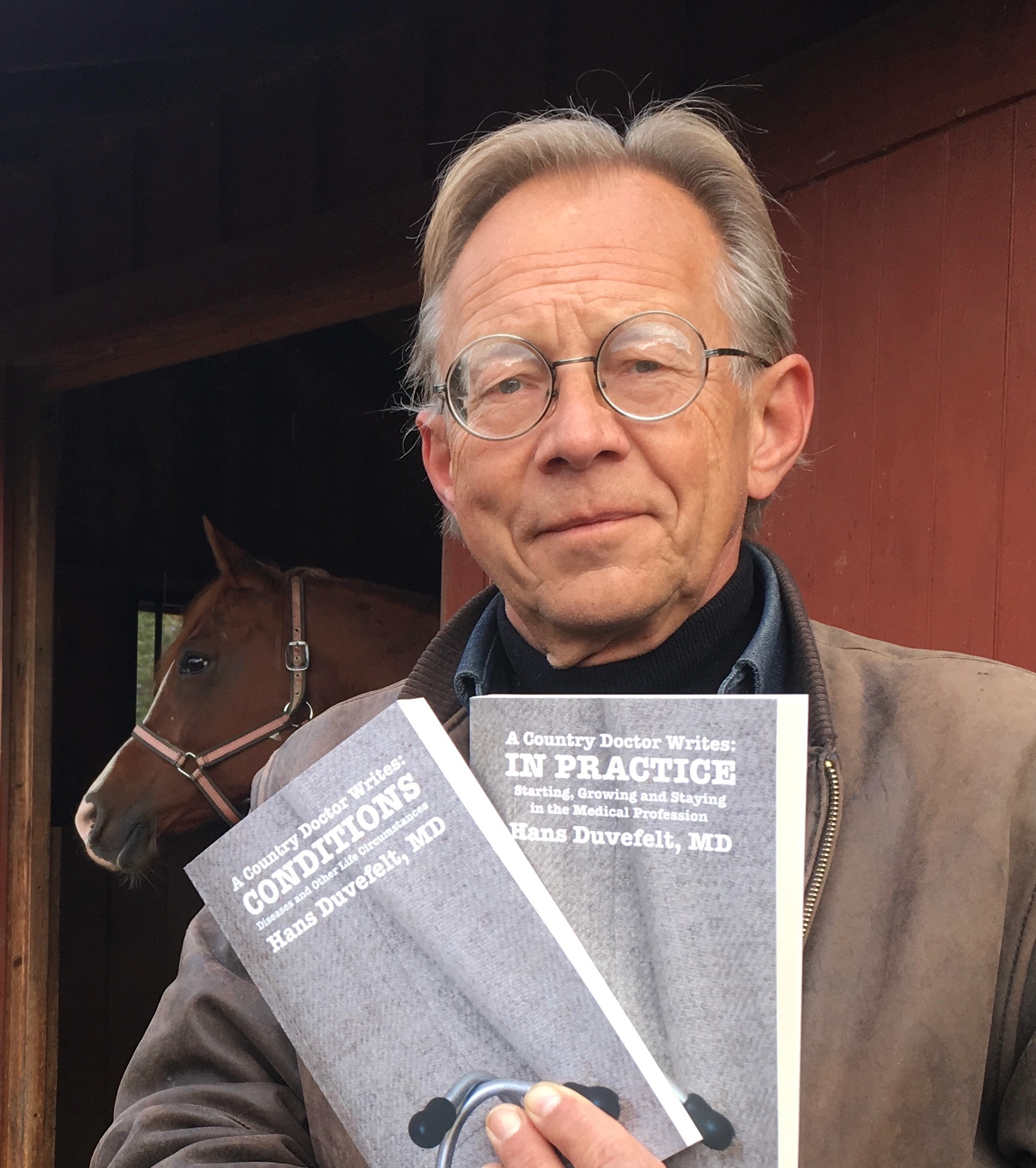
BOOKS BY HANS DUVEFELT, MD

CONDITIONS, Chapter 1: An Old, New Diagnosis

Top 25 Doctor Blogs Award

Doctor Blogs

Enter your email address to subscribe to this blog and receive notifications of new posts by email.

Mailbox

contact @ acountrydoctorwrites.com
Bookmark and Share
© A Country Doctor Writes, LLC 2008-2022 Unauthorized use and/or duplication of this material without express and written permission is strictly prohibited. Excerpts and links may be used, provided that full and clear credit is given.