Archive Page 138

“When I Was Your Age…”

“Listen, when I was your age, I did the same thing…”

The words came out of my mouth too fast for my frontal cortex to weigh them or to monitor, let alone modulate, the intensity of my delivery.

He was a relatively new patient, 17 years old, scheduled for a well child exam. A tall, athletic young man, he was alone in the exam room. His right arm was in a sling.

“What happened to you?” I asked.

He started telling me about how his right arm got pulled out of its socket a week earlier and how the emergency room had done an X-ray and a CT-scan that were both negative.

There was a knock on the door and Autumn produced the ER note and the radiology reports. The disposition was to see the on-call orthopedist at Cityside within a few days.

“Did you get an appointment with the orthopedic doctor? It says here you were supposed to see him within a couple of days”, I said.

He shook his head, adding “but it doesn’t hurt as much as it did the first couple of days. My dad told me to climb the wall with my fingers like this..”

“I wouldn’t do that until the orthopedist says it’s okay”, I interjected. “Let me call Dr Fazad and see what’s going on with your appointment.”

I pulled my old Motorola from my pocket and called. My young patient looked at the clock on the wall. Dr. Fazad’s office said they didn’t have anything from the ER. “But, he’s under 18 so he needs to be seen by pediatric orthopedics”, the secretary said. “I’ll connect you.”

A minute or two later the pediatric orthopedic clinic wanted to know his name and date of birth.

“No, we don’t have anything on him, but I can see from the ER note that he needs to be seen. We’ll call them later today with an appointment.”

I repeated what they had told me and what I had blurted out before.

“Don’t do any range of motion exercises until the orthopedic doctor tells you to. Usually you need to be in a sling for six weeks with this type of injury.”

His whole body revolted and he got up from his chair.

“Six weeks?!”

“Yes, that’s how long it takes for the tissues around the joint to heal. When I was your age I had the same injury. I was away from home and figured since it popped back in, I must be okay. That’s why I’ve dislocated it twenty more times since then.”

He cringed at what I said.

“You might even want to tie the sling behind your back”, I added.

He gestured toward the loops on his sling that were just for that purpose.

“I say what I say because I wouldn’t want you to have to be guarding that shoulder for the rest of your life”, I said.

I know you usually can’t tell a young person very much – I should have remembered from raising my own children. But I wanted to spare him the complications I suffered from ignoring my injury.

I didn’t tell him about the other medical regrets in my life.

A few years after my shoulder dislocation, my grandfather developed double-sided groin hernias, and I didn’t know then that two simultaneous hernias sometimes means there is a growing tumor inside the abdomen.

When I was already a young doctor, I watched my mother during one July visit stop and catch her breath now and then in the summer heat. I thought she was just suffering from the heat, and didn’t consider paroxysmal atrial fibrillation. She had to have a stroke before that diagnosis was made.

I hope he follows my advice.

If 911 Worked Like a Medical Office Phone System

Thank you for calling 911 or your local emergency response number.

Please listen carefully as our options have recently changed.

If this is a life threatening medical emergency please press “1”.

For non-life threatening medical emergencies, please press “2”.

For fire, press “3” but for a fire with life threatening burn or smoke inhalation victims, please press “31”.

For fire with non-life threatening injuries, please press “32”.

For Police, press “4” if you wish to reach State Police.

For your local police department, please press “5“.

If you don’t know which police authority to call, please press “6” for traffic related complaints, “7” for domestic assault that has happened in the past, but “71” for ongoing, life threatening assault and “72” for ongoing, non-life threatening assaults.

Press “8” for burglaries that have happened in the past.

For burglaries in progress, please press “9”.

For all other inquiries, please press 0.

To repeat these options, press the “#” key.

Today’s Medicine has no Credibility

This week’s issue of The New England Journal of Medicine once again questions two practices that used to be almost the backbone of primary care.

One article is about the low likelihood that prostate cancer detected through PSA screening will shorten a man’s life, even if he chooses just to keep an eye on it.

The other article is about how repeated mammography screening mostly leads to the diagnosis of small and not very aggressive tumors, just like PSA screening.

These two common health screening issues, along with the disappearance of all scientific rationale for cholesterol targets, baseline EKGs, digital rectal exams, testicle exams and “routine” lab work, not to mention routine physical exams, have essentially forced primary care doctors to rethink how they spend their days.

CMS has plenty of other things for us to do, although they still want us to do some of the things the evidence has debunked, and much of their vision for doctors falls within the Public Health domain.

As a result of these changes, physicians today face a serious credibility problem. The more dogmatic we have been before about following the guidelines that are now relegated to the history books, the more ridiculous we look to our patients as we more or less enthusiastically make our required 180 degree course corrections.

Thank goodness I always spoke of the guidelines as just that, current expert opinion, not something carved on stone tablets, handed down to us from Mount Sinai. As my father used to say, “view everything a little von Oben”. That’s the German expression for “from above”. The full phrase is von Oben heraus”, which rings of superiority and can even mean snooty.

As a physician, I am not putting myself above the expert opinion of the day, but I see myself as a humble servant and disciple, not of the current guidelines but of the principles of my forbears, from Hippocrates to Osler. If I take them seriously, and always speak of today’s guidelines as something likely to be temporary, I don’t seem to have to feel embarrassed when the guidelines change, which they inevitably do.

I think this attitude requires knowing your caft and its science well enough to be able to tell why the guideline looks the way it looks. Without the proper depth of knowledge you can’t be “above it all”.

Seriously, whether we are making guideline related u-turns without explaining why suddenly our practice is changing, or reciting all the possible side effects of a medication we are about to prescribe, we are making ourselves look bad compared to other practitioners, whose research isn’t double blinded and who aren’t mandated to badmouth their own treatments the way we are.

With guidelines coming and going, promising new drugs suddenly disappearing from the market, and with so many of our favorite prescriptions barely more effective than placebos, we need to go back to the source for the physicians of yesterday and those of the future:

Know your science, view today’s guidelines from a historical perspective and don’t be completely immersed in today. Because the present is just the razor sharp boundary between the past and the future.

Double-Booking the Doctor is Half-Booking the Patient

Not only have we shortened medical appointments to 15 minutes. We also sometimes double book them.

I get the feeling that non-providers think of this as something fairly ordinary, and even reasonable. But it is often a very difficult and destructive thing to do.

The term “double booking” and the way it looks in an ordinary doctor’s scheduling grid suggest that the physician might possibly be expected to be in two places at the same time. That is hardly ever the case for those of us who are mere mortals.

Sometimes a patient does need a lot of non-provider time, for example to get undressed and ready for a Pap smear. In such a case the doctor could take a quick look at another patient’s sutures or something simple like that in another exam room while the first patient is getting ready.

There is a tendency to squeeze in simple things almost anywhere, but, depending on who is losing half of their fifteen minute appointment, that might be a very unkind thing to do. In today’s reality, with Meaningful Use, ACOs and Patient Centered Medical Homes, we have to screen for various conditions and risk factors, update medication lists, immunizations and family and social history in every single visit. There really are no in-and-out quick visits anymore, thanks to our well meaning(?) Government.

In small practices, where the scheduler knows patients really well, it might be possible to predict better whose visit will be short and whose will take more time. But we have found as we have grown that this kind of knowledge is disappearing a little, and in some computer programs, the scheduling grid doesn’t show the names or concerns of scheduled patients, just that a slot is already filled.

This is why, the other day, somebody else got double booked with an elderly patient of mine who was given only a fifteen minute appointment for depression.

Double booking is sometimes used as a strategy to manage no-shows. That can be really bad.

In some practices, patients who have no-showed too many times are double booked with another patient, so that the expensive doctor doesn’t risk being idle for fifteen minutes. Of course, if the habitual no-show patient does make it to the appointment, the doctor is faced with managing both the catch-up of a patient who may be well overdue for whatever they came in for and the compromised visit of another unsuspecting patient. That unfortunate person ends up paying the consequences of having another patient booked in the same time slot. Two players in this triangle pay the price of the past transgressions of the third.

There is no good solution for no-shows. Dismissing such patients may seem easy for the practice, but even if you don’t believe health care is everybody’s right, some people no-show because of their economic or social situations and really need to be seen when they are finally able to keep an appointment, for example a child who is behind on immunizations.

The double booking due to being busy needs to be looked at in a humane and business-like way, and it needs the direction of the medical provider: The random double booking of unmarked squares on a computer screen is no better than throwing darts. We need to analyze our data to better predict the demand for services on a Monday morning or Friday afternoon before a long weekend.

And we need to risk a provider sometimes having fifteen unscheduled minutes. That time could be spent on patient relations or care coordination. Because doctors aren’t just faceless widget makers who produce visits. We are the ambassadors and medical leaders, or brains, if you will, of our practices.

Something Extra

The pressures of time, the complexity of our patients’ needs and today’s documentation requirements can easily make a medical provider feel less than generous these days. We must counteract that in order to carry on as healers.

All day long, I am conscious of the time as I work my way through my long list of fifteen minute encounters. But I am also conscious of the fact that the more pressure I feel, the less empathic I can become, and the less effective I am in building and maintaining the relationships that lie at the root of my ability to care for my patients.

It is only because of those relationships that I am in any way able to tell a fellow human being what to do; it is that relationship that allows me to reassure someone in just a few words with only my demeanor and the tone in my voice.

I can only cover so many issues and help solve so many problems in fifteen minutes, and I have long been aware that some of those minutes need to be time spent nurturing the relationship that allows me to be my patient’s doctor, not just any doctor.

I have made it my golden rule to always be realistic about the size of the agenda of every patient encounter, but to also always give something extra that the patient didn’t ask me for. By thinking and working like that, I have found myself less frustrated at the end of each day, more energized and, I believe, more effective in my craft.

That extra effort with each patient can take different form: Sometimes I personally bring a wheelchair bound patient back out to the reception area, sometimes I show an animal lover a picture of my horses or miniature goats, sometimes I tell a child a story of when I was their age, and sometimes I just give a more detailed explanation of a medical issue and tell the history behind the medication or treatment I am recommending.

It’s like when you give or get a humble gift that is wrapped really neatly with carefully chosen matching paper and a hand-made instead of stick-on bow.

It isn’t calculated this way, but not only does that little extra in every visit help create a more healing atmosphere in the medical encounter, it also creates an emotional bank account so that in those situations when I do have to rush or when I can’t deliver the help my patient was hoping for, they are more likely to still understand that I am only doing the best I can.


I just realized none of the posts show on an iPad or a computer, but they do show on an iPhone. WordPress is working on this. In the meantime, please visit my Substack.


Osler said “Listen to your patient, he is telling you the diagnosis”. Duvefelt says “Listen to your patient, he is telling you what kind of doctor he needs you to be”.


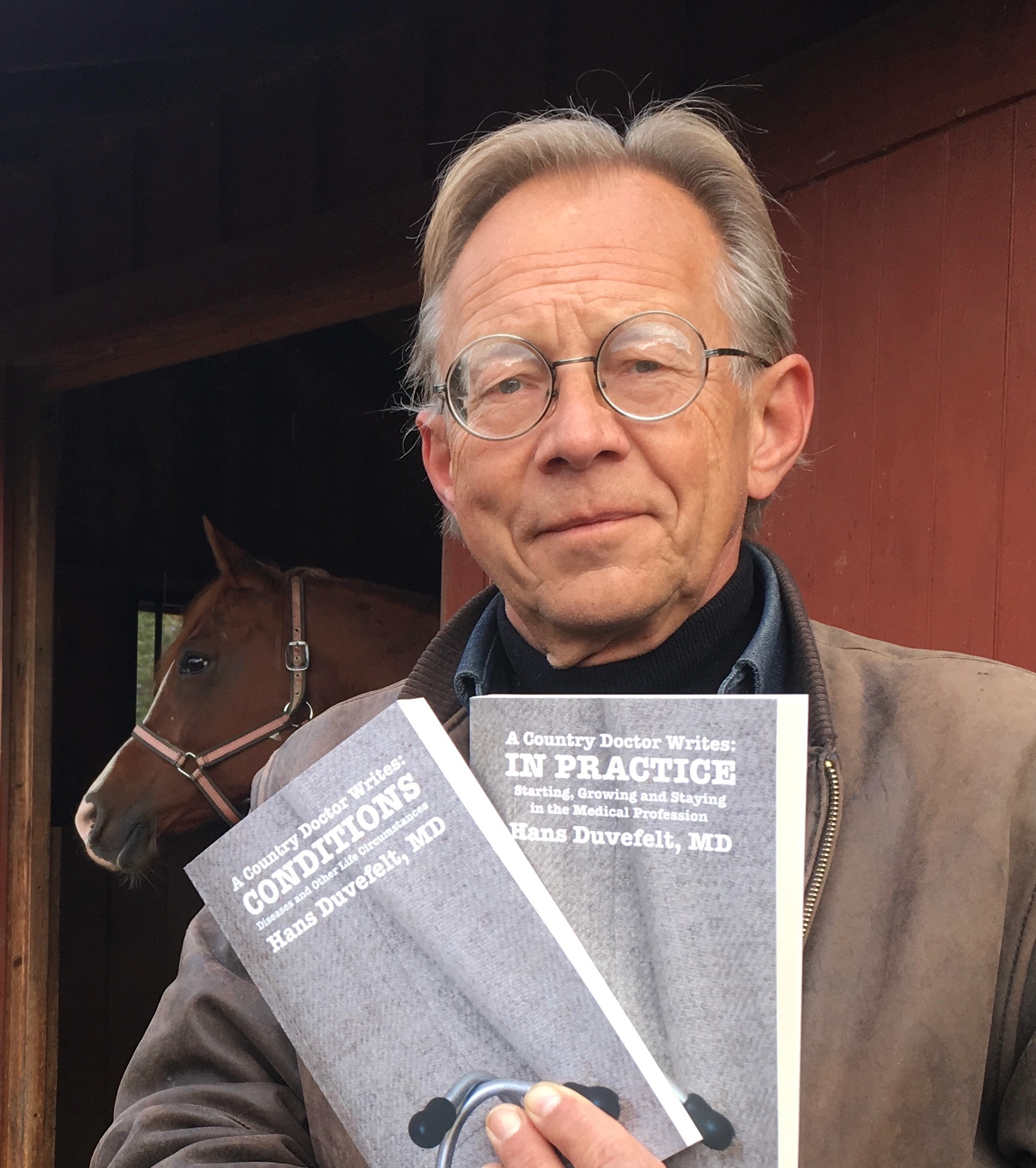
BOOKS BY HANS DUVEFELT, MD

CONDITIONS, Chapter 1: An Old, New Diagnosis

Top 25 Doctor Blogs Award

Doctor Blogs

Enter your email address to subscribe to this blog and receive notifications of new posts by email.

Mailbox

contact @ acountrydoctorwrites.com
Bookmark and Share
© A Country Doctor Writes, LLC 2008-2022 Unauthorized use and/or duplication of this material without express and written permission is strictly prohibited. Excerpts and links may be used, provided that full and clear credit is given.