Archive Page 137

An Anniversary of Sorts

Theresa Miller is one of the hardest working women I know. She doesn’t come in to the office very often. She no longer needs my prescription for her heartburn medication, as it costs less for her to buy it over the counter these days.

Today I saw her for a preoperative clearance. She had decided to finally get her chronically sore shoulder operated on. She had injured it many years ago, and in spite of the heavy physical work she does, she has managed to live and work with her pain and limited range of motion until now. She never took a pain pill in all the years I’ve known her.

“I figured as things slow down for the winter, it’s time to deal with it. I’ve got ten more years before I’ll want to be done working, so it’s an investment”, she said as I opened up her record in our EMR.

I asked all the usual questions about chest pain, heart palpitations, shortness of breath on exertion and so on. Her answers were quick, to the point and full of her typical down to earth determination.

As I listened to her lungs, I remembered the first time I met her and her husband. They had moved to our area from Connecticut earlier the same year. He had become ill with cancer, and I had agreed to do a housecall one Saturday after my morning clinic. He died at home a few months later, and I saw Theresa only occasionally after that.

“You know”, she said after I removed my stethoscope from her chest, “sixteen years ago last weekend was the day you came to se Ron. It was Thanksgiving weekend.”

I hadn’t remembered that it was just this time of year.

“We talked about it this Thanksgiving, among the family, how unique that is, to have a doctor do housecalls like that”.

“Around here it isn’t”, I said. “Maybe Maine is a kinder, gentler place than Connecticut.”

“That’s what my sisters just said”, she answered.

Sixteen years ago, I thought to myself, I was a father of teenagers, the millennium was almost new, Y2K never really happened, the World Trade Center still towered over New York, and life seemed almost innocent that Thanksgiving. Except for the newly diagnosed cancer in the man who had so recently brought his wife to Maine for a better, gentler life, away from the hustle and bustle of the big city.

Life in medicine is never without sorrow. Today had a twinge of it, too.

One Shot Medicine: The Stilted Pseudo-comprehensiveness of American Primary Care

As a Family Practitioner, I trained and I always practiced with the philosophy that my work is best done over time, in an ongoing relationship with each patient. The longer I know someone, the more they trust me and the closer they let me into their personal lives and the workings of their minds. In many cases I treat several generations of the same family. Even with a brand new patient, I often find out I know and have treated several of their relatives, and such new patients often act as if they already know me.

All that is very different from the stilted pseudo-comprehensiveness of medicine in America today.

First, those in power think that we can cover each patient’s presenting concern AND all appropriate health screenings, immunizations and other public health issues, along with the latest protected-minority-and-political-correctedness inquiries, in our typical fifteen minute visits.

“They”, whoever they are that decide coding standards, Patient Centered Medical Home standards, Meaningful Use standards, EMR workflows and the general purposes of life in medicine, have, in their inscrutable wisdom, decided that all of these items are best addressed by administering standardized, “validated” questionnaires every time we see each patient, just like even a patient with a dozen prescription medications is supposed to get a complete medication reconciliation every time they walk through the door, even for a hangnail. At twenty seconds per medication, that would take up four of our precious fifteen minutes, just for starters.

“But not all of this has to be done by the physician”, goes the refrain. “Team members, practicing at the top of their license, can do this”.

Right, have a medical assistant who never took a day of pharmacology reconcile medication lists, and trust that they know that Compazine is prochlorperazine, Trilafon is perphenazine, Phenergan is promethazine, and Thorazine is chlorpromazine. And, that metoprolol tartrate is a 12 hour drug, while metoprolol succinate is taken once every 24 hours and that bupropion comes in short, intermediate and long acting varieties.

And, right, keep telling me that a two or nine item questionnaire administered in rapid-fire fashion during check-in will outperform a trusted physician leaning forward, asking a long term patient “how are you feeling?”

And, right, tell me how much a woman with pneumonia appreciates being cornered for her overdue Pap smear when she’d rather just get an antibiotic and some cough medicine and crawl back under the covers for a few days.

And, right, tell me the local pastor is going to be forthcoming with a medical assistant he also sees in the second pew from the back of his church every Sunday as she probes his alcohol habits while pumping up the blood pressure cuff.

And, right, that new patient with anxiety and heart palpitations is going to feel much more reassured after her EKG and careful history and physical and a thorough discussion about whether or not she would want to be resuscitated if her heart were to stop suddenly.

Doctors have been doctoring for thousands of years and we have learned a few things along the way. Medical progress usually comes to practicing physicians via scientific research and from the major teaching institutions.

Since when do we really think it will come to us from bureaucrats, statisticians and other nonmedical sources?

A Thanksgiving Reflection

For eight and a half years now, I have chronicled some of the challenges and many of the small victories of my journey toward being the person, and the doctor, I strive to be. I have painted sketches of some of the patients who have entrusted me with their care. I helped some, and failed some. I have described the things that motivate me, and I have quoted the mentors I’ve collected, real and imagined, during my 35 years as an American family doctor.

I have sometimes vented about the silliness we must deal with in health care today. But most of my writing has been about the day to day work and the day to day emotions that define me as a doctor in my adopted homeland.

For an introverted, nearsighted kid from a small town in Sweden, I’ve done pretty well, blending into another country, another culture and another system of health care. I’ve said it before, my education was superb, but I felt a bit constrained in the tightly regulated and culturally unambitious healthcare system I graduated into in 1979.

Healthcare, as many other aspects of Swedish society was steeped in the culture of only being good enough, “Lagom”, a word that makes good enough sound like a virtue.

I was restless and ambitious, and didn’t understand why people in my clinic took their coffee breaks so seriously, or why they seemed to slow down when their 3 pm break was over, even though we were open until five. I couldn’t reconcile the long waiting lists for services and the lack of panic, or at least concern, in my Chief’s eyes when we talked about “the system”.

I was also a little puzzled by the sometimes a bit bureaucratic attitude of my older colleagues toward their patients. They were nice enough, but there wasn’t the spark, the pathos, I had expected to find.

Of course, now I realize they were blunted by years of working in a system that wasn’t as patient focused as they themselves had been when they first started in medicine, just like doctors around me here in America struggle with professional frustration and burnout.

I don’t know enough about medicine in Sweden today to imagine what my life would have been like if I had spent my career there. I do know I have worked harder, made more money, seen more poverty, handled more advanced cases, and played a bigger role in many of my patients’ lives than most Swedish doctors have an opportunity to do.

I discovered a few months ago that one of my classmates became professor of medicine at Uppsala University. For a brief instant I thought, would I have wanted to be in his shoes? But I quickly dismissed the thought.

I am where I am supposed to be, working among the farmers, fishermen and retirees of this small Maine town. They have accepted and adopted me as their own, and I feel connected to every one of them.

My father used to joke that I could almost have been a priest, but my faith wasn’t strong enough, or a lawyer, but I was too honest, so medicine was the only profession open for me.

In a way, as a small town doctor, you actually sometimes perform the priestly duties of helping people forgive themselves and find hope in their despair. And, like a lawyer, you sometimes help your patients stand up against oppressive insurance companies, unfair employers or rigid bureaucracies.

Tonight, as I spend a little extra time with the cats and the goats, as I prepare the evening mash for the horses and clean their stalls for the night, I am thinking about how grateful I am for the life I have chosen.

At age four, I announced I was going to become a doctor, and fourteen years later I knew I wanted to be a small town doctor in America. I don’t know why that became my vision, but it has guided me in many small steps that finally put me in this particular little farmhouse, on this particular plot of land, in precisely this little village in this remote corner of North America.

Primary Care Has a Dirty Little Secret

We are like restaurants that charge handsomely for sit down dinners but give away food for free at the takeout window. And we pay our providers only for serving the dining room guests. If traffic gets backed up at the drive-through, we hold our providers responsible, even though we never planned for our ever increasing demand for takeout.

In simpler times, patients went to the doctor when they felt unwell, and doctors didn’t claim responsibility for what patients did on their own time between visits.

Now, doctors are working just as hard taking care of patients in the office, but they are also expected to, on their own time, handle all sorts of ongoing hand-holding between visits. This happens through phone calls, electronic messaging and reading and commenting on endless streams of reports from case managers, specialists, hospitals, emergency rooms, walk-in clinics, pharmacy benefit managers, insurance companies and medical supply companies.

There is talk about how all this extra work will some day generate income streams from cost savings and improved outcomes, but today, the very foundation of how doctors get paid is how many patients they see in the office on a daily basis. Few health care organizations have the cash on hand to schedule provider time for what isn’t going to bring money in during the present budget year.

The dirty little secret we all deal with in primary care is that we make our doctors, PA’s and NP’s see as many patients as they possibly can, with ever increasing demands on the complexity of care they deliver, and on the comprehensiveness of their documentation and quality reporting, and then we quietly assume they will be able to do all this extra, unscheduled and uncompensated work without falling behind, making medical mistakes or simply burning out.

Imagine a CEO who spent all day in meetings and never had any time to himself or herself available to think, plan or write.

Imagine an average office worker, who is said to spend 25% of their time on business related email, suddenly being told that all company emails from now on have to be done outside working hours.

Imagine a judge, presiding over case after case at the bench from 8 am to 5 pm, without any scheduled time to read briefs or write judgements.

Imagine a TV anchor, broadcasting 8 hours a day, never taking any time to study the issues of the day or to speak with colleagues or newsmakers.

Imagine an orchestra, constantly performing, never practicing, never studying the sheet music.

And we are now offering resilience training to our medical providers to help them not burn out…

“When I Was Your Age…”

“Listen, when I was your age, I did the same thing…”

The words came out of my mouth too fast for my frontal cortex to weigh them or to monitor, let alone modulate, the intensity of my delivery.

He was a relatively new patient, 17 years old, scheduled for a well child exam. A tall, athletic young man, he was alone in the exam room. His right arm was in a sling.

“What happened to you?” I asked.

He started telling me about how his right arm got pulled out of its socket a week earlier and how the emergency room had done an X-ray and a CT-scan that were both negative.

There was a knock on the door and Autumn produced the ER note and the radiology reports. The disposition was to see the on-call orthopedist at Cityside within a few days.

“Did you get an appointment with the orthopedic doctor? It says here you were supposed to see him within a couple of days”, I said.

He shook his head, adding “but it doesn’t hurt as much as it did the first couple of days. My dad told me to climb the wall with my fingers like this..”

“I wouldn’t do that until the orthopedist says it’s okay”, I interjected. “Let me call Dr Fazad and see what’s going on with your appointment.”

I pulled my old Motorola from my pocket and called. My young patient looked at the clock on the wall. Dr. Fazad’s office said they didn’t have anything from the ER. “But, he’s under 18 so he needs to be seen by pediatric orthopedics”, the secretary said. “I’ll connect you.”

A minute or two later the pediatric orthopedic clinic wanted to know his name and date of birth.

“No, we don’t have anything on him, but I can see from the ER note that he needs to be seen. We’ll call them later today with an appointment.”

I repeated what they had told me and what I had blurted out before.

“Don’t do any range of motion exercises until the orthopedic doctor tells you to. Usually you need to be in a sling for six weeks with this type of injury.”

His whole body revolted and he got up from his chair.

“Six weeks?!”

“Yes, that’s how long it takes for the tissues around the joint to heal. When I was your age I had the same injury. I was away from home and figured since it popped back in, I must be okay. That’s why I’ve dislocated it twenty more times since then.”

He cringed at what I said.

“You might even want to tie the sling behind your back”, I added.

He gestured toward the loops on his sling that were just for that purpose.

“I say what I say because I wouldn’t want you to have to be guarding that shoulder for the rest of your life”, I said.

I know you usually can’t tell a young person very much – I should have remembered from raising my own children. But I wanted to spare him the complications I suffered from ignoring my injury.

I didn’t tell him about the other medical regrets in my life.

A few years after my shoulder dislocation, my grandfather developed double-sided groin hernias, and I didn’t know then that two simultaneous hernias sometimes means there is a growing tumor inside the abdomen.

When I was already a young doctor, I watched my mother during one July visit stop and catch her breath now and then in the summer heat. I thought she was just suffering from the heat, and didn’t consider paroxysmal atrial fibrillation. She had to have a stroke before that diagnosis was made.

I hope he follows my advice.


I just realized none of the posts show on an iPad or a computer, but they do show on an iPhone. WordPress is working on this. In the meantime, please visit my Substack.


Osler said “Listen to your patient, he is telling you the diagnosis”. Duvefelt says “Listen to your patient, he is telling you what kind of doctor he needs you to be”.


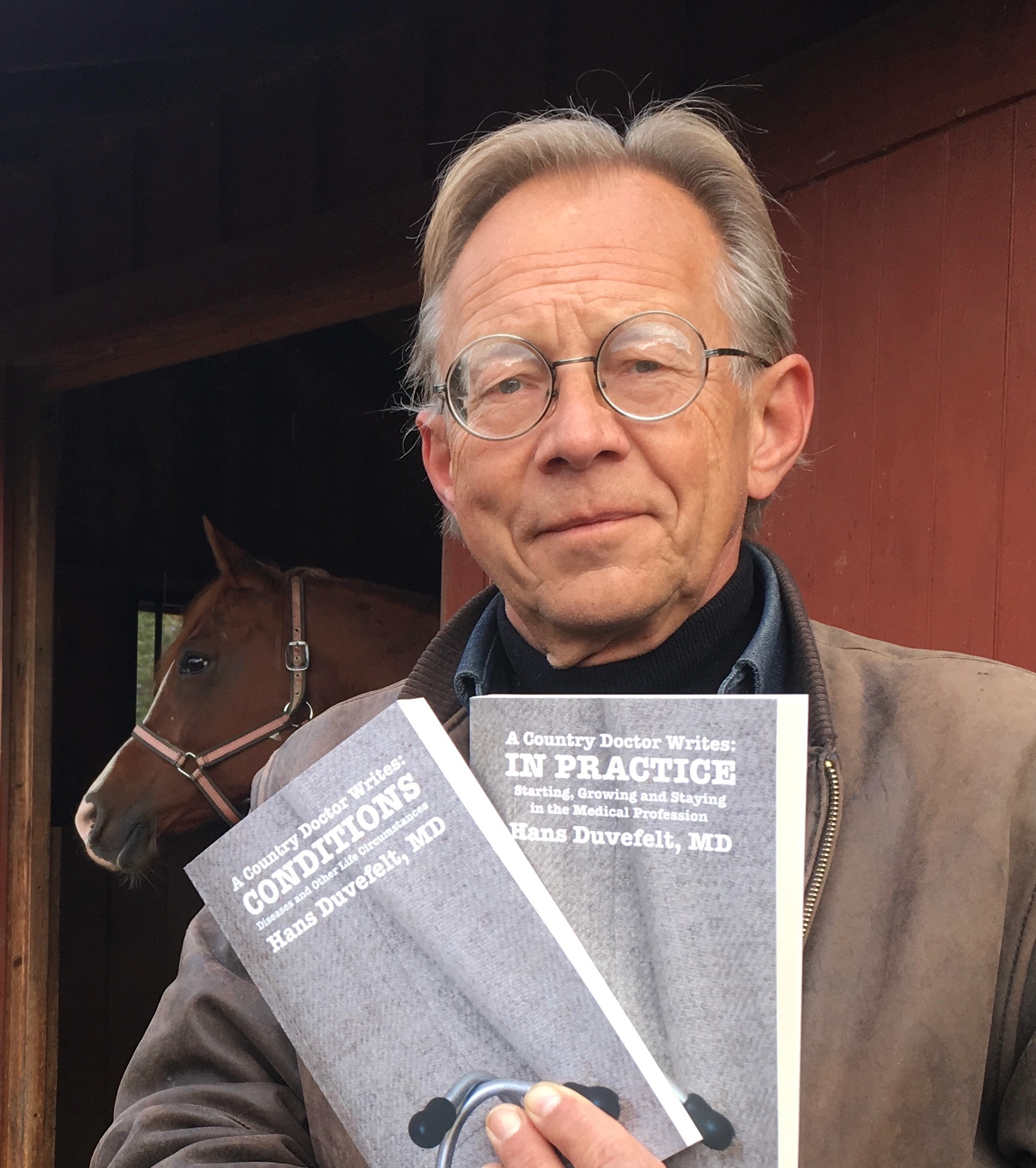
BOOKS BY HANS DUVEFELT, MD

CONDITIONS, Chapter 1: An Old, New Diagnosis

Top 25 Doctor Blogs Award

Doctor Blogs

Enter your email address to subscribe to this blog and receive notifications of new posts by email.

Mailbox

contact @ acountrydoctorwrites.com
Bookmark and Share
© A Country Doctor Writes, LLC 2008-2022 Unauthorized use and/or duplication of this material without express and written permission is strictly prohibited. Excerpts and links may be used, provided that full and clear credit is given.