Archive Page 125

A Christmas Wish

It’s just after six o’clock on a Sunday morning in December. The barn animals have fresh hay and warm water. My wife and the dogs are asleep. The cats are gathered around me as I sit down to write. One of them has jumped up in my lap and is pawing and clawing my jeans.

The fire is roaring in the wood stove but the 1790 room is still cold. I have read the morning news on my iPad. Our house is quiet, always; we don’t have a television or a radio. We have more time to think that way.

I do a lot of thinking these days, even though I put in long hours at work. During my commute to and from the clinic and during the long winter evenings I have plenty of time to think about my role as a doctor at this age, in this place and in these times.

I never wanted to do anything else, and I never want it to end. I cringe when I hear things like the commenter on my blog who wrote “I am sick of it and intend to retire as soon as I am able”. What a shame, what a waste. Kings, Presidents, Supreme Court Justices, Popes and Archbishops don’t usually retire “as soon as they are able”.

In some fields, age and wisdom are valued, especially the combination of the two. In many areas of medicine, at least in this country, doctors aren’t feeling valued at any age or skill level. Many feel like pawns or cogs in big, corporate schemes.

We have allowed ourselves to be devalued, and we as a profession have lost our clarity of vision, our sense of calling. Because of how unappreciated and squeezed we feel, we are at risk of losing our love for mankind, without which we will completely lose our professional purpose. We are thinking too much about production and quality metrics and losing sight of our apostolic and archetypal role in the lives of the patients we serve.

We are too distracted these days; we are practicing medicine with our minds, but not always with our hearts. We need to remember why we are in this profession and we need to stop feeling sorry for ourselves.

Victims of psychological domestic abuse undervalue themselves, overestimate the power of their tormentors and underestimate their own options. They stay in abusive situations sometimes because they don’t see clearly what is happening to them. They become physically isolated and feel shame, isolation and loneliness.

Professional burnout has many similarities with these facets of domestic abuse. But doctors are not really as tortured and trapped as abused spouses. Some of us just feel and act that way. We have one of the most meaningful jobs in the world. What a shame that so many of us want to get out of it while they are still able to do it.

Others have thought and written many wise words, not so often spoken today, about finding meaning in work:

“No man needs sympathy because he has to work, because he has a burden to carry. Far and away the best prize that life offers is the chance to work hard at work worth doing.”
― Theodore Roosevelt

“He who works with his hands is a laborer.
He who works with his hands and his head is a craftsman.
He who works with his hands and his head and his heart is an artist.”
― Francis of Assisi

“The purpose of life is not to be happy. It is to be useful, to be honorable, to be compassionate, to have it make some difference that you have lived and lived well.”
― Ralph Waldo Emerson

A small taste of these ideas is what I wish for those of my colleagues who are unhappy this Christmas.

Reengineering Primary Care (Again)

A few years ago primary care was all about being Patient Centered. But that turned into a bureaucratic set of superficialities that didn’t do half as much for patients’ experiences, let alone outcomes, as many of its proponents had envisioned.

Now, other forces are making us reexamine not only how we do things, but even what we are doing.

Our clinic’s Federal grant for next year will be smaller. A provider is leaving. Medicare is starting to shift from paying us a per visit fee to paying us for reaching randomly chosen quality targets. The mandates of what to fit into each visit are growing continually – very specific alcohol habits, physical activity level, sexual orientation, and on and on.

We only have so many providers, so many nurses and medical assistants and so many exam rooms. Practices around us are losing providers faster than we are, and more and more patients want to enroll with us.

The Patient Centered Medical Home recognition we achieved promised to give us some modest bonus payments, but it also cost us money in its nit-picking implementation, and now we are facing financial issues that overshadow such symbolic bonuses as PCMH incentives. It is simply time to roll up our sleeves and redefine the basics of what we do while trying to figure out how to meet the increasing demands from the community we serve.

We have previously paid lip service to the idea of having staff members work to the top of their license, because we have been stuck in the notion that only providers can enter orders and sign off reports in the electronic medical record, for example. We hold our providers to productivity targets that could easily be much higher with more support staff and more effective work flows, not only in terms of units of service but also “covered lives”.

The time has come for all of us to sit down, management with providers, nurses, medical assistants and clerical staff to look at our unique situation, our resources, our patients and start from scratch:

What can we do, here and now, and what do we envision in our own future, to better serve our patients?

If we don’t have enough providers and don’t expect to get many more – increase support staff and liberate us from unnecessary clerical tasks.

If we don’t have enough exam rooms, create check-in stations between the reception and the clinic area. Use technology to let patients check in via tablets or their own smartphones in the waiting room or even from home before they show up.

If we don’t have enough people to answer the phone to triage and make same-day appointments, open blocks of time for walk-in care, and divide providers’ time between protected time for time-consuming patients and intense stints doing urgent care.

Invest in building better EMR templates for faster documentation.

If we can’t afford or don’t want scribes to follow each provider into each visit, allow use of a paper visit form and hire one data entry person to input a stack of such forms at the end of every day if that might increase provider productivity.

In other words: Imagine local solutions for local needs.

The other day I read these encouraging words in the Harvard Business Review:

“The lesson for leadership is clear: Design your practice to maximize physician capability. Productivity, cost effectiveness, and satisfaction will follow.”

PCMH wasn’t the solution, because its recognition criteria were too rigid. Maybe the latest crises we are facing will turn into opportunities to bring some real life and passion into the next round of changes we must make in how we serve our patients and our community.

As a doctor, I solve problems all day long. As a Medical Director, I welcome the opportunity to bring my experience to the table where all of us can brainstorm in order to redefine, redesign and reengineer what is still a pretty inefficient system.

A Lousy Diagnostician

The tall, youthful seventy year old woman wore her strikingly white hair in a tight bun. She was dressed like a Donald Fagen song – in jeans and pearls (”Maxine”, 1982).

She had an intense burning, itching sensation on the left side of her neck and occiput. Looking closely at her neck and hairline, I saw a couple of small, red papules. A few of them looked like early blisters.

I suspected herpes zoster and offered her a generic antiviral. The earlier you start it, the better your chances of avoiding long lasting pain afterward, I explained.

A week later, there were some red blotches and several scratch marks. Her burning and itching were worse.

I prescribed gabapentin and told her how to titrate herself up from 100 mg at bedtime to 300 mg three times a day.

The following week she still had red blotches and scratch marks and felt no better. I frowned.

She said “My granddaughters have head lice, so I asked my daughter to check me, but she couldn’t find any. Would you check me, just to make sure?”

I leaned close and removed my -11 diopter glasses. My focal point is about one finger length from my corneas.

It took me a while, but I found half a dozen nits, enough to be sure she had the real thing.

Didn’t I feel a little sheepish. Seventy year old woman with burning and itching scalp? Must be zoster, right? Head lice is more of a pediatric problem, right?

Wrong. I narrowed my differential diagnosis too quickly.

And, I didn’t take my glasses off the first time.

Between Patients: The Myth of Multitasking

Primary care doctors don’t usually have scheduled blocks of time to read incoming reports, refill prescriptions, answer messages or, what we are told the future will entail, manage their chronic disease populations. Instead, we are generally expected to do all those things “between patients”.

This involves doing a little bit of all those things in the invisible space between each fifteen minute visit, provided we can complete those visits, their documentation and any other work generated in those visits, in less than he fifteen minutes they were slotted for.

If we can’t capture (steal, really) enough time from our scheduled visits, we are still expected to somehow get that work done, but then on our own time. This results in most primary care doctors logging in to their EMRs from home after supper and on the weekends. Mismatched workloads and work schedule are a major source of professional burnout.

Compare this with air safety. Are airplanes scheduled to be in the air all the time, with refueling and maintenance squeezed in only if they happen to land ahead of schedule?

Quickly reviewing a couple of messages, a few lab results and some imaging reports, and then rushing in to see the next patient is an extremely inefficient and sometimes unsafe way of working.

I have likened this to jumping back and forth between baking a cake, balancing your checkbook and mowing the lawn. Normal people don’t work that way. Why do we expect doctors to?

Neuroscience teaches us that there is no such thing as multitasking. We really only do one thing at a time, and every time we switch from one task to another, we expend mental energy and brain glucose. Switching rapidly between tasks reportedly reduces usable IQ by ten points. Maybe doctors in general have IQ points to spare, but why organize our work that way on purpose?

MIT neuroscientist Earl Miller points out that juggling multiple plates floods the brain with cortisol (the stress hormone) and adrenalin (the fight or flight hormone), which prevents clear thought.

And those are the chemicals involved in burnout. In moderate doses, they are known to boost performance, but constant, low levels of them are the biochemical basis for burnout. We all know that.

My ideal way to work would be “protected” time for Results Review and Care Planning, and then, while another doctor does that, give me two medical assistants and double my number of exam rooms for efficient visits where I have already studied the charts and know better what I’m supposed to accomplish.

And, let me do slow visits grouped together, like physicals and wellness visits, and quick visits together, like sore throats, earches, rashes and knee pains. Slow and fast visits require different mindsets and skill sets. Again, comparing with everybody’s personal life, playing ping-pong or whack-a-mole interspersed with practicing or teaching yoga is very unintuitive an inefficient, at least as far as the yoga part goes.

Kind of like scheduled refueling and maintenance for aircraft…

Appendagitis – Not a Typo

A couple of years ago I saw a young man with pain in his lower right abdomen. I sent him for an urgent CT scan with a “wet read” to check for appendicitis.

It was afternoon and things were crazy at the office. I forgot all about the pending CT report. I have learned this about myself: I am efficient because I have the ability to hyperfocus, but that has made me dependent on my support staff to see the big picture of my schedule or pending, unfinished tasks.

The next morning there was a fax from Cityside with a lengthy explanation saying he had an epiploic appendagitis, and it went on to explain that this is a harmless and self limited condition.

I did some reading. These appendages are little fat bumps that run along the outside of the colon. They can undergo torsion, or twisting, and become acutely inflamed. This condition is found in up to 7% of patients suspected of having appendicitis and 1% of patients with suspected diverticulitis.

I had never heard of appendagitis, and I wondered how certain the distinction was between this harmless and the other potentially lethal -itis was.

Checking with the patient, he was in more pain and more nauseous than the day before.

I suggested going to the ER just to make sure. I just didn’t feel comfortable trusting a CT and a diagnosis I had never heard of. I imagine this is a result of training before CT scans were in use and then not rubbing elbows enough with major surgery to be aware of the finer distinctions of the differential diagnosis in acute abdomens already too sick for the primary care office.

The ER report from Cityside was gracious in its description of why my young patient was there. He got an anti inflammatory medication and some pain pills and went home reassured. He was still uncomfortable when we called him a day later, but feeling better.

The other day I saw a young woman who had been to Mountainview Hospital for left lower quadrant abdominal pain.

She had a history of diverticulosis, and at her young age had already had a CT proven episode of acute diverticulitis a few years earlier. This time, the CT showed a sigmoid epiploic appendagitis with no evidence of diverticulitis. The ER doctor prescribed antibiotics that would have been appropriate if she had diverticulitis.

I saw her two days after the emergency room visit. She was feeling a bit better. Her exam was benign and I explained to her that she didn’t really need the antibiotic. But I also told her it was a rare condition that I had not heard of in my first 35 years of practice. I told her the Mountainview ER doc probably hadn’t seen a case before either, or didn’t trust the CT.

My patient was happy to stop her antibiotics and happy that her diverticular disease was not the cause of her symptoms.

You’re never too old to learn.


I just realized none of the posts show on an iPad or a computer, but they do show on an iPhone. WordPress is working on this. In the meantime, please visit my Substack.


Osler said “Listen to your patient, he is telling you the diagnosis”. Duvefelt says “Listen to your patient, he is telling you what kind of doctor he needs you to be”.


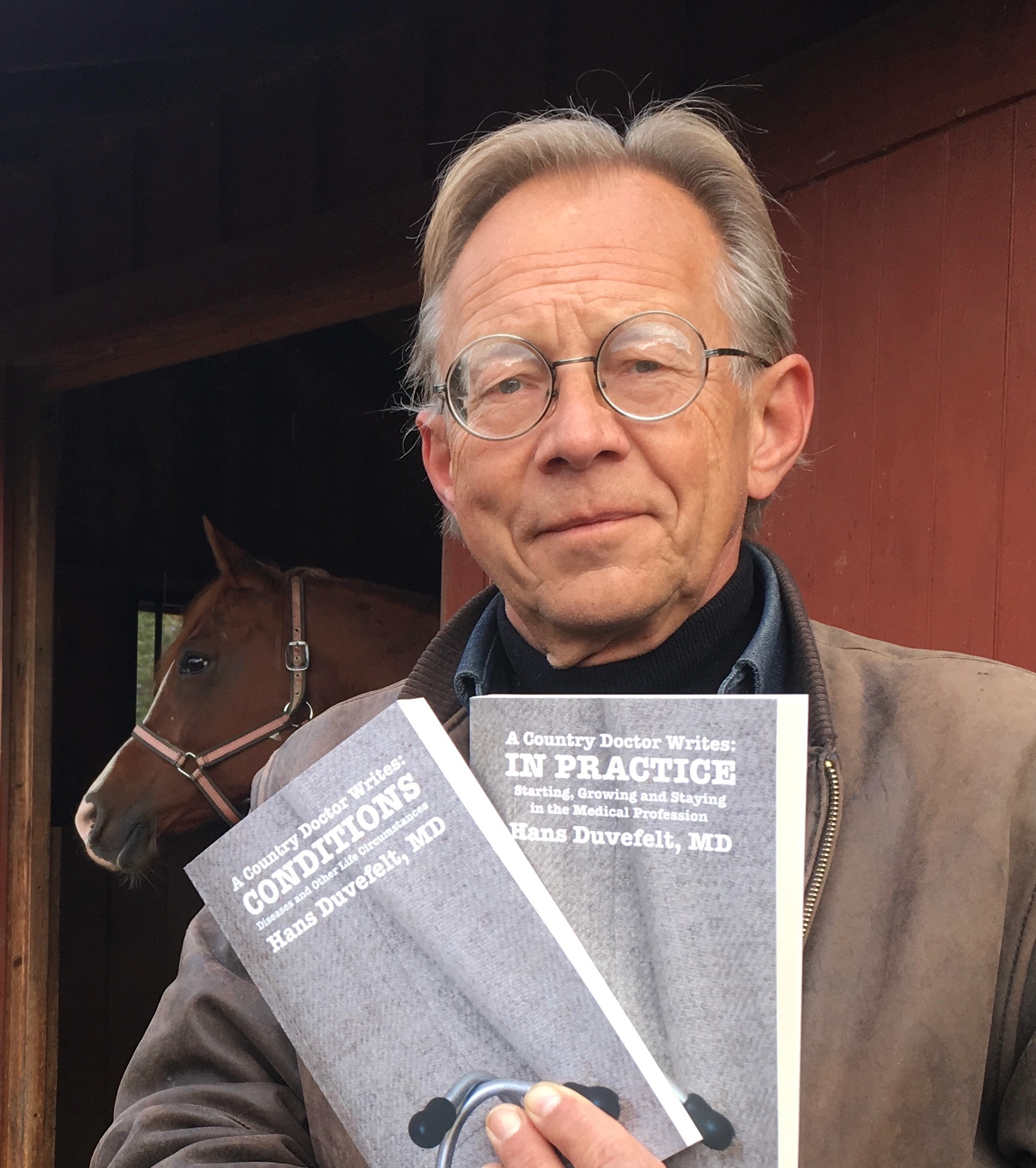
BOOKS BY HANS DUVEFELT, MD

CONDITIONS, Chapter 1: An Old, New Diagnosis

Top 25 Doctor Blogs Award

Doctor Blogs

Enter your email address to subscribe to this blog and receive notifications of new posts by email.

Mailbox

contact @ acountrydoctorwrites.com
Bookmark and Share
© A Country Doctor Writes, LLC 2008-2022 Unauthorized use and/or duplication of this material without express and written permission is strictly prohibited. Excerpts and links may be used, provided that full and clear credit is given.