Archive Page 116

Endocarditis or Not? A Saturday Triage Decision

Saturday clinic. No lab. Just me and a medical assistant.

A fifty year old woman comes in with a fever a couple of days after a dental cleaning. Her gums are sore and she has some bodyaches. I’ve never seen her before. She used to see Dr. Wilford Brown and transferred to Dr. Kim.

The inflammation in her mouth is mild. She has a Grade 1 holosystolic murmur. Nobody has documented that before, but a Grade 1 is usually insignificant and barely worth documenting.

The only other thing I notice on her exam is that she has two thin brown lines under one of her fingernails. Like splinter hemorrhages. But there are only two.

“I banged that finger by accident a month ago, I’m pretty sure those lines have been there since way before my dental cleaning”, she said.

“Hmm, how bad are your bodyaches?”

“I’m not a complainer, I guess you could call them pretty bad.”

Time to make a decision. A judgement call: Hospital for blood cultures, possibly IV antibiotics, or blame the whole thing on a sore mouth and a virus and an incidental fingertip injury. One explanation or three?

Logic seemed to dictate one explanation for three clinical signs: mouth, fever, fingernail. But then there are bodyaches, bad bodyaches.

I made my decision, explained it carefully, and she concurred.

“So, stop in first thing Monday morning for some bloodwork, pick up the prescription I’m sending to the pharmacy, and call us if you don’t hear back from me by 10 am”, I said.

I slept well for two nights and did my Sunday farm chores without thinking much about it.

Monday, 9 am:

Lowish white blood cell count, close to 50% each of lymphocytes and neutrophils.

“I got your bloodwork. How are you feeling?”

“Fine, my mouth feels great and the fever is gone.”

“The blood count looks very typical for a virus.”

Minor mouth infection, viral illness and a banged fingertip. Bingo.

Two Cases of Bubbly Urine

I saw two patients with a chief complaint of bubbles in their urine this month.

One middle aged woman had eaten some wild mushrooms she was pretty sure she had identified correctly, but once her urine turned bubbly a few days later, she came in to make sure her kidneys were okay.

Even though she was feeling quite well they were not and she ended up going straight to Cityside hospital for IV fluids, a kidney biopsy and dialysis. We don’t know yet how much her kidney function will recover and we still don’t know if the mushrooms had anything to do with it.

I saw her in followup the other day and she was taking everything in stride, showing more curiosity than fear and despair.

The other, a woman in her thirties, came in for sudden swelling of her ankles. She mentioned her urine had been bubbly for months. She had googled her symptoms and was convinced she had either acute kidney or heart failure. She felt weak.

Her review of systems had several positives, including joint pain. Specifically, one knee had been swollen and painful for a while.

“Have you taken any ibuprofen or naproxen for your knee?” I asked.

“Yes, why?”

“Nonsteroidals can cause sodium and fluid retention”, I explained.

Her cardiovascular exam was normal.

Because of her obvious anxiety, I minimized the EMR on my computer screen and googled “leg edema NSAIDs” and showed her that Dr. Google agreed with me that this was a plausible explanation.

“The problem with Google is that it displays possible diagnoses without ranking their probability. Exotic things may rank higher because more people look them up”, I explained.

She understood but was visibly not reassured. She did agree to hold the ibuprofen for a while to see if her swelling resolved and to get some labwork to check her kidney function.

So far, I know that her kidney function is perfectly normal. We’ll see if her swelling goes away and stays away.

I didn’t tell her that I once had a woman about her age come in one December day with just a little ankle swelling and, ten years later, ended up with a heart transplant.

As I told another patient the other day, it is my job and not the patient’s to think of the worst case scenarios.

Only Pain and Fear Bring Patients to the Doctor

It’s been said in the world of business that people only buy two things: Good feelings and solutions to problems. In medicine, the single most important factor that brings patients through our doors isn’t a “toward” kind of desire, but an “away” one – away from feeling bad.

More specifically, it is pain and fear that most often cause patients to call and ask for an appointment. They hopefully leave with good feelings and solutions to their problems, but that only happens when we have the knowledge, resources and, perhaps most important, the time to give them the relief they seek from us.

I am not considering the purely administrative functions we perform, but even some of them are more “away” desires, like patients needing a work excuse due to illness out of fear of otherwise losing their jobs. Even getting a flu shot or a physical is often rooted in pure fear of illness.

So, how often do we have the knowledge, resources and time to help our patients escape their torments?

And also, forbid the thought, how often is this relief of suffering in the broadest sense the overarching principle that guides each doctor and each healthcare organization?

In my random readings the other night I came across an article, almost a manifesto, by the British National Health Service from 2011. The document was titled “A Better NHS” and I am quoting the part about patients’ pain and the profound responsibility of the treating physician:

“The commonest reason for visiting a GP is ‘fear’.

Fear that the lump is cancer, that the chest pain is another heart attack, the headache a stroke, like the one that tragically disabled Maureen. Fear that I may die before my children grow up, fear that I may lose my sight, my balance or my mind. Fear that I cannot cope, that I am a failure or that I will be judged unfairly and blamed for my suffering. To be a patient is to be unfamiliar with oneself, to inhabit an unfamiliar shell, barely in control and in need of help. The world and our relationships are radically altered when we are patients.

What an extraordinary job we do. Grounded in a therapeutic relationship, everything we do depends on trust. What an extraordinary responsiblity to be charged with caring for people when they are at their most vulnerable and most easily exploited.

Because of this it is absolutely vital that we are not led into temptation. Just as monks and nuns need to be protected from the distractions of the world so that they can dedicate themselves to God, so we need to be protected from mammon and the perverse incentives of the market-place, so that we can dedicate ourselves to our vocation and our patients, and be the doctor that they need, not the doctor the market makes us.”

This was a call, or a prayer, not to be led into temptation by greed. As employed physicians, which is what most of us primary care physicians now are in the US, our temptations to profit from our patients’ fear, misfortune and illness are limited. Here and now, the temptation we all face is maybe not one of the deadly sins, but it is gaining traction:

Distraction from what really matters is perhaps our biggest temptation and a poison we are constantly exposed to. We let our focus wander away from the patient and toward the clock, away from the therapeutic moment and toward the measurable quality indicators. Even when we embark on practice redesigns to become more patient focused, the certification process itself becomes a distraction from the work we set out to improve.

This week I saw two new patients, both of them with shortness of breath and heart palpitations, both fearful that something was dreadfully wrong. Each one ran over their allotted thirty minutes (my longest appointment type, reserved for new patients and hospital followups) by a good ten minutes, but each one left reassured, one with a clean bill of health, the other with reassurance that only two tests were needed to confirm my clinical assessment that there was nothing serious. Both women gave me a firm handshake, repeated by their largely silent accompanying husbands, both of whom silently mouthed the words “thank you”.

I laid it on fairly thick, I invoked what I sometimes refer to as the source of my calling, and I drew on my experience and they gray hair I have earned recently, and my ability to use simple language and everyday analogies to dispel the mystery of how our bodies work.

Instead of feeling pressured or overwhelmed by these encounters, I felt satisfied and energized. I easily caught up with my schedule and I didn’t give the daily distractions much thought.

I had done some real Doctoring. I had mitigated the fears of two fellow human beings.
Instant Relief

Few things in primary care give patient and doctor mutual and instant gratification.

It’s been a while since I reduced a “nursemaids elbow” or a spontaneous shoulder dislocation other than my own, or a finger dislocation, but those all count.

I once wrote about curing deafness in a man with a movement disorder by flushing ear wax more or less on the run as he bobbed around the exam room. That was instantly rewarding and also both exhausting and exciting. Even more ordinary cases of cerumen impaction are rewarding to treat. I almost never let my medical assistants get the satisfaction, or the risk, associated with that procedure.

A few months ago a man came to my Saturday clinic with a plastic tip from his hearing aid lodged sideways deep inside his ear canal. With the help of my modern headlamp (I trained on the cartoonish forehead mirror ENT doctors used to sport) and a delicate long pair of forceps I was able to remove it and relieve the stranger’s suffering.

Often, I delight in asking a patient to make the shoulder movements that hurt them so much a few minutes earlier and now feeling no pain, confirming that my steroid-Xylocaine (Hurrah Sweden!) injection hit the right spot.

A few weeks ago I saw a patient for an unrelated problem, who had recently received a nerve block by a nurse practitioner to the minor occipital nerve. The patient had presented with severe pain on the side of her head and the shot gave instant relief. I had never heard of that injection, so I read up on it.

Wouldn’t you know it, the following week I saw a different woman with an excruciating pain on the left side of her head. The pain seemed to originate in the back of her head. She was tender on the scalp over her ear and even more so over the lesser occipital nerve. She agreed to an injection. It was instantly successful.

In medical school it was “see one, do one, teach one”. This time it was “read about it, then do it”. Now I’m ready to teach it, thanks to a clinician with fewer years of education, born well after I started medical school. I’ll happily learn from anyone who knows something I don’t.

Lists of Three: Unforgettable Lessons from Medical School

A few weeks ago, I saw a patient with shortness of breath during my Saturday clinic. He had been short of breath for a few of weeks, and on a couple of occasions he had also experienced mild chest pain. He has known aortic stenosis, moderate according to his last echocardiogram two years ago.

My brain kicked into autopilot and I asked “have you fainted or passed out recently?” It was a flashback to medical school, where it seemed we were inundated with lists of threes.

For aortic stenosis, the triad of surgical indications for critical degrees was: Angina, synkope (remember I’m Swedish) and svikt, which is Swedish for failure, specifically congestive heart failure.

I’ve already written about a diagnosis right under my nose that I missed because the onset was so gradual: Dementia, urinary incontinence and gait disturbance, the diagnostic triad of normal pressure hydrocephalus.

A few months ago a crackerjack nurse practitioner came to me with the question: “What’s the syndrome with a droopy eyelid and a small pupil?”

“And a sunken-in eyeball?” I added.

“Yes!” She exclaimed.

“Horner’s Syndrome”, I proclaimed. “I still remember it from medical school and from a patient and my first Persian cat who both had sinus cancer.”

I don’t know why there are all these diagnostic triads out there, is it by some divine design or just because medical students can only retain short lists because of the multitude of diagnoses we have to memorize?

Where would we be without memorization? Sure, we could use computers to sift through endless lists of symptoms, most of which are red herrings, but there’s nothing quite as satisfying as knowing, in an instant, what the diagnosis is.

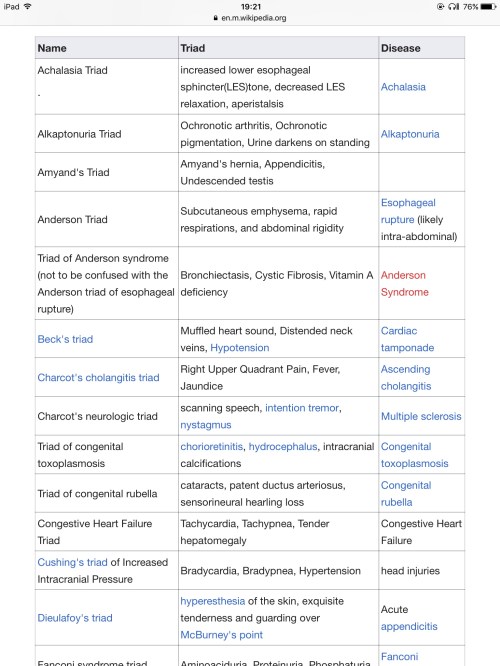
Wikipedia has a list of fifty clinical triads:

https://en.m.wikipedia.org/wiki/List_of_medical_triads_and_pentads

And, I almost forgot, last week I saw a patient with Reiter’s Syndrome, now called Reactive Arthritis: Persistent conjunctivitis, frequent urination and migrating arthritis that all began after a bout of severe diarrhea. She had already seen one other primary care clinician and her optometrist and both knew there was a bigger, overarching diagnosis behind her eye irritation. I was the one who nailed it.


I just realized none of the posts show on an iPad or a computer, but they do show on an iPhone. WordPress is working on this. In the meantime, please visit my Substack.


Osler said “Listen to your patient, he is telling you the diagnosis”. Duvefelt says “Listen to your patient, he is telling you what kind of doctor he needs you to be”.


BOOKS BY HANS DUVEFELT, MD

CONDITIONS, Chapter 1: An Old, New Diagnosis

Top 25 Doctor Blogs Award

Doctor Blogs

Enter your email address to subscribe to this blog and receive notifications of new posts by email.

Mailbox

contact @ acountrydoctorwrites.com
Bookmark and Share
© A Country Doctor Writes, LLC 2008-2022 Unauthorized use and/or duplication of this material without express and written permission is strictly prohibited. Excerpts and links may be used, provided that full and clear credit is given.