Archive Page 117

Suboxone for Pain? Not in Maine

Many patients who end up in Suboxone treatment have chronic pain. They were originally prescribed other opiates and ended up addicted to them.

Skeptics argue that his is just substituting one opiate for another. But that isn’t quite accurate. More on that in a bit.

In my seven years of prescribing Suboxone for opiate addiction, I have often observed how potent a pain reliever this medication is, even in fairly low doses. More on why in a bit, too.

Now and then I hear about patients who are prescribed Suboxone for pain and not for addiction. I’m not sure exactly how that is done, since Maine law requires prescribers not only to include our Suboxone license number, but also the ICD-10 diagnosis code (F11.20, opiate use disorder) on the electronic prescription.

We also, in the case of some national pharmacy chains (Walmart) who don’t understand the Maine law, have to add “Chronic”, which is only of relevance as opposed to “Acute” when it comes to pain. Medication Assisted Treatment is always chronic. Also, they require us to put “Code D”, which is indeed a Maine Exemption Code for Medication Assisted Treatment, but only relevant when the Suboxone (or methadone) treatment exceeds 100 Morphine Milligram Equivalents (MME).

Anyway, even though you have to indicate the diagnosis of addiction on scripts, I hear there are several Maine doctors who prescribe Suboxone for pain. The more I think about it, and the more I read up on it, the more sense it makes. But I’m not going to break any laws just because it makes sense.

This is what I know:

Buprenorphine, the opiate ingredient in Suboxone, is a partial (opiate) mu-agonist, which is the most obvious explanation why it has any analgesic properties at all. But it is also an ORL1 (nociceptin) agonist, which is another pain relieving mechanism. This one is among several proposed mechanisms for why buprenorphine has been shown to reduce Opioid Induced Hyperalgesia, a Fibromyalgia-like state of generalized increased pain perception that paradoxically can make patients with, say, opioid treated back pain start to hurt absolutely everywhere.

In fact, it has been observed that there is analgesic effect at lower doses than usually required for management of opiate cravings.

Buprenorphine is superior to traditional opioids for nerve pain and, because it also is a Kappa-opioid antagonist, it has antidepressant and anxiolytics properties.

Buprenorphine has fewer side effects than straightforward opiates, specifically less constipation, less sedation, less immunosuppressant effect, less induction of gallbladder spasm (morphine is a bad choice for gallbladder attacks), less or even no decrease in sex hormones, less risk for heart rhythm problems (QT abnormalities) and it is even safe to use in older patients with chronic kidney disease.

But the law is the law. Suboxone is for addiction only. How soon will that change?

Follow link (here) for in-depth background reading about buprenorphine.
Flirting With Functional Medicine

“I used to brag that I was taking all those medications so I could keep eating anything I wanted. I guess that isn’t working anymore”, said the rotund sixtysomething man in front of me.

I had never met him before, but I have seen plenty of people like him. His Hemoglobin A1c had been rising steadily over several years, and now his diabetes was way out of control and his copays for all the newfangled pills and shots he was taking were crippling his retirement lifestyle just as much as his obesity and neuropathy were.

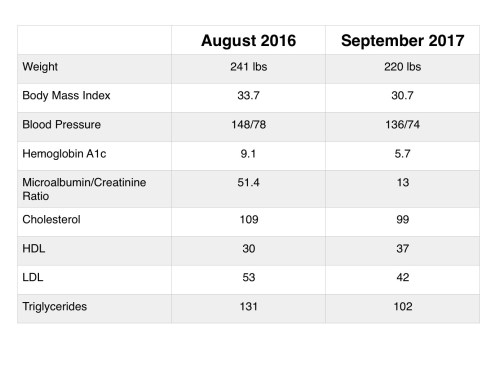
I delivered my usual, miniature plain talk monologue, aided by my personal iPad. I have a table of what happened to another patient’s numbers in one year following such an intervention.

.

I call this person my “flex fuel man”, because, just like many cars, our bodies can run on different kinds of fuel, but most people are hesitant to switch fuel even though what they’re using now clearly isn’t working anymore.

I tell my diabetic patients that I agree with the notion that a balanced diet is generally best, but that their diet so far has probably been unbalanced enough to completely stress their carbohydrate burning system. It is as if they have already had their lifetime supply of carbohydrates and they now need to correct that imbalance.

The man in front of me became enthusiastic and said he would stop eating processed, carbohydrate rich foods and eat more like our ancestors, more similar to my own post-vegetarian diet (more on that here).

Thinking more deeply about these conversations that I am having more and more often, I guess I am steadily moving closer to what has had many names and permutations but has now become known as Functional Medicine.

Chronic disease is crippling our people and our healthcare system. Like the man said, many medications, blockbuster drugs, are developed and promoted so people can keep doing what is obviously hurting them. This is true for diabetes, hypertension and countless chronic disease processes we know to be linked to inflammation, gut bacterial imbalance and more or less subtle nutritional deficiencies and toxin buildups.

Functional Medicine is about addressing these root causes of disease.

I, for one, am starting to devote a few of my precious fifteen minutes with patients to the conversation starter “There is another way to handle this”.

Monday night, I registered for some free classes with the Institute of Functional Medicine and on my way up to Van Buren Tuesday night I finished Chris Kressler’s audiobook “Unconventional Medicine”.

My experiences with curing diabetes have nudged me toward a new journey.

How Often Should Doctors Check Labwork?

Back when cholesterol target numbers ruled unopposed (before 2013), we all checked fasting lipids every three months. Before 2012, we also checked liver function quarterly in hapless riders on the cholesterol pill merry-go-round. That year the FDA announced there had not been enough reports of statin induced liver problems to recommend routine monitoring.

I have many colleagues who still do this, and who also routinely monitor routine labs quarterly or even more often on patients on blood pressure pills and sometimes even in the absence of high risk medications, “just in case”.

For patients on the traditional blood thinner, warfarin, many colleagues monitor blood work on an almost weekly basis, and home-testing requires weekly testing in order to be reimbursed.

There is a problem with 1) doing blood tests often and 2) paying close attention to those numbers.

I liken this to driving your car in a snow storm with your high beams on. When you do this, you see way too many distracting snowflakes immediately ahead of you, and not enough of the road further ahead, to see where you are going.

This myopic arrangement tempts you to overcorrect your steering wheel angle; the road suddenly appears to curve in either direction and you assume you are entering a major curve, but it is just a slight wiggle in an essentially straight roadway. This could make you drive into the ditch.

The healthy way to drive in a snowstorm is to turn off the high beams and paradoxically see further ahead by not emphasizing all the snowflakes just ahead of the car hood. There is less detail in this view but a better sense of the general direction of the road.

Doctors overcorrect too often. Warfarin dosing is a common and frightening example. Over the years I have often seen the practice of ordering based on only the current dose and the current PT/INR value.

Say the INR is 1.5 (should be 2-3) on 5 mg of warfarin. The doctor orders 7.5 mg daily without seeing that two months ago when the patient was given that dose, the INR shot up to 3.9. Even electronic medical records sometimes display the current value (and/or the place to order and “sign off” on it) in a whole different area from where we see historical values and dosing (Any reference to Greenway or eClinicalWorks here is purely coincidental). This causes a risk for overcorrection very much like my winter driving example.

The same thing happens with all kinds of laboratory parameters. Recently I saw a man who periodically had to take a diarrhea inducing drug to treat high serum potassium. His kidney function is mildly reduced. After a lot of detective work, going back over bloodwork and medication orders two years back, I saw that a colleague had stopped the patient’s fluid/blood pressure medication, hydrochlorothiazide, one day when the kidney number jumped up a little. That medicine wastes potassium. Ever since, there had been incidents of high potassium, causing physician worry and subsequent emergency prescriptions for the diarrhea causing rescue medication.

Looking back and forth in time, I realized that the patient’s kidney numbers had fluctuated in the same range two years before and two years after the stopping of the fluid pill. I restarted it and don’t expect to have to fuss with high potassiums again. I believe this was another case of myopic laboratory analysis.

Some amount of testing is necessary, for example after starting a new medication like lisinopril, to make sure the kidneys tolerate it (people with poor blood flow to the kidneys don’t handle this medication well), but there has to be limits to how paranoid we continue to be about the medicines we prescribe for bread and butter medical problems; if ordinary drugs are that scary, should we even be using them?

What is a Dose of Psychotherapy?

I don’t know how many times a patient has told me “I was in therapy once, and it didn’t help”.

My response is always: “That’s like saying ’I saw a movie once and I didn’t like it’”.

That usually breaks the ice just a little.

In primary care we certainly run into a few patients with chronic mental health problems that could use some long term, in depth counseling. But usually patients in my practice have a specific problem they need help with.

So I went to my Director of Behavioral Health and asked: “Would you be able to offer a couple of sessions for people with insomnia, retirement quandaries, illness in he family…you know, typical life change stuff”.

He got inspired and came back to me a few weeks later with rough outlines for more than two dozen structured interventions for common psychological scenarios.

A month later, he mused about the concept of “a dose of behavioral health treatment”, like a treatment plan for any medical condition where cure or remission is anticipated: Ten days of penicillin, five weeks of radiation, several courses of chemotherapy or whatever.

Mental health agencies around me are struggling with how to adapt to the times we live in. Neither patients nor insurance companies want decades of psychoanalysis. Today, it’s all about solution focused therapy. My Behavioral Health guy is ahead of the curve by structuring interventions for common problems with a “curriculum” to show patients, insurers and referring clinicians.

We are doing that with chronic pain. Any patient who needs ongoing pain medication is required to attend four individual sessions to learn about what pain is, how the brain is the center of the pain experience, and how our pain experience can be altered by internal and external factors. We don’t use “pain scales” for the simple reason that pain is never objective.

We now have formalized treatment plans for a long list of common psychological symptoms, centered on one-on-one assessment and education with heavy doses of between session assignments.

Like the now so popular “coaching” modality, we explore drivers of thoughts and behaviors and challenge patients to get out of the ruts they feel so trapped inside.

The title of a 1996 book I bought around then at the Harvard COOP, skimmed through and put on a shelf, is frequently on my mind. I need to get back to it and see if it is really about what we are now doing. But even if it’s not, the title itself is beautifully inspiring:

“Doing What Works in Brief Therapy” by Ellen K Quick.

Update: The book is on Amazon and new ones are now fetching collector prices. I’m really enjoying it.

Where is Relationship, Authority and Trust in Healthcare Today?

Healthcare is on a different trajectory from most other businesses today. It’s a little hard to understand why.

In business, mass market products and services have always competed on price or perceived quality. Think Walmart or Mercedes-Benz, even the Model T Ford. But the real money and the real excitement in business is moving away from price and measurable cookie cutter quality to the intangibles of authority, influence and trust. This, in a way, is a move back in time to preindustrial values.

In primary care, unbeknownst to many pundits and administrators and unthinkable for most of the health tech industry, price and quality are not really even realistic considerations. In fact, they are largely unknown and unknowable.

The real price in primary care isn’t just the cost of each doctor visit. It is the cost of the total number of visits needed to solve a problem, and also the cost of the various tests, procedures and treatments each primary care doctor orders when solving that problem or managing a particular condition. This can vary enormously.

In Accountable Care Organizations, actual costs are compared to presumed or projected costs, which are based on Hierarchical Code Categories (see my post), which aren’t well known or commonly used by primary care doctors. To a degree, you can game this baseline cost calculation by mastering HCCs (Medicare Advantage plans’ financial well being hinges on making the most of this; this is why they offer doctors $150 to sign off on a list of each patient’s known or suspected expensive diagnoses).

Quality in healthcare is largely in the eye of the beholder. I’ve said it before and I’ll say it again here: A patient population’s immunization rates or aspirin use or non-use (depending on shifts in knowledge) are not comprehensive measures of quality. Accuracy of diagnosis, if anything, is. But who is measuring that? You might say “those who can’t practice medicine measure it”. That’s why most quality measures these days are of things you don’t need a medical degree or license to accomplish.

Primary care, in the eyes of our patients, is instead about relationship, authority, trust and (gasp) convenience. This is what people in most other businesses talk about all the time. It is what even tech and medicine pundits, EMR companies and many other middlemen want for themselves. They don’t want to be evaluated on the basis of price or quality standards set by others. Yet they want mass market medicine for the masses, not relationship based care.

Driving 200 miles between my two clinics, I often listen to audiobooks. Once I finished my Board Review, I turned to business books. “Influence”, “Authority”, “Brand”, “Story” and “Content” have replaced “Quality”, “Six Sigma” and “Excellence”. In business now, it is all about standing out and setting your own standards. It is about building relationships with and listening to consumers.

In healthcare, I see the paradox that insurers are now reaching out to patients to check up on them while at the same time making doctors work so hard and so fast producing “encounters” that there is less and less time for us to talk with our patients when we are with them, and never mind on the phone in between visits. Do they really think patients wouldn’t rather see their own doctors having enough breathing room to talk to them than have some strangers from out of state they never met calling to check in?

We have data that the doctor-patient relationship influences outcomes. From hospitalization rates to prescription adherence to effectiveness of treatments for mental health diagnoses, it is well known that the doctor is a large part of the treatment.

Doctors have increasingly become part of multicenter systems that, in spite of efforts like Patient Centered Medical Home recognition, simply have become too large and impersonal to foster the kind of customer relationships the business world is now realizing are necessary.

Between the bottom-line objectives of such healthcare organizations and the bureaucracies of health insurers, doctors and patients are clearly not in complete charge of their own relationships anymore.

So what happens with those relationship dependent outcomes when so many doctors feel like lineworkers, rather than professionals? What happens to their ability to nurture those relationships, gain that authority and earn that trust?

What happens if they lose it altogether?

There are modern, big companies who listen to their customers, even research and anticipate their customers’ needs. There are companies that empower their employees to solve customer problems, give refunds and do extras. There are companies who treat employees like owners or even offer them actual ownership.

Healthcare could do some more of that.

But there is more, lest we forget: Doctors aren’t just employees.

Who has the license to practice medicine? Who places the needle or scalpel? Who selects the medication? Who says “I’m sorry, we did everything we could” or “Congratulations, it’s a beautiful baby girl”?

Salespeople, YouTube stars and business leaders give a lot of thought to their customer relationships, their personal authority and the essentials of building and maintaining trust.

Are we doctors doing enough of that? Those things are ours to claim, and to strive for. Even if a big corporation issues our paycheck.


I just realized none of the posts show on an iPad or a computer, but they do show on an iPhone. WordPress is working on this. In the meantime, please visit my Substack.


Osler said “Listen to your patient, he is telling you the diagnosis”. Duvefelt says “Listen to your patient, he is telling you what kind of doctor he needs you to be”.


BOOKS BY HANS DUVEFELT, MD

CONDITIONS, Chapter 1: An Old, New Diagnosis

Top 25 Doctor Blogs Award

Doctor Blogs

Enter your email address to subscribe to this blog and receive notifications of new posts by email.

Mailbox

contact @ acountrydoctorwrites.com
Bookmark and Share
© A Country Doctor Writes, LLC 2008-2022 Unauthorized use and/or duplication of this material without express and written permission is strictly prohibited. Excerpts and links may be used, provided that full and clear credit is given.


