Archive Page 113

Will Technology Keep Us From Thinking?

The New York Times quotes Plato’s play Phaedrus to make a point about Facebook’s use of data. They make the claim that “Technology promises to make easy things that, by their intrinsic nature, have to be hard”.

In the play, a wise king, Thamus, is offered the art of writing by the god Theuth.

The art of writing, Theuth said, “will make the Egyptians wiser and give them better memories; it is a specific both for the memory and for the wit.”

But Thamus rebuffed him. “O most ingenious Theuth,” he said, “the parent or inventor of an art is not always the best judge of the utility or inutility of his own inventions to the users of them.”

The king continued: “For this discovery of yours will create forgetfulness in the learners’ souls, because they will not use their memories; they will trust to the external written characters and not remember themselves.”

It struck me how this analogy is also perfectly applicable to the new technologies entering the field of medicine, from EMRs with “Decision Support” to Artificial Intelligence.

Just like there are store clerks who can’t make change (for customers who still pay with money) or school children who can’t multiply without a calculator, will the doctors of the future be helpless if dislocated from the propping up we are now starting to expect should they ever have to practice in a natural disaster, remote area or mass computer hacking situation?

(P.S. This reminds me of something I read in The Lancet years ago. They tried to coin McCoy’s Syndrome for when Star Trek like doctors rely too much on technology.)

A Country Doctor Reads is Moving

When I started blogging I put my random reads on a separate blog. After much pondering I have decided to bring both blogs under one roof. So from now on I’ll put both kinds of posts on A Country Doctor Writes.

Older posts from A Country Doctor Reads will remain as an archive at their original address:

http://acountrydoctorreads.wordpress.com

Teflon Doctors and Velcro Patients

I guess I should take it as a compliment when patients come to see me after visiting a specialist and ask me a bunch of difficult specialty-related questions.

“Did you ask the specialist that?” I typically ask, and the the answer will be a plain “no”.

I’ve seen it in action. Some doctors speak quickly, say a lot, and exude so much authority that it’s hard to stop and question them. There is also the fact that on a first visit there isn’t yet much of a doctor patient relationship.

As a long term family doctor, I’m probably viewed as more approachable and less intimidating and therefore end up getting the questions that didn’t get asked in the consultation.

I think a lot about this balance of ours – when and how to engage deeply and with a large “contact area” and when to appear close without engaging or attaching too much. Still remembering when the Teflon frying pan technology, first patented in 1954, took Sweden by storm in the sixties, I use the metaphor “Teflon doctors”.

I consciously move back and forth along this spectrum. In line with my effort to be the kind of doctor my patient needs in a particular situation, I think there are times when I should “stick” and times when I need to be like Teflon.

When a patient hesitates tackling an important issue or feels desperately depressed or disconnected, it is my role to “stick” tight and help them stay with their task or avoid drifting emotionally. But on the other hand, there are times when I don’t let anything stick to me.

The other day when a patient started listing all the minor to moderate aches and pains he’d been saving up for his once a year routine physical, I mentally took a step back and, sensing he was looking for pain medications, said:

“If you have specific pains or orthopedic issues, I or an orthopedist can look into them, but my first duty in a physical is to go over the big health risks you may be facing at your age. Today I will focus on if all your pains are part of a bigger picture, some underlying disease, or if your body just has a lot of wear and tear.”

When patients are suffering in large or small ways, doctors risk feeling like they “own” the patient’s problem. We never do. We are guides, supports, experts and even friends, but we should never shoulder a patient’s problems for them, no matter how much love and empathy we feel for our patients as fellow human beings. Taking over their problem weakens them and creates an unhealthy dependence.

Being “Teflon Doctor” and still helping the patient is an art to cultivate. It involves putting the patient at the center, by saying things like, “how do you feel when…” and “what have you found to be helpful when…”

Sometimes we come across patients who are like Velcro, another product of my childhood, patented in Switzerland in 1955. Perhaps a more common word doctors use for such patients is “sticky”. Fancy talking doctors call them “Frontal lobey“. This is because people with frontal lobe lesions can exhibit symptoms like inability to make decisions and lack of the ability to interact, feel joy and express spontaneity.

One review of the function of the frontal lobe puts it this way:

“The evolution of the human frontal lobes lies at the very essence of the characteristic behavior of humans. Everyday traits that define our existence, both socially and as individuals, have important substrates in the frontal lobes: humor, intuition and insight, deception and truthfulness, optimism and skepticism, affection and hatred, and inspiration. One of the great tragedies for patients and their families is a disease of the frontal lobes that destroys the distinctive personality around which a whole life has been built.”

All doctors have known patients who have difficulty moving forward or away from a minute topic or medical history item, who keep coming back to a thought, often kept on a list of concerns, and who seem unable to grasp a bigger picture.

What I tend to do in order to move forward with patients like that is to “chunk it down”. I try to create smaller steps, descriptions, decisions and interventions. But it is hard work and it almost always takes more than fifteen minutes.

Unless you’re a better Teflon Doc than I am…

Suboxone for Pain? Not in Maine

Many patients who end up in Suboxone treatment have chronic pain. They were originally prescribed other opiates and ended up addicted to them.

Skeptics argue that his is just substituting one opiate for another. But that isn’t quite accurate. More on that in a bit.

In my seven years of prescribing Suboxone for opiate addiction, I have often observed how potent a pain reliever this medication is, even in fairly low doses. More on why in a bit, too.

Now and then I hear about patients who are prescribed Suboxone for pain and not for addiction. I’m not sure exactly how that is done, since Maine law requires prescribers not only to include our Suboxone license number, but also the ICD-10 diagnosis code (F11.20, opiate use disorder) on the electronic prescription.

We also, in the case of some national pharmacy chains (Walmart) who don’t understand the Maine law, have to add “Chronic”, which is only of relevance as opposed to “Acute” when it comes to pain. Medication Assisted Treatment is always chronic. Also, they require us to put “Code D”, which is indeed a Maine Exemption Code for Medication Assisted Treatment, but only relevant when the Suboxone (or methadone) treatment exceeds 100 Morphine Milligram Equivalents (MME).

Anyway, even though you have to indicate the diagnosis of addiction on scripts, I hear there are several Maine doctors who prescribe Suboxone for pain. The more I think about it, and the more I read up on it, the more sense it makes. But I’m not going to break any laws just because it makes sense.

This is what I know:

Buprenorphine, the opiate ingredient in Suboxone, is a partial (opiate) mu-agonist, which is the most obvious explanation why it has any analgesic properties at all. But it is also an ORL1 (nociceptin) agonist, which is another pain relieving mechanism. This one is among several proposed mechanisms for why buprenorphine has been shown to reduce Opioid Induced Hyperalgesia, a Fibromyalgia-like state of generalized increased pain perception that paradoxically can make patients with, say, opioid treated back pain start to hurt absolutely everywhere.

In fact, it has been observed that there is analgesic effect at lower doses than usually required for management of opiate cravings.

Buprenorphine is superior to traditional opioids for nerve pain and, because it also is a Kappa-opioid antagonist, it has antidepressant and anxiolytics properties.

Buprenorphine has fewer side effects than straightforward opiates, specifically less constipation, less sedation, less immunosuppressant effect, less induction of gallbladder spasm (morphine is a bad choice for gallbladder attacks), less or even no decrease in sex hormones, less risk for heart rhythm problems (QT abnormalities) and it is even safe to use in older patients with chronic kidney disease.

But the law is the law. Suboxone is for addiction only. How soon will that change?

Follow link (here) for in-depth background reading about buprenorphine.

Flirting With Functional Medicine

“I used to brag that I was taking all those medications so I could keep eating anything I wanted. I guess that isn’t working anymore”, said the rotund sixtysomething man in front of me.

I had never met him before, but I have seen plenty of people like him. His Hemoglobin A1c had been rising steadily over several years, and now his diabetes was way out of control and his copays for all the newfangled pills and shots he was taking were crippling his retirement lifestyle just as much as his obesity and neuropathy were.

I delivered my usual, miniature plain talk monologue, aided by my personal iPad. I have a table of what happened to another patient’s numbers in one year following such an intervention.

.

I call this person my “flex fuel man”, because, just like many cars, our bodies can run on different kinds of fuel, but most people are hesitant to switch fuel even though what they’re using now clearly isn’t working anymore.

I tell my diabetic patients that I agree with the notion that a balanced diet is generally best, but that their diet so far has probably been unbalanced enough to completely stress their carbohydrate burning system. It is as if they have already had their lifetime supply of carbohydrates and they now need to correct that imbalance.

The man in front of me became enthusiastic and said he would stop eating processed, carbohydrate rich foods and eat more like our ancestors, more similar to my own post-vegetarian diet (more on that here).

Thinking more deeply about these conversations that I am having more and more often, I guess I am steadily moving closer to what has had many names and permutations but has now become known as Functional Medicine.

Chronic disease is crippling our people and our healthcare system. Like the man said, many medications, blockbuster drugs, are developed and promoted so people can keep doing what is obviously hurting them. This is true for diabetes, hypertension and countless chronic disease processes we know to be linked to inflammation, gut bacterial imbalance and more or less subtle nutritional deficiencies and toxin buildups.

Functional Medicine is about addressing these root causes of disease.

I, for one, am starting to devote a few of my precious fifteen minutes with patients to the conversation starter “There is another way to handle this”.

Monday night, I registered for some free classes with the Institute of Functional Medicine and on my way up to Van Buren Tuesday night I finished Chris Kressler’s audiobook “Unconventional Medicine”.

My experiences with curing diabetes have nudged me toward a new journey.


I just realized none of the posts show on an iPad or a computer, but they do show on an iPhone. WordPress is working on this. In the meantime, please visit my Substack.


Osler said “Listen to your patient, he is telling you the diagnosis”. Duvefelt says “Listen to your patient, he is telling you what kind of doctor he needs you to be”.


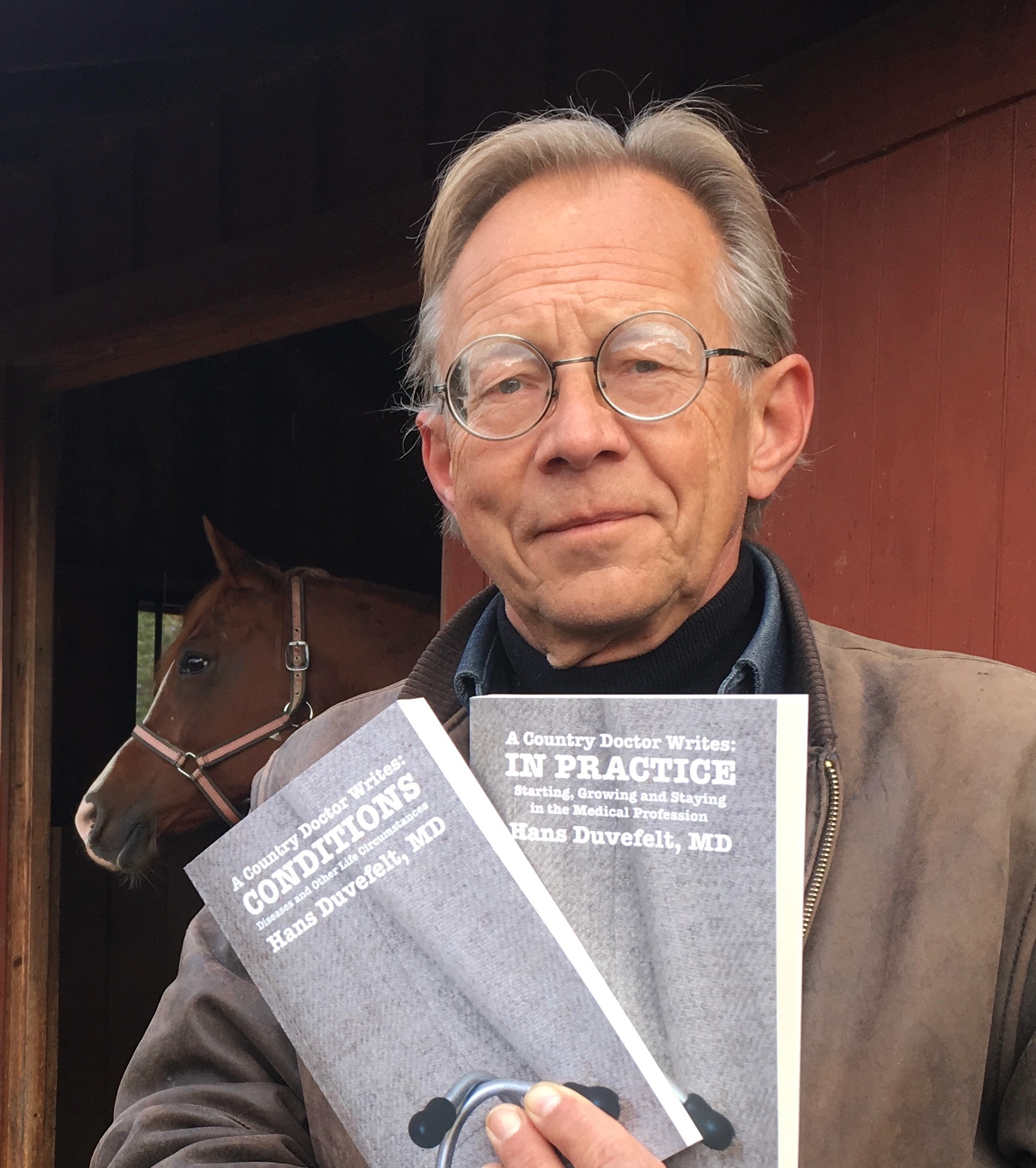
BOOKS BY HANS DUVEFELT, MD

CONDITIONS, Chapter 1: An Old, New Diagnosis

Top 25 Doctor Blogs Award

Doctor Blogs

Enter your email address to subscribe to this blog and receive notifications of new posts by email.

Mailbox

contact @ acountrydoctorwrites.com
Bookmark and Share
© A Country Doctor Writes, LLC 2008-2022 Unauthorized use and/or duplication of this material without express and written permission is strictly prohibited. Excerpts and links may be used, provided that full and clear credit is given.