Archive Page 111

A Country Doctor Reads: January 26, 2019

Average is No Longer Normal – The New York Times & The British Medical Journal

I didn’t have a real handle on what the average weight or BMI in this country is. But recently NYT announced:

“Meet the average American man. He weighs 198 pounds and stands 5 feet 9 inches tall. He has a 40-inch waist, and his body mass index is 29, at the high end of the “overweight” category.

The picture for the average woman? She is roughly 5 feet 4 inches tall, and weighs 171 pounds, with a 39-inch waist. Her B.M.I. is close to 30.”

https://www.nytimes.com/2019/01/14/health/height-weight-americans-cdc.html?smprod=nytcore-ipad&smid=nytcore-ipad-share

So, cause for pause: In a few years, the average American will be obese. Will someone then advocate for redefining obesity?

I also didn’t have the exact correlation between BMI and all cause mortality, so I googled for an answer and came up with a 2016 paper in the British Medical Journal with a systematic review of 230 cohort studies with 3.74 million deaths among 30.3 million participants. This paper puts ideal BMI between 22 and 24, and the relative risk at the average American BMI of 29 is in the 1.2 range compared to people with ideal BMI.
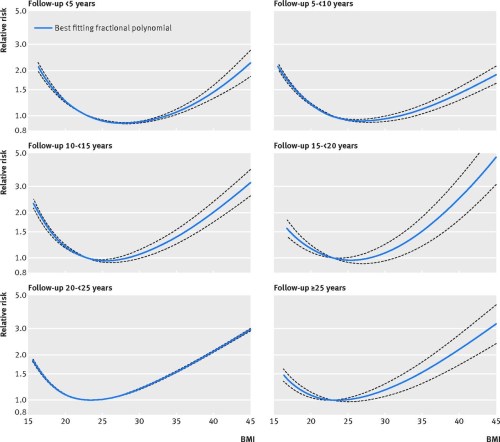
It is sobering to look at the exponential increase in death risk when BMI exceeds ideal: 20% excess risk for even average Americans, 50% greater risk at a BMI of 35 and double the risk at a BMI of 40.

https://www.bmj.com/content/353/bmj.i2156


Better Words for Better Deaths – The New England Journal of Medicine

I appreciate the philosophical pieces in many of the major medical journals. Medicine isn’t only about technology.

Ours is a vocation of emotion and communication; we work with words and need to use them wisely.

Linguist-turned-doctor Anna DeForest writes about the words we use for when patients die and also of the words doctors use when we acknowledge that death is inevitable.

DeForest writes about how she stopped using the D-word:

“I was an intern with a half-year of training, and we saw five deaths in the first week before I stopped counting. “He’s gone,” we’d say. “She passed, we lost her.” Or when we felt dark, we’d say among ourselves, “He was transferred to the morgue.” At first I tried to just say “died.” Physicians, at least, should call death what it is. It didn’t take me long, though, to begin using the euphemisms. The families weren’t the only ones who needed consolation.”

She also writes about the expression “Withdraw Care”, pointing out that withdrawing efforts to cure should in no way mean we stop delivering all care.

“I have a reflex like the snap of a ruler when I hear someone say that. When the end of life is inevitable and patients or their families consent, we may withdraw aggressive therapies or medications, or stop interventions, but we should never withdraw care.”

She describes a situation when, as an intern in the ICU, she ordered a patient to be extubated by respiratory therapy and was not there herself to help manage the patient’s process of dying:

“I do regret that we did not make the time to find the right combination of morphine and glycopyrronium or atropine to prepare her for extubation, to spare her sons the trauma of seeing her die that way. Our inattention to her symptom burden at the end of her life represents a real withdrawal of care.”

https://www.nejm.org/doi/full/10.1056/NEJMp1810018

A Spot-On Analogy

The young woman was only slightly overweight, with a BMI of 28, but she seemed really wound up about her need for me to continue the phentermine her previous doctor out of state had started her on. She volunteered that her BMI was only 29 when she started.

She was a walk-in patient, not a regular, and we didn’t have any records on her, except I was able to verify her prescriptions on the multi-state Prescription Monitoring Program website. I told her it was incredibly easy to lose weight if you really want to, “just don’t eat any refined carbs”, and cited my own example as a recovering vegetarian.

She almost broke into tears.

“With your weight, you don’t even have to be all that radical to get your BMI down under 25”, I tried to reassure her. She did not seem reassured.

I decided to try some analogies.

“Taking diet pills with a BMI of 28 or 29 is like asking for ADHD medication just so you can stay up all night and study for a final exam; it’s not a case of a lifelong, debilitating problem.”

She burst into tears.

“They do help me keep track of my life, I’m so disorganized and so distracted. I flunked out of college, I can’t keep a job…”

“So you think you have ADHD?”

“Yes, and PTSD and anxiety.”

“Well, then, let’s deal with that! I’ve got Behavioral Health Staff right here. On Saturdays, too.”

She stopped crying. I looked at the clinic schedule. My psychologist had a no-show.

“I can introduce you to my psychologist, who can help figure out your diagnosis. Would you like to meet him?

“Sure”, she said and straightened up in her chair.

“You wait right here and I’ll be back in a few minutes.”

I made the introduction, mentioned that I have collaborated with Dr. Brandt for 25 years, and said:

“I’ll refill the phentermine for one month only, and you guys figure out what’s the real problem with your attention. Then, when you see your new primary care provider, you’ll be able to go over what you and Dr. Brandt have found out and go from there. Deal?”

“Deal”, she said, and added “Thank you. I was almost ready to walk out.”

“Just be straight with us. We’ll work with you”, I said and excused myself.

There were three more walk-ins waiting to be seen.

I love my job. And I love working in an integrated practice.

Outlook and EMRs: Culture Clash in the Medical Office

I have many equally important administrative and clinical duties, but I miss many more meetings than patient appointments. The reason for this is simple: Non-clinical activities are scheduled by non-clinical people in Microsoft Outlook and patient appointments are scheduled in our EMR.

No-showing for a patient appointment is extremely bad patient care, and I go where the EMR tells me to go.

Outlook can send instantaneous, simultaneous invites to hoards of people, who with one screen tap or click can accept and populate their schedules years in advance.

The EMR requires specially trained and authorized people to custom create blocks of various types which may show up in one (grid) view but not in another (list) view.

This is a small, but telling example of how an activity that even the most basically computer literate person handles automatically in the business world requires special skill and privileges in a modern EMR.

Non-clinical coworkers are still puzzled by my seemingly erratic meeting attendance, and they give me blank stares when I suggest they stop using Outlook and make the EMR their appointment book and message hub. They’re no fools; they know how clunky my technology is.

And (I’m on a roll now), compare EMR messages with email: If a clinical message in my EMR has various new timestamps and comments added to it, it doesn’t move to the top the way emails do; it stays in the order it was created, so while I never miss a patient appointment, I do miss new information in patient communications.

Why does my EMR not work like modern office computer programs? It’s a rhetorical question we all know the answer to: Proprietary functionalities of their software with lack of interoperability is a cornerstone of the business strategy of EMR vendors; profits to be made as long as customers stay with the product. And the more expensive and complex it would be to migrate data and retrain people, the surer those ongoing profits are.

A Country Doctor Reads: January 19, 2019

Are Crohn’s and Ulcerative Colitis Infectious Diseases?

This week, an article in JAMA by Costello and colleagues describes a successful, brief protocol for fecal transplants in ulcerative colitis:

“In this preliminary study of adults with mild to moderate UC, 1-week treatment with anaerobically prepared donor FMT compared with autologous FMT resulted in a higher likelihood of remission at 8 weeks. Further research is needed to assess longer-term maintenance of remission and safety.”

Last year I had a patient with refractory clostridium difficile colitis go to Portland for a single fecal transplant and return home cured, with a normal bowel movement the next day.

So, we understand clostridium difficile as an infection, but are Crohn’s Disease and ulcerative colitis also infections? We have thought of them as autoimmune. Now many thinkers are proposing that diet influences bacterial homeostasis and intestinal permeability, which in turn causes our immune system to become exposed to antigens it normally doesn’t encounter. This in turn triggers an inflammatory response that manifests itself as autoimmune disease in any of many organs.

In recent years there have been several articles published about the use of fecal transplants in Crohn’s disease, including a 2017 paper by Bak and colleagues, which expands a bit on the concept of DYSBIOSIS, altered gut flora. The idea is apparently quite old:

“The concept of FMT for treatment of human intestinal diseases was described in China during 4th century, and human fecal suspension by mouth was used to treat patients who had food poisoning or severe diarrhea.”

The paper continues:

“Increasing evidence suggests that specific changes in the composition of gut microbiota, termed as dysbiosis, are a common feature in patients with inflammatory bowel disease (IBD). Dysbiosis can lead to activation of the mucosal immune system, resulting in chronic inflammation and the development of mucosal lesions. Recently, fecal microbiota transplantation, aimed at modifying the composition of gut microbiota to overcome dysbiosis, has become a potential alternative therapeutic option for IBD. Herein, we present a patient with Crohn’s colitis in whom biologic therapy failed previously, but clinical remission and endoscopic improvement was achieved after a single fecal microbiota transplantation infusion.”

What Causes “Leaky Gut?”

“Leaky Gut” has been triggered by any degree of gluten intolerance and many other things.

Chris Kresser, a prominent Functional Medicine practitioner wrote last summer:

“Obesity, diabetes, and metabolic syndrome have long been associated with gut barrier dysfunction and an altered gut microbiota composition”.

He goes on to quote work on how ingested sugar causes leaky gut, but also points out that leaky gut has been noted to cause insulin resistance, an apparent vicious cycle:

To many, dysbiosis and leaky gut are at the root of many of today’s chronic diseases, while others downplay the importance of these mechanisms even though they acknowledge that they exist. The conservative British National Health Service states:

“Alcohol, aspirin and non-steroidal anti-inflammatory drugs (NSAIDs) such as ibuprofen are well-known irritants of the bowel lining. They can damage the seals between cells, allowing some substances to pass through the gaps and into the bloodstream.”

Other causes of increased gut permeability listed by the NHS are chemotherapy drugs, radiation, immunosuppressants, HIV/AIDS and Cystic Fibrosis. They also list Inflammatory Bowel Disease as a cause of leaky gut, but it now seems it’s the other way around.

Once considered “fringe” theories, leaky got and dysbiosis are rapidly becoming mainstream.

Inhaler Cures GERD?(!)

His heartburn was way out of control, even on maximum doses of pantoprazole and ranitidine. It burned all the way up behind his breastbone and he could feel the choking quality of the sticky acidity deep in his throat. He hurt and coughed after eating, so hard that he would vomit and lose his breath. What he vomited was mostly mucous. “It’s like my esophagus is bubbling over”, he described it.

If he missed a dose of either medication, his symptoms worsened within an hour. “So the medications must be doing something, but nowhere near enough”, he told me.

A couple of years ago he had been turned down for an upper endoscopy because he also happened to have severe angina, and the gastroenterologist was concerned about his anesthesia risk.

“So I keep suffering”, he sighed.

He had the head of his bed elevated, and he didn’t eat spicy food or drink alcohol, but he did smoke. And he admitted to a “smokers cough”, every morning with some light colored phlegm.

I listened. Something didn’t fit. He talked too much about mucous.

“Would you be willing to try something?” I asked.

“Anything”, he answered.

I listened to his lungs and recorded his Peak Expiratory Flow, 300, moderately below normal.

“You have COPD”, I explained.

He raised his eyebrows.

“Chronic Bronchitis, one form of COPD, is defined as cough with phlegm more than two months out of the year. I’d like you to try an inhaler that reduces your phlegm production and improves your breathing.”

I left the room and went to get an inhaler from the sample closet. I logged it in the EMR and showed him how the device works and said, “use this once a day and see me back in two weeks. It will help your ’smokers cough’, but it may also do something for your heartburn. If not, we’ll really have to put our thinking caps on”.

Exactly two weeks later, after I knocked on the exam room door and entered, he rose from his chair with a big grin and stretched out his right hand.

“With that inhaler just once a day, my heartburn is completely gone.”

I checked his Peak Flow, 420.

“And your breathing is better, too”, I added.

“Yes, and my smokers cough.”

I sat down.

“All these years, all the doctors I’ve seen, and you just listened for a few minutes and…gave me an inhaler. Was it not GERD?”

I told him what I thought.

“You’ve got bad acid reflux, no question, but you also, obviously, have chronic bronchitis. So we’ve helped your breathing and dried up your bronchial secretions, which were very significant and very bothersome. Some of them probably went down your esophagus, even if you weren’t consciously swallowing them, and maybe caused some irritation.”

I took a deep breath and continued:

“But the inhaler I gave you is called an anticholinergic. It doesn’t just reduce secretions in your lungs. It is absorbed into the blood stream and can have anticholinergic effects elsewhere in the body. I once had a patient, an older man with an enlarged prostate, become unable to urinate and need his bladder catheterized because the inhaler affected his bladder’s ability to contract. We use anticholinergic pills to help the problems many women have with frequent urination. Medications with anticholinergic side effects, like amitriptyline, can also affect bowel contractions and cause constipation. But I’ve never seen that from an inhaler like the one I gave you.”

He seemed almost spellbound, and I continued:

“I really didn’t know if the inhaler would do much for your acid reflux, and I’ve never heard of it being used for that, but when I was young I had terrible heartburn from the hiatal hernia I didn’t even know I had back then. This was before the kinds of medicines you take were invented, before omeprazole, the Swedish forerunner to pantoprazole, and before ranitidine. The only medicine that existed for stomach acid was – an anticholinergic. I still remember, it was called “ULCOBAN” [probably for ’ulcer banned’?], and I also still remember how dry my mouth used to be when I took it. But it worked.

So, it was just a gut feeling, no pun intended, that there might be a double effect from the anticholinergic inhaler, less mucous in your lungs and less acid in your stomach. And we lucked out.”

I thought he’d never let go of my hand as he shook it on his way out.

.


I just realized none of the posts show on an iPad or a computer, but they do show on an iPhone. WordPress is working on this. In the meantime, please visit my Substack.


Osler said “Listen to your patient, he is telling you the diagnosis”. Duvefelt says “Listen to your patient, he is telling you what kind of doctor he needs you to be”.


BOOKS BY HANS DUVEFELT, MD

CONDITIONS, Chapter 1: An Old, New Diagnosis

Top 25 Doctor Blogs Award

Doctor Blogs

Enter your email address to subscribe to this blog and receive notifications of new posts by email.

Mailbox

contact @ acountrydoctorwrites.com
Bookmark and Share
© A Country Doctor Writes, LLC 2008-2022 Unauthorized use and/or duplication of this material without express and written permission is strictly prohibited. Excerpts and links may be used, provided that full and clear credit is given.


