Archive Page 103

A Country Doctor Reads: April 13, 2019

Vitamin D as Cancer Therapy? Insights From 2 New Trials – JAMA Network

All right, I’ve been less than enthusiastic, even downright acerbic, about the widespread interest in Vitamin D. I’ve written many times about it. Then I started taking Functional Medicine courses….

This is from this week’s JAMA:

It may be tempting to interpret the preliminary findings regarding recurrence- and progression-free survival as specific antineoplastic effects of vitamin D3 supplementation. However, higher vitamin D levels have been associated with substantially decreased mortality and morbidity among hospitalized patients with a range of nonneoplastic diseases as well as with cancer.14-16 Thus, the findings of the 2 trials may reflect relatively broad biological effects of vitamin D.

In summary, the SUNSHINE and AMATERASU clinical trials reported in this issue of JAMA provide new information regarding the potential use of vitamin D among patients with colorectal cancer and other luminal gastrointestinal malignancies. Confirmatory trials are needed to evaluate these preliminary findings, ideally with longer follow-up to obtain better estimates of effects on survival as well as biological measurements to clarify underlying mechanisms.

— Read on jamanetwork.com/journals/jama/fullarticle/2730095

———–

Billion dollar Medicare Fraud depends on doctors signing papers without reading – The New York Times

In this day of electronic medical records, we still get a lot of paper to sign, and we really never have time to read much of it. Home Health nursing orders require a signature on every single spaced page, for example.

This week, the New York Times wrote about the billion dollar market for fraudulent prescriptions for a back braces etc. I get these often, always return faxed with the comment “MEDICARE FRAUD!”, and I also get prescriptions “needing” my signature for compounded enormously expensive pain creams.

www.nytimes.com/2019/04/09/us/billion-dollar-medicare-scam.html

————-

Leonardo da Vinci – The Lancet

We may laugh or shrug at the Brits, but when it comes to their medical journals, I am always impressed by their depth, from both a humanistic and historical perspective. Last week’s The Lancet has a nice article about Leonardo da Vinci:

“It is a sobering thought”, said the satirist Tom Lehrer, “that when Mozart was my age he had been dead for 2 years”. Leonardo di ser Piero da Vinci lived almost twice as long as Wolfgang Amadeus Mozart, but his life and work provoke an even deeper sense of hopeless awe. Leonardo made three of the most influential and most parodied artworks in history—the Mona Lisa, The Last Supper, and his sketch of Vitruvian Man. Throughout his life, he kept notebooks, works of art in themselves, crammed with crisp observations and lists of questions from every field of life. No-one, wrote Giorgio Vasari in his gossipy biography of the Renaissance masters, was ever his peer in “vivacity, excellence, beauty and grace”. What can we do but throw up our hands and call him a genius?

More snippets from this wonderful article:

“the four universal conditions of man”—joy, weeping, fighting, and labour..

… he began the Mona Lisa and the Salvator Mundi, and became the subject of intense jealousy from the young Michelangelo…

True to form, he left behind a mess: unfinished paintings, flaking murals, and a heap of manuscripts that took centuries to sort—a fitting memorial for what the art historian Kenneth Clark called “the most relentlessly curious man in history”. But the “disciple of experience”, as he once signed himself, also left a humanist paradise in paint and ink, revealing the world as it might have wished to depict itself.

————-

Stress related disorders and risk of cardiovascular disease: population based, sibling controlled cohort study – The BMJ

This population based, sibling controlled analysis showed a clear association between clinically confirmed stress related disorders and a higher subsequent risk of cardiovascular disease, particularly during the months after diagnosis of a stress related disorder, in the Swedish population. This association applies equally to men and women and is independent of familial factors, history of somatic/psychiatric diseases, and psychiatric comorbidities. These findings call for enhanced clinical awareness and, if verified, monitoring or early intervention among patients with recently diagnosed stress related disorders.
— Read on www.bmj.com/content/365/bmj.l1255

————-

Writing the body – The Lancet

The Lancet offers free access to some of its articles by just signing up. This week has an interesting book review:

Ned Beauman argues for the utility of the appendix, arguing in favour of the theory that in less hygienic times it served as a reservoir for helpful bacteria, ready to repopulate our insides after infection had purged us. Appendicitis, he says, is the mark of an immune system “deranged by tedium”.
— Read on www.thelancet.com/journals/lancet/article/PIIS0140-6736(19)30801-3/fulltext
Treatment of Peritendinitis Crepitans: Heparin or Prednisone?

In Sweden, my treatment would have been IV Heparin. But a single dose prednisone also worked.

My trusted SUV, now with 266,000 miles on it, needed a new transfer case so I couldn’t trailer my monthly hay purchase last weekend as I usually do. Instead I rented a U-Haul with an incredibly awkward driving position. Afterward, the front of my right lower leg started hurting and Saturday morning, almost a week later there was the characteristic crunching feeling of peritendinitis crepitans whenever I dorsiflexed my ankle.

In a sudden blast from the past I remembered how we used to treat it in Sweden: A little heparin IV push. I’ve been gone long enough that I don’t know if they even do that now but I certainly have never heard of it in this country.

I demonstrated my clinical findings to Autumn, my Medical Assistant, and to a colleague, and told them about the heparin. Obviously, we don’t stock any in my clinic, and, besides, it wouldn’t look good if I injected myself with anything intravenously in this day and age. (I have previously quoted the famous 1800’s Parisian Swedish physician and writer Axel Munthe, who shamelessly reported shooting up some “Morphia” after a hard day at the office).

So I did he next best thing I could think of, 20 mg prednisone (the wonder drug I wrote about the other day). Saturday 7 pm, resting after a somewhat crazy Walk-in day and a nice dinner, the crunching is gone and the pain much less severe.

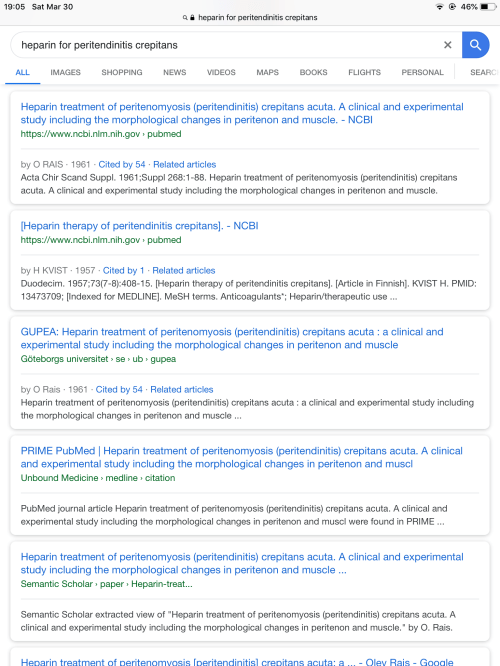
So now I have time to do some research. The first page or two on my Google search had articles from 1957-1961, all or most from Scandinavia.

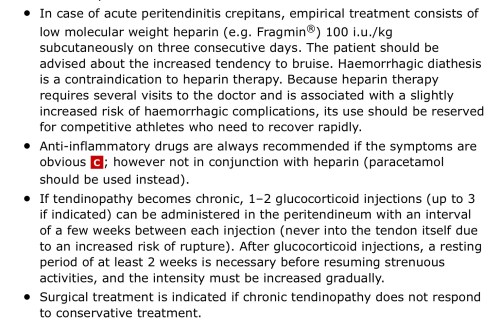
I did find one guideline from 2017 that recommends low molecular weight heparin:

http://www.ebm-guidelines.com/ebmg/ltk.free?p_artikkeli=ebm00430

But, in my case, the prednisone seems to be working. And my old Mercedes is fixed, running like new again, so my next hay trip will be more comfortable.

A Country Doctor Reads: March 30, 2019

A No-Pain Gene Mutation – NYT

Last week I wrote about whether pain is a sensation or an emotion. This week, there was a story across multiple platforms about Jo Cameron, a 71 year old woman who has felt almost no pain in her lifetime, including from burns, arthritis and several surgeries. She also scored zero on standardized anxiety questionnaires and doesn’t recall ever feeling depressed. Her two gene mutations responsible for this have been mapped now and may open doors to new approaches to treating chronic pain. And, of course, this discovery supports the notion that physical and emotional pain are, really, all the same.

https://www.nytimes.com/2019/03/28/health/woman-pain-anxiety.html?smprod=nytcore-ipad&smid=nytcore-ipad-share

………..

Is it a Crime to Underestimate How Long a Patient Will Live? – WSJ

The Wall Street Journal has an interesting piece about a court battle involving a hospice and home health agency whose patients seemed to live longer than the certifying doctors predicted. Was it fraud, and should the doctors get penalized? In a funny twist, the prosecution’s expert witness physician contradicted himself in some cases he happened to review twice: One time he agreed the patient qualified for hospice because they had six months or less to live, yet another time he thought they would live much longer. The article concludes:

“The antidote is not to pretend that subjective decisions in a hospital room become objective facts in a courtroom. 

Some medical judgments can be false. But the government is trying to create a standard that is far too broad. Professional disagreement should not be illegal.”

https://www.wsj.com/articles/medicares-hospice-rules-could-make-your-doctor-a-criminal-11553209261

……….

FREE: Important Articles – JAMA

So many journals, even single articles (including some of my links, I would think) are expensive to access. JAMA has one free section, called JAMA Network Open Access.

For example, the current issue has an article on how opioid prescribing has changed in each state over the past several years.

https://jamanetwork.com/journals/jamanetworkopen/fullarticle/2728005

PDSA for Dummies

Clinics like mine are supposed to do lots of PDSAs, rapid quality improvement projects. It’s part of our agreement with Uncle Sam. We keep starting them, but many of them fizzle. Our Federal Project Officer told us (again) at his last inspection to do more of them.

We have gone through multiple forms and formats, one more complicated than the other. But simple folks like me can’t wrap our heads around them. It should be simple: P stands for Plan, D for Do, S for Study and A for Act. Four short words, fourteen characters and, in our case, years of confusion.

Every PDSA form creator has his or her own idea. In some iterations, Plan means a detailed description of multi step processes, without declaring the overarching idea or purpose behind the project in the first place. In some, Do is where you enter your measurements and Study is where you analyze the results, while in others Do is the experimental workflows and Study is where you put the measurements.

So, as one to often reduce complicated things to their bare essence, here’s what I’ll be presenting my boss with. I’ll call it “PDSA for Dummies, v. 1”. My secret weapon is that each word, Plan, Do, Study and Act, is followed by a sentence that spells out my interpretation of what it stands for. It may not be the best, and is certainly not the only, way to do it but at least I think it’s clear:

P – Plan: In one sentence, what will you try to do?

(Example: Decrease the number of patients who leave the clinic without making a followup appointment)

D – Do: What steps or workflows will you carry out and how will you measure what works?

(Example: Give the first ten of my patients a numbered, sealed envelope and ask them to drop it off at the reception and have me or my medical assistant give everyone else just a friendly reminder to stop there on their way out. Keep a log of who got an envelope, a nurse reminder or a doctor reminder.)

S – Study: What results did you record?

(Example: Did more envelope carrying patients make followup appointments than reminder-only ones? Was there a difference between doctor and nurse reminders?)

A – Act: Given what we observed, should we adopt one of these new workflows or do we need to try something else?

(Example: Nothing seemed to work very well, maybe we should relocate the checkout station in another PDSA.)

Four boxes, each with a definition of exactly what we mean with Plan, Do, Study and Act and, in small print, simple examples.

That’s my opinion, we welcome yours…

A Wonder Drug of Ill Repute

If I could only have one drug in my pharmacopeia, what would it be?

An antibiotic? A pain reliever? A happy pill? Keep guessing…

During my Saturday clinic I saw a man I had done a physical on two weeks before. He told me he had suffered from daily headaches for several years and was popping over the counter medications just about daily to no avail; he clearly had developed rebound headaches on top of his frequent migraines. In today’s appointment he announced he had been headache free for nearly a week from the ten day prescription I had given him.

I also saw a woman with hives from head to toe. I prescribed for her with absolute confidence that her symptoms would go away.

Another patient with what the rheumatologist called inflammatory polyarthritis was not doing well on methotrexate, but told me that while she was on prednisone before that, she felt normal.

A few days before I saw a sciatica patient whose leg pain had completely resolved within a week of his first visit with me.

The day before that I prescribed it for a woman with a flare up of multiple sclerosis.

Prednisone is truly a wonder drug. It treats allergies, sciatica, gout, eczema, intractable headaches, rheumatoid arthritis, inflammatory bowel disease, asthma and COPD exacerbations, chronic lymphocytic leukemia (at least when I was a medical student), cancer related hypercalcemia and a multitude of other conditions.

It is about as old as I am, and neither of us has many undiscovered secrets left.

In the case of prednisone, that is very comforting to me.

Younger doctors are more afraid of it than I am. I have seen a colleague with arthritis die from a newer medication due to pneumonia and sepsis. I worry about the way many of these newer agents can cause problems very suddenly; prednisone is a bit more predictable.

Years ago I had a British reader question my use of prednisone for acute gout. It is my go-to, better tolerated than colchicine and safer on stomach and kidneys than indomethacin.

It is amazing what steroids do, not only to rheumatological conditions but also to our pain perception. I liken their effect to the instant ability people have in times of crisis to exert more effort than any other time and never notice pain or weakness; it can give us the sudden ability to run faster than ever before, lift heavy objects that pin down an accident victim and so on.

In some arenas it has had a renaissance: I learned in school that it decreases our ability to fight acute infections, but now it improves survival in septic shock.

The problem is its side effects with long term use, but its versatility in acute care is amazing and I do think it would be the one drug, if had to pick a single one, in my extreme survival kit.

But, may I please have one or two more?


I just realized none of the posts show on an iPad or a computer, but they do show on an iPhone. WordPress is working on this. In the meantime, please visit my Substack.


Osler said “Listen to your patient, he is telling you the diagnosis”. Duvefelt says “Listen to your patient, he is telling you what kind of doctor he needs you to be”.


BOOKS BY HANS DUVEFELT, MD

CONDITIONS, Chapter 1: An Old, New Diagnosis

Top 25 Doctor Blogs Award

Doctor Blogs

Enter your email address to subscribe to this blog and receive notifications of new posts by email.

Mailbox

contact @ acountrydoctorwrites.com
Bookmark and Share
© A Country Doctor Writes, LLC 2008-2022 Unauthorized use and/or duplication of this material without express and written permission is strictly prohibited. Excerpts and links may be used, provided that full and clear credit is given.