Archive Page 102

A Country Doctor Reads: April 27, 2019

Hypertension Hot Potato — Anatomy of the Angiotensin-Receptor Blocker Recalls | NEJM

I had not seen any numbers on the magnitude of the cancer risk in the angiotensin receptor blocker recall avalanche. A couple of days ago the New England Journal of Medicine published the number – one new case of cancer per 8000 users of maximum doses for four years:

Although not all products containing valsartan, irbesartan, or losartan that are marketed in the United States have been recalled, the scope of the exposure, the scale of the 20 recalls, and their impact on patient care are substantial (see timeline). FDA officials believe that U.S. patients have been ingesting ARBs containing carcinogenic impurities for approximately 4 years; they estimate that for every 8000 patients taking the highest dose of an affected product for the full 4 years, one new cancer above the background incidence would be expected.
— Read on http://www.nejm.org/doi/full/10.1056/NEJMp1901657

———

What we need to talk about when we talk about health – The Lancet

What is it then that we need to talk about when we talk about health? We need to talk about health as a public good, and recognise that health, like all public goods, is inseparable from politics. The reason we have libraries, public parks, a system of public education, and other such goods is because we elected leaders who made political choices to create and maintain these institutions. Public goods were once the centre of political gravity in the USA. Programmes like the New Deal and the Great Society were attempts to leverage a spirit of collective investment into a network of polices and institutions that promote wellbeing at every level of American life. In recent decades, however, the legacy of these programmes have come under attack by a political philosophy that prizes unfettered individualism above all else, even health. This philosophy, which notably informed the Reagan and Thatcher era and has now been eagerly embraced by US President Donald Trump, sees government as a largely harmful influence, and led to a campaign of roll-back and privatisation that has been good for corporations and unfriendly to the policies and institutions that promote health. In the USA, for example, the current administration has, in the name of freeing up the markets, pursued an aggressive dismantling of environmental standards, placing profits over health. It has undermined collective investment in areas like public housing, which it has sought to keep from people in need, and education, which it has worked to privatise. At nearly every turn, it has embraced an ethos of “you’re on your own”, rather than “we’re all in this together”. While the latter may sound idealistic, even utopian, it is nothing of the kind. In fact, it is the only way we can organise ourselves, as a society, if we wish to be healthy. This is especially true at a time of nationalist retrenchment, Brexit, and building walls. When we reject collective effort in favour of ever-deeper divides, we open the door to sickness and shut it to health. More…

———–

Pills or public health? – The BMJ

Once again, the Brits seem to show a more balanced view on how to treat lifestyle related chronic disease:

How best to tackle the rising tide of non-communicable disease linked to lifestyle, or, more accurately, linked to the environments in which people live? With pills or with traditional public health interventions: healthier food and cleaner air?

The push for pills is strong. As reported by the Science Media Centre, the expert response to NICE’s draft guideline on hypertension has been glowing (http://bit.ly/2IjMEgD). NICE wants to lower the threshold for starting treatment for mild hypertension. All six experts (of whom two declare industry ties and three give no statement of interests at all) welcome the draft guidance. One expert, also quoted in our own news report (doi:10.1136/bmj.l1105), suggests the guidance doesn’t go far enough.
— Read on www.bmj.com/content/365/bmj.l1791

_________

Rate of Fentanyl Positivity Among Urine Drug Test Results Positive for Cocaine or Methamphetamine. | Substance Use and Addiction | JAMA Network Open |

It is well known that heroin is often spiked with fentanyl, sometimes of great potency, causing overdose deaths. But I have also seen fentanyl in urine drug screens done on patients who admit using cocaine and are very upfront about that. Spiking cocaine with fentanyl exposes opioid naive patients to serious risks. One patient, new to our Suboxone clinic was confronted with such a test result and said, indignantly, “I guess you can’t even trust your drug dealer anymore”.

An increasing number of UDT results positive for cocaine or methamphetamine were also positive for nonprescribed fentanyl. This provides additional insight into recently reported increases in cocaine- and methamphetamine-related overdoses. Stimulant users who may be opioid naive are at a heightened risk of overdose when exposed to fentanyl. Clinicians need to be aware that patients presenting for treatment of suspected drug overdose or substance use disorder may have been exposed, knowingly or unknowingly, to multiple substances, including the combination of stimulants and opioids.
— Read on jamanetwork.com/journals/jamanetworkopen/fullarticle/2731684
Drug Rehab, Life Hab (ilitation)

We do two things when we treat young adults with opioid use disorder in our Suboxone clinic.

The obvious one is providing the chemical that attaches to certain opiate receptors and quiets cravings without feeding the reward cycle.

Because buprenorphine is also a Kappa antagonist, it has antidepressant and anxiolytics properties that traditional opioids don’t have.

By prescribing Suboxone, we help our patients’ brains return, partly or completely, to the way they functioned before they became habituated to opioids.

The other thing we try to do, although it isn’t just our job, but that of everyone who cares about a young adult in recovery, is habilitation.

Habilitation isn’t relearning what you used to know, but acquiring skills you never had in the first place.

We generally say that your emotional and character development stops when you become addicted. It can also arrest when you suffer trauma. The life lessons of cause and effect, immediate and delayed gratification, giving and taking, joy and sadness, self and community are all skipped over to some degree when you are on a chemical roller coaster or suppressed by the weight of emotional trauma.

In our group therapy, facilitators and participants challenge newcomers who feel the world owes them things they haven’t earned. We talk about sticking with a job you don’t like to build a resume for better jobs in the future. We talk about proving to the DHHS that you can be appropriate and responsible with your children. We talk about making new social contacts and friendships, developing new interests and about coping with stress, emptiness and disappointment.

We have also started a group for friends and families of people in recovery. This group, aided by veteran Suboxone patients, serves as a sounding board for our journey. Because it isn’t a paved highway – the prescription part is pretty straightforward, but the other part is different for every patient, every group and every community. It must be local, a grassroots effort.

A lot of interest and a lot of money is flowing into opiate dependence treatment right now, mostly the chemical part.

But once that happens we must face the next big challenge, which isn’t talked about much yet, of helping a large cohort of young adults catch up from a decade or two of skipping classes in the school of life.

A Country Doctor Reads: April 20, 2019

Suppressing The Inward Eye Roll

The Canadian RuralMed listserv, which I was invited to join, had a comment today, inspired by my post “If You Are a Doctor, Act Like One“, Dr. Yogi Sehgal reflected on how seemingly trivial concerns can be very appropriate if you try to understand the context:

“[Dr. Duvefelt’s] post reminds of one of my little practice tips that I have learned over the years to reduce frustration in the ER.

When a patient presents to the ER or the office with a very minor complaint, and the nurse says to you, “OMG, I can’t believe they came to the ER/office with this,” followed by an eyeroll, it’s easy to get jaded or cynical. I find the simple question, “Was there something specific you were worried about?” or “What was it about this that worried you?” is the gist of the “FIFE” questions that we were taught in medical school and do so poorly except on exams. It opens up the discussion about what the real issue is and gives you a chance to educate (doctor, from the Latin “docere”, meaning “to teach”) and feel less cynical or jaded.

Real cases recently:

Patient with a tiny little scratch on their finger which probably doesn’t need a bandaid. “I have a cut I’d like to get checked out.”

You (suppressing inward eyeroll): “Was there something specific you were worried about?”

Patient: “My grandmother died of tetanus from a minor cut like this, my mother died of sepsis from blood infection from a wound like this, I’m worried I’m going to die of this too.”

You: (Aha, now I get it!) “Ok, it sounds like the issue is not your finger so much but your family history. When was your last Td? Screen for anxiety… etc.”

Teenage patient comes to ER (with Mom) with a sore foot that comes and goes for the past week, not an athlete, pain-free now: “I sometimes have a sore foot.”

You (suppressing inward eyeroll): “Was there something specific you were worried about?”

Patient and Mom: “We were worried it had something to do with her congenital hip dysplasia.”

You (Aha, now I get it!): “Ok, sounds like we need to know a bit more about the hip and mechanics of what’s going on.” (Turns out that indeed it likely was partly related to her hip in this case, and she needed to do some PT at home which she had not been doing.)”

(yogi sehgal)

——–

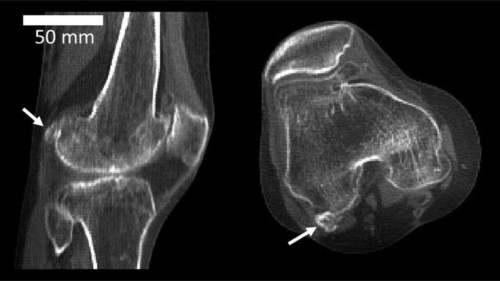
Sore knee? Maybe You Have a Fabella

The BBC has an interesting little piece about a small extra (sesamoid) bone that seems to be more common now than even just a hundred years ago, even though other sesamoid bones elsewhere in the body are not becoming more common.

The fabella (“little bean” in Latin) can be the cause of knee pain and perineal nerve palsy.

“Between 1918 and 2018, reports of the fabella bone’s existence in the knee increased to the extent that it is now thought to be three times as common as 100 years ago.
The scientists’ analysis showed that in 1918, fabellae were present in 11% of the world population, and by 2018, they were present in 39%.”

https://www.bbc.co.uk/news/health-47950258

The BBC originally picked this item up from a Wiley publication

“Hou (2016) recently investigated the effects of the fabella on posterolateral pain and palsy of common peroneal nerve following total knee arthroplasty. During trials, fabellae were excised from some patients but left in others. Post‐surgery, posterolateral pain and palsy of common peroneal nerve were only observed in patients who still had fabellae. Accordingly, Hou recommended removing the fabella when knee replacement surgery is performed.”

https://onlinelibrary.wiley.com/doi/full/10.1111/joa.12994

 ———–

Vaccination is Not Really Just a Personal Decision: People Don’t Understand Herd Immunity -NEJM

I may survive an infectious disease just fine, but what about vulnerable people I come in contact with? The less of it there is going around, the less risk for morbidity and mortality for everyone.

The New England Journal of Medicine editorialized about this:

Exposure to measles in the community certainly represents a danger to high-risk persons during a local outbreak; however, nosocomial transmission may pose an even greater threat and has been reported throughout the world. For example, during a measles outbreak in Shanghai in 2015, a single child with measles in a pediatric oncology clinic infected 23 other children, more than 50% of whom ended up with severe complications, and the case fatality rate was 21%.5 When the umbrella of herd immunity is compromised, such populations are highly vulnerable.
— Read on www.nejm.org/doi/full/10.1056/NEJMp1905099

If You Are a Doctor, Act Like One

Osler said “Listen to your patient, he is telling you the diagnosis”. Duvefelt says “Listen to your patient, he is telling you what kind of doctor he needs you to be – Yours Truly

It cannot be said enough: Ours is a relationship based vocation. Unless you are doing autopsies for a living, you need to establish rapport with real, live human beings in need of something, with fears or suffering, with past experiences and future hopes.

As a doctor, I play some sort of role, small or big, in the life of every patient I see, for a single visit or over the course of many years.

I am only one person, but I have a vast repertoire of demeanors and vocal inflections, a rich vocabulary of medical and non-medical words and a well honed body language I can put to use in each patient encounter depending on what my patient needs in that moment.

One obvious role is to be the one who correctly diagnoses and treats each medical problem. But medicine is more complicated than that. We know that a physician’s behavior greatly influences medical outcomes, even for conditions that don’t appear to be psychosomatic.

Another role I often think, speak and write about is that of guide. In that role, we need to carefully balance our own authority with deference to our patient’s need to develop and maintain their own. Project too much confidence in your knowledge and experience and hold the patient back; project too little and be of no help at all.

When it comes to the lifestyle related epidemics of our time, we need to be the bellwether for our patients, not by preaching from a pedestal but from a position of a near equal, just one small step ahead. Never obese, I still carried more weight than I should, and I use my own fifteen pound weight loss journey as a peer-to-peer example.

When our patients face the end of life or tragedies of any kind, like it or not, we need to shoulder the priestly mantles many modern people need us to wear as they lack religious connection or foundation. In such cases, we need to seem a little bit above the trivialities of this world, which often makes no sense to those who suffer.

Oftentimes, in the maze of the healthcare bureaucracy that our patients find themselves lost within, we as doctors need to fill the role of advocates. We cannot ever give the impression, or think to ourselves, that we aren’t working for them. Without patients who believe we are on their side, where would we be? This one is probably the most important role we play in 2019.

Choosing how to behave in any given patient encounter is not “acting” in the sense of not being yourself. It is being tuned in to each patient in each instance and filling the need each one has. It is about not barging into the exam room with our own agenda all set. It is approaching each patient with an open mind, ready to listen:

“How can I help you today?”

I Am Not an InstaDoc*; This Is Not InstaMedicine*

* (I know these words are used for Instagram pictures of beautiful medical professionals and gory surgical procedures, but I choose to use them as words of instancy in the practice of medicine.)

The other day a patient called every hour to inquire about the status of her elective cardiology referral. She had been thoroughly evaluated twice at the hospital for chest pain and wanted a consultation.

Another patient called three times the same day because she had seen “Ambulance Chaser” legal firm advertisements about lawsuits against manufacturers of generic valsartan, which may have traces of Chinese cancer causing chemicals.

It has been said that new medical information takes 17 years to alter the way we practice medicine. Contrast that with the immediacy of today’s electronic media…

A certain delay before acting is not a terrible thing in every instance. Overcorrection can be just as risky as undercorrection when you’re steering a big ocean liner approaching a harbor or a fast moving car on icy Maine winter roads. Or when you’re juggling the multifaceted responsibilities of caring for hundreds of patients’ lives.

We live an era of instant fulfillment. We have become impulsive and impatient. Fewer and fewer things are considered better when taking the time they used to take: Faster is viewed as inherently better.

Speed reading and speed dating, same day surgery, curing lifelong depression with a single infusion – we strive to defeat time and the forces of nature. There is no respect for the rhythms of life.

And yet, there is also the mindfulness movement, but it is largely linked to the alternative practices of medicine. Mainstream medicine is paying some lip service to such things, but it is becoming more and more firmly pigeonholed in the whirlwind of consumerism and electronic immediacy.

The practice of medicine used to be, and should return to being, a more contemplative pursuit. When we constantly go for the quick fixes, we risk overlooking or not even understanding the big picture.

In the case of the drug recalls, it wasn’t too long ago that some of my patients insisted on being switched from one angiotensin receptor blocker to another and then another and then yet another as the news about their impurities trickled in.

And, remember Vioxx, Merck’s stomach-friendly arthritis pill? Sales were booming, then reports of high blood pressure and heart attacks started to make the news. Merck panicked and took the drug off the market. Pfizer had steadier nerves and kept making their sister drug, Celebrex. Not long after, the data came out that Celebrex also increased heart attack risk, so doctors started to avoid it and switched patients back to the older NSAIDs. However, they, too, turned out to increase heart attack risk. Not as much, but still enough to make us reconsider our use of all of them.

In this case, instead of panicking and switching patients back and forth in desperation, we would have been better off doing nothing while stepping back and assessing the situation.

We’re supposed to be professionals, not robots…


I just realized none of the posts show on an iPad or a computer, but they do show on an iPhone. WordPress is working on this. In the meantime, please visit my Substack.


Osler said “Listen to your patient, he is telling you the diagnosis”. Duvefelt says “Listen to your patient, he is telling you what kind of doctor he needs you to be”.


BOOKS BY HANS DUVEFELT, MD

CONDITIONS, Chapter 1: An Old, New Diagnosis

Top 25 Doctor Blogs Award

Doctor Blogs

Enter your email address to subscribe to this blog and receive notifications of new posts by email.

Mailbox

contact @ acountrydoctorwrites.com
Bookmark and Share
© A Country Doctor Writes, LLC 2008-2022 Unauthorized use and/or duplication of this material without express and written permission is strictly prohibited. Excerpts and links may be used, provided that full and clear credit is given.


