Archive Page 100

A Country Doctor Reads: August 10, 2019 – High Blood Pressure is High Blood Pressure, No Matter Where or When

I learned in medical school (1974-79) that white coat hypertension was not clinically important and should not be treated. Somewhere along the line I was also told that people with little variability in their blood pressure fared less well than people whose blood pressure varied according to their circumstances.

As late as 2008, articles were pointing out that awareness of these phenomena could avoid misdiagnosis and unnecessary treatment.

White coat hypertension is an important clinical problem given its potential to result in misdiagnosis and possibly inappropriate drug treatment. Although ambulatory and home BP measurements are more accurate and predictive of target organ damage, physicians’ office measurements continue to be the criterion standard. That being the case, the sources of measurement error that occur in the office setting remain an impediment to the accurate diagnosis and treatment of hypertension. Data from several studies show that who takes the BP and how it is taken (ie, by a person or an automated device) have a substantial effect on the measurement.24 Our findings indicate that measurements taken by physicians appear to exacerbate the white coat effect more than other means. We suggest that one way of addressing this problem is to modify the method by which BP is measured in the office setting given the wide availability of reliable and validated automated BP monitors that are suitable for both office and home use. Similarly, home BP monitoring has been shown to predict target organ damage as well as (or better than) ambulatory monitoring25 and, thus, is superior in this regard to traditional office measurements. Thus, BP taken by an automatic device, while the patient is alone in the physician’s office, may provide the best means of avoiding a hypertension misdiagnosis.
— Read on jamanetwork.com/journals/jamainternalmedicine/fullarticle/773457

In June of this year, the Annals of Internal Medicine published a widely cited paper that demonstrated that people with white coat hypertension (WCH or WCHT) have up to twice the death rate of people who don’t have it.

“Untreated WCH, but not treated WCE, is associated with an increased risk for cardiovascular events and all-cause mortality. Out-of-office BP monitoring is critical in the diagnosis and management of hypertension.”

— Read on www.acc.org/latest-in-cardiology/journal-scans/2019/06/24/13/01/cardiovascular-events-and-mortality-in-wch

An old article I found explains that white coat elevations can be transient or sustained and can happen in people with or without hypertension. So what the Annals authors mean by “treated WCE” confuses me. If a white coat elevation is sustained, isn’t that the same as white coat hypertension?

White coat hypertension (WCHT) and white coat effect (WCE) are often thought to be of the same entity. They are in fact different conditions which carry distinctive definitions and prognostic significance. WCHT is diagnosed when office blood pressure (OBP) is ≥140/90 mmHg on at least 3 occasions, while the average daytime or 24-hour blood pressure is <135/85 mmHg. It is common with 15% prevalence in the general population and may account for over 30% of individuals in whom hypertension is diagnosed. Although individuals with WCHT were reported to have a better cardiovascular (CV) prognosis when compared to those with sustained hypertension and masked hypertension; they were also shown to have a greater prevalence of target organ damage (TOD) and metabolic abnormalities than that of normotensive subjects. In contrast, WCE is defined as the transient elevation of OBP induced by the alerting response to a doctor or a nurse. WCE can occur in both normotensive and hypertensive
— Read on www.ncbi.nlm.nih.gov/pmc/articles/PMC4170363/

Nevertheless, the most recent piece published on this topic reveals that not only 24 hour measures of blood pressure determine outcomes, but nighttime blood pressure does to the same degree.

“In this population-based cohort study, higher 24-hour and nighttime BP were significantly associated with greater risks of death and a composite cardiovascular outcome, even after adjusting for other office-based or ambulatory blood pressure measurements.“
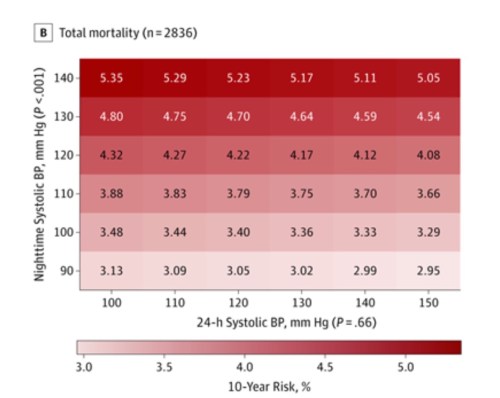
— Read on jamanetwork.com/journals/jama/fullarticle/2740719

So, with the possible exception of brief elevations from pain or trauma (I think and hope that still holds true), I guess if we see it, we treat it.

And my clinic just got some ambulatory Blood Pressure monitors…
A Day of Practicing Medicine Without the Computer

It wasn’t even nine o’clock when the screen on my laptop suddenly froze. From that moment until my last patient left the building, my clinic had no Internet.

For my part, the day went pretty smoothly, mostly because of some of my own work habits. It also helped that it was a warm, sunny day and my schedule was on the light side. Others have frowned at my old-fashioned work habits, but this is what I do:

PRINTING THE LAST OFFICE NOTE

For all pre-booked visits, we print the last office note. We also print important lab results and outside reports. One reason is that I may give these to the patient. The other is that when you create an office note and need to incorporate what happened in the ER or hospital, what the MRI showed and so on, the EMRs I have worked with don’t easily allow me to read the source document and type/dictate my own note in a split screen. And since interoperability is just a theoretical concept most of the time, I cannot import or cut and paste from outside sources.

Having the last office note printout gives me a reminder of what happened, the medication and allergy lists, all kinds of information that helps me move quickly through an Internet blackout day.

MY WORK SHEET

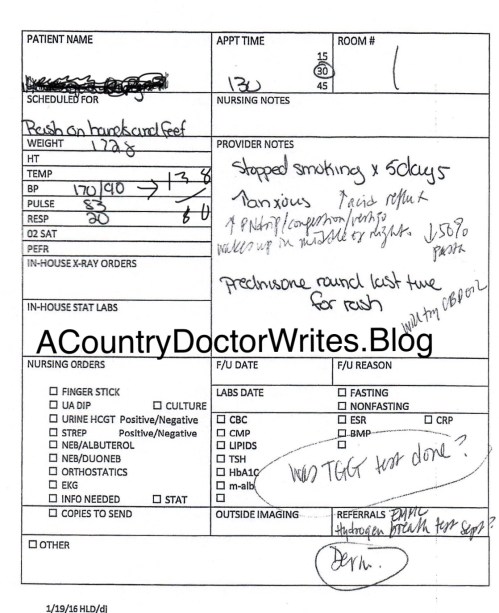
I don’t know what life would be like without this paper, which has gone through a few renditions over the years. It lets me quickly jot down important parts of my patient’s history and exam, what tests I need to order, what referrals I need to make and all kinds of things which in theory would be super quick to do with a computer but unfortunately aren’t.

At the end of the day yesterday, I copied these sheets, left the originals with my medical assistant and brought the copies home, so that on my day off (who pays the price for a computer failure?) I can finally enter the lost visits into the system while the office schedules the followup appointments and things like that.

Ironically, I have been toying with the idea of making an update to my work sheet, inspired by old rheumatology notes I used to see; they had a drawing of a body with each joint made into a stylized box for notations about which joints were affected by disease.

My recent thought has been to put a picture of a body on my sheet with simple indicators for things like, how much edema, size of a lesion, grade of murmur and so on…

Here is my work sheet in its current form. It saved the day for me yesterday:

A Country Doctor Reads: July 28, 2019

Where Have All The Young Docs Gone? – NEJM

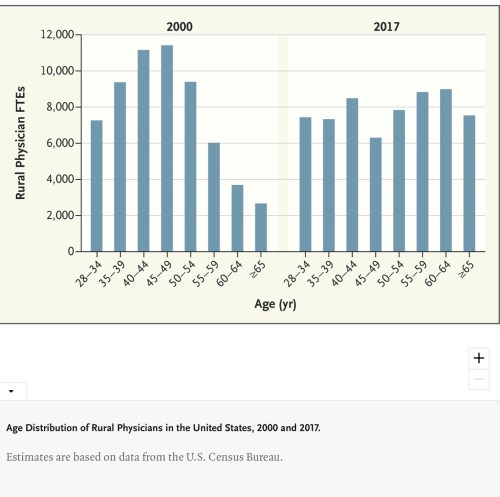
The New England Journal of Medicine published a sobering piece about the rapid changes in age distribution among rural physicians. They also point out that the aging and chronic disease burden of the US rural population is expected to increase demand for rural medical providers.

“Maintaining physician supply in rural areas has important equity implications, given that, as compared with more urban populations, rural residents are likely to be older and poorer, are more commonly uninsured, and have lower life expectancy.”

The article by Skinner et al makes a few suggestions about what to do to forestall what they describe as an evolving crisis, from loan repayment to hiring more Nurse Practitioners.

I think these types of strategies are unlikely to reverse what is a bigger trend in our society. As a 66 year old physician moving back to Caribou, Maine, I see the challenges of my community all around me: A more than half empty shopping mall in Presque Isle, the closing of a 100 employee customer service call center in Caribou, the empty store fronts lining Main Street in Van Buren. It isn’t just the physician work force that is changing, de demographics of rural America are changing.

It’s strange in a way, when our world is increasingly well connected and distances appear to mean less and less (if only my Internet connection were better and less expensive…) why being physically located in an urban area is so attractive.

In rural New England people don’t need to lock their cars or their houses, they don’t have to stand in line, sit in traffic or feel crowded by the noise around them. But they do need jobs that pay a decent wage. That’s the problem here. Fix the economy (if you can) and the health disparities will diminish.

As the number of younger physicians entering rural practice has declined, the rural physician workforce has grayed. By 2017, more than half of rural physicians were at least 50 years old, and more than a quarter were at least 60. In contrast, the number of urban physicians under 50 grew 12% from 2000 to 2017, and in 2017 only 39% of urban physicians were 50 years of age or older and only 18% were at least 60.
— Read on www.nejm.org/doi/full/10.1056/NEJMp1900808

————–

Switch

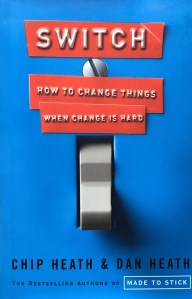
Moving into my new home office I constantly run into books I bought and read years ago but have thought little of since. One book I haven’t read since I first bought it but often keep referring to is “Switch” by Chip and Dan Heath. Subtitled “How to change things when change is hard”, the book has given me a lot to think about as a doctor, whose job often involves trying to cause my patients to change for the purpose of achieving better health.

The three steps to consider when asking someone, even yourself, to change are described, metaphorically as:

1.) Direct the rider. This is what we doctors usually try to do when we tell our patients to eat less, exercise more or take their pills every day.

2.) Motivate the elephant. This is harder, because it involves addressing the subconscious, which cares very little about things like logic or what’s best for us.

3.) Shape the path. If we make it easier somehow to do the “right” thing than the “wrong” thing, people are more likely to do it.

The book has illustrations from all walks of life, from health care to teaching to sales. And, after all, practicing medicine is part teaching and part sales, too.

The central idea for me is how necessary it is to understand and communicate with the elephant, the Heath brothers metaphor for our subconscious. I guess moving our subconscious is not only like riding an elephant, but also a lot like moving horses into a new environment.

I can’t just tell these guys what I would like them to do, I have to find ways to motivate them that are natural for them, that they might want to do in some fashion anyway.

The notion of shaping the path is something I also keep coming back to. So many times we hear that people just aren’t doing what they’re supposed to do, when in fact we are being asked to do things that seem awkward, silly or even impossible.

The recent Boeing crashes due to a software redesign that may have looked good on paper but didn’t make any sense to airline pilots comes to mind.

Similarly, in my world, the “work flows” of modern EMRs may look all right to a computer programmer, but make little sense to health care personnel.

So often in our culture, people are blamed for things that are systems problems and not people problems at all.

SWITCH feels as up to date today as it did the first time I read it.

How Much Should Physicians Touch?

Touch is a sensitive thing. No pun is intended here, but whether and how we touch our patients deserves our careful thought and deliberation.

So much interpersonal contact these days is virtual, with emojis, abbreviations and whole words thrown around as substitutes for human contact. Think :-), 💕, 😏, XOXO and “Hugs and kisses”. And when people do touch in our healthcare environment it is often with gloves, even for simple fingerstick blood sugars, immunizations or routine ambulance transports.

Shaking hands when you meet a patient for the first time is not standard procedure by any means. I wonder if it shouldn’t be in this country. There’s a lot of cultural history behind such a simple gesture.

When I examine a patient I often start by listening to their heart. I do this sitting and I almost always do this through their shirt or blouse. For my purposes, I’m able to hear what I need to hear through one thin layer of clothing; these days we tend to get an echocardiogram anyway if we hear or suspect that a murmur is present.

Listening to the heart is something so expected that almost no one is surprised, intimidated or offended by it. As I do this, I often put my left hand on the patient’s back as I press my stethoscope a little firmer against the patient’s chest with my right hand. This does give me a better chance to hear and it prevents the patient from moving away subconsciously from my stethoscope. It also creates a sort of clinical embrace as I, still fairly lightly and very clinically and professionally put their body between my two hands.

Listening to someone’s lungs, whether I do it through a thin layer of clothing, which I sometimes do, or after asking permission to pull a shirt or blouse up on the back, I don’t also touch the back with my hands while I listen to the lungs.

If, in doing a review of systems, the topic of leg swelling comes up, I often start my exam checking there by first lightly touching and then pressing with my finger for pitting edema. This is a non threatening place to start touching a patient and it feels natural as part of the history taking.

After either of those two initial exam points, I do what everyone does, although I will point out that I don’t wear gloves unless I am doing a genital or rectal exam or perhaps examining an Ebola suspect or something else that might be dreadfully contagious. I have known doctors who wear gloves for every patient visit and I think that does not help in gaining anybody’s trust or confidence in you.

Social touching I don’t do much of. I often shake hands at the end of a visit, and I only occasionally put my hand on somebody’s leg, arm or shoulder. The reason is that I’m not a very gregarious person and I wouldn’t feel that being socially touched by me would seem natural in most cases. I do make a point of “touching” people in spirit, by talking about their personal concerns and sometimes sharing my interests, joys or experiences.

The more I feel that we have a personal connection, the more likely I would be to place my hand on an arm or shoulder, and the less we connect in words or “energy”, the less likely I am to touch someone in a social way.

I find that by being “open” as a person, patients are likely to initiate social physical contact with me, and that’s easier to navigate.

But I do feel awkward if during a visit with a patient there isn’t even a brief clinical physical contact, and I have heard so many patients speak of other doctors with the words “he didn’t even touch me”. I feel strongly that even a small amount of physical contact can cement the therapeutic alliance between doctor and patient.

As I renewed my Maine medical license the other day, I had to answer questions about what is proper and improper physical contact between doctor and patient. I answered correctly the multiple choice questions about kissing and about having affairs when the patient initiates them.

It’s sad to think that someone would have to formulate questions like that for licensing adults who are supposed to be among the most trusted professionals in our society.

“Thanks for Your Time”: Einstein’s Relativity in the Clinical Encounter

In business literature I have seen the phrase “getting paid for who you are instead of what you do”. This implies that some people bring value because of the depth of their knowledge and their appreciation of all the nuances in their field, the authority with which they render their opinion or because of their ability to influence others.

This is the antithesis of commoditization. Many industries have become less commoditized in this postindustrial era, but not medicine. Who in our culture would say that a car is a car is a car, or that a meal is a meal is a meal?

The differences between services with the same CPT code for the same ICD-10 code aren’t, hopefully, quite that vast. But they’re also not always the same or of the same value. There is a huge difference between “I don’t know what that spot is, but it looks harmless” and “It’s a dermatofibroma, a harmless clump of scar tissue that, even though it’s not cancerous, sometimes grows back if you remove it, so we leave them alone if they don’t get in your way”.

I always feel a twinge of dissatisfaction when, after a visit, a patient says “Thanks for your time”. It always makes me wonder, on some level, “did my patient not get anything out of this other than the passage of time, did we not accomplish anything”?

It reminds me of a phrase from an ancient Swedish language course on cassette my first American girlfriend played over and over (she eventually became fluent, but only by living in Sweden): “Vad kostar tre minuter?” (”How much is three minutes”, referring to operator connected long distance phone calls.)

Three minutes of static on a phone line or three minutes with a dear one can never seem like the same three minutes, so thanking a doctor for his or her time only makes me think of an almost wasted encounter, almost like “thanks anyway”.

Now, one thing about charging for time that isn’t completely ridiculous is the fact that you can charge even if you don’t do a physical exam if “greater than 50%” of the visit was spent on “counseling and education“, which is pretty much the majority of what we do in primary care.

We are all familiar with Einstein’s formula E=mc2. He showed that energy equals mass times the speed of light squared.

Einstein’s formula, if you allow speed to be variable, also applies to calculating the impact of head-on motor vehicle collisions or the stopping distance of a freight train.

In medicine, just like in physics, the energy (impact) of a visit and the mass of its actual, meaningful medical content are really just different manifestations of the same thing. Their conversion factor is time.

When calculating the stopping distance of a train or impact of a head on vehicle collision, the speed means a whole lot more than the weight (mass) of the moving object. In our business, energy and mass are presumed constants and therefore time is thought of as the variable, especially when it comes to provider scheduling.

All of us intuitively know that a ping pong ball traveling at many times the speed of a slow moving freight train would still never cause similar damage on impact.

Similarly “Mass” in medicine (or “amount of clinical information considered or conveyed”) can vary enormously and isn’t always what it appears to be. Let’s say an unknown, untrusted clinician speaks at length, using many big words and all the patient hears is the “static” of one of my three minute phone call examples above.

What if “Mass” in these sample formulas is not what the provider THINKS (and documents) is delivered, but actually what the patient receives or “HEARS”?

It seems as if the staticky three minute phone call is like an office visit with a provider with lower credibility due to less relationship or shared history, resulting in less therapeutic weight and impact.

To quote myself:

“Medicine, at least in the non-procedural specialties, is a relationship based business. If a hostile stranger spends fifteen minutes trying to change your behavior, is that more effective or more valuable than if a trusted doctor, friend or admired mentor mentions the same thing almost in passing?”

So, instead of thinking of TIME as the variable, as in 15, 20 or 30 minute visits, we need to look harder at the “Mass”, or what might be called effective content of a visit.

Let’s think of time as a constant and accept that during their career, clinicians have the same number of hours available to them every week.

Let’s think more about the two things that are the value laden variables in Einstein’s theory:

E (Energy, or therapeutic impact) = M (Mass, or ACTUAL effect of our attempted clinical interventions).

If we counsel smokers at a rate of a hundred every month and none of them actually quit, does anybody really believe that is that better than succeeding a dozen times a month with fewer patients?

Health care should not be a speed contest. That would be like saying we could increase cardiac output in heart failure patients by increasing their heart rate. We all know from medical school that this isn’t true if their heart rate was normal to begin with. Like I explain to my patients: if you try to flush your toilet too frequently, each flush will become less effective.

So, while speed in medical encounters may not be a absolute constant, its variability is definitely limited, and as we approach that limit, we risk becoming less and less effective.

I believe it is easier and more effective to work on increasing the value and weight of each of our clinical encounters. Then, and only then, might it be possible to improve our speed. This is where the idea of being paid for who you are instead of what you do comes in. One sentence of advice from a professor, judge, priest, guru, most trusted friend or personal physician could be worth much more than fifteen minutes with a generic health care provider.


I just realized none of the posts show on an iPad or a computer, but they do show on an iPhone. WordPress is working on this. In the meantime, please visit my Substack.


Osler said “Listen to your patient, he is telling you the diagnosis”. Duvefelt says “Listen to your patient, he is telling you what kind of doctor he needs you to be”.


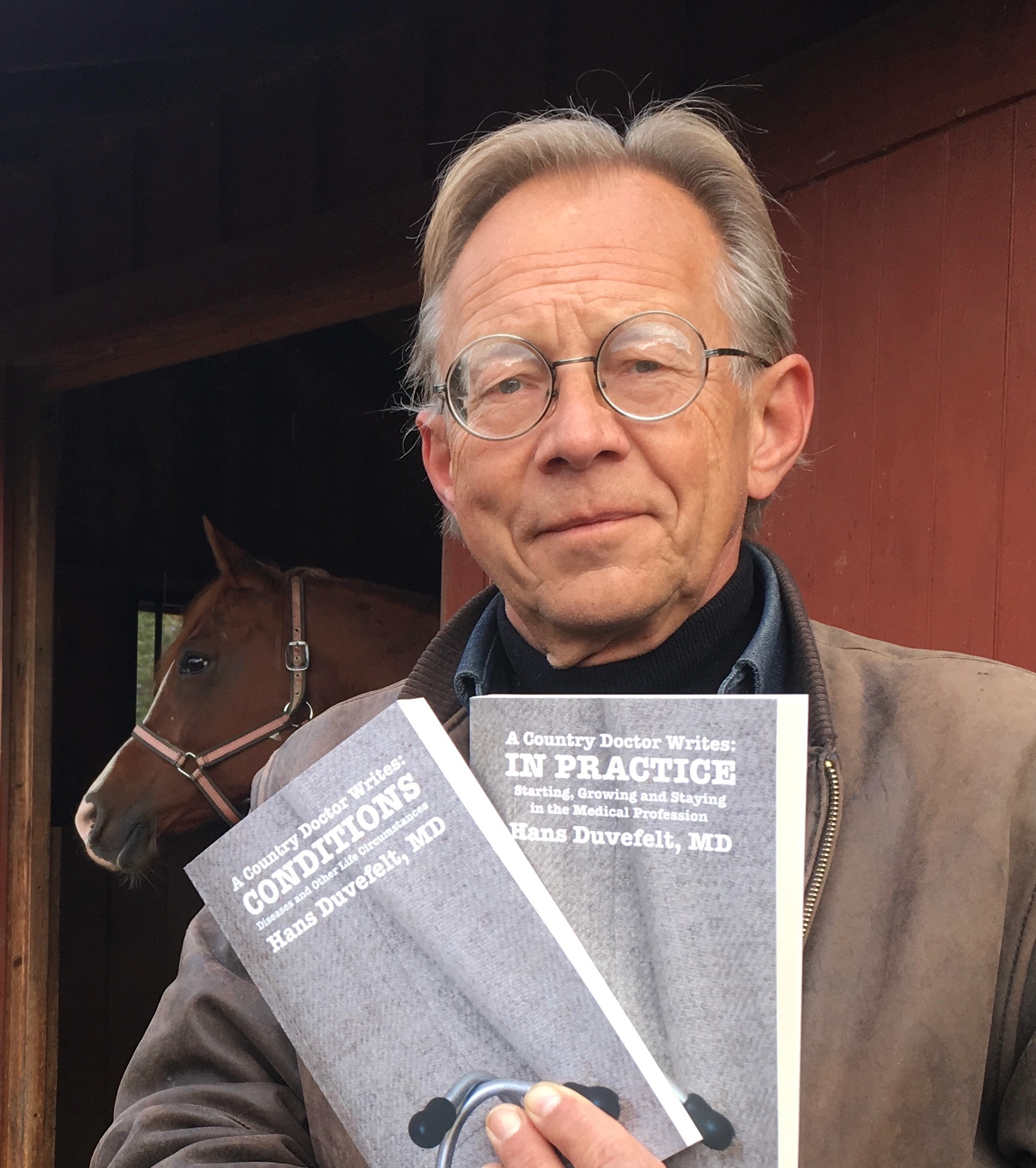
BOOKS BY HANS DUVEFELT, MD

CONDITIONS, Chapter 1: An Old, New Diagnosis

Top 25 Doctor Blogs Award

Doctor Blogs

Enter your email address to subscribe to this blog and receive notifications of new posts by email.

Mailbox

contact @ acountrydoctorwrites.com
Bookmark and Share
© A Country Doctor Writes, LLC 2008-2022 Unauthorized use and/or duplication of this material without express and written permission is strictly prohibited. Excerpts and links may be used, provided that full and clear credit is given.