Archive for the 'Reflections' Category


Beyond the Male Menopause

One of my medical school professors was an internationally renowned subspecialist, whose ward occupied the entire top floor of the medical tower at Academy Hospital in Uppsala.

He had cadres of residents working for him, and for two glorious months I rotated through his ward as part of my internal medicine training in medical school.

One thing that stands out in my memory, to this day, from those two months is how Professor B refused to deal with anything but the esoteric diseases his patients came to his ward for. If anyone had a cough or an ache or a rash, he would scornfully say “I treat diseases, not ailments”.

It seems that nowadays many ailments have been given disease status. Restless legs, premenstrual syndrome, thinning hair and overactive bladder are bona fide diseases now.

Even aging is, in this country, largely viewed as a constellation of diseases. It strikes me as odd that in this age of high regard for Evidence Based Medicine, we so boldly define things that happen to all of us sooner or later as diseases and try out treatments for these symptoms when every shred of available evidence suggests these are actually natural occurrences.

When I was a resident, I got docked if I didn’t offer postmenopausal women estrogen replacement. It seemed like such an obvious thing to do – who wouldn’t want to keep women from aging as nature had so cruelly intended? Who wouldn’t want to save them from heart disease, dementia, osteoporosis, genito-urinary symptoms and decreased joie de vivre? Who wouldn’t want to preserve and prolong youth?

Now, of course, everyone agrees that estrogen replacement increases a woman’s breast cancer risk and also increases her risk for blood clots, stroke and heart disease.

The male aging process seems to be the current frontier for many of those who wish to medicalize the human experience. As if we never learn from our mistakes, we are now prompted to look for low testosterone levels in middle-aged and older men, who might not have their usual vitality, muscle mass or sex drive anymore.

Never mind that there are already concerns about what male hormone treatment might do to prostate cancer and maybe even heart disease risks.

I wonder when the drug companies will focus their attention on the other big transition we all go through.

Adolescence is a life-changing condition for both girls and boys with many undesirable, hormone-mediated “symptoms”. Every generation of parents and teenagers until now has had to go through it without help from the pharmaceutical industry. If we were to follow the menopause-and-aging-as-diseases logic, this is probably the next medical frontier after we conquer the male menopause. Just think of all the “patients”, who suffer their way through this “disease”.

It’s probably only a matter of time until we have diagnostic codes and blockbuster drugs for this, too.

Time, Money and Midlevels

A Primary Care resident wrote in one of the journals recently about making the limited time she has with each patient matter the most.

How refreshing, I thought when she concluded that time ultimately is an absolute and finite resource. We often feel as if we are battling time as much as we are battling disease, and we sometimes have trouble admitting when we are losing either one of those battles. Some of us find it more difficult than others to say “no” to unrealistic demands for clinical output per unit of time.

But the writer had another agenda: By teaming up with Nurse Practitioners or Physician Assistants, she envisioned having more time to spend with each patient.

This type of New Math doesn’t really work in Primary Care. A physician who performs expensive procedures can maximize his or her time in the operating room by sharing office visits with a less trained and lower-paid “midlevel” practitioner, who could never replace the physician in the operating room.

In Primary Care, however, physicians, Nurse Practitioners and Physician Assistants tend to do the same type of work, and if anything, physicians tend to have shorter appointments than “midlevel practitioners”, reflecting their higher level of training and justifying their higher salaries. Every patient deserves the best care we can give them, and there is no reason to believe that patients who see a physician are so much more complicated that they always deserve more time than patients who see a “midlevel”.

If the young writer expects to have “midlevel providers” somehow subsidize her requirements of time and money, she is not likely to find this in today’s medical environment. She may instead find herself in direct competition with them. In states where Nurse Practitioners can practice without physician supervision, she might actually be at a competitive disadvantage, should her productivity drop below that of providers making half her salary.

Decision Support, Professionalism and the Lost Art of Healing

Health care in the United States is struggling to redefine itself. We have been spending twice what other countries spend on health care, yet our citizens are less healthy. We now have legislation to create more or less universal insurance coverage, and we are about to embark on a technology-driven quest for quality and uniformity. At the same time, Americans are increasingly turning to alternative health care practitioners, mostly at their own expense, because the health care system is not meeting their needs.

In the three decades since I entered this profession the typical role of physicians has changed dramatically. In the 1980’s most doctors were self-employed and received payment directly from their patients. Now most doctors are employees who receive their salaries from organizations that collect payment from insurance companies on behalf of the patients.

With this arrangement patients have lost the power that came with directly paying doctors for their services. Doctors now have to answer not only to their patients, but also to their own employers and to the insurance companies, whose profits are carved from the difference between insurance premiums collected and medical care delivered.

Medicine has until now been considered one of the three learned professions along with Law and Theology. These three professions are said to require advanced learning and high principles. Physicians, lawyers and clergy study and interpret their material. They sometimes find themselves in a position where they are forced to disagree with others of similar training, who draw different conclusions from the same text.

It is very tempting to think that there is only one right way to do things in medicine. After all, medicine is a science, and we spend a lot of money on doctors, tests and treatments. For those who remember, Marxism was also touted as a science, yet the planned economies of the world collapsed because their scientific theory created systems that were too large and rigid to manage effectively, let alone meet the needs of their customers.

Every day I read about medical errors that only computers could avoid and alleged epidemics of unprofessional conduct, negligence and incompetence among physicians. The solution is made to seem obvious: Change the role of physicians from intellectually independent professionals to generic health care providers. Put them in front of computers that offer “Decision Support”, which is jargon for suggesting to them what to do, and then measure their compliance with the computer’s suggestions.

Even the New England Journal of Medicine recently printed an article that suggested that computers could make unnecessary the “master diagnosticians of past eras”.

Is it any wonder that so many hard-working, decent doctors are dissatisfied with their careers? Is it any wonder that the primary care specialties are having recruitment problems?

Doctors will happily do the right thing, if we show them what the right thing is, President Obama inferred after the United States Public Health Service recommended cutting back on mammography screenings.

This is an example of where we, unfortunately, stand with “Evidence-Based Medicine” (EBM) in the United States today. The mammography recommendations were changed, not because the evidence changed, but because the task force looked at the data differently.

“Evidence Based Medicine”, in my opinion, requires individual physicians to continue to act as professionals, read the literature and expert opinions with a discerning eye, look for bias and ultimately help individual patients with unique situations take the best action.

The proponents of uniformity, today’s capitalists or yesterday’s Marxists, have both failed to understand the art in what we do. Health care is like food, wine or music. The ingredients, even the recipes, may look similar, but the interpretation and delivery makes it what it is. Two different doctors can deliver the same care in theory but get different clinical results and different patient satisfaction. And two patients with the same stage of a disease may respond differently to the same treatment.

In 1996 Nobel Prize winner Bernard Lown wrote “The Lost Art of Healing”. It is still missing in many places.

No matter how technologically advanced medicine gets, and no matter what financial or administrative pressures doctors are subjected to, ours is a healing profession. Our duty is to maintain our professionalism and use our scientific training, never forgetting that patients come to us to be healed or comforted. Even our Evidence-Based treatments are sometimes only marginally better than placebo, for example antidepressants. A therapeutic relationship between doctor and patient can sometimes do more for a patient’s health than a hastily delivered, computer-generated prescription.

Physicians need to take pride in their work and act like doctors, not health care drones, who blindly and mindlessly toil for the big health care machine.

Problem List Problems

In Family Medicine it has been common to keep a “Problem List” in patients’ paper charts. Usually placed on the left hand side, on top of the Medication List, it has given doctors like me an instant thumbnail sketch before considering the specifics of each patient’s visit for that day.

A typical Problem List would include diagnoses like diabetes, hypertension, high cholesterol or rheumatoid arthritis. It would list prior surgeries, like gallbladder surgery, hysterectomy and appendectomy, and medication allergies. Many of us also would list important tests done, such as a patient’s last colonoscopy or cardiac catheterization and make note of their Family History.

Because Problem Lists are brief and the page usually has a fair amount of empty space, they can usually be digested in a quick glance, almost subconsciously and without effort.

In fifteen seconds or less I could prepare myself before seeing a colleague’s diabetic patient with abdominal pain, loss of appetite and loose bowels by checking that she had had her appendix out and a hysterectomy but never had agreed to a colonoscopy. I can also note that she is allergic to contrast dye and that her mother died from colon cancer at age 62.

The Problem List can usually be read as I walk down the hall to the exam room – that’s how quick it is to use. Because of its placement to the left in the chart, it can also be seen regardless of what page the chart is opened to on the right side.

My office notes tend to start with the presenting problem, and technically I don’t need to go into the items that are listed on the Problem List, as they are already so prominently displayed on the very first page of the patient’s chart. I may choose to do that anyway, after the presenting complaint. Incidentally, some insurance companies pay better if we spell out what we already registered semi-automatically by just glancing at the Problem List.

Occasionally I have worked with or taken over after Internal Medicine doctors. They do many things the way Family Practitioners do, but their use of Problem Lists is often different. Some of my internist colleagues leave the Problem List blank. Instead, they treat each patient visit as an independent event with no connection to the other pages in the medical record. They introduce the patient as if seen for the first time and begin every office note with an often lengthy summary, such as:

This 65-year old nonsmoking married white female with a past medical history of Type 2 Diabetes, contrast dye allergy, hysterectomy and appendectomy has a family history of colon cancer in her mother, who died at 62, yet the patient has previously declined screening. She presents today with…

As I look at Electronic Medical Records (EMR’s), which will be more or less required by law in this country in the next few years, I see a new type of Problem List, and it makes me sad. EMR’s tend to “populate” their Problem Lists automatically with every single diagnosis the physician makes. Important things like diabetes may drown among diagnoses of ordinary and self-limited things like influenza, colds, ankle sprains, ringworm and poison ivy – things that are unlikely to affect the future care of the patient. They would never be included in the original kind of Problem List unless a patient were to have those conditions often enough to be noteworthy.

One of the things I see happening in medicine today is that physicians are more and more documenting to serve the needs of others. Our own needs for speed and clinical efficiency are not driving the technology. Those who wish to count, evaluate and analyze what happens in the exam room seem to have more of their needs met by the technology we have available today.

Most electronic systems make it easy to document hoards of clinical data by just pointing and clicking, but they lack the ability to prioritize the data. Systems that don’t give clinicians the opportunity to distinguish between important and not-so-important data risk creating information overload and could cause the health care information system to clog up. Intelligent Problem Lists could help keep things in order.

See You Next Time

Can you imagine a doctor telling a heart attack survivor:

“That was a close call, but I’m glad you made it. I’ll see you next time you have one. Oh, by the way, you might want to watch that cholesterol.”

I thought not. Yet, that is how most of the one million kidney stone cases are handled every year in the United States at a cost reported to exceed four billion dollars.

Kidney stone pain is said to be one of the worst pains a person can experience. In medical school we were taught that patients with a ruptured appendix are likely to lie perfectly still on the exam table whereas kidney stone patients are in such agony that they are unable to stay long enough on the table for you to examine them.

We have all kinds of technologies available for kidney stone removal, all of them expensive. Prevention, on the other hand, is cheap but seldom done. Cynics may say that there are no incentives in this country to prevent diseases that provide steady work for physicians who treat them.

Over the years I have seen public awareness and special interest groups crop up for just about every disease, even rare ones like SCID, Asperger’s and Rett Syndrome. Common things like avoiding recurrent kidney stones seem to get less media attention.

Kidney stones are made up of uric acid (the same compound responsible for gout) or salts containing calcium and another ingredient like oxalate, phosphate or struvite. Regardless of stone composition, recurrences can be partly prevented by simply drinking more water, which dilutes the stone-forming chemicals. Interestingly, there is a “kidney stone belt” in the southern part of the United States that is said to be expanding northward as a result of global warming, with projections of a 25% increase in kidney stone cases by the year 2050.

The Calcium Paradox

Depending on the chemical composition of kidney stones and levels of urinary excretion of key ingredients, specific dietary interventions and medications can help reduce a patient’s risk for recurrent stones. Doctors, like everyone else, however sometimes jump to conclusions. Some things seem so obvious that nobody questions them. Then, when scientific research proves our assumptions to be wrong, we refuse to believe, or perhaps we just forget what we have learned. This is at the core of what we call Evidence Based Medicine.

It was long assumed that if you restricted a person’s intake of calcium, the risk for kidney stones would decrease. The New England Journal of Medicine reported in 1993 that the opposite was true; a low calcium diet increases kidney stone risk. I seem to remember hearing the same thing during my training in Sweden long before then.

The reason for this calcium paradox seems to be that a low calcium diet causes more ingested oxalate in the intestine to exist in a free form, rather than attached to calcium. The free intestinal oxalate is more easily absorbed, leading to more oxalate in the urine, where it can combine with even small amounts of calcium to form a kidney stone.

Yet, I often hear that kidney stone patients are told by their doctors to restrict their calcium intake. I also hear both doctors and patients make general statements about the effects of fluid pills (diuretics) and vitamin C. Without knowing what type of stone a patient has, such generalizations are simply not helpful. 

Physicians have an obligation to help patients avoid illness when there is good evidence available to guide us. Kidney stone prevention is not as glamorous as blasting stones with lithotripsy. As with any disease prevention, the way you know it works is that nothing happens. Any physician who has faced a kidney stone patient writhing with excruciating pain can appreciate that nothing happening is more humane than “See you next time”.


I just realized none of the posts show on an iPad or a computer, but they do show on an iPhone. WordPress is working on this. In the meantime, please visit my Substack.


Osler said “Listen to your patient, he is telling you the diagnosis”. Duvefelt says “Listen to your patient, he is telling you what kind of doctor he needs you to be”.


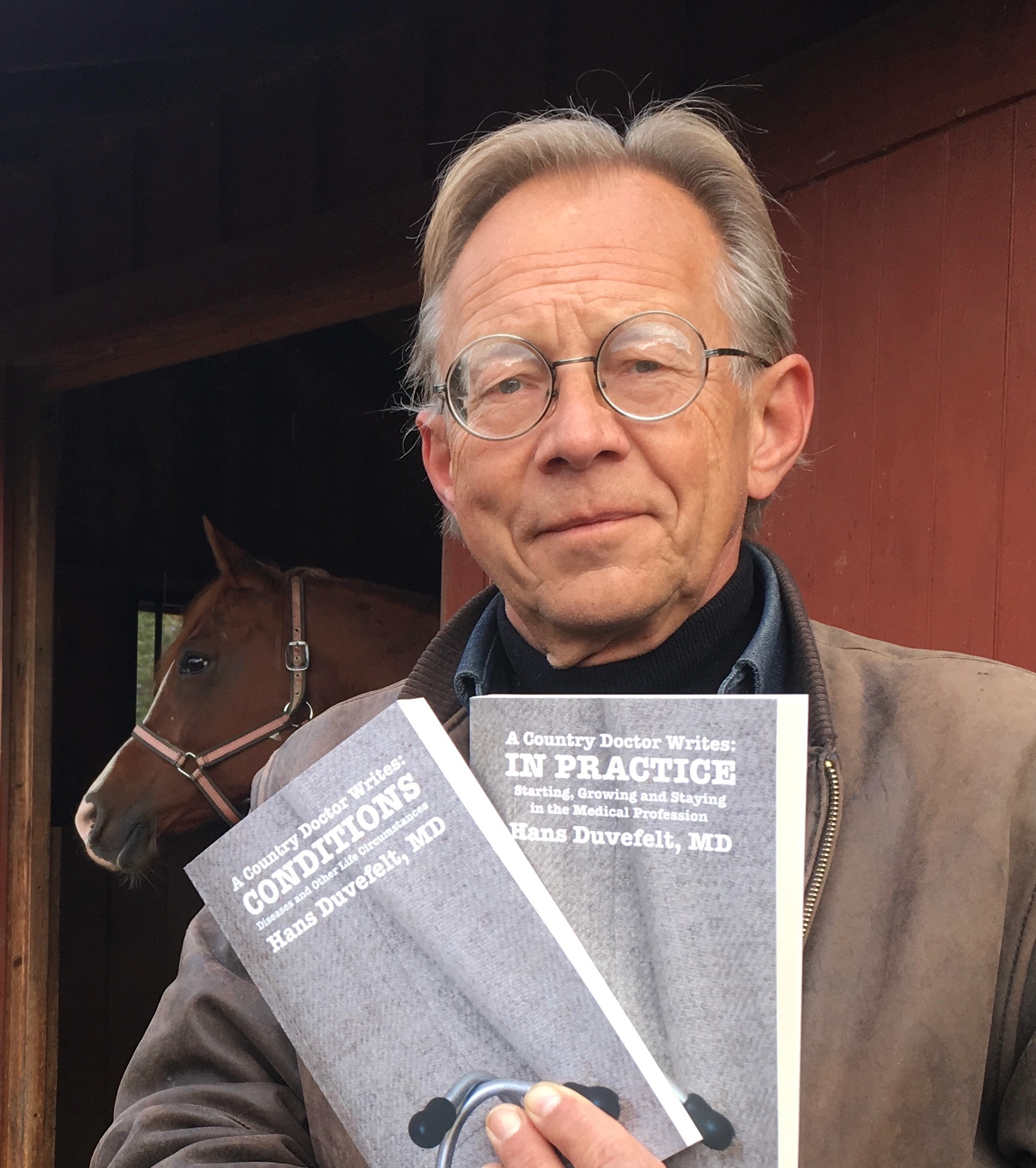
BOOKS BY HANS DUVEFELT, MD

CONDITIONS, Chapter 1: An Old, New Diagnosis

Top 25 Doctor Blogs Award

Doctor Blogs

Enter your email address to subscribe to this blog and receive notifications of new posts by email.

Mailbox

contact @ acountrydoctorwrites.com
Bookmark and Share
© A Country Doctor Writes, LLC 2008-2022 Unauthorized use and/or duplication of this material without express and written permission is strictly prohibited. Excerpts and links may be used, provided that full and clear credit is given.