Archive for the 'Progress Notes' Category


Choices in Swedish Health Care

Times are tough for most airlines. Scandinavian Airlines used to offer a choice of entrees even in economy class.  That ended a year or two ago. I found out when the steward handed me my food with a grumpy face. “I thought there was a choice”, I said. His grumpiness deepened, and he quipped “You have a choice whether to eat it or not”.

The Stockholm newspaper I read shortly after takeoff from Newark had side-by-side articles on Swedish health care. One piece described the waits for elective surgery within Sweden’s socialized system. At Stockholm’s Karolinska, the wait for knee replacement surgery is currently 20 weeks, down from 52 weeks in 2005. The smaller Södersjukhuset makes patients wait 32 weeks to have their gallbladder out, which is better than suburban Danderyd Hospital’s 44 week wait.

Other than going to one of very few strictly private hospitals, patients have few options but to wait. Right now, they can’t seek elective care at a hospital other than the one near where they are legally residing. That will change in 2009, but the new freedom to choose hospitals will only apply to certain surgical procedures.

The second article mentioned that until recently in Stockholm, patients were not able to choose which primary care clinic to use. Now patients can choose freely, but their new freedom has not yet resulted in enough resources going to the clinics with the most needs and highest volume.

Of course I remember working under this system, but I hadn’t been thinking about the waits and the lack of choice for a while. The private option wasn’t available when I practiced in Sweden. It is a nice luxury option for those few who can afford it, just like flying business class. However, the majority travels economy class through life and has the choice between waiting many months for elective surgeries like knee replacements, and not having them at all.

Maybe Sweden needs to learn from American insurance companies about medical tourism – sending elective surgery patients abroad for what is touted to be high quality, low cost care.

Is There a Doctor On Board?

I am sitting at Newark International Airport, waiting for a flight to Sweden. Instead of a book I have my laptop with me this time. I think it took longer to log on to the wireless network than it took to fly here.

I am hoping for a quick, quiet flight to visit family for a few days, but you never know. As a physician I have occasionally been called to assist fellow passengers with medical problems.

My last summer sojourn to Sweden ended on a particularly hot day. The economy cabin of the big SAS Airbus was filled to capacity. We were minutes from takeoff from Arlanda airport and the cabin crew was making its way down the double aisles to check seat backs, trays and overhead bin doors.  Just two rows behind us they stopped and I heard them ask, “Sir, are you all right?” and soft voices spoke inaudibly for a while. The purser arrived, and soon that familiar phrase came over the intercom:

“Is there a doctor on board? Is there a medical doctor on board the aircraft?”

I reached over, tapped one of the crewmembers on the shoulder and said: “I am a doctor.”

The middle-aged man was drenched in perspiration. He was American, his wife Swedish, and they had three school age children.

“I don’t feel so good”, he said. His pulse was weak and rapid, but not irregular. The wife described that he had been running high fevers on and off for the past 48 hours. The day before he had gone to a primary care clinic in a distant suburb of Stockholm with no firm diagnosis made. The wife asked him if he wanted to get off the plane and go to the Karolinska Institute. He seemed ambivalent. As I went through a brief review of systems, the Captain arrived. He needed to make a decision and asked for my advice. Should the passenger be allowed to remain on the flight?

It seemed to be my call. On one hand, the man might have had just a garden variety viral illness and might have made it back to the States without losing control of any bodily functions, but on the other hand we could have had a real mess in the cabin. He could also have had something more ominous going on, where his life would be in jeopardy hours later and 30,000 feet in the air. Lastly, imagine if what he had was very contagious – remember the SARS epidemic in 2003, thought to have spread through air travel.

I told the Captain I thought the man should stay in Stockholm. The Captain seemed relieved. The wife decided that she and the children would also get off the plane.

The Captain announced the delay while the family deplaned. The purser brought me some free champagne, and another doctor suddenly appeared from the Business Class cabin with a small box of chocolate for me. He seemed mildly intoxicated at 10:30 am. 

Triage is a crude process. You don’t have to make a diagnosis. You don’t have to be right. All you have to do is choose the course of action that minimizes the harm of any wrong decisions you might make.

Friday’s Child

Danny Ames was in for a Well Child Visit Friday, and I’ve been thinking about him all weekend. I had not seen him before; he used to see one of my partners, who retired last year. There are plenty of people named Ames in our community, but not all of them are related. 

Danny Ames turned out to be a very resolute young man, just about to enter the eighth grade. He told me he is living with his father in the next town, because that way he has a choice of High Schools. Danny wants to become a professional soccer player, and he wants to go to High School at a nearby private academy that tutors in students from towns without their own High School. 

He has spent the summer learning roofing. He told me with pride in his voice that his father has a roofing business. In the next breath he told me that since age seven he had lived with his mother, because his father went to prison. Now that Danny’s dad is out of prison, the two of them have become close again.

Danny is missing a big chunk of his left ear. He told me matter-of-factly that when he was four years old he happened to be standing behind is uncle, who was using a chain saw. The uncle swung the chainsaw behind him and cut into Danny’s ear. Danny remembered the whole incident vividly – the first two doctors he was taken to wouldn’t stitch him up, so he ended up at the hospital, the anesthesia didn’t take very well, and Danny screamed the whole time. 

Danny was alone in the exam room for his physical. His grandmother was in the waiting room with a younger child. As I went through the usual questions about alcohol, drugs, sex and peer pressure, Danny told me self-assuredly that he had been trusted to take care of himself since he was eight years old with his father in prison and his mother having to work two jobs to support herself and her two boys.

I rattled through the immunizations Danny might want to update, brought the grandmother in for signatures, but basically acknowledged that I was dealing with a very young adult. Danny had clearly not had an easy life up to this point, but he had the character to turn it all into something positive; he was proud of both his parents, he was learning a trade, and he had a dream. I know not many kids from around here become professional soccer players, but if anybody will, Danny Ames just might be the one.

Doctor Fix-It

Today I visited Ginny Leach. She lives by herself in an old trailer not far from our house. She is an ageless more or less shut-in woman. 

A mild chaos erupted the moment I walked through Ginny’s front door. She was on the phone with her sister; I think they must call each other at least three times a day. Her only other contact seems to be the nuns from a nearby order; they help her out with chores and hand-me-downs. As I walked through the door, Ginny gestured to me, stretched the phone cord, and somehow her Slimline telephone fell to the floor and went dead on her. Ginny worried that her sister would assume something bad had happened.

Before I knew it, I was on my knees on the floor, examining the jack and the telephone. Everything looked all right, but the phone line was dead. Fortunately, she still had her old, black rotary phone handy. I carry a “SwissCard” with scissors and a Phillips screwdriver in my wallet, and soon had the wall jack opened and the old phone connected to the innards of the wall jack, so that Ginny could call her sister and report on what just happened.

I chuckled to myself as I remembered how during my previous house call I had fixed her doorknob. The old one had broken off, and the nuns had installed a new one, which didn’t close right. That time I had used my SwissCard to adjust the strike plate to make the door shut properly.

I take care of Ginny’s blood pressure and cholesterol, and somehow also ended up picking up her prescriptions at the drugstore for her. That’s fine with me, and I never minded that she never asked about the cost; her state insurance covers all but a few dollars co-pay. Gradually my shopping list has grown, so now I also seem to be her only source of aspirin, calcium tablets and Icy Hot patches. The issue of money just never seems to come up.

Ginny enjoys her home visits, but never wants them to drag on. We take care of her medical issues, chat for a few minutes, and she seems ready to return to her TV shows. Living alone in this rural part of the country isn’t easy, but Ginny makes the most of the resources at her disposal, me included!

Tuesday Evening House Call

Jeremy Doyle’s house is perched high on a knoll with peaceful meadows and a distant ocean view. I had been there a few times before, a dozen years ago, when our teenage daughters were friends. Tuesday evening I went there for my first house call.

Jeremy is a couple of years younger than I am and slowly dying from two forms of cancer. He has his family curse; I also tended to his brother, who died less than a year ago. Jeremy’s Hospice nurse had called earlier in the day and suggested it was time I went there.

The change in Jeremy since I saw him last was profound. He had been under the care of several specialists, so I hadn’t seen him for a few months. Now, with no further treatment options, Hospice nurses are going in several times a week. He is on a morphine drip for his pain, breathes through a tracheostomy and gets his nourishment through a feeding tube.

The last time I was there, we were on opposite sides of 40, he just under and I just over. Yesterday I was there to see for myself how we might change his medications to ease his final journey. Both Jeremy and his wife, Samantha, are rock solid. They have been through enough ups and downs in his cancer battle that they have learned to endure more than most people could imagine, and they have tackled each new obstacle slowly and methodically. Samantha has learned to do absolutely everything the Hospice nurses do.

Sitting in their kitchen in the bright early evening light with friends stopping in for a brief visit and a young dog at their feet, I clearly had the sense that Jeremy and Samantha were in the moment, accepting and appreciating each hour of life and relative comfort. The scene was peaceful, and somehow more significant as a sign of life than one of impending death. We went through his medications, checked on all the issues raised by the Hospice nurse, and I took care of his new medication orders.

As I patted Jeremy’s elbow when I left, I said “I’ll see you soon”. Both of us knew that “soon” might never happen.


I just realized none of the posts show on an iPad or a computer, but they do show on an iPhone. WordPress is working on this. In the meantime, please visit my Substack.


Osler said “Listen to your patient, he is telling you the diagnosis”. Duvefelt says “Listen to your patient, he is telling you what kind of doctor he needs you to be”.


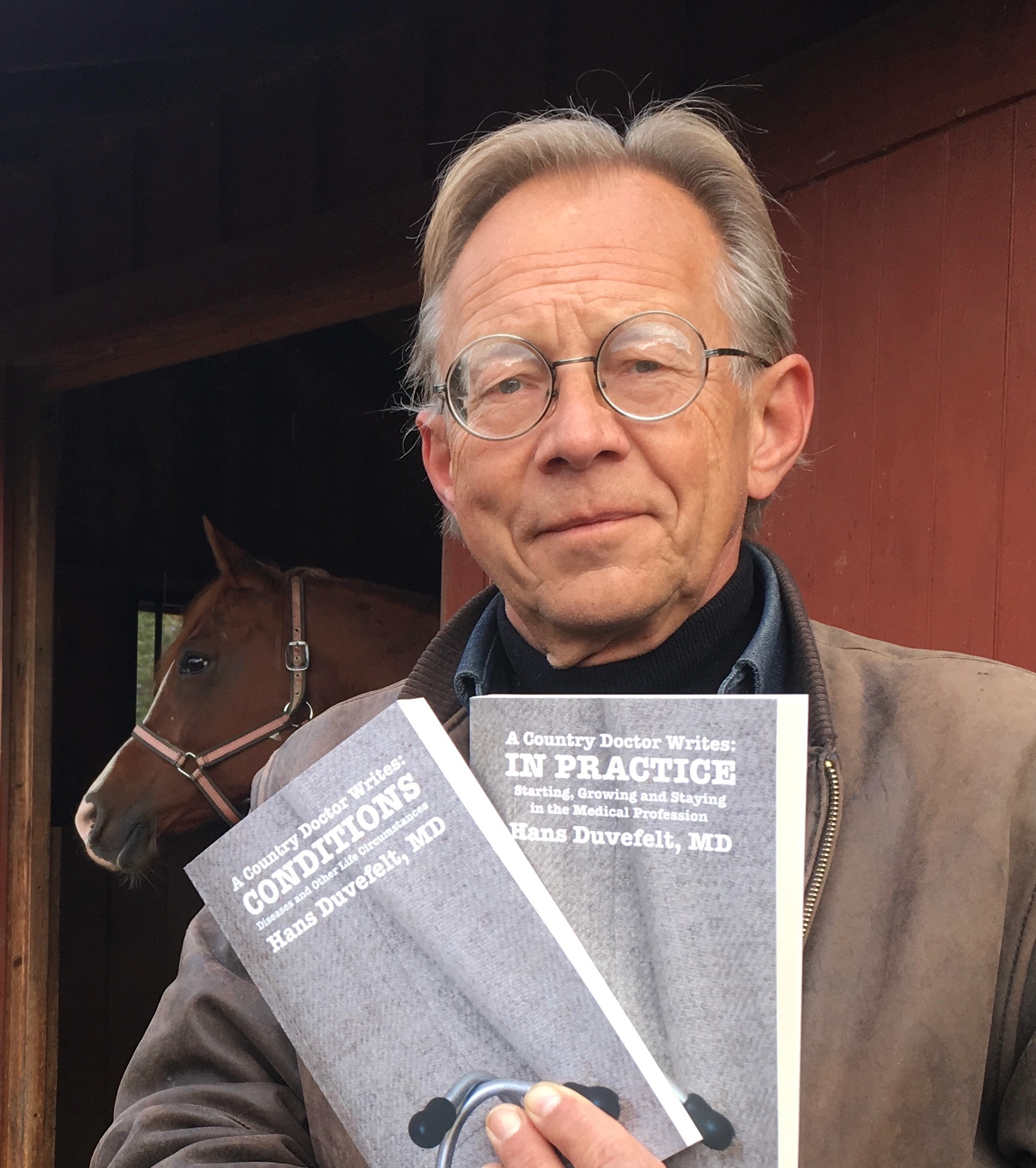
BOOKS BY HANS DUVEFELT, MD

CONDITIONS, Chapter 1: An Old, New Diagnosis

Top 25 Doctor Blogs Award

Doctor Blogs

Enter your email address to subscribe to this blog and receive notifications of new posts by email.

Mailbox

contact @ acountrydoctorwrites.com
Bookmark and Share
© A Country Doctor Writes, LLC 2008-2022 Unauthorized use and/or duplication of this material without express and written permission is strictly prohibited. Excerpts and links may be used, provided that full and clear credit is given.