Archive for the 'Progress Notes' Category


Normal Blood Pressure

Dwight Frost had all the risk factors, plus he had already had a stroke several years ago. His blood sugars were too high, his lipid profile was near the top of the class, he still smoked a cigar now and then, and his blood pressure hovered around 200. He also seemed a little vague about which medications he actually took and which ones he didn’t.

He spoke rapidly with a slight tremulousness in his voice and seemed to be eager for the visit to be over.

On his second visit he brought a big bag of medications, not just the neatly written list his wife had sent him in with the first time. Some of the bottles were marked on the lid “AM” or “PM”, others said “BP”, “sugar” and some had a rubber band around them, which seemed to mean he was definitely taking them as prescribed.

His thyroid function and other routine labs were normal. At both visits I recorded his blood pressure in both arms; I had him sit and stand; the first time I saw him, I also checked the pressure in his right leg.

His wife was a retired nurse, he told me, and she also checked her own blood pressure with a stethoscope and a manual sphygmomanometer. She had recorded almost daily blood pressures, all under 140, that she had done on him between his two visits with me. She couldn’t come in with him, because she was actually bedridden from severe arthritis. She rarely got out of the house to see her rheumatologist, the only doctor she had.

I thought for a moment. There was only one way I could resolve this, so I asked:

“Would you mind if I stopped in next Friday afternoon to check your blood pressure when you’re relaxing at home?”

“Anytime, were always home“, he answered.

Friday afternoon I drove across town in a light snowfall. The faint February sun filtered its way between the snowflakes, which seemed to sparkle and rotate in the air ahead of me without ever hitting the windshield.

The Frost home was a tidy ranch house with an ell connecting it to the garage. Dwight saw me drive up and greeted me at the door.

Ada, his wife, was lying on a day bed near a pellet stove in the paneled room. A large Persian cat was sleeping at her feet.

Dwight walked over to a Canadian rocker near his wife’s bed and sat down. As we made small talk, the majestic cat woke up and moved over to Dwight’s lap. Slowly, almost absentmindedly, Dwight patted the cat and told me she was almost twenty years old.

I noticed that Dwight spoke without the tremor in his voice I had heard at the office, and he exuded a calm that I had not seen in him before.

As I watched from the chair he had offered me, a slow ritual unfolded before me. With the cat in his lap, Dwight placed the blood pressure cuff on his arm and gave the stethoscope to his wife. “Ready”, he said to Ada, and when she nodded, he pumped the cuff up and then slowly deflated it.

“134/82”, she said.

I walked over, put my own cuff on his arm instead and pulled out my own stethoscope from the pocket of my tweed jacket.

As I pumped up the cuff, Dwight patted his cat, who started purring, and leaned his head back against the back of his chair.

Slowly deflating the cuff from a high of 240, I listened in anticipation. At exactly 132, I heard the first Korotkoff sound. I continued to deflate the cuff and finally had my answer.

“Your blood pressure is fine”, I said, and reached down to record the numbers. “It’s just high when you come in to the office. So, why don’t you come and see me in three months, and just bring your readings from home.”

I gathered my equipment. As I looked up again, Ada and Dwight were holding hands. He was not the same anxious man I had seen in the office twice before. The cat was still in his lap, sleeping.
Border Doc

IMG_0018Driving to work, I sometimes tune in the Canadian morning news on my car radio. It feels so comfortable to this old Swede to hear the weather forecast with temperatures measured in degrees Celsius – Anders Celsius was a professor of astronomy almost 300 years ago at Sweden’s Uppsala University, my Alma Mater.

Everyone’s memories are smattered with numbers that carry great significance; I once had a 40.2 degree fever (104 F), my bedroom temperature was 13 degrees (55 F) one January morning, and so on. Numbers you grow up with carry more emotional weight than ones you learned as an adult.

The Swedes and the French-Canadians have many similarities, not just the metric system. I feel very much at home with the way my older patients here on the border view health care. Just like the Swedes, they often question medical interventions, and they believe in their bodies’ ability to heal without the help of medicines and procedures. This is the classic view, dating back to Hippocrates’ writings, far from today’s notion that most processes in the human body are diseases that should be treated or regulated with blockbuster drugs. Many French-Canadian patients are relieved to hear that their infections can be managed without antibiotics, while more mainstream Americans often question why they can’t have a prescription “just in case”.

When I first moved to this country, I needed to polish my English. Finding the right balance between medical terminology and common words, sometimes learning the colloquialisms, took some work. In Maine, we use words like “spleeny” for being squeamish or less than heroic in medical situations, and “bunch” for any unknown tumors, lumps and bumps on the human body.

Here, on the Canadian border, my one year of High School French was nowhere near enough to understand conversations in the grocery store or the local diner. Even a more proficient French speaker would have had trouble understanding the local dialect. Some of the purely local “Valley French” words are also used in English here. People often come in, saying things in English like “every time I eat broccoli I get the flu”, which means broccoli gives them diarrhea. Many English words have made their way into Valley French, like “une appointment avec le docteur”; neither “appointment” nor “docteur” are proper Parisian word choices for saying that you have a doctor’s appointment.

On a typical day at my border clinic, which actually overlooks the river that separates our two countries, more than half my patients have French surnames. Many slip French words into our conversation. And often, when family members speak together in French, they throw English words in here and there. Some of my older patients feel more comfortable receiving all their instructions in French rather than in English.

I also feel the French-Canadian presence when I move around within the clinic or sometimes just lean too far back in my office chair, and my cell phone vibrates with a text message that announces that I am now connected to a Canadian cell phone tower, and roaming fees may apply.

This connectivity issue gets in the way of using my EMR on my little tablet computer during housecalls. We have to maintain parallel paper and computer records for our home bound patients, who live where there is no cellular internet connection.

In our little store, Canadian money is always welcome, but there are strict limits on how many eggs, how much meat and how many bottles of wine our neighbors can bring back across the river.

The Credit Union gladly exchanges Canadian money also, and the stores in much of Maine accept Canadian dollars.

Some of my patients cross over to Canada to shop for their medications. Prices are government regulated there and sometimes much lower than here. I and many other doctors in our state have a “border license”, which makes our prescriptions valid across the border. Prescribing for Canadian pharmacies requires some knowledge of the differences between what is available here and across the river. Some brand names are different, and some drugs are available only here while some only exist there.

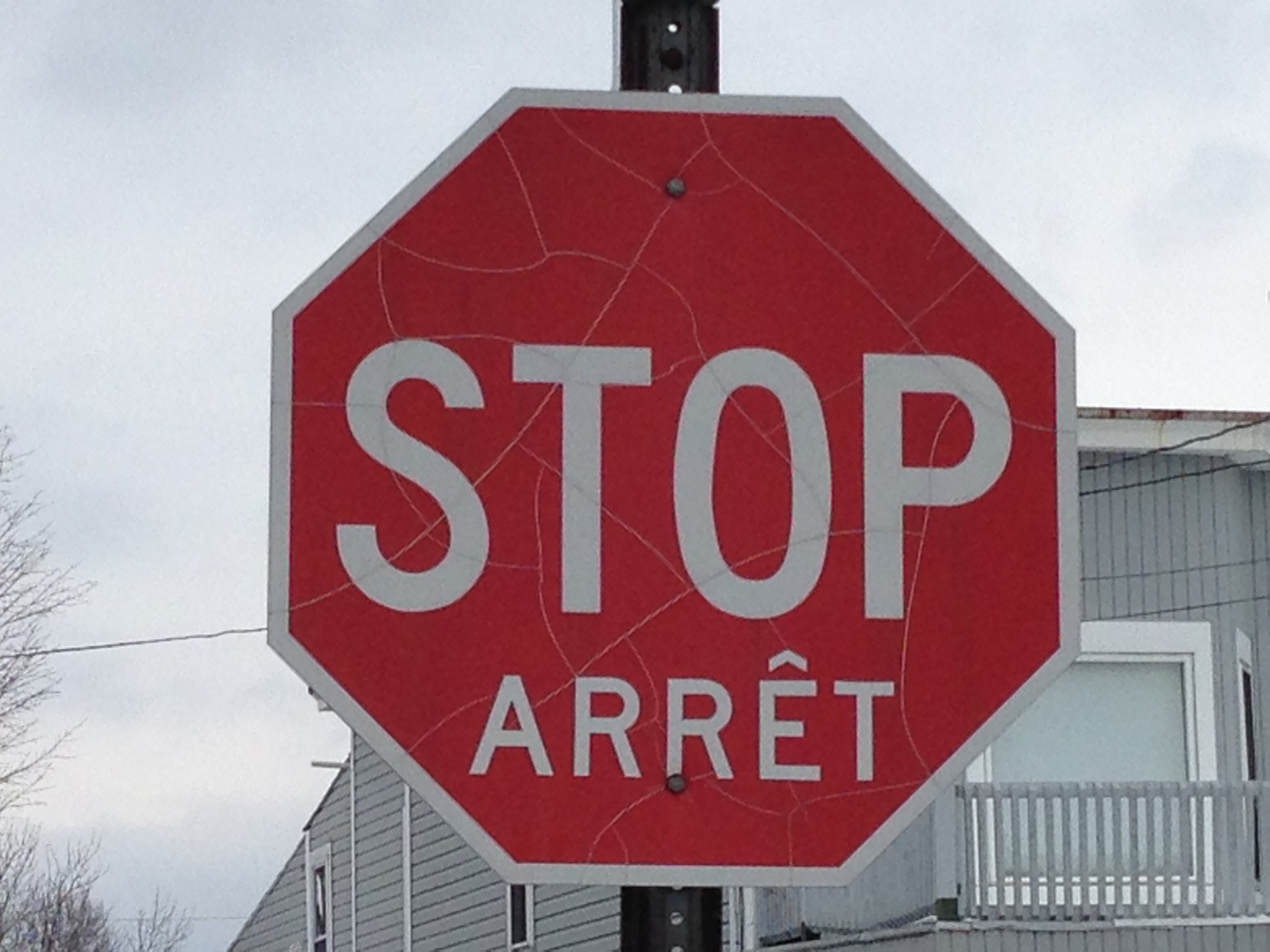
Driving through town, I stop at a bilingual Stop/Arrêt sign before pulling out into the modest traffic. Minutes later, as I drive down the stretch of Route One we call “Moose Alley”, I slow down for a hesitant four legged jaywalker and then set the cruise control to 56 miles per hour. With the push of a button on my steering wheel, the dashboard display reads 90 km/h. That feels very familiar and comfortable.

My commute takes me through the dense pine forest and over the hills with their long vistas across to the mountain ranges of Canada and towards the south. There, almost two hundred miles away, are the specialists I have referred my patients to for thirty years, colleagues I know by first name and often speak with over the phone, but rarely see in person. That’s how far my patients have to travel to see a gastroenterologist or a vascular surgeon, or to have a PET scan, stress echo or a balloon angioplasty.

After the last stretch, on a snow covered back road, my little red 1936 farmhouse gradually appears in view. Seeing it, with its Swedish flag by the front door, you could think you were three thousand miles away in Sweden, in the village where my father was born, and his father and grandfather before him.

I sometimes ponder that this area looks a lot more like the Sweden I grew up in than the modern day Sweden I have visited in recent years. It also doesn’t look like the increasingly congested suburban America I first visited forty years ago, near where the Pilgrims landed south of Boston. Time somehow passed faster elsewhere than it did in these remote northern towns and villages where I live and work, on the very outskirts of America. My office is in the only town in this country where McDonald’s opened and later closed a restaurant due to a lack of customers. It is an environment with fewer distractions than most places, closer to nature and to the timeless essentials of life. It is a place where doctors shoulder big responsibilities but also get to feel a unique closeness to and appreciation of the patients who depend on them.


Does Lightning Strike Twice?

My uncle in Sweden got hit by lightning twice. He is a stubborn farmer, who twice was a little too late getting his tractor and plow off the field in a flash thunderstorm.

Today I saw Gordon Grass, the man who had surgery for his subclavian steal that I had diagnosed recently. One of his symptoms had been dizziness and multiple falls. Gordon’s blood pressure is now equal in both arms and his brain doesn’t have to share its blood supply with his left arm anymore. But he is still dizzy and lately he has had this strange, irregular clicking in his right ear. It is definitely not his pulse. I had seen him for this a week ago and as his right eardrum looked dull and his Weber and Rinne tuning fork tests were equivocal, I prescribed a nasal steroid spray and told him that would probably clear up his symptoms.

Today he was back.

“I’ve been reading online about acoustic neuromas, and I have all the symptoms”, he said.

“Don’t you know you can only have one rare condition and you’ve already had yours”, I sad with feigned seriousness. He smiled faintly. I repeated his tuning fork tests and did a whispered voice discrimination test. His eardrum still didn’t look quite normal.

At that moment, there was a ruckus in the hallway. I excused myself and left Gordon’s room. Autumn and the receptionist were wheeling a man I’d never seen before, about my own age, down the hall in a wheelchair. He was moaning and writhing in obvious pain.

I instantly remembered Winfield Smith, a patient I had almost twenty years ago. He arrived the same way, writhing in the waiting room wheelchair, and he had an arterial embolism in his leg. We shipped him to Cityside via ambulance and he was soon on the operating table under the care of the same vascular surgeon, then new to our area, who had just taken care of Gordon Grass across the hall.

“It’s my leg, it’s a clot, just like seven years ago”, the stranger in the hall groaned.

“What happened?” I asked as we wheeled him into an empty exam room. His right shoe and sock were already off.

“I was walking to the store and this pain just grabbed me in the thigh”, he said.

“The sheriff dropped him off”, Autumn said. “He flagged the cruiser down.“

I knelt down in front of him, just like I had done when Mr. Smith rolled in the same way twenty years ago, and checked the skin temperature of his right foot. He winced at my light touch. His foot was a little dusky in color and his skin was slightly cool. I couldn’t feel any pulses.

“Let me just get my Doppler”, I said and got my little hand held device from my office.

Same result with the Doppler – no distal pulses.

“Let’s call the ambulance. I’ll alert the hospital” I began. A few minutes later the crew wheeled him down the hall to their rig and I returned to Gordon and his ticking ear.

I told Gordon that it wasn’t likely that he had an acoustic neuroma, partly because of his exam findings and also (I guessed) because the MRA’s he had before his vascular surgery probably would have picked up a tumor. I said I wanted to make a referral to Dr. Ritz, the wise old ENT specialist who bailed me out with my bacterial parotitis case a while back.

“This ticking is driving me crazy”, Gordon said.

“We sometimes prescribe low dose Valium for ear noises, because of how intolerable they can be”, I explained.

“I’ll have some then”, he quipped.

A Near Miss, Technology Notwithstanding

The other day I ordered a CT scan with contrast on a patient with an apparent mass on his neck. I explained about the need to get a blood test to make sure his kidneys could handle the iodine contrast. Because our lab was closed, I had to print a requisition for him to bring to the hospital lab.

Printing a requisition from our EMR is a multi step process that involves leaving the “superbill” (I don’t know what’s so superior about it, but that’s a different topic), going to “chart”, clicking on “requisitions”, highlighting the “creatinine” I just ordered, selecting “in-house lab” even though the requisition is meant to bring to the hospital, selecting “ok”, then getting transported to another screen where I must again highlight “creatinine“, clicking “print”, getting to a pop up window that says “could not find a printer…”, clicking on the name of the only printer on the network I ever use (immediately to the left of my desk back in my office), clicking “ok” and walking down the hall to get the piece of paper, signing it by hand even though it says “electronically signed” and (finally) giving it to the patient.

The next day we got a fax from the x-Ray department with their premedication protocol for iodine allergic patients. I had missed the fact that my patient had an allergy to iodine.

I simply missed the fact that my patient had this allergy, and he didn’t catch my comment about “iodine contrast”. I should have asked more specifically about iodine allergy, and I should have made the detour from “superbill” to “medications” to “allergies” before going to “chart” to go through the steps of ordering the creatinine, but this time I didn’t.

My million dollar system, which doesn’t even have a spell checker, doesn’t know that a CT with contrast requires a creatinine and is contraindicated if the patient is allergic to iodine. It makes me follow a “workflow” that reminds me of my High School introduction, in the early seventies, to the early programming languages of the day (COBOL and Fortran, if I remember correctly) and my first Atari home computer. It is far removed from the $500 iPhone I carry on my belt.

In the days before our EMR, filling out a paper requisition took only a few seconds and gave me more time and mental space to chat with the patient about the test itself while I was completing the task. With the archaic workflows of my EMR, my attention is drawn away from the clinical scenario to the not-so-smart computer in the room.

What was supposed to make the practice of medicine safer and more efficient is, to date, only a gleam in the eye of software designers, politicians and clinic administrators. For those of us in the trenches, it is at least some of the time just a bunch of extra work with very uncertain benefits.

When a Housecall is Worth a Thousand Tests

Flossie Marks used to complain now and then about shortness of breath on exertion. She never had chest pain and, after all, she carried firewood from the basement to feed the wood stoves and fireplaces in her large Victorian house. At 81, who wouldn’t be a little short of breath doing that?

Last summer, she finally sold the house where she and Eli had raised four children and hosted nine grandchildren for holidays and summer vacations. After Eli died three years ago the large house had become a millstone around her neck and she had lowered her asking price by more than half before it finally sold. She had confided in me last spring that she didn’t think she could handle another winter there.

She had been so excited when she told me about the cute little apartment she would be moving into in September.

Then in November, I saw Flossie with a concern about nighttime coughing. She had gained some weight, but of course, she wasn’t running up and down three stories and down in the basement anymore.

She confided in me that she wasn’t thrilled with the apartment complex she had moved into. There was loud music and neighbors’ late night arguments sometimes kept her awake.

Her EKG and chest X-ray were normal, and she wasn’t anemic, but her BNP was mildly elevated. I ordered an echocardiogram. That was normal. As I contemplated my next move, Flossie ironically broke her ankle slipping on the wet bathroom floor. She never injured herself feeding the fires in her Victorian, but a wet tile floor put her in a cast boot and crutches.

I needed to proceed with my assessment of her cough and shortness of breath so I offered to do a housecall.

The first thing I noticed when I arrived at dusk for my visit was that several light fixtures outside and inside the building weren’t working. I also heard the music Flossie had told me about as I walked down the dimly lit carpeted hallway.

Entering her ground floor apartment at the back of the building, my nose instantly registered a strong smell of mold and my mucous membranes started to burn.

Flossie was sitting in a recliner with her injured foot elevated and as we spoke, her conversation was interrupted now and then by a dry cough.

“Did you see all the broken lights and did you hear the thumping rock music coming in?” Flossie asked. “I should have moved into the Leblanc Apartments instead – they have more people like me there. My best friend Norma Beck lives there, you know her. The Superintendent there has said I can have an apartment close to Norma’s that becomes available the first of next month.”

“Sounds like that could be a good change for you”, I said, and I thought to myself as my eyes watered from the mold in the air, “it might stop our breathing work-up right there”.


I just realized none of the posts show on an iPad or a computer, but they do show on an iPhone. WordPress is working on this. In the meantime, please visit my Substack.


Osler said “Listen to your patient, he is telling you the diagnosis”. Duvefelt says “Listen to your patient, he is telling you what kind of doctor he needs you to be”.


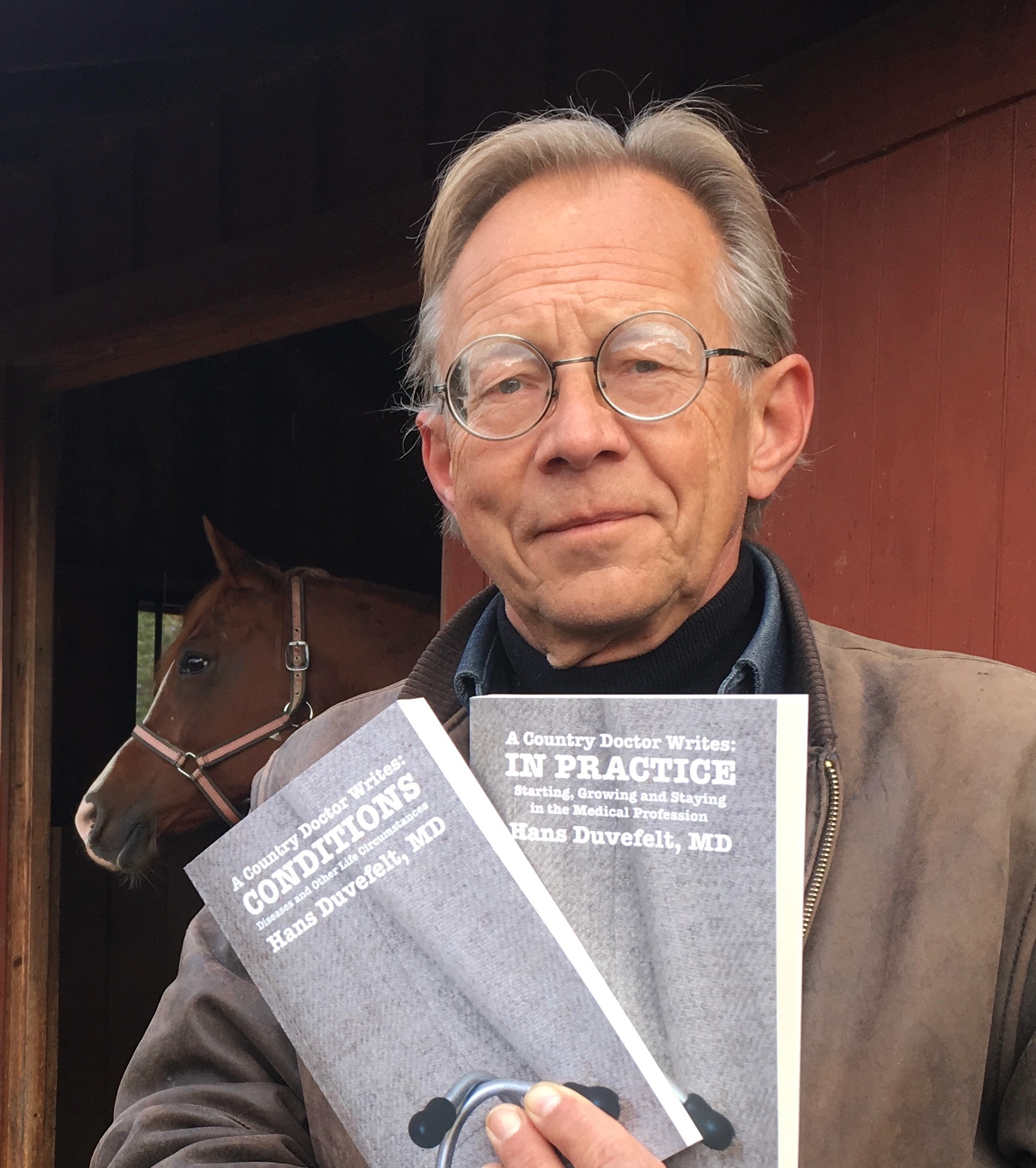
BOOKS BY HANS DUVEFELT, MD

CONDITIONS, Chapter 1: An Old, New Diagnosis

Top 25 Doctor Blogs Award

Doctor Blogs

Enter your email address to subscribe to this blog and receive notifications of new posts by email.

Mailbox

contact @ acountrydoctorwrites.com
Bookmark and Share
© A Country Doctor Writes, LLC 2008-2022 Unauthorized use and/or duplication of this material without express and written permission is strictly prohibited. Excerpts and links may be used, provided that full and clear credit is given.