Archive for the 'Progress Notes' Category


A Really Bad Bruise

Theodore Black woke up two weeks ago with a massive bruise from the left side of his chest to his lower abdomen. He ended up admitted to the intensive care unit and wasn’t discharged from the hospital until today.

“Cough and rash”, was his chief complaint in my clinic schedule that morning. I had an emergency room report from Lakeside Hospital, near where he had spent a week at a conference. Two days before I saw him, he had gone to Lakeside’s ER with a nasty cough and pain across his lower chest and upper abdomen, radiating all the way around his mid-back like a vice. They got a normal chest X-ray, and a normal complete blood count and chemistry profile, so they sent him out with prescriptions for pain pills and some cough medicine.

“I’ve still got this really bad cough, and the pain hasn’t let up”, he started, “and when I woke up this morning, I had this rash…”

He lifted his shirt and exposed a massive bruise running along the left side of his body from the level of his nipple to his hip.

My mind raced into action as I listened to his heart and lungs, palpated his lymph nodes, examined his abdomen by inspection, auscultation, palpation and percussion. His breath sounds were slightly diminished at the base of his left lung, the bruised area was dense and extremely tender. His abdomen wasn’t very tender, except under the bruise, but he had some flank dullness on the right. He hurt too much on the left side to let me percuss him there, and he was unable to roll over on his left side to allow me to check if the right-sided dullness to percussion shifted with a chance in position.

His blood pressure was a little lower than usual, but his pulse was low – which was to be expected with the beta blocker he takes for his blood pressure.

I couldn’t remember the eponym for what he had, but I knew he had massive internal bleeding somewhere. In the back of my mind I thought I remembered retroperitoneal bleeding from coagulopathy or cancer, necrotizing pancreatitis or possibly intraabdominal bleeding.

I ordered a fingerstick prothrombin time, which came back normal at 1.0 and a CBC and a chemistry profile which I knew would be ready in just a few minutes with our new chemisty analyzer. I told him I’d be back as soon as the labs were done.

Back in the office I googled “flank ecchymoses” and saw the eponym I had forgotten, Grey Turner’s Sign. Everything I remembered or just instinctively knew about it matched the monograph I found.

His CBC came back first, and his hematocrit had dropped from 40 at Lakeside to 27 – definitely a massive bleeding. I went back in his room and told him that I not only wanted him to go to the hospital but that I didn’t want him going all the way there in a private car, but in the ambulance. Just as Autumn was calling the emergency dispatch number, Ted’s chemistries came back, with the lowest sodium level I have ever seen, 116 mg/deciliter. It had been 140 two days earlier.

I have seldom seen symptomatic hyponatremia, and the correlation between sodium levels in the brain and in peripheral blood isn’t very predictable, but the literature suggests that people with sodium levels as low as Ted’s are likely to be obtunded or having seizures. He seemed quite normal in that regard. Still, it made me feel good about my decision to recommend that he should go to the hospital via ambulance.

Ted had a chest CT angiogram, showing a modest amount of blood in his left chest cavity, but there was no bleeding or any other abnormality in his abdomen or pelvis on those scans. His pancreas and kidneys looked just fine.

They slowly corrected his sodium deficiency and watched him carefully, but he didn’t lose any more blood and he had no seizures or any other neurological symptoms.

In the end, after his long and likely very expensive hospital stay, he was discharged for the second time on pain pills and strong cough medicine.

The final diagnosis was “Hyponatremia secondary to volume loss from left hemothorax and extensive ecchymoses from severe cough”.

I had expected to hear bad news any day from the hospital, but my first and possibly only sighting of Grey Turner’s Sign turned out to be very benign. My colleagues were aware of my initial observations and this afternoon I walked around and told them how things had turned out.

“I’m sure someone will write that case up and publish it”, Dr. Brown said, probably referring to one of the major medical journals.

“Definitely”, I answered. I never did get around to telling Dr. Brown that I am writing this blog.

So, if The New England Journal of Medicine runs a piece on hyponatremia due to severe internal hemorrhage from coughing, you read it here first.

Inside and Out

77 year old Edward Tripp had been to the emergency room with chest pain last Friday night. It was relentless, aching, and involved the upper part of his left chest.

He had no cough, fever or shortness of breath. He was not sweaty or nauseous, and his blood work, EKG and chest X-ray were normal. He was distinctly tender over the part of his rib cage where bone and cartilage join each other a few inches from his breastbone. He had indeed done some heavy work with his arms in the days before, so the doctor made the assessment that his pain was caused by this apparent costochondritis.

Ed received a shot of pain medication at the hospital and was sent home with a prescription for hydrocodone. As the weekend went by, he started to feel worse and worse.

When I saw him Monday morning, he looked pale. He was short of breath and lightheaded. He had no appetite, and he had been sweating with the slightest exertion.

His blood pressure was low, even for him, a tall, sinewy vegetarian, and his pulse was 115. He did not have a fever, and his oxygen saturation was normal. On exam, there was no heart murmur and his lungs were clear, but his breath sounds seemed a little weaker on the left. His abdomen was diffusely tender, and he was still quite tender over each rib in the upper part of his left rib cage.

His EKG had some very nonspecific changes, which could conceivably go along with impaired blood flow to his left ventricle. Putting all this together, I recommended that we send him back to the hospital for reevaluation. I wondered about angina, a blood clot in his lungs or internal bleeding in his abdomen. His chest wall strain was clearly not the only thing going on.

At the hospital, they did another chest X-ray, which showed some minimal haziness in the left lung. His cardiac enzymes were normal, but he had an elevated D-dimer, so there was a possibility that he had a blood clot in his lung.

His CT angiogram ruled out a clot, but he had a dense infiltrate, by all indications a pneumonia, in his left upper lung, exactly underneath his sore ribs.

When the first chest X-ray was re-read with the second one and the CT as comparisons, the pneumonia was faintly visible.

We all tend to look for one diagnosis that explains everything that is going on with the patient, and we often tend to latch on to the first positive finding we make. But medicine is often more complicated than that, and sometimes we see diseases in early stages, when findings are too subtle to make a diagnosis.

I have come to feel a certain discomfort deep in my gut when an older patient has pain in or even near the chest that appears to have an orthopedic cause.

That feeling dates back to my first job, just out of residency, when an 80 year old woman with shoulder pain I had evaluated came back to the emergency room two hours later with an obvious myocardial infarction on her EKG.

Being the first one to evaluate a patient, you don’t have the advantage of elapsed time that the second examiner has. Such is primary and emergency care.

Specialists in Diagnostics

Every primary care physician has had this experience: We refer a patient to a cardiologist, pulmonologist or gastroenterologist and get a note back that says our patient’s symptoms are not cardiac, pulmonary or GI related – “Not my department”, in essence.

Medical specialties are organized by organ or organ system, and not by symptom. This really leaves primary care doctors in the default role of being specialists in diagnostics. I often say to patients with poorly localized symptoms: “Once we know what body part is causing your symptoms, we can get help from a specialist in that organ system, but until then, it’s up to you and me to figure it out”.

Some years ago I took too long to properly diagnose an older woman’s shortness of breath. It had developed gradually over a period of about a year. She had a smoking history and a mild chronic cough. She was also a diabetic with high blood pressure. I ordered a chest X-ray, pulmonary function tests and an echocardiogram before I realized I hadn’t checked her blood count. She turned out to have iron deficiency anemia from a chronic gastritis. That is a lesson I will never forget.

In the fifteen minutes we have with each patient, we sometimes zero in too quickly on the most obvious symptoms in front of us. This is perhaps even more likely if our support staff documents the medical history in the electronic medical record before we even enter the room. I constantly remind myself to take the time to listen carefully to the patient’s own story, and to simply observe before I begin examining.

A few weeks ago I saw a woman in her forties with a history of mild asthma and stable depression. She showed up as a “triage” at the front desk and was hoisted into our “trauma room”, gasping for air. She had been to a walk-in clinic a few days before and was prescribed an antibiotic for a bronchitis but had become progressively more short of breath since then.

“I don’t know if I’m having a panic attack or what”, she said between deep, rapid breaths. “My hands are getting all tingly and I have this constant pressure in my chest.”

Her oxygen saturation was normal and her peak flow was better than the old values we had in her record. Her lungs were perfectly clear. Her heart rate was in the 120’s and her EKG was normal.

Working quickly and speaking slowly, trying to get her to relax, I checked her legs for swelling and calf tenderness and checked her skin temperature. Her hands were ice cold and very pale.

“Yes, you are hyperventilating”, I said. “That’s why your hands are tingling. I’ll cut you a deal. Let’s give you some oxygen, so you’ll be able to breathe a little slower.”

She felt better and her respiratory rate settled down. With the pressure in her chest, she needed to be transported to the hospital for further testing to rule out a heart attack or a pulmonary embolus.

I finished up my note and handed it to the ambulance attendants. I remember typing in “distal pallor” as one of my exam findings. In the back of my mind I wondered if this was another case of severe anemia presenting with shortness of breath. At the walk-in clinic she might just have been pigeon-holed as having a chest infection, because it seemed the easiest diagnosis.

A call from the hospital the next day shed light on her symptoms: She had normal troponins and a negative D-dimer, but she was indeed profoundly anemic with a hemoglobin of 6, half of what would be normal for her, and her periods had been irregular and unusually heavy for the last year. She had also been taking a lot of ibuprofen, but her gastroscopy showed only some mild gastritis. So the cause for her shortness of breath, ultimately, was gynecological – not the first thing we usually think of with that symptom, although any kind of anemia should be in the differential diagnosis.

A simple bedside observation had suggested she might be anemic.

We do need to manage many common chronic diseases in our role as primary care providers, and this is something that is becoming more and more complex with time. But our role as frontline diagnosticians is possibly under-appreciated and under-emphasized. We need to continually hone our diagnostic skills in order to serve our patients. Even in cases where we refer patients out, to the Emergency Room or to specialists, we need to actively consider the diagnostic process beyond where our involvement or responsibility ends, so that we can become better and better diagnosticians ourselves.

We have all kinds of tools these days for looking up treatments for even the most esoteric diseases, and once we have a general idea of the diagnosis, we can easily look up the specific criteria. The challenge is to make that initial broad assessment that points toward the ultimate, specific diagnosis. That is a skill not easily taught in medical school, because it involves gauging multiple probabilities simultaneously and sifting through countless extraneous details in patients’ medical histories, lab tests and exam findings. Only hands-on experience teaches us to do that, but only if we cultivate an inquisitive mindset and a personal investment in the diagnostic process.

In all the quality literature I read, little mention is made of the value of accurate diagnosis; are we focusing too much on simple housekeeping parameters, measuring only what is easy to measure? Looking at malpractice statistics, failures and delays in diagnosis make up the majority of claims in primary care. That would suggest that what patients value and expect most is to be correctly diagnosed. Perhaps we need to redefine quality in health care to begin with accurate diagnosis of what our patients present to us with, before getting too far into the metrics of blood sugars, blood pressures, prescribing ACE inhibitors, aspirin and beta blockers.

An Invitation

“I invite you to follow me on my journey”, she said with a voice that sounded proud, calm and courageous.

Her brain MRI had shown a large, inoperable glioblastoma. Her cheeks were already puffy from the steroids the neurosurgeon had prescribed to counteract brain swelling and seizure risk.

“I am not afraid of my cancer”, she continued. “It is now part of who I am. I even gave him a name, and he follows me wherever I go. There is no point in wishing it wasn’t so.” She chuckled a little and added, “I talk to him sometimes, and say things like ’so, what are we going to do today?’ I can tell he is there when my right hand refuses to cooperate and I am unable to dial on my cordless phone, and when I feel spasms coming on that make me drop my teacup or whatever I am holding in my hand.”

She spoke with a grace and a dignity that made me feel privileged to be in her presence. I have followed, intimately, the course of many incurable diseases in dozens of patients over the last thirty years, and a handful of these patients have etched themselves into my memory with their serenity and otherworldly radiance of faith and purpose. This was the first time a patient spoke of her disease as a journey, and used the words “I invite you to follow me”.

I felt I was on such a journey when I travelled back to Sweden and shared my father’s last days and death from Alzheimer’s disease a few years ago. But there was something very unusual and humbling to hear a patient with a new terminal diagnosis open her private world to let me, a stranger and only her new doctor, inside.

I sometimes spend too much time and energy, or “jing” as my wife says, thinking, talking and writing about how health care should be organized and delivered. But then, every once in a while, a few words, a look, a sigh or an outstretched hand from a fellow human being cuts through all the distractions of my work and reminds me of my own purpose, my own journey as a physician, a fortunate apostle of the ancient masters.

I started medical school forty-two years ago this month. I am grateful to begin another new year in medicine.

The Interview

Today I met a man who wanted to interview me before transferring his records.

He was about my age and seemed polite and pleasant enough. He told me his doctor of a dozen years had started to taper him off his long term narcotics after he reported some of them missing because of theft. He used to take the equivalent of about 1,200 mg of morphine per day for his back pain. Our office classifies anything over 120 mg of morphine as a high risk dose.

He left that practice and transferred his care to a hospital run clinic across his home town. His next doctor at first prescribed him the medications, and then quickly begun tapering him off them. The story was a little vague as to exactly why.

He then landed in the hospital for something unrelated, and the report from that admission was available on our state’s medical information sharing website. He told the hospitalist that he was on the high dose that actually two doctors had already tapered him off. The hospital doctor called his new primary care doctor to clarify things and was told the patient had failed a urine drug test because it contained a pain killer he was supposed to have run out of months before. He told me he wasn’t trying to deceive the hospital, he just thought they wanted to know what he used to be on before things changed. He also told me he had kept a few of the discontinued pills on hand, and had used them when his main medicine was being tapered.

The man said he had been off his narcotic pain killers for a few weeks now. He drove himself the 25 miles to our clinic, and he walked the long way from the parking lot to my corner office. He sat in a relaxed position in the office chair across from me, but he told me that he had suffered a big loss of quality of life when he lost access to his narcotic prescription.

After he was done telling me about what it felt like to be tapered off his pain medications, and as a by-the-way, he also told me he needed to get back on the amphetamine he had been on for his attention deficit disorder.

I listened carefully and told him with my most gravelly and serious voice that I didn’t think any doctor would prescribe the kinds of doses he used to be on, and that he did seem to function without them – at least to a degree. I told him that his best bet was probably to talk with the doctor he had known for twelve years. I told him that particular practice has a committee that reviews the care of their difficult pain patients, and he could ask for their involvement. I offered to take care of his other medical needs if he wanted me to, but that there was not enough trust between us for me to just give him narcotics again because of the history he provided me with.

He thanked me politely, rose from his chair, offered a firm goodbye handshake and walked slowly down the hall back to the reception area.


I just realized none of the posts show on an iPad or a computer, but they do show on an iPhone. WordPress is working on this. In the meantime, please visit my Substack.


Osler said “Listen to your patient, he is telling you the diagnosis”. Duvefelt says “Listen to your patient, he is telling you what kind of doctor he needs you to be”.


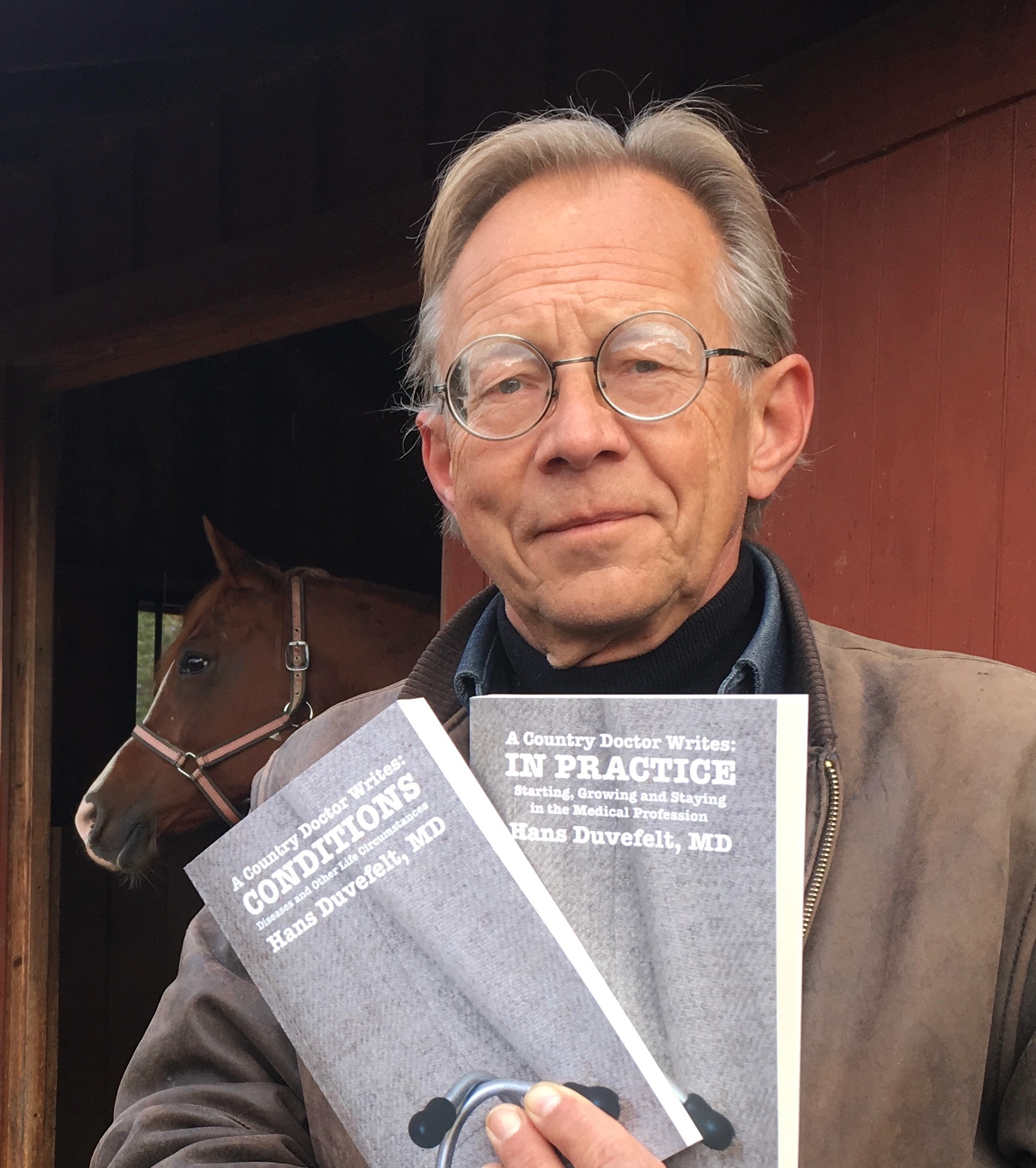
BOOKS BY HANS DUVEFELT, MD

CONDITIONS, Chapter 1: An Old, New Diagnosis

Top 25 Doctor Blogs Award

Doctor Blogs

Enter your email address to subscribe to this blog and receive notifications of new posts by email.

Mailbox

contact @ acountrydoctorwrites.com
Bookmark and Share
© A Country Doctor Writes, LLC 2008-2022 Unauthorized use and/or duplication of this material without express and written permission is strictly prohibited. Excerpts and links may be used, provided that full and clear credit is given.