Archive for the 'Progress Notes' Category


Doctoring, In Simple Terms

Friday afternoon, during the last two hours before the long Labor Day weekend, I had two patients with shortness of breath, one who was feeling bad all over, one with a brand new neuropathy and just then I got an urgent fax with an MRI report that a patient I had seen two days earlier had very severe spinal stenosis.

One of the patients with shortness of breath had a stable EKG, an unchanged chest X-ray and a normal blood count. But his oxygen saturation trying to walk down the hall to the bathroom dropped from 91% to 84% and his pulse rose to 137. On exam, he had loud pleural rubs over both lungs. He required some convincing before agreeing to go to the hospital by ambulance. I told him that with his atrial fibrillation and rapid pulse, he was probably trying to compensate for what might just be a viral infection with some pleurisy, but the faster his heart beats, the sloppier and more inefficiently it pumps, which is why he, more than the average person, needed to be in the hospital with everything he had going on.

The patient who felt bad all over looked jaundiced to me and while I waited for his chemistry profile to come back, I went back to my second patient with shortness of breath. Her oxygen saturation was fine both at rest and with a walk down the hall, her EKG was unchanged, her breath sounds and peak expiratory flow were normal and her chest X-ray hadn’t changed from her last one. But she had a new, significant but not critical anemia.

Sitting down next to her, I explained in English while her son listened from his corner of the exam room:

“There are basically three reasons why someone can be short of breath – a weak heart that can’t pump the blood around enough, bad lungs that can’t take enough oxygen from the air and transfer it to the blood, or weak blood with too little hemoglobin to carry the oxygen to all the organs in the body that need it.”

He spoke rapidly to his mother in French, and she nodded in understanding. Then he looked at me and said:

“I’ve never heard anybody explain that so simply before.”

“It really is pretty simple”, I answered. “Someone once said that if you can’t explain something to a twelve year old, you don’t really understand it yourself, or it isn’t worth knowing.”

Madame Theriault refused a rectal exam but agreed to get me some stool cards, the first one the next morning, Saturday. Sadie, the lab tech, had enough blood to send off a B-12, folate and iron studies. We agreed to be in touch Saturday morning and Tuesday. If she gets worse, she will go to the emergency room.

The man who felt bad all over had a bilirubin twice the upper limit, his liver enzymes were elevated and although he didn’t have a fever, his white blood cell count was elevated. I explained to him and his wife that his bile ducts were plugged and he was being poisoned from inside by all that bile and there may even be a brewing infection in his gallbladder. The ambulance had just come back from the hospital, and after they loaded him on the rig, I called the emergency room again and said “I’ve got another one for you”.

The neurosurgeon on duty returned my call just after five. He was able to look at the MRI images as I told him about the patient’s physical exam and his two week history of back pain with sudden urges to urinate or defacate (which in my office note had been transcribed as “deprecate” by the voice recognition software). He told me to have the patient call his office Tuesday morning and they’d get him in to the Wednesday neurosurgery clinic. I called the patient and told him the news. He was feeling quite a bit better on the prednisone I had prescribed. I explained what the MRI report said about how tight his spinal canal and the exit holes for the nerves were.

And, speaking of nerves, I also sat down with the woman with beginning neuropathy and described how it usually starts at the end of the longest nerves. Her big toe is a hair shorter than the two affected toes, so it may be next. We also talked about how better blood sugar control can sometimes make neuropathy better, but not always.

Eight o’clock Saturday morning, I sat with a fifty something man with poorly controlled diabetes. He is a junk dealer, who always fixes his own vehicles.

“Walk me through your day, tell me what you’re eating”, I asked him. After he did, I explained:

“You can keep eating a pretty balanced diet like you’re doing, and take some more pills or even insulin, and we can get your blood sugars down, or you could get more radical with your diet and avoid taking more medicines.”

“Well, I sure don’t want the needle”, he answered. I went on:

“I’ve got my old van out there in the parking lot. It’s a flex fuel thing that’ll run on regular gas or ethanol. If it started to sputter on gas and my mechanic told me to try ethanol, I’d be thinking, like, I’ve been putting gas in my cars for over forty years, and I don’t know anybody who uses ethanol in their car – why me, why should I have to change now, at this age? But, then again, what if my van starts to run better, isn’t it worth switching?”

He shrugged: “So what do I eat?”

“Think of it this way, you’ve already eaten almost all the carbohydrates a person should eat in his lifetime. That’s why people with the right genetic predisposition develop diabetes if they eat more carbs than they can burn right away. Eat protein, and green vegetables; humans can survive quite well on that, just like my van could run on only ethanol.”

Every day I find myself speaking very plainly about how diseases and the human body work. It almost feels like that is the biggest part of what I do. In doctoring, it isn’t enough to know what to do; my job is to help each patient understand their illness and their options for conquering or living with it. Unlike a surgeon, I seldom deliver complete cures that don’t involve a lot of self care in the form of medication or life style changes.

The simple word “doctor” is derived from the Latin “docere”, which means “to teach” and “to point out”. That is what I do, every day, every chance I get. And as health care continues to get more complex with more and more options for every disease, I find myself doing more and more of it, with greater and greater satisfaction the longer I do it. It is a labor of love.

Return Visit: A Shot in the Arm

All the talk about the high cost of Epi-Pens made me think about how much we have relied on cheap, generic epinephrine in this country, and how much respect my Swedish mentors had for that drug.

Back in 2009 I wrote a post about epinephrine, prompted by the high cost of my wife’s albuterol inhaler. Of course, that doesn’t seem all that expensive now, compared to the latest in a long series of price shocks. So my last sentence didn’t accurately foretell the future.

Here is my post from January 2009:

Three asthma inhalers for my wife cost us $90 in copayments this week. Not long ago, generic albuterol inhalers were about seven dollars each. The main reason for the price increase is the new U.S. law that banned the use of fluorocarbons in prescription asthma inhalers this winter. The old-fashioned inhalers are harmful to the ozone layer. This new law prompted the development of novel, brand name, delivery systems, which drove up the cost to levels many of my patients have trouble affording. It does seem ironic that people around here often have remote starters for their gas-guzzling, high-polluting Sport Utility Vehicles, so they don’t have to drive to work in a cold car, but we make our asthmatics help take care of the environment by giving up their inexpensive inhalers for newer, more expensive and not necessarily better devices.

As far as I know, you can still buy old-technology, ozone-depleting inhalers with adrenaline (epinephrine) over the counter for under $10. By the way, we use the name epinephrine in the U.S. because somebody (Parke-Davis) patented the name Adrenalin in 1900 (without the “e”, but still similar enough to force the introduction of a new generic name, epinephrine, different from what the rest of the world uses).

I remember when I was a resident in Sweden in 1981, we had asthma medicines that were years ahead of the American products. We used so-called beta-2 selective inhalers and injectables like terbutaline (Bricanyl), which had fewer side effects, as they acted mostly on the lungs without stimulating the heart the way adrenaline does. In the U.S., adrenaline (epinephrine) in injectable form is commonly used for asthma attacks and allergic reactions. It is even available in auto-injectors for personal use by allergy sufferers.

My Swedish teachers and mentors had little or no experience with adrenaline. In fact, one night in a community hospital where I worked, we had an asthmatic in the emergency room with a stubborn attack, and the senior physician decided to use straight adrenaline since the patient wasn’t responding to injections of terbutaline. We actually transferred the patient to the intensive care unit before injecting the adrenaline, more because of our fear of side efecs from the drug than fear of respiratory failure from the asthma attack.

A couple of years later, new here in town, I met Elwood “Woody” Black.

Woody Black was almost seventy when I met him, and he lived for a good many more years in spite if his bad asthma. The first day I met him, he pulled a beat-up metal case from his shirt pocket with an ancient syringe, a well used needle and a couple of vials of adrenaline. When his asthma kicked in, he would roll up his sleeve and give himself a shot in the arm with adrenaline. It was with great trepidation I agreed to refill his prescription, but he had obviously used it many times without coming to harm.

Driving home from the pharmacy with three inhalers worth about $150, I wondered if generic injectable adrenaline might see a resurgence in this country…

Opiates, Pain and Integration

We are witnessing a strange migration of restless tribes, moving between doctors and clinics, traveling great distances in search of what no one wants to give them anymore.

This eerie movement is steadily gaining momentum in our community, in our state and across the country. We can hear it in telephone calls, we can read it in records of patients looking to switch their care, and we can see it in the eyes of the hopefuls who hobble through our doors, looking for a doctor who will contradict their previous provider and reinstate the status quo: a steady supply of opioids for their pain.

The CDC has made new recommendations for opiate dosing and monitoring, and our state is legislating finite opioid dosing limits. Colleagues everywhere are tapering doses, scouring new and existing patients’ prescription monitoring reports, and aggressively enforcing their opioid contracts by doing more urine drug screens and pill counts than in the past.

Last week, two new patients no-showed for their first appointment after the intake nurse called them to make sure they were aware of our prescription policies. Yesterday, a new patient I sent home the day before to bring me her most recent oxycodone pill bottle called back saying it was empty. It shouldn’t have been. I offered to take care of her other medical needs but I let her know I would not be prescribing narcotics for her. I doubt she’ll be making the 45 minute trip again.

Most of the people I see looking for a new source of pain medications are of the baby boomer generation, grandparents and even retirees, and have been diagnosed with lumbar disc disease. Many carry the diagnosis of fibromyalgia, and almost all of them report symptoms of depression, anxiety and PTSD.

I also see a surprising number of adults with a diagnosis of attention deficit disorder, who have been cut off their prescribed stimulant medications. They were diagnosed as middle aged adults, not during their school years.

Most of these medical migrants seem to be singularly focused on finding a source for the prescriptions they have relied on for many years. Only a few, like the grandmotherly sixty eight year old woman I saw yesterday, say they want to manage their chronic pain and are willing to hear what options I can offer them. This woman had a large hole in her nasal septum from snorting cocaine decades earlier.

This particular woman told me that a month after she was cut off from her opioids, she actually had a three or four week stretch when she hardly felt any pain at all. Then, gradually, her pain returned. She didn’t have any idea of what made it go away and then return.

I told her she had just experienced the power of her own mind over the vicious cycle of sensory input and faulty interpretation of its significance. She eagerly accepted my offer to enroll in our pain management program that day.

She is one of the few new or prospective patients I have met lately who told me she wanted to experience less pain, rather than get a certain prescription.

Pain is a mysterious phenomenon. Our four session pain program, offered individually and not in groups, helps patients understand how pain perceptions work, and gives them a sense of control they never had before. Many participants voluntarily reduce their dose of pain medications after attending, and a large proportion of those on low doses get off them completely.

I introduce the basic idea behind the classes by telling my patients about an old Boy Scout trick:

Sitting by the campfire, you put a branding iron in with the embers and watch it get glowing hot. Then you blindfold the newest member of the troop and expose his arm. While you place the branding iron on a slab of bacon, making it smoke and sizzle, you touch the person’s bare arm with a smuggled-in Popsicle.

What sensation does the poor newcomer experience? Cold or heat?

The answer is intense heat, 99% of the time.

Pain exists in the brain, where noxious stimuli from our bodies are given meaning. The idea, and it is a vey powerful one, is that we can learn to change our interpretation of our own noxious stimuli. They are only nerve signals. Our minds, through our past experiences and because of our expectations, can change their character, intensity and significance.

Opioids do nothing to our aching backs, knees or feet; they just create a certain level of more or less modest euphoria that helps us reframe the meaning of unwanted nerve signals from our arthritic joints.

And now the pendulum is gaining momentum in its swing from one extreme to the other: Pain isn’t a vital sign anymore. Opioids aren’t safe anymore. They’re hardly ever indicated anymore. But we can’t just stop them without offering something else. We can offer an empowering understanding of how pain works, and we can help reduce the broader suffering that we used to speak of only in terms of physical pain.

50% of our patients who have completed the pain sessions have asked to continue seeing their behavioral health professional to work on other issues.

By speaking of pain matter-of-factly, we create a platform for also dealing with other kinds of suffering.

This is true integration of behavioral and primary care.

A Motherless Child Without a Father

The young man with chest pains, shortness of breath and heart palpitations had come back for his followup visit.

His thyroid test and blood count were well within the normal range, his EKG was normal and his chest X-ray was declared normal by the radiologist.

We talked some more about his anxiety and poor sleeping habits. We talked about his late shift at work, and we talked about his late gaming habits on the computer and how he sleeps until ten and misses out on mornings with his young daughter. He had been setting his alarm and getting up two hours earlier than he used to. That had made him more tired and less inclined to stay up past one o’clock in the morning.

We talked about how many years it had been since his mother died, and the emptiness he had felt ever since then. We talked about how he has had to mother himself in some ways ever since then.

We talked about how he had now gone from being a motherless child to a young father, and I asked him what kind of father he wanted to be for his little girl.

That’s when he said, “I wish my dad would act more like a father”.

“Do you wish he would give you some more guidance?” I left it open ended.

“Yeah, I feel insecure, like I’ll mess up with the baby.”

“Have you asked him?”

“Not in so many words. But, he doesn’t seem that interested. He’ll take me out to lunch and we eat without saying all that much and here he is, fifty years old, texting his girlfriend like some teenager instead of talking with me. I’m scared, I don’t know exactly what I’m supposed to do or be like, and he is no role model at all.”

“So if your father acted exactly the way you need him to, what would that look like?” I asked.

He thought for a while, and then, with words that flowed on a river of silent tears, he painted a touching picture of a a young father and a still young grandfather talking about what it takes to be a man.

“See, you have a pretty good idea of the kind of advice you would get, then”, I said. “And your wife and daughter, what kind of man do you imagine they wish you will turn into as you mature and continue to evolve? Do you think you know that?”

He nodded.

“I understand that you wish your father could help you more, but for whatever reason, he isn’t able to give you what you need right now, but it sounds like you already know what kind of man you want to be like.”

He nodded again.

“Be the kind of man you wish he was, be the father you want your little girl to have. She will teach you, just watch her and listen. And talk, really talk, with your wife.”

With the image still in my mind of the fifty year old man texting his girlfriend while his son pined for his love and attention, I added:

“Maturity and age don’t always move along at the same speed. I think you’re growing up faster than many people your age.”

He shook my hand, very firmly, and said:

“Thanks, Doc.”

A Failed Transition of Care

Alvion Barr had a four month delay in his diagnosis.

He is technically a patient of my colleague, Dr. Laura McDonald. But he had drifted between two of our regular doctors and a locum tenens physician we hired to work during March, when both Laura and Dr. Wilford Brown were on vacation.

I saw him late Thursday afternoon for a rash, but he also asked what he could do about his heartburn.

“Tell me more about your heartburn”, I said.

What followed was a near classic description of angina pectoris. He had been getting progressively more short of breath with exertion since Christmas, and if he didn’t slow down when he started to get winded, he would get a dull pain in the middle of his chest that gradually spread to his jaw.

Alvion’s problem list read like a Who’s Who of vascular diseases and interventions: Coronary artery disease with a prior bypass operation and two stents a couple of years later, surgical repair of an abdominal aortic aneurysm, bilateral carotid bruits and mild intermittent claudication. He is also a diabetic and he quit smoking only two years ago.

“I have an appointment with the lung doctor next week to go over all the testing he just put me through”, Alvion said.

I checked his peak flow. It was 550, same as mine.

“When was your last stress test”, I asked him.

It became evident that he wasn’t the best historian.

“Just a month or two ago, and it was okay.”

“Do you remember who ordered it?”

“Dr. McDonald, I think.”

Our EMR had no stress test result, not even an order for a stress test.

Health InfoNet, the statewide Internet repository of test results and hospital records, did have a nuclear stress test report from March 21 of this year, done at Cityside hospital.

My eyes scanned their way down the report and as I read the conclusion, I could feel the hair on the back of my neck rising:

“Large, reversible anterolateral defect….”

“March 21”, I said out loud as I scanned the Health InfoNet site. “Here it is: Hospital discharge, March 21″. We did have that document in our own record also. I continued reading out loud:

“Final diagnosis: Non-Cardiac chest pain.”

Alvion’s troponins had been negative and the EKG portion of his stress test had been normal. There was no report from the nuclear images, but there was a comment, indicating that the images were of poor technical quality and that a final report would not be forthcoming for that reason.

He was prescribed pantoprazole for acid reflux, and here he was in my office after five o’clock on a Thursday afternoon four months later with classic, frequent although not crescendo angina and a highly abnormal stress test.

He had had a hospital followup with the locum tenens doctor, a Transition of Care visit as we now call them. We have created a template to meet the Medicare criteria for the new transition of care codes 99495 and 99496. One of the items is “Pending results at discharge:”. In Alvion’s case the word after the colon was “None”.

I started Alvion on isosorbide mononitrate, a long acting nitroglycerin. He was already on a beta blocker, a statin and a blood thinner. I made sure he had more sublingual nitroglycerin and told him not to push himself and to call 911 if he had chest pain that didn’t go away after two nitroglycerins.

The next morning I called the cardiology office and happened to get to talk to the doctor who had read the nuclear images after the patient had already left the hospital. He took no responsibility for the confusion. All he had to say was “I thought the hospitalist would contact the patient in a case like this”.

“If he was on duty when the report came in”, I thought, adding to myself “and if he read through the whole thing, since you had already told him it was uninterpretable”.


I just realized none of the posts show on an iPad or a computer, but they do show on an iPhone. WordPress is working on this. In the meantime, please visit my Substack.


Osler said “Listen to your patient, he is telling you the diagnosis”. Duvefelt says “Listen to your patient, he is telling you what kind of doctor he needs you to be”.


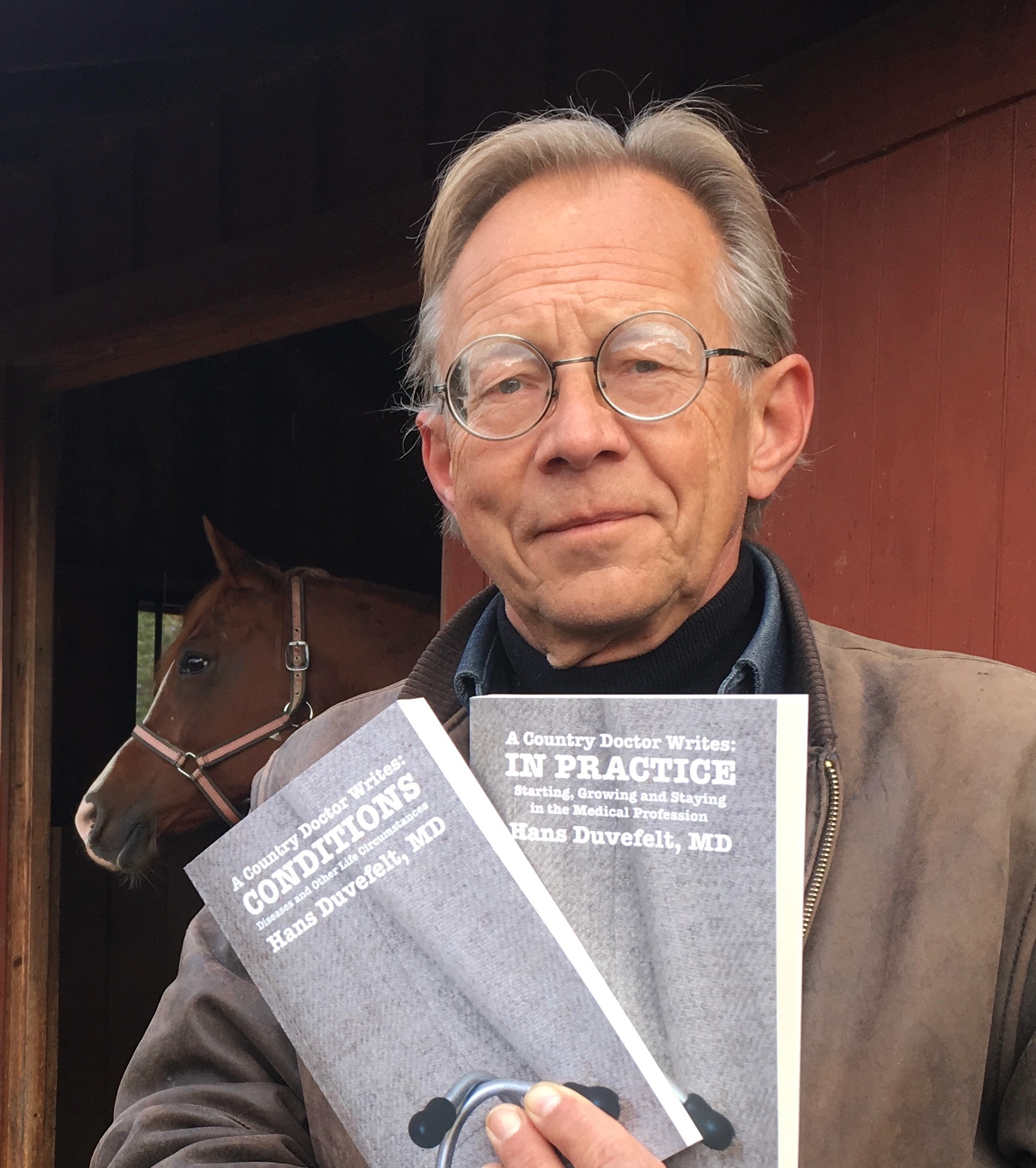
BOOKS BY HANS DUVEFELT, MD

CONDITIONS, Chapter 1: An Old, New Diagnosis

Top 25 Doctor Blogs Award

Doctor Blogs

Enter your email address to subscribe to this blog and receive notifications of new posts by email.

Mailbox

contact @ acountrydoctorwrites.com
Bookmark and Share
© A Country Doctor Writes, LLC 2008-2022 Unauthorized use and/or duplication of this material without express and written permission is strictly prohibited. Excerpts and links may be used, provided that full and clear credit is given.