Archive for the 'A Country Doctor Reads' Category


A Country Doctor Reads: September 20, 2019 – Full Circle With Sertraline, Airmanship and Mastery in Medicine, EMR Notes Exaggerate Comprehensiveness

Full Circle With SertralineAntidepressant that Treats Anxiety or Anxiety Medication that Only Sometimes Helps Depression?

Yesterday’s buzz about sertraline brought a sad smile of recognition to my face. The research, done in British General practice settings was first published by The Lancet Psychiatry, which costs money. I read it on BBC. Sertraline: Antidepressant works ‘by reducing anxiety symptoms first’ was the headline and the study showed that sertraline had almost twice as much effect on anxiety as it did on depressive symptoms, and the effect on anxiety came much quicker:

“After six weeks, the patients taking sertraline reported a 21% greater improvement in anxiety symptoms – such as feeling worried, nervous and irritable – compared to the control group taking a dummy pill. After 12 weeks, the gap was 23%.

But there was little evidence of the drug reducing depressive symptoms, such as poor concentration, low mood and lack of enjoyment after six weeks – and only marginal improvements (13%) after 12 weeks.

Nonetheless, the group taking antidepressants were twice as likely as the other trial participants to say their mental health felt better overall.

“It appears that people taking the drug are feeling less anxious, so they feel better overall, even if their depressive symptoms were less affected,” said lead study author Dr Gemma Lewis, from UCL.”

Back when SSRIs were brand new, they were only indicated for treating depression. I still remember the mental acrobatics doctors went through as we prescribed it for anxiety. The thinking then was that the anxiety we so successfully treated with sertraline was in fact a manifestation of less-than-obvious depression. And here we are, with the opposite being touted as the real scoop on how this now 28 year old drug works.

Does anyone believe we have precision in psychiatric diagnosis? Or even in describing or naming symptoms?

________________________________________________________________________________________

AIRMANSHIP – Mastery in Aviation, Seamanship on the Ocean. How About Mastery in Medicine?

The New York Times ran a piece about the relative inexperience of pilots involved in a Boeing 737 Max crash. Even with many years of experience, commercial pilots don’t really gain the experience flying under extreme conditions, like fighter pilots. This article certainly made me think of a new dimension to the typical comparisons between the airline industry and healthcare: There’s all this talk about predictability and checklists, but what about getting some practice flying upside down – or in medicine, practicing under adverse conditions as part of your training?

“Airmanship” is an anachronistic word, but it is applied without prejudice to women as well as men. Its full meaning is difficult to convey. It includes a visceral sense of navigation, an operational understanding of weather and weather information, the ability to form mental maps of traffic flows, fluency in the nuance of radio communications and, especially, a deep appreciation for the interplay between energy, inertia and wings. Airplanes are living things. The best pilots do not sit in cockpits so much as strap them on. The United States Navy manages to instill a sense of this in its fledgling fighter pilots by ramming them through rigorous classroom instruction and then requiring them to fly at bank angles without limits, including upside down. The same cannot be expected of airline pilots who never fly solo and whose entire experience consists of catering to passengers who flinch in mild turbulence, refer to “air pockets” in cocktail conversation and think they are near death if bank angles exceed 30 degrees. The problem exists for many American and European pilots, too. Unless they make extraordinary efforts — for instance, going out to fly aerobatics, fly sailplanes or wander among the airstrips of backcountry Idaho — they may never develop true airmanship no matter the length of their careers. The worst of them are intimidated by their airplanes and remain so until they retire or die. It is unfortunate that those who die in cockpits tend to take their passengers with them.

www.nytimes.com/2019/09/18/magazine/boeing-737-max-crashes.html

__________________________________________________________________________________________

BREAKING NEWS: Doctors’ EMR Notes Overstate Comprehensiveness of History and Physical Exam – JAMA

Question  How closely does documentation in electronic health records match the review of systems and physical examination performed by emergency physicians?

Findings  In this case series of 9 licensed emergency physician trainees and 12 observers of 180 patient encounters, 38.5% of the review of systems groups and 53.2% of the physical examination systems documented in the electronic health record were corroborated by direct audiovisual or reviewed audio observation.

Meaning  These findings raise the possibility that some physician documentation may not accurately represent actions taken, but further research is needed to assess this in more detail.

https://jamanetwork.com/journals/jamanetworkopen/fullarticle/2751388
Despair and Happiness in America and in Medicine

Earlier this month Ross Douthat wrote a piece in The New York Times titled “The Age of American Despair” where he posed the question “Are deaths from drugs and alcohol and suicide a political, economic or spiritual crisis?”

Douthat writes:

“The working shorthand for this crisis is “deaths of despair,” a resonant phrase conjured by the economists Anne Case and Angus Deaton to describe the sudden rise in deaths from suicide, alcohol and drug abuse since the turn of the millennium.

Now a new report from the Senate’s Joint Economic Committee charts the scale of this increase — a doubling from 22.7 deaths of despair per 100,000 American in 2000 to 45.8 per 100,000 in 2017, easily eclipsing all prior 20th-century highs.

But had deaths of despair remained at 2000-era levels, approximately 70,000 fewer Americans would have died this year alone.”

He imagines what the presidential candidates would say about the cause for this epidemic:

“The Technocrat (voice of Pete Buttigieg): “This is primarily a drug abuse and mental-health crisis, and the only way to solve it is with more and better drug treatment programs, more and better psychiatric care. We’ll save these lives one patient, one addict, one treatment center at a time.”

The Socialist (voice of Bernie Sanders): “This is obviously an economic crisis! People are despairing because their jobs have been outsourced, their wages are stagnant, the rich have hijacked the economy. Tax the plutocrats, raise the minimum wage, give everybody health insurance, and you’ll see this trend reverse.”

The Cultural Healer (voice of Marianne Williamson): “You can’t just medicate this away or solve the problem with wonkery alone. There’s a spiritual void in America, a loss of meaning and metaphysical horizon. The problem is cultural, spiritual, holistic; the solution has to be all three as well.”

Somehow, somewhere I came across a psychiatrist and public speaker named Gordon Livingston, who wrote a lot about grief and happiness. He said this about drug abuse, a year before he died in 2016, but it applies to a lot of things Americans do today:

We can try to turn drug abuse into a disease, but we are just dealing with the larger paradox: the mindless pursuit of pleasure brings pain.

Now, I think drug abuse amounts to a disease because it involves changes in brain function and chemistry, but I do believe his generalization that the harder you pursue pleasure the more elusive it becomes.

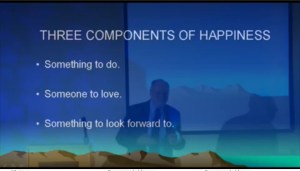
Happiness, Livingston said, requires three things: Something to do, someone to love and something to look forward to.

Looking at my own life and career, with the major changes of recent months, I took these three fundamentals to heart – they actually stopped me in my tracks when I first saw this slide on YouTube. These three things are actually so simple and don’t have to cost much, or anything at all, but they are so undeniably necessary for every human being. But how many people can honestly say they have all three, or give much thought to what they are.

This is exactly what I’ve been thinking and doing. I gave up administrative work and focused on the one-on-one work of seeing patients while I also moved back into my little farmhouse that calls out for me to catch up with some “deferred maintenance” (I love American euphemisms). I also carved out the time to do a substantial amount of horse and farm chores.

So I have several things to do that are meaningful to me. And this would be my addition to Dr. Livingston’s list – we have to see meaning in what we do, even if it is a job we don’t love (although I love mine) but we do it because it makes us feel valuable in some way, to society or our family.

And, speaking of family, and of love, I am deepening my relationships with my adult children and their families after years of working too hard with blinders on much of the time. And not everyone can understand this, but I love my Arabian horses and view them as family. Caring for these noble creatures and being in their presence is almost like a higher purpose.

And what I look forward to now is so different from earlier in my life. I wasted so much mental energy making long term plans before. Now at this age, with the biggest long term plan of all (growing old with my wife) suddenly evaporated, my perspective is shorter, allowing me to take in the present, appreciate the moment, in a way that has profoundly grounded me emotionally.

Back to the three fundamentals of happiness:

How many people in today’s society have defined for themselves what these three things are in their own life?

And, for me as a physician, how many patients do I see who suffer from depression, anxiety, addiction, maladjustment or dysfunctional relationships? How can I better, with whatever influence I have in my role as healer or guide, help them see how simple it can actually be to move closer to being happy?

I wrote this in 2012, in a post titled “The Secret of Life“:

Observing which of my patients live well and handle age, illness and adversity the best, I see the power of this every day.

Jungian therapist Robert A. Johnson describes in his book, “Transformation: Understanding the three levels of masculine consciousness”, how the male psyche evolves from simple man (exemplified by Don Quixote), who asks “What’s for dinner?” to complicated man (Hamlet), who asks “What does it all mean?” to enlightened man (Faust), who asks “What’s for dinner?”

(Here I am again, seven years later, realizing how one has to work at this being grounded kind of thing because modern life pulls us in so many distracting directions…)

With everything published these days about physician burnout, I also think Livingston’s three principles of finding happiness can be useful professionally for doctors. Aside from the love we need in our personal lives, I think doctors today have become distracted from the fundamental need to feel love for humankind, empathy with people, who now are increasingly cast as consumers or “populations” in the scripting of our work lives.

(I also, obviously perhaps, think that what we do has become separated from what we were trained to do, hope to do and need to do. The agendas for healthcare today are to a great degree neither our patients’ nor our own and that spells burnout for us and frustration for our patients.)

Our society is a selfish one. Happiness has become a selfish pursuit. The harder we strive for it, the more elusive it becomes and the more despair we feel.

Happiness is like floaters in our eyes: Try to focus on them and they move out of your field of vision. Keep your eyes on what you’re doing and they’ll remain visible slightly in the periphery as long as you don’t think too hard about them.

P.S.

So here is my happiness recipe for this September Sunday:

I finished my stall cleaning. Soon I’ll make breakfast and if the sun stays around I’ll eat it outside by the horse barn.

My short term goals in life are to catch up on some filing and vacuum the downstairs. And, coming back to me trying to be enlightened man instead of complicated man – what’s for dinner? Grilled salmon and asparagus, my favorite.

I’m not planning tomorrow too hard. Today is today.

…..

A Country Doctor Reads: September 7, 2019 – Workarounds in Healthcare, Empathy in he Age of the EMR, US vs Swedish Postoperative Pain Management

The American Medical System is One Giant Workaround – NYT

The nurses were hiding drugs above a ceiling tile in the hospital — not because they were secreting away narcotics, but because the hospital pharmacy was slow, and they didn’t want patients to have to wait.

So begins an article in Friday’s New York Times. How many times have I used or thought of the word “workaround” recently? Lots, certainly in my personal life, with an older house, an older car, in far northern Maine. But as a descriptor of our country’s entire healthcare system? Well, to be honest, there’s a lot to that notion…

The United States spends more per person on health care than any other industrialized country, yet our health outcomes, including overall life expectancy, are worse. And interventions like bar code scanning are a drop in the bucket when it comes to preventable medical mistakes, which are now the third-leading cause of death in the country. Our health care nonsystem is literally killing us.

As the workarounds accumulate, they reveal how fully dysfunctional American health care is. Scribes are workarounds for electronic medical records, and bar code scanning is a workaround for our failure to put patient safety anywhere near the top of the health care priority list.

www.nytimes.com/2019/09/05/opinion/hospital-workaround-health-care.html

____________________________________________________________________

Empathy in the Age of the EMR – Danielle Ofri, MD

Danielle Ofri has another article on the plights of today’s physician, this time in The Lancet. I had offered some feedback on her article “The Business of Healthcare Depends on exploiting Doctors and Nurses” in The New York Times some months ago, and I ended up joining her mailing list. This just arrived in my inbox and it certainly resonates:

Many of us physicians muddle through our clinical encounters in this manner. We’re half-listening, half-typing, half-processing what tests we’ll need to order, half-chiding ourselves about an oversight from our last patient, half-ignoring the red-flag alerts that keep cropping up, half-thinking about the next three patients in the waiting room, and half-pondering whether one of the EMR buttons could do something practical like conjure up a cup of coffee and a sandwich.

 The only thing that’s not diminished by half is the feeling that we’re cutting corners on every front and scraping by with mediocre medical care. 
— Read on danielleofri.com/empathy-in-the-age-of-the-emr/

_____________________________________________________________________

US, Canadian and Swedish Postoperative Opioid Prescribing – JAMA

I had an open appendectomy in Sweden back in 1972, weeks after returning from my year as an exchange student in Massachusetts. I remember distinctly that I was in relative agony but never asked about my pain level or offered anything for pain while I was recovering in the hospital. I remember spending a few days there. Then, as now, the Swedish healthcare system is lean on interventions and generous with bed-days, so by the time I was discharged I didn’t hurt much at all.

I was aware that Swedish patients to this day don’t receive as much pain medication as Americans, but I had no idea of the magnitude. This week I read an article that pegs the numbers – a seven fold difference:

This cohort study determines whether there are differences in the frequency, amount, and type of opioids dispensed after surgery among the United States, Canada and Sweden.

In summary, we observed differences in opioid prescribing after low-risk surgical procedures across 3 countries in North America and Europe. Patients treated in the United States and Canada received opioids after surgery more often and in higher doses compared with patients treated in Sweden. These findings highlight opportunities to encourage judicious use of opioids in the perioperative period in both the United States and Canada. Understanding the societal and cultural factors that influence these prescribing patterns could inform areas of further research and identify targets for future interventions.
— Read on jamanetwork.com/journals/jamanetworkopen/fullarticle/2749239

A Country Doctor Reads: August 31, 2019 – Polypill for CVD risk reduction; Assisted living is a money-making fantasy; Why doctors should read business journals

The Polypill is Back – The Lancet

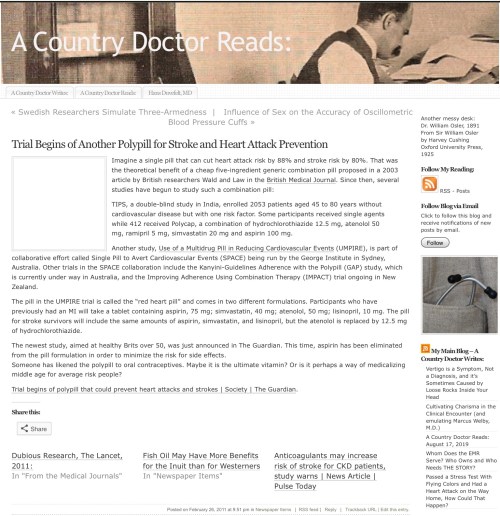
One of my first posts on “A Country Doctor Reads”, in 2011, was about a Polypill study that promised dramatic reductions in cardiovascular disease rates from a combination of inexpensive generic ingredients. In the past few weeks another such study reported similar results in The Lancet. When will we be able to prescribe something like this? So far, I’ve only seen Caduet, a combination of atorvastatin (Lipitor) and amlodipine (Norvasc), which was an expensive brand name for many years…

— Read on acountrydoctorreads.wordpress.com/2011/02/26/trial-begins-of-another-polypill-for-stroke-and-heart-attack-prevention/

_________________________________________________________

Assisted Living is a Money-making Fantasy – The New York Times

There are nursing homes, boarding homes and assisted living facilities. I have certainly seen patients who are unsafe on their own at home who themselves or whose families are hoping they “don’t have to go to a nursing home”. But assisted living facilities, just like their advertisements often suggest, are really only for people who want an extra level of support available in case they need it, but not right now.

“Assisted living seems like the solution to everyone’s worries about old age. It’s built on the dream that we can grow old while being self-reliant and live that way until we die. That all you need is a tiny bit of help. That you would never want to be warehoused in a nursing home with round-the-clock caregivers. This is a powerful concept in a country built on independence and self-reliance.

The problem is that for most of us, it’s a lie. And we are all complicit in keeping this dream alive.

The assisted living industry, for one, has a financial interest in sustaining a belief in this old-age nirvana. Originally designed for people who were mostly independent, the number of assisted living facilities has nearly tripled in the past 20 years to about 30,000 today. It’s a lucrative business: Investors in these facilities have enjoyed annual returns of nearly 15 percent over the past five years — higher than for hotels, office, retail and apartments, according to the National Investment Center for Seniors Housing & Care.

The children of seniors need to believe it, too. Many are working full time while also raising a family. Adding the care of elderly parents would be a crushing burden.”

“We need to let go of the ideal of being self-sufficient until death. Just as we don’t demand that our toddlers be self-reliant, Americans need to allow the reality of ourselves as dependent in our old age to percolate into our psyches and our nation’s social policies. Unless we face up to the reality of the needs of our aging population, the longevity we as a society have gained is going to be lived out miserably.”

www.nytimes.com/2019/08/29/opinion/sunday/dementia-assisted-living.html

__________________________________________________________

Why Doctors Should Read Business Journals and Books (Like HBR)

Hey, Doc – read this and tell me if it makes you think of anything that’s happening in your organization. I can, off the top of my head, think of at least one post I have written that totally resonates with the front page story of this month’s Harvard Business Review. That post is about taking advantage of, if not exactly rigging, the numbers, titled “Don’t do Chronic Care in December“.

Quoting from HBR:

Idea in brief

THE PROBLEM

Companies that work hard on their strategies and carefully monitor their progress often run into spectacular trouble.

WHY IT HAPPENS

People have a behavioral tendency – known as surrogation – to confuse what’s being measured with the metric being used.

HOW TO FIX IT

To reduce the risk of surrogation, make sure that the people executing your strategy have a role in formulating it, don’t link incentives too tightly to strategy metrics, and use multiple metrics to assess performance.

A Country Doctor Reads: August 17, 2019

I Learned a New Word Today: RECRUDESCENCE – NEJM

The New England Journal of Medicine’s question of the week was about an elderly man with a prior stroke history, who during a febrile illness had a temporary recurrence of his original stroke symptoms.

“Patients who have had neurologic deficits as a result of stroke or multiple sclerosis sometimes experience reemergence or recrudescence of those deficits in the setting of an intercurrent illness. The most common triggers include infection, hypotension, hyponatremia, hypoglycemia, insomnia, stress, and benzodiazepine use. Recrudescence occurs most commonly with middle cerebral-artery infarcts and can lead to language, sensory, and motor deficits. Gaze preference, hemianopsia, and neglect are not typically observed.

— Read on knowledgeplus.nejm.org/question-of-week/1860/

Diabetes Related Hospitalizations Not Necessarily Caused by Poor Outpatient Management – JAMA

Quality is an elusive thing: JAMA Network Open has a piece about what kind of correlation there is between the diabetes quality indicators we all deal with in primary care and what really happens to patients. Any guesses?

In this study, the associations among different types of diabetes quality measures were weak, and much variation in the rates of utilization-based outcomes was unexplained by clinical practice group performance on traditional process and disease control measures. This outcome may be due in part to the topped-out nature of process measures, but the weak association between clinically robust disease control measures and hospitalization rates, the modest difference in hospitalization rates based on process and disease control performance, and the small amount of variation between clinical practice group hospitalization rates explained by process and disease control performance all raise concern about the validity of utilization-based outcomes as a measure of quality in chronic diseases. In chronic diseases such as diabetes, more hospitalizations may not necessarily be evidence of poor outpatient care, which has significant implications for quality-based reimbursement in chronic disease management.

— Read on jamanetwork.com/journals/jamanetworkopen/fullarticle/2747756

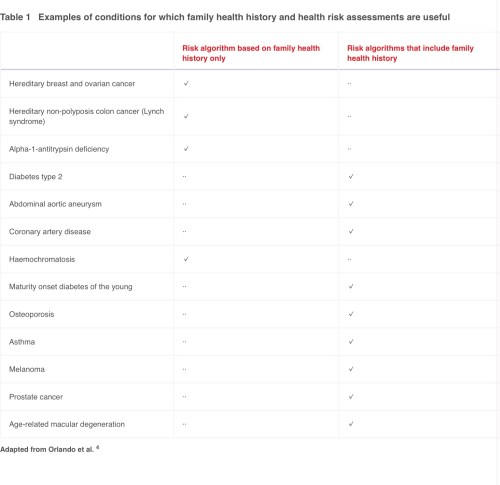
Family health history: underused for actionable risk assessment – The Lancet

I’m making a plug again for The Lancet, which has lots of free material, available just by registering.

Here’s something so basic we should be ashamed for not making better use of: The FAMILY HISTORY. Now that there are genetic markers and all, why don’t we pay more attention to obtaining a proper Family History?

If applied across the general population, systematic FHH-based risk assessment has the potential to have a substantial effect on population health management. Up to 44% of people meet criteria for increased risk for at least one hereditary condition based on current guidelines, so the potential for impact on health is huge.40 Scaled to a population, FHH becomes a means of assessing the true risk and potential costs that a health system might use to better manage its financial risk. When multiplied to potentially affected family members, the effect becomes even greater.
— Read on www.thelancet.com/journals/lancet/article/PIIS0140-6736(19)31275-9/fulltext


I just realized none of the posts show on an iPad or a computer, but they do show on an iPhone. WordPress is working on this. In the meantime, please visit my Substack.


Osler said “Listen to your patient, he is telling you the diagnosis”. Duvefelt says “Listen to your patient, he is telling you what kind of doctor he needs you to be”.


BOOKS BY HANS DUVEFELT, MD

CONDITIONS, Chapter 1: An Old, New Diagnosis

Top 25 Doctor Blogs Award

Doctor Blogs

Enter your email address to subscribe to this blog and receive notifications of new posts by email.

Mailbox

contact @ acountrydoctorwrites.com
Bookmark and Share
© A Country Doctor Writes, LLC 2008-2022 Unauthorized use and/or duplication of this material without express and written permission is strictly prohibited. Excerpts and links may be used, provided that full and clear credit is given.