Archive Page 95


Magnesium Deficiency: An Undiagnosed Epidemic Behind the Epidemics of Heart Disease and Diabetes

A patient who hadn’t felt good for many years came in the other day and told me an osteopathic physician she had gone to for OMT, manipulative treatment, had suggested she take a basic 400 mg magnesium supplement and it had been life changing for her.

She handed me a xeroxed little essay the osteopath had written about the many functions of magnesium in the human body and the symptoms of deficiency.

All her vague gastrointestinal symptoms were gone, her skin had cleared, her energy level had improved and she felt more clearheaded.

“What was your level?” I asked.

“He didn’t check it” was her answer.

I didn’t know what to think, I mean it’s probably harmless to take, but without knowing the level…

I started looking into this and the more I read, the more intrigued I became.

I found several articles from the last century (the 1990’s) all the way up to last week (news that excess vitamin D can lead to osteoporosis, apparently through lowering bone magnesium levels), all saying mostly the same things:

Even though magnesium is abundant on this planet, many people (for example 80% of postmenopausal women with osteoporosis) have low intracellular magnesium. Almost half the US population consume less than the recommended daily amount of magnesium.

Serum levels of magnesium tell us nothing about total body magnesium, because we are programmed to pull magnesium from our tissues to keep blood levels in range. Only 1% of our body’s normal 25 grams of magnesium is found outside our cells, and about 90% is found in bone and muscle cells.

Magnesium is essential for the function of 300 enzymes, mitochondrial ATP production and activation (cellular energy), synthesis of DNA, RNA and protein and regulation of ionic gradients (keeping sodium and potassium levels normal).

Magnesium deficiency is linked to inflammation (as measured by C-Reactive Protein, CRP), atherosclerosis, vasospasm, insulin resistance and metabolic syndrome as well as isolated hypertension.

Magnesium deficiency has been linked to sudden cardiac death.

The magnesium content of ur modern diet is decreasing, because of more and more processing of food as well as modern farming practices and soil depletion; we are also consuming things like phosphorus (in soft drinks) that lower body magnesium levels.

According to the NIH:

“Early signs of magnesium deficiency include loss of appetite, nausea, vomiting, fatigue, and weakness. As magnesium deficiency worsens, numbness, tingling, muscle contractions and cramps, seizures, personality changes, abnormal heart rhythms, and coronary spasms can occur. Severe magnesium deficiency can result in hypocalcemia or hypokalemia (low serum calcium or potassium levels, respectively) because mineral homeostasis is disrupted.”

Not only can low magnesium contribute to the development of diabetes, but there are indications that magnesium supplementation may improve blood sugar control in diabetics. Magnesium supplementation has been shown to improve lipid profiles. Other not yet certain possible benefits of magnesium supplementation are migraine prevention and asthma control.

People at risk for magnesium deficiency, besides diabetics, include the elderly, patients taking diuretics or Proton Pump Inhibitors, those with inflammatory bowel disease or chronic diarrhea from other conditions, patients who have had small bowel surgery, people with gluten sensitivity and patients with alcohol or soft drink dependence. Perhaps surprisingly, people who exercise vigorously can also become magnesium deficient.

Foods that supply good amounts of magnesium include almonds (check), spinach (check), black and kidney beans (check) and avocado (check), and also some things that aren’t on my meal plan: Peanuts, soy milk, shredded wheat, bread (presumably whole grain) and yogurt.

So, this is from someone who usually doesn’t think much of vitamins and supplements: Because I’ve been taking PPIs for my hiatal hernia since they first came out and because my blood pressure is higher than I’d like in spite of being pretty ideal weight – I picked up a bottle of magnesium capsules the other day.

And the more I read, the more I worry about the decreasing nutrient value of much of our mass produced foods. The BMJ article cited below points out:

“The loss of magnesium during food refining/processing is significant: white flour (−82%), polished rice (−83%), starch (−97%) and white sugar (−99%). Since 1968 the magnesium content in wheat has dropped almost 20%, which may be due to acidic soil, yield dilution and unbalanced crop fertilisation (high levels of nitrogen, phosphorus and potassium, the latter of which antagonises the absorption of magnesium in plants).”

Here are two comprehensive references:

National Institute of Health Office of Dietary Supplements Fact Sheet for Health Professionals
Subclinical magnesium deficiency: a principal driver of cardiovascular disease and a public health crisis (BMJ)

A Country Doctor Reads: August 31, 2019 – Polypill for CVD risk reduction; Assisted living is a money-making fantasy; Why doctors should read business journals

The Polypill is Back – The Lancet

One of my first posts on “A Country Doctor Reads”, in 2011, was about a Polypill study that promised dramatic reductions in cardiovascular disease rates from a combination of inexpensive generic ingredients. In the past few weeks another such study reported similar results in The Lancet. When will we be able to prescribe something like this? So far, I’ve only seen Caduet, a combination of atorvastatin (Lipitor) and amlodipine (Norvasc), which was an expensive brand name for many years…

— Read on acountrydoctorreads.wordpress.com/2011/02/26/trial-begins-of-another-polypill-for-stroke-and-heart-attack-prevention/

_________________________________________________________

Assisted Living is a Money-making Fantasy – The New York Times

There are nursing homes, boarding homes and assisted living facilities. I have certainly seen patients who are unsafe on their own at home who themselves or whose families are hoping they “don’t have to go to a nursing home”. But assisted living facilities, just like their advertisements often suggest, are really only for people who want an extra level of support available in case they need it, but not right now.

“Assisted living seems like the solution to everyone’s worries about old age. It’s built on the dream that we can grow old while being self-reliant and live that way until we die. That all you need is a tiny bit of help. That you would never want to be warehoused in a nursing home with round-the-clock caregivers. This is a powerful concept in a country built on independence and self-reliance.

The problem is that for most of us, it’s a lie. And we are all complicit in keeping this dream alive.

The assisted living industry, for one, has a financial interest in sustaining a belief in this old-age nirvana. Originally designed for people who were mostly independent, the number of assisted living facilities has nearly tripled in the past 20 years to about 30,000 today. It’s a lucrative business: Investors in these facilities have enjoyed annual returns of nearly 15 percent over the past five years — higher than for hotels, office, retail and apartments, according to the National Investment Center for Seniors Housing & Care.

The children of seniors need to believe it, too. Many are working full time while also raising a family. Adding the care of elderly parents would be a crushing burden.”

“We need to let go of the ideal of being self-sufficient until death. Just as we don’t demand that our toddlers be self-reliant, Americans need to allow the reality of ourselves as dependent in our old age to percolate into our psyches and our nation’s social policies. Unless we face up to the reality of the needs of our aging population, the longevity we as a society have gained is going to be lived out miserably.”

www.nytimes.com/2019/08/29/opinion/sunday/dementia-assisted-living.html

__________________________________________________________

Why Doctors Should Read Business Journals and Books (Like HBR)

Hey, Doc – read this and tell me if it makes you think of anything that’s happening in your organization. I can, off the top of my head, think of at least one post I have written that totally resonates with the front page story of this month’s Harvard Business Review. That post is about taking advantage of, if not exactly rigging, the numbers, titled “Don’t do Chronic Care in December“.

Quoting from HBR:

Idea in brief

THE PROBLEM

Companies that work hard on their strategies and carefully monitor their progress often run into spectacular trouble.

WHY IT HAPPENS

People have a behavioral tendency – known as surrogation – to confuse what’s being measured with the metric being used.

HOW TO FIX IT

To reduce the risk of surrogation, make sure that the people executing your strategy have a role in formulating it, don’t link incentives too tightly to strategy metrics, and use multiple metrics to assess performance.

Vertigo is a Symptom, Not a Diagnosis, and it’s Sometimes Caused by Loose Rocks Inside Your Head

I often hear patients speak of vertigo as if it were some brilliant diagnosis made by a genius emergency room doctor. Just because it’s a foreign word, that doesn’t make it any more clever than if they’d been told they were dizzy.

In my native Sweden there seems to be a domestic lay word for almost every disease. The runner up prize in my book goes to FÖNSTERTITTARSJUKAN, “The Window Shoppers Disease”, which we call intermittent claudication, usually caused by poor blood flow to the legs (people feeel better if they stand still for a while, for example pretending to look in a store window) but occasionally we get tricked and the symptom can be caused by pressure on the spinal cord from disc disease.

I absolutely love the number one word on my Swedish Disease Names list: The word they use for the most common cause of true vertigo, “Benign Positional Vertigo” or BPV. The Swedish word is KRISTALLSJUKAN (The Crystal Disease).

I also love explaining to patients how it works, because I think the body is a pretty clever contraption.

Vertigo is the illusion of movement, a spinning or rotatory form of dizziness. It usually originates in the balance organ, called the labyrinth, in the inner ear. Two common causes of vertigo are labyrinthitis, which is a viral infection, and Benign Positional Vertigo, which I wish we also would call the Crystal Disease.

This is how it works:

The labyrinth has two parts, the otololith organ and the semicircular canals. They are connected and filled with a sort of hydraulic fluid that we call the endolymph. Each inner ear, left and right, has this setup, and normally they provide the brain with the same, consistent information on where in space we are – but not always.

The otolith organ has one chamber, the utricle, that registers movement along a flat surface, like me rolling around the exam room on my stool (that’s how I demonstrate this). I hold my hands up with fingers pointing to the ceiling. “There are nerve cells in the otolith organ with little hairs sticking up like this”, I explain. Touching each fingertip with my other hand, I continue “and there is a weight, a little crystal, attached to the top of each of these hairs. If I move like this (stool roll..) the crystals make the little hairs bend, actually exaggerating the movement so I can register the slightest change in my position along this level path…”

The other chamber in the otolith organ, called the saccule, is set up to register movement in a vertical plane. Here I scrunch down or straighten up as I sit on my stool.

The Semicircular canals are curved tubes running in three different planes. They have a wider portion at one end with hairy nerve cells, similar to the otolith organ but without the crystals. When we turn our heads, the endolymph (fluid) movement causes the little hairs in each of the three semicircular canals to move a little differently and bend the nerve cell hairs to a different degree and maybe even in a different direction. All this information gives the brain a detailed sense of where in space we are.

Sometimes the little crystals fall off the hairs they’re sitting on top of in the otolith organ and travel with the endolymph into the semicircular canals.

Imagine what happens if the balance organ on one side tells the brain “movement to the left, thirty degrees” (here, I make the fingers on my left hand wiggle in unison just a little) and the other side, because some crystals flattened the nerve cell hairs, reports “wow, we’re upside down” (right hand and arm making a slam dunk movement). For at least a brief moment, our poor brains believe the louder, more dramatic yet inaccurate alarm report and we feel quite ill from that.

This explains why, in Benign Positional Vertigo, head movements in one direction can be much worse than movements in a different direction, depending on which angle causes the most dramatic effect from the little crystals.

This situation can go away spontaneously as the crystals can end up randomly traveling away from where the nerve cells register them.

There are also head maneuvers that can force the crystals away from the semicircular canals. Physical therapists and doctors in the specialties that deal the most with dizziness can put people through these movements, and you can even find instructions online.

Here is one of the most comprehensive explanations of all this that I have come across:

Lastly, a clinical pearl from Harvard’s neurology professor Dr. Martin Samuels. In his classic lecture on dizziness, he warns us never to suggest specific aspects of this symptom when taking a history. Most patients with dizziness will say yes to any description you suggest to them, therefore making diagnosis nearly impossible. Instead, he calls on his physician audience to repeat the word “dizzy”, maybe even a few times, scratch their chin and fix their gaze on something outside the window while rubbing their chin now and them – for however long it takes – until the patient starts to describe their symptoms themselves. Once they do, the diagnosis usually presents itself very plainly.

Cultivating Charisma in the Clinical Encounter (and emulating Marcus Welby, M.D.)

If medical journals are the religious texts that guide me as a physician, the New York Times has become the secular source of illumination for my relationship to my country and the world I live in.

That doesn’t exactly mean that I feel like a citizen of the world. Quite the opposite, particularly now, with just me and my horses sharing our existence on a peaceful plot of land within walking distance of the Canadian border; my physical world seems quite small even though I am aware, sometimes painfully but with an obvious distance, of the calamity of our planet.

Early Sunday morning, drinking coffee in bed as the gray morning light revealed the outline of the trees and pasture outside my window, I read the Times on my iPad as usual and came across an article titled “What makes people charismatic and how you can be too”.

The article claims that charisma can be learned and cultivated, and that thought resonated with me as I think often about how we as physicians have roles to fill in the stories of diseases and transitions in our patients lives. I try to be the kind of doctor each patient needs as I walk into each exam room.

The article mentions three pillars of charisma: Presence, Power and Warmth.

As I think of my current third guiding light in addition to my medical journals and the New York Times, my DVD collection of the Marcus Welby, M.D. shows, which is shorthand for his character and all the other role models I carry mental images and video clips of, Charisma is definitely something we need to consider and cultivate in our careers.

My job, my reason for being, is to guide and motivate people, and how I come across, how people perceive me, helps determine my chances of filling that role.

So, these pillars of Charisma in the archetypal physician, in my case Marcus Welby, look somewhat like this – first quoting the Times:

“The first pillar, presence, involves residing in the moment. When you find your attention slipping while speaking to someone, refocus by centering yourself. Pay attention to the sounds in the environment, your breath and the subtle sensations in your body — the tingles that start in your toes and radiate throughout your frame.”

Marcus Welby was certainly a keen observer and a good listener. He was also aware of and in tune with his own feelings. Thinking back over my own writing, I recall posts like “The Power of Focus” and “Today’s Masterpiece”. This is about being present so you can connect with each patient, and also so you can do your best under whatever circumstances exist in that moment.

Power, the second pillar, involves breaking down self-imposed barriers rather than achieving higher status. It’s about lifting the stigma that comes with the success you’ve already earned. Impostor syndrome, as it’s known, is the prevalent fear that you’re not worthy of the position you’re in. The higher up the ladder you climb, the more prevalent the feeling becomes.

The key to this pillar is to remove self-doubt, assuring yourself that you belong and that your skills and passions are valuable and interesting to others. It’s easier said than done.”

I think many of us are afraid to use the power we have and just as the Times article points out, power is not about status; in medicine it is about power to help, fix or influence. Consider their words “assuring yourself that you belong and that your skills and passions are valuable” – Marcus Welby certainly didn’t seem to doubt that when he spoke up to his hospital medical staff or to patients and families. He projected a quiet power and confidence that we, today, as cogs in the big healthcare machine may not always feel that we have. My own writing includes “Where is Relationship, Authority and Trust in Healthcare Today?” and “Getting it Right”.

“The third pillar, warmth, is a little harder to fake. This one requires you to radiate a certain kind of vibe that signals kindness and acceptance. It’s the sort of feeling you might get from a close relative or a dear friend. It’s tricky, considering those who excel here are people who invoke this feeling in others, even when they’ve just met.

To master this pillar, Ms. Cabane suggests imagining a person you feel great warmth and affection for, and then focusing on what you enjoy most about your shared interactions. You can do this before interactions, or in shorter spurts while listening to someone else speak. This, she says, can change body chemistry in seconds, making even the most introverted among us exude the type of warmth linked to high-charisma people.”

Marcus Welby, strict as he could be, exuded a well measured warmth, kindness and relatedness. I have speculated, for example in “Role Play”, that this warmth isn’t necessarily of our own making but emanating from the source of everything, whatever people may choose to call that.

When you get right down to it, I think healthcare providers today are too often viewed by others and increasingly also by themselves as interchangeable. That is the opposite of Charisma. Like so many times before in recent years, I’m puzzled by how everywhere else in our society people and businesses strive to stand out and to establish their constant presence, perceptions of power and warm relationships with their customers, while healthcare professionals are hiding too much behind a vail of sameness and anonymity, seemingly even creating distance and projecting a lack of warmth – almost on purpose in a misguided effort to seem professional?

A Country Doctor Reads: August 17, 2019

I Learned a New Word Today: RECRUDESCENCE – NEJM

The New England Journal of Medicine’s question of the week was about an elderly man with a prior stroke history, who during a febrile illness had a temporary recurrence of his original stroke symptoms.

“Patients who have had neurologic deficits as a result of stroke or multiple sclerosis sometimes experience reemergence or recrudescence of those deficits in the setting of an intercurrent illness. The most common triggers include infection, hypotension, hyponatremia, hypoglycemia, insomnia, stress, and benzodiazepine use. Recrudescence occurs most commonly with middle cerebral-artery infarcts and can lead to language, sensory, and motor deficits. Gaze preference, hemianopsia, and neglect are not typically observed.

— Read on knowledgeplus.nejm.org/question-of-week/1860/

Diabetes Related Hospitalizations Not Necessarily Caused by Poor Outpatient Management – JAMA

Quality is an elusive thing: JAMA Network Open has a piece about what kind of correlation there is between the diabetes quality indicators we all deal with in primary care and what really happens to patients. Any guesses?

In this study, the associations among different types of diabetes quality measures were weak, and much variation in the rates of utilization-based outcomes was unexplained by clinical practice group performance on traditional process and disease control measures. This outcome may be due in part to the topped-out nature of process measures, but the weak association between clinically robust disease control measures and hospitalization rates, the modest difference in hospitalization rates based on process and disease control performance, and the small amount of variation between clinical practice group hospitalization rates explained by process and disease control performance all raise concern about the validity of utilization-based outcomes as a measure of quality in chronic diseases. In chronic diseases such as diabetes, more hospitalizations may not necessarily be evidence of poor outpatient care, which has significant implications for quality-based reimbursement in chronic disease management.

— Read on jamanetwork.com/journals/jamanetworkopen/fullarticle/2747756

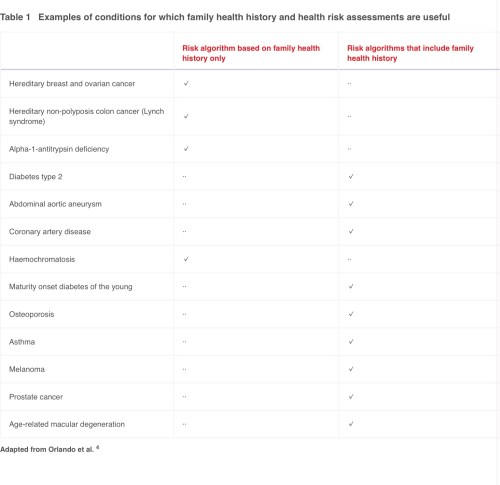
Family health history: underused for actionable risk assessment – The Lancet

I’m making a plug again for The Lancet, which has lots of free material, available just by registering.

Here’s something so basic we should be ashamed for not making better use of: The FAMILY HISTORY. Now that there are genetic markers and all, why don’t we pay more attention to obtaining a proper Family History?

If applied across the general population, systematic FHH-based risk assessment has the potential to have a substantial effect on population health management. Up to 44% of people meet criteria for increased risk for at least one hereditary condition based on current guidelines, so the potential for impact on health is huge.40 Scaled to a population, FHH becomes a means of assessing the true risk and potential costs that a health system might use to better manage its financial risk. When multiplied to potentially affected family members, the effect becomes even greater.
— Read on www.thelancet.com/journals/lancet/article/PIIS0140-6736(19)31275-9/fulltext


I just realized none of the posts show on an iPad or a computer, but they do show on an iPhone. WordPress is working on this. In the meantime, please visit my Substack.


Osler said “Listen to your patient, he is telling you the diagnosis”. Duvefelt says “Listen to your patient, he is telling you what kind of doctor he needs you to be”.


BOOKS BY HANS DUVEFELT, MD

CONDITIONS, Chapter 1: An Old, New Diagnosis

Top 25 Doctor Blogs Award

Doctor Blogs

Enter your email address to subscribe to this blog and receive notifications of new posts by email.

Mailbox

contact @ acountrydoctorwrites.com
Bookmark and Share
© A Country Doctor Writes, LLC 2008-2022 Unauthorized use and/or duplication of this material without express and written permission is strictly prohibited. Excerpts and links may be used, provided that full and clear credit is given.