Archive Page 99

I Wish My Clinical Hunches Were Wrong More Often

He did a double take as we passed on our small town sidewalk the other day.

“Hey Doc, I didn’t recognize you dressed like that, without your…”, he gestured to where my tie or stethoscope would have been. I was wearing a cafe-au-lait colored T-shirt and faded Levis.

“Did you hear about the appointment with the cardiologist yet”, I asked.

“It’s in two weeks”, he answered. “Tell me, Doc, how serious is this murmur?”

“Right now, not very, but you could end up needing a valve job some day, so you’ll need to have another echo done through your esophagus so they can get a better look at that noisy valve and then regular follow-ups”, noting silently to myself and I’ll never know how you make out now that I’m handing over your care to one of my partners.

He started thanking me for being his doctor for so many years, through so many illnesses, both life threatening final diagnoses and mere scares we had worked our way through.

Two years ago, almost to the day, I had a hunch that he might have a malignant kidney tumor, based on some nonspecific symptoms and an extremely elevated sedimentation rate.

In the end, he had something a bit less serious, and I was more relieved at him not having cancer than embarrassed about my inaccurate clinical hunch.

This time, he had been in for a routine checkup and as I listened to his heart I heard something new. He had a distinct early diastolic murmur. Soft systolic murmurs, between the first and second heart sound, are dime-a-dozen, but diastolic ones are fairly rare and his was fairly loud – what I ballparked as a 2-3/6 (more than a third of the maximum volume imaginable).

Systolic murmurs sound like Bipzzzt-Bip; diastolic ones sound like Bip-Bipzzzt. The diastolic murmur I knew the most about but haven’t diagnosed very often is mitral stenosis, usually caused by rheumatic fever. My patient had never had that as far as I knew and he had no symptoms of heart failure. I sent him for an echo and I got a call from the cardiologist who read it, praising me for my “excellent pick-up” of the murmur, which on the transthoracic echo indeed looked like at least a moderate if not severe mitral stenosis.

Being praised for my auscultation skills was nice, but I wasn’t pleased that my patient could be facing heart surgery in just a few years.

Early in our careers, doctors have a tendency to triumph over serious or rare diagnoses we make as we marvel over our newfound skills and the logical complexity of the human body.

At this stage of mine, I often feel sadness when a patient I care for, and care about, develops a symptom that signals the possibility of a serious disease.

If the diagnosis I think they might have is easily treatable with a good prognosis, I can triumph over my clinical hunches and diagnostic acumen. But if it is not, how can I feel proud about my skill at recognizing the distant footsteps of the grim reaper?

My New Life

We all have 168 hours a week to spend.

For some time now, I have been working well over 60 hours a week and spending 15 hours in the car traveling the more than 200 miles between my two homes and clinics.

As of this July, the month of my 66th birthday, I am staking out a new life for myself. I’ll be spending 30 hours a week in my Van Buren clinic, only 3 hours commuting, 30 on horse related things and 30 on my writing. Add the 63 hours I figure I need just to survive, and I will still have 12 hours to do something else. I admit some of that time, probably 5 hours a week on average, will be remote chart work, which can be done while looking out at the horse pasture. That still leaves an hour a day on average to do something new.

I’m calling this a semiretirement although it is really just slowing down to a more normal pace.

That means I’m giving up the medical directorship and work in my other clinic. But it also means I’ll be a more well balanced human being, I hope, as I consolidate my life in northern Maine, in a Swedish looking little red farmhouse not far from the village of New Sweden.

Aerial view of SOLTORP, which means “Sunny Little Farm” in Swedish

I have written about this before: During my internship in Sweden, I read an article in a Stockholm newspaper about the Swedish colony near Caribou. I was in the process of applying for my Family Practice residency in Maine, so I wrote to one of the people featured in the article. He forwarded my letter to the presidents of both the Caribou and Presque Isle hospitals and they both invited me to come and take a look. The rest is part of my career history and apparent ultimate destiny.

First trip to New Sweden, 1983

As I now reach what the American Social Security Administration calls my full retirement age, I hope to be able to continue the work I love for many more years, but at a pace that allows me to smell the roses along the way. I look forward to having more horse time and more time for my writing.

Another change, sadly, is that I have exchanged my wedding ring for a newly purchased caduceus signet ring. Not that my dedication to medicine and long hours caused this to come about, but this change certainly did make me think hard about how I want to spend whatever time I have left on this planet.

Raking the roof at Soltorp

Look for much more writing in the future, at least after I get settled into my new routine.

Thanks for listening (I mean, reading).

Hans

Psychiatrist: My Medicine Raised Our Patient’s Blood Sugar, Can You Help? PCP: That’s a Dump!

If my hypertensive patient develops orthostatism and falls and breaks her hip, I fully expect the orthopedic surgeon on call to treat her. I may kick myself that this happened but I’m not qualified to treat a broken hip.

If my anticoagulated patient hits his head and suffers a subdural hematoma, I expect the local neurosurgeon to graciously treat him even though it was my decision and not his to start the patient on his blood thinner. After all, brain surgery is tricky stuff.

Why is it then that primary care docs, sometimes myself included, feel a little annoyed when we have to deal with the consequences of psychiatric medication prescribing?

My psychiatry colleagues diligently order the blood work that is more or less required when prescribing atypical antipsychotics, for example. But when the results are abnormal I get a fax with a scribble indicating that the PCP needs to handle this.

We need to just deal with that and appreciate that there has been communication between treating providers. Because that doesn’t always happen. Particularly with medication prescribing, we don’t always get a notification from our psychiatry colleagues when a patient is started on something new because their records are so much more secret than ours.

The other day I sat in my monthly conference with staff from the Behavioral Health Home that I serve as the medical director for. I consult on clinical and policy matters.

I heard of a couple of examples like the one in the headline and thought that we need to have a Clinical Collaboration Contract in place between providers who see these patients.

This would require notification when medications are started or changed and an expressed understanding that the participating clinician who is best qualified to treat a complication of either a psychiatric or somatic medication should do so.

If a prescribing provider notices that their prescription has a side effect, but the medicine is clearly the best choice for the patient, I can’t just expect them to stop what may be a major therapeutic breakthrough for the patient.

Here are some ideas for what a Clinical Collaboration Contract might include:

I will tell my colleagues if I start, stop or change any medication.

I will share lab work I have done in order to avoid duplication.

I will update my colleagues on major changes in the patient’s health or circumstances.

I will collaborate with my colleagues for the benefit of the patient even if it’s inconvenient.

I will not criticize my colleagues in front of my patient but raise my concerns provider-to-provider in a professional and open-minded manner.

Maybe this is too obvious and self evident to formalize, but judging from the stories I heard the other day, it probably isn’t.

Our Profession is Deprived of its Language

When I use Dragon and say “PRN”, the words “as needed” appear on the screen.

I cringe every time. My medical record needs to be a tool for me and my peers, and most non-medical people have watched enough medical dramas on TV growing up to be thoroughly familiar with that particular abbreviation.

Why is it that almost everybody on the planet eagerly adopts the acronyms, abbreviations and technical terms of smartphones and other modern inventions without whining that the words are too difficult?

We have all had to add SIM card, SMS, jpg, mp3, LTE, RAM and a host of other abbreviations to our vocabulary in the last few years.

The language of everyday technology is advancing naturally and organically with the times while the language of medicine is continually being dumbed down and held back by political forces that assume people are unable to learn even the simplest words of any technical jargon.

But the US isn’t the worst in this regard. I just came across a listing by the British National Health Service, NHS, that strives to tell doctors how to speak with patients.

The Brits always did have a quirky sense of humor, and it seems to me that this list has sprung from that tradition:

passing wind

We don’t use “passing wind”. People understand “fart” better.

pee

We use the nouns “pee” and “urine”. We know that everyone can understand “pee”, including people who find reading difficult. Most people also understand and search for “urine”, for example in phrases like “blood in urine”.

We don’t use “wee” because it can confuse people who use voice technologies or screen readers.

We use “pee” for the verb, not “urinate” or “pass urine”. We know that the people who use NHS digital services talk about and search for “peeing more often” and “peeing at night”.

persist

We use “carry on” or “keep going”.

poo

We mostly use “poo”, rather than “stool”. We know that everyone can understand “poo”, including people who find reading difficult.

rectum

We prefer “bottom” or “anus”. Only use “rectum” when the other alternatives aren’t clear enough, for example when talking about surgery to remove part of the rectum.

We found that people don’t search for “rectum” in Google as much as other terms.

sick

We use “feeling sick” instead of “nausea”, but you may want to put “nausea” in brackets afterwards: feeling sick (nausea).

We use “being sick” instead of “vomiting”. Again, you may want to put “vomiting” in brackets afterwards: being sick (vomiting).

https://beta.nhs.uk/service-manual/content/a-to-z-of-NHS-health-writing#P

I think much of that list is a bunch of poo…

A Country Doctor Reads: June 1, 2019

Thought Provoking Titles and Concepts

This week I read some articles whose titles or first few words grabbed my attention and opened my mind to issues I had thought about only casually in recent months. These pieces put their concepts in the forefront of my thinking as a physician. The last item seemed thought provoking enough as it promised to tell the story of how human adipose tissue became a hot commodity a couple of hundred years ago, but the story gets better, or, rather, worse – much worse.

ARRIVAL FALLACY – NYT

Thursday’s The New York Times has an article titled “You Accomplished Something Great. So Now What?” It describes the phenomenon of striving for something you expect to make you happy, but once you achieve it, you just feel empty. This introduced me to the term “Arrival Fallacy”.

“Arrival fallacy is this illusion that once we make it, once we attain our goal or reach our destination, we will reach lasting happiness,” said Tal Ben-Shahar, the Harvard-trained positive psychology expert who is credited with coining the term.

Dr. Ben-Shahar said arrival fallacy is the reason some Hollywood stars struggle with mental health issues and substance abuse later in life.

“These individuals start out unhappy, but they say to themselves, ‘It’s O.K. because when I make it, then I’ll be happy,’” he said. But then they make it, and while they may feel briefly fulfilled, the feeling doesn’t last. “This time, they’re unhappy, but more than that they’re unhappy without hope,” he explained. “Because before they lived under the illusion — well, the false hope — that once they make it, then they’ll be happy.”

The article offers this advice on how to avoid Arrival Fallacy:

“We need to have goals,” Dr. Ben-Shahar said. “We need to think about the future.” And, he noted, we are also a “future-oriented” species. In fact, studies have shown that the mortality rate rises by 2 percent among men who retire right when they become eligible to collect Social Security, and that retiring early may lead to early death, even among those who are healthy when they do so. Purpose and meaning can generate satisfaction, which is part of the happiness equation, Dr. Gruman said.

https://www.nytimes.com/2019/05/28/smarter-living/you-accomplished-something-great-so-now-what.html?smprod=nytcore-ipad&smid=nytcore-ipad-share

LANGUAGE OF TOUCH – NYT

Another piece in Thursday’s The New York Times with the title “Your Surgeon’s Childhood Hobbies May Affect Your Health” introduced me to the concept of “The Language of Touch”, similar to a language you learn as a young child as opposed to in college or graduate school.

Medical schools are noticing a decline in students’ dexterity, possibly from spending time swiping screens rather than developing fine motor skills through woodworking and sewing.

“There is a language of touch that is easy to overlook or ignore,” said Dr. Roger Kneebone, professor of surgical education at Imperial College London. “You know if someone has learned French or Chinese because it’s very obvious, but the language of touch is harder to recognize.” And just like verbal language, he thinks it’s easier to acquire when you’re young: “It’s much more difficult to get it when you’re 24, 25 or 26 than when you’re 4, 5 or 6.”

Dr. Robert Spetzler, former president and chief executive of the Barrow Neurological Institute in Phoenix, agreed. “Think about the difference between someone who has learned to ski when they were a little kid and someone who spent a long time, perhaps even the same amount of time, skiing as an adult,” he said. “That elegance that you learn when very young, doing that sport, can never be equaled by an adult learning how to ski.”

Dr. Spetzler earned a reputation as a virtuosic brain surgeon during his more than 40 years operating. He said he developed his dexterity as a child by playing the piano. And he began performing surgery in high school — on gerbils. All of them survived.

“The sooner you begin doing a physical, repetitive task, the more ingrained and instinctive that motor skill becomes,” Dr. Spetzler said. “What makes a great surgeon is unrelenting practice.”

https://www.nytimes.com/2019/05/30/well/live/surgeons-hobbies-dexterity.html?smprod=nytcore-ipad&smid=nytcore-ipad-share

DIAGNOSTIC OVERSHADOWING – NEJM

I have often thought of this phenomenon, but never heard this term for it: When someone has an important or severe diagnosis, we tend to blame it for everything else that ever happens to them and thus run the risk of missing new diagnoses in such patients.

So here is my speculation about Michael’s diagnostic delay. His providers saw a patient with complete quadriplegia, paralyzed below his neck. When he developed new symptoms, perhaps they succumbed to “diagnostic overshadowing” — the erroneous attribution of all new symptoms to an underlying health condition, especially in patients with disability. After all, maybe extreme MS-related constipation caused Michael’s distended abdomen; wheelchair users commonly have lower extremity edema; and breathing difficulties occur in late-stage MS. Perhaps they thought Michael’s PPMS was at its end stage.

https://www.nejm.org/doi/full/10.1056/NEJMp1903078?query=featured_home

SPONTANEOUS HUMAN COMBUSTION – The Atlantic

The Atlantic has a story about human fat that opens with a case of a corpulent woman who burst into flames, presumably a victim of what we now call Spontaneous Human Combustion.

The Lucrative Black Market in Human Fat

In 16th- and 17th-century Europe, physicians, butchers, and executioners alike hawked the salutary effects of Axungia hominis.

One night in 1731, Cornelia di Bandi burst into flames. When the 62-year-old Italian countess was found the next morning, her head and torso had been reduced to ash and grease.

https://www.theatlantic.com/health/archive/2019/05/human-fat-was-once-medicine-black-market/590164/

I had never heard of this phenomenon, but it has been described many times:

Though the term “spontaneous human combustion” is of fairly recent vintage, it was a rare-but-real concern to many in the 1800s. In fact, there are nearly a dozen references to people bursting into flames in pre-1900 fiction. The most famous example is Charles Dickens’s 1853 novel “Bleak House,” in which a character explodes into fire, though the phenomenon can also be found in the works of Mark Twain, Herman Melville, Washington Irving and others. In modern times, SHC has appeared in movies and on television shows, including “The X-Files,” and it’s even, sort of, the super-power of Johnny Storm, the Human Torch, in “Fantastic Four” comic books.

https://www.livescience.com/42080-spontaneous-human-combustion.html


I just realized none of the posts show on an iPad or a computer, but they do show on an iPhone. WordPress is working on this. In the meantime, please visit my Substack.


Osler said “Listen to your patient, he is telling you the diagnosis”. Duvefelt says “Listen to your patient, he is telling you what kind of doctor he needs you to be”.


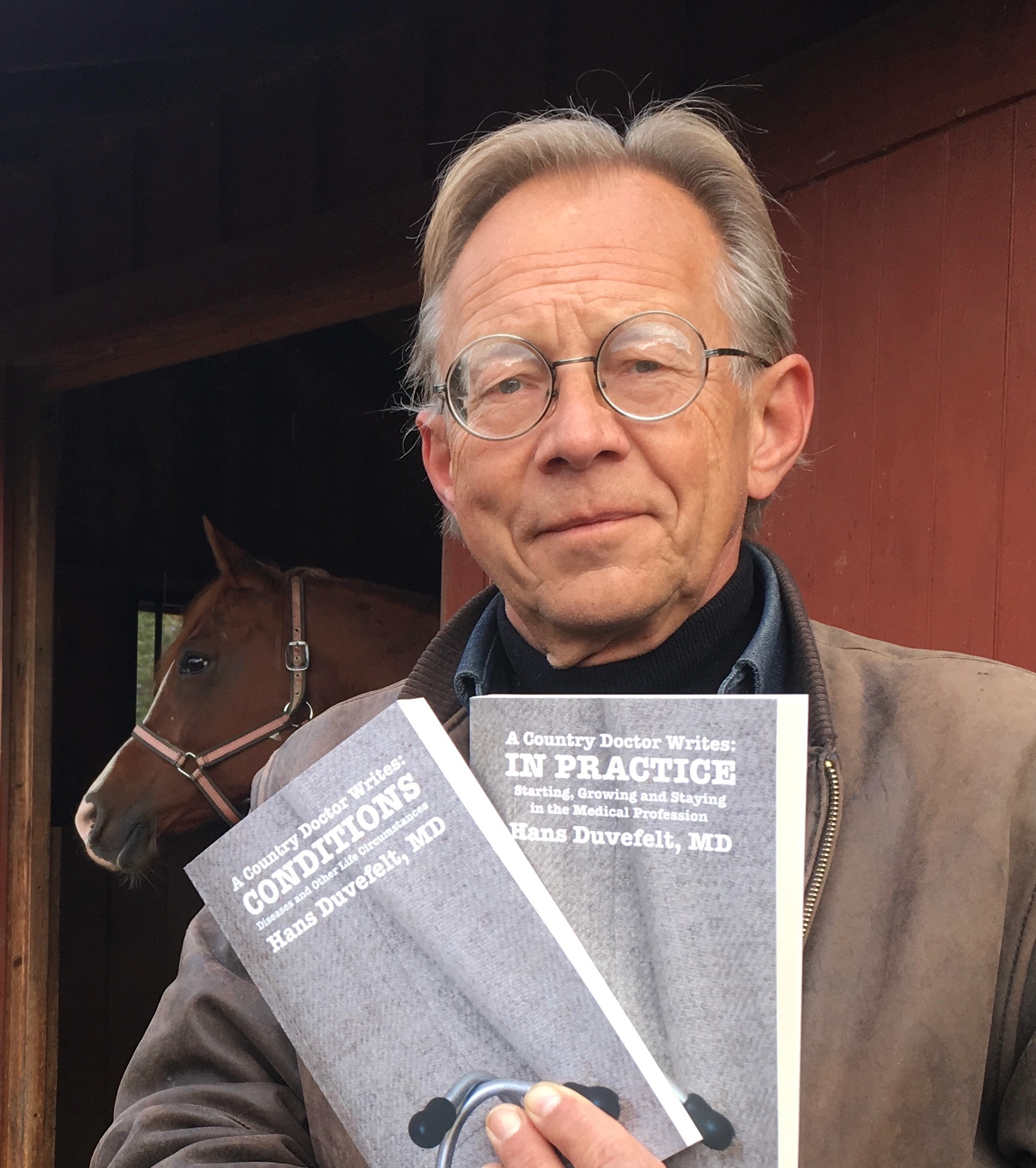
BOOKS BY HANS DUVEFELT, MD

CONDITIONS, Chapter 1: An Old, New Diagnosis

Top 25 Doctor Blogs Award

Doctor Blogs

Enter your email address to subscribe to this blog and receive notifications of new posts by email.

Mailbox

contact @ acountrydoctorwrites.com
Bookmark and Share
© A Country Doctor Writes, LLC 2008-2022 Unauthorized use and/or duplication of this material without express and written permission is strictly prohibited. Excerpts and links may be used, provided that full and clear credit is given.