Archive Page 97

Sickle Cell Disease and Phenylketonuria (PKU): You May Have the Genes, But Your Diet Determines Your Symptoms

Sickle cell trait is much more common among Africans in Africa than among African-Americans. But sickle cell anemia is more common here. How can that be?

The answer is very simple – EPIGENETICS, specifically your diet.

Not all people with sickle cell trait from both parents get sickle cell anemia. An environmental link had long been suspected and has been known for almost 90 years. I was unaware of it, having grown up and trained in Sweden and working in Maine, two corners of the world with almost no sickle cell anemia cases.

The reason for this difference is that the typical African diet includes cassava and African yam, foods with significant amounts of thiocyanate. Americans with sickle cell trait don’t typically eat these foods, and that’s why they develop symptoms more often.

In 1932 potassium thiocyanate (KSCN) was used to resolve sickle cell crisis. My reading suggest that this method never did become standard care, and was hardly mentioned at all until 50 years later, when it still didn’t become an accepted strategy. Potassium thiocyanate binds through a process called carbamylation to the site of error on the sickle hemoglobin molecule inside the red blood cell and corrects it. The shape and lifespan of the red blood cell are normalized by this reaction.

A 1986 article that tells the story from 1932 even proposed viewing sickle cell anemia as a thiocyanate deficiency anemia affecting people only if they are homozygous for sickle cell trait, rather than a genetically determined disease.

UptoDate mentions hydroxyuria treatment, which can be very toxic, but makes no mention of dietary modification of sickle cell disease at all.

This is an example of EPIGENETICS, factors that affect how our genes (GENOTYPE) may or may not cause disease or other visible attributes (PHENOTYPE). People who are homozygous for the sickle cell trait and still don’t get the disease because they eat cassava have the genotype but not the phenotype, if you will.

But it gets even more interesting. While sickle cells are more resistant to the malaria parasite, and cassava eating normalizes the shape and behavior of the red blood cell, this does not increase susceptibility to malaria. This is because cassava provides phytochemicals that weaken the plasmodium falciparum. This is an example of what has been called Human Plant Parasite Coevolution. This is explained in a talk by anthropologist Fatima Jackson. I highly recommend watching it.

So, as the saying goes, we are what we eat, or more accurately, what we eat determines or influences the environment of our genes and their tendency to manifest (express) their potential OR NOT.

All this came to my attention somewhat randomly, and I found it shocking that this isn’t more widely known. This knowledge puts Sickle Cell Disease in the same category as PKU, a genetic disease we routinely screen for and prevent by modifying the diet of patients with the PKU genotype. Having had two patients with this disease, born before routine testing started, I am particularly struck by the fact that this old discovery hasn’t become common knowledge 87 years after it was first published.

So there it is, PKU (or sickle cell) genotype causes the disease (phenotype) only if the genes are in a certain environment (epigenetics), for example with regards to diet.

…

Ordering Tests Without Using Words: Are ICD-10 and CPT Codes Bringing Precision or Dumbing Us Down?

The chest CT report was a bit worrisome. Henry had “pleural based masses” that had grown since his previous scan, which had been ordered by another doctor for unrelated reasons. But as Henry’s PCP, it had become my job to follow up on an emergency room doctor’s incidental finding. The radiologist recommended a PET scan to see if there was increased metabolic activity, which would mean the spots were likely cancerous.

So the head of radiology says this is needed. But I am the treating physician, so I have to put the order in. In my clunky EMR I search for an appropriate diagnostic code in situations like this. This software (Greenway) is not like Google; if you don’t search for exactly what the bureaucratic term is, but use clinical terms instead, it doesn’t suggest alternatives (unrelated everyday example – what a doctor calls a laceration is “open wound” in insurance speak but the computer doesn’t know they’re the same thing).

So here I am, trying to find the appropriate ICD-10 code to buy Henry a PET scan. Why can’t I find the diagnosis code I used to get the recent CT order in when I placed it, months ago? I cruise down the list of diagnoses in his EMR “chart”. There, I find every diagnosis that was ever entered. They are not listed alphabetically or chronologically. The list appears totally random, although perhaps the list is organized alphanumerically by ICD-10, although they are not not displayed in my search box, but that wouldn’t do me any good anyway since I don’t have more than five ICD-10 codes memorized.

Patients are waiting, I’m behind, the usual time pressure in healthcare.

Can’t find a previously used diagnosis. Search for “nonspecific finding on chest X-ray” and multiple variations thereof.

I see R93.89 – “abnormal finding on diagnostic imaging of other body structures”. Close enough, use it, type in exactly what the chief of radiology had said in his report. Move on. Next patient.

Several days later I get a printout of that order in my inbox with a memo that the diagnosis doesn’t justify payment for a PET scan. Attached to that is a multi page list of diagnoses that would work.

Frustrated, I go through the list. It’s another day, other patients are waiting. Eventually I come across R91.8 “other nonspecific finding of lung field” – not exactly pleura, but what the heck, close enough, let’s use that one.

Why is this – me hurriedly choosing the next best thing on a multipage printout, while my other patients are waiting – any more practical, accurate or fraud proof than having me describe in appropriate CLINICAL language what the patient needs and letting SOMEONE ELSE look for the darn code?

Here I am, trying to order what a radiologist told me to order, without having the tools to do it.

Next thing you know, Henry’s insurance will probably have some third party radiologist deny coverage because he disagrees with my radiologist, and I’ll be stuck in the middle…

Not quite what I thought I’d be doing. Who works for whom in healthcare?

A Country Doctor Reads: September 20, 2019 – Full Circle With Sertraline, Airmanship and Mastery in Medicine, EMR Notes Exaggerate Comprehensiveness

Full Circle With Sertraline – Antidepressant that Treats Anxiety or Anxiety Medication that Only Sometimes Helps Depression?

Yesterday’s buzz about sertraline brought a sad smile of recognition to my face. The research, done in British General practice settings was first published by The Lancet Psychiatry, which costs money. I read it on BBC. Sertraline: Antidepressant works ‘by reducing anxiety symptoms first’ was the headline and the study showed that sertraline had almost twice as much effect on anxiety as it did on depressive symptoms, and the effect on anxiety came much quicker:

“After six weeks, the patients taking sertraline reported a 21% greater improvement in anxiety symptoms – such as feeling worried, nervous and irritable – compared to the control group taking a dummy pill. After 12 weeks, the gap was 23%.

But there was little evidence of the drug reducing depressive symptoms, such as poor concentration, low mood and lack of enjoyment after six weeks – and only marginal improvements (13%) after 12 weeks.

Nonetheless, the group taking antidepressants were twice as likely as the other trial participants to say their mental health felt better overall.

“It appears that people taking the drug are feeling less anxious, so they feel better overall, even if their depressive symptoms were less affected,” said lead study author Dr Gemma Lewis, from UCL.”

Back when SSRIs were brand new, they were only indicated for treating depression. I still remember the mental acrobatics doctors went through as we prescribed it for anxiety. The thinking then was that the anxiety we so successfully treated with sertraline was in fact a manifestation of less-than-obvious depression. And here we are, with the opposite being touted as the real scoop on how this now 28 year old drug works.

Does anyone believe we have precision in psychiatric diagnosis? Or even in describing or naming symptoms?

________________________________________________________________________________________

AIRMANSHIP – Mastery in Aviation, Seamanship on the Ocean. How About Mastery in Medicine?

The New York Times ran a piece about the relative inexperience of pilots involved in a Boeing 737 Max crash. Even with many years of experience, commercial pilots don’t really gain the experience flying under extreme conditions, like fighter pilots. This article certainly made me think of a new dimension to the typical comparisons between the airline industry and healthcare: There’s all this talk about predictability and checklists, but what about getting some practice flying upside down – or in medicine, practicing under adverse conditions as part of your training?

“Airmanship” is an anachronistic word, but it is applied without prejudice to women as well as men. Its full meaning is difficult to convey. It includes a visceral sense of navigation, an operational understanding of weather and weather information, the ability to form mental maps of traffic flows, fluency in the nuance of radio communications and, especially, a deep appreciation for the interplay between energy, inertia and wings. Airplanes are living things. The best pilots do not sit in cockpits so much as strap them on. The United States Navy manages to instill a sense of this in its fledgling fighter pilots by ramming them through rigorous classroom instruction and then requiring them to fly at bank angles without limits, including upside down. The same cannot be expected of airline pilots who never fly solo and whose entire experience consists of catering to passengers who flinch in mild turbulence, refer to “air pockets” in cocktail conversation and think they are near death if bank angles exceed 30 degrees. The problem exists for many American and European pilots, too. Unless they make extraordinary efforts — for instance, going out to fly aerobatics, fly sailplanes or wander among the airstrips of backcountry Idaho — they may never develop true airmanship no matter the length of their careers. The worst of them are intimidated by their airplanes and remain so until they retire or die. It is unfortunate that those who die in cockpits tend to take their passengers with them.

www.nytimes.com/2019/09/18/magazine/boeing-737-max-crashes.html

__________________________________________________________________________________________

BREAKING NEWS: Doctors’ EMR Notes Overstate Comprehensiveness of History and Physical Exam – JAMA

Question  How closely does documentation in electronic health records match the review of systems and physical examination performed by emergency physicians?

Findings  In this case series of 9 licensed emergency physician trainees and 12 observers of 180 patient encounters, 38.5% of the review of systems groups and 53.2% of the physical examination systems documented in the electronic health record were corroborated by direct audiovisual or reviewed audio observation.

Meaning  These findings raise the possibility that some physician documentation may not accurately represent actions taken, but further research is needed to assess this in more detail.

https://jamanetwork.com/journals/jamanetworkopen/fullarticle/2751388

Despair and Happiness in America and in Medicine

Earlier this month Ross Douthat wrote a piece in The New York Times titled “The Age of American Despair” where he posed the question “Are deaths from drugs and alcohol and suicide a political, economic or spiritual crisis?”

Douthat writes:

“The working shorthand for this crisis is “deaths of despair,” a resonant phrase conjured by the economists Anne Case and Angus Deaton to describe the sudden rise in deaths from suicide, alcohol and drug abuse since the turn of the millennium.

Now a new report from the Senate’s Joint Economic Committee charts the scale of this increase — a doubling from 22.7 deaths of despair per 100,000 American in 2000 to 45.8 per 100,000 in 2017, easily eclipsing all prior 20th-century highs.

But had deaths of despair remained at 2000-era levels, approximately 70,000 fewer Americans would have died this year alone.”

He imagines what the presidential candidates would say about the cause for this epidemic:

“The Technocrat (voice of Pete Buttigieg): “This is primarily a drug abuse and mental-health crisis, and the only way to solve it is with more and better drug treatment programs, more and better psychiatric care. We’ll save these lives one patient, one addict, one treatment center at a time.”

The Socialist (voice of Bernie Sanders): “This is obviously an economic crisis! People are despairing because their jobs have been outsourced, their wages are stagnant, the rich have hijacked the economy. Tax the plutocrats, raise the minimum wage, give everybody health insurance, and you’ll see this trend reverse.”

The Cultural Healer (voice of Marianne Williamson): “You can’t just medicate this away or solve the problem with wonkery alone. There’s a spiritual void in America, a loss of meaning and metaphysical horizon. The problem is cultural, spiritual, holistic; the solution has to be all three as well.”

Somehow, somewhere I came across a psychiatrist and public speaker named Gordon Livingston, who wrote a lot about grief and happiness. He said this about drug abuse, a year before he died in 2016, but it applies to a lot of things Americans do today:

We can try to turn drug abuse into a disease, but we are just dealing with the larger paradox: the mindless pursuit of pleasure brings pain.

Now, I think drug abuse amounts to a disease because it involves changes in brain function and chemistry, but I do believe his generalization that the harder you pursue pleasure the more elusive it becomes.

Happiness, Livingston said, requires three things: Something to do, someone to love and something to look forward to.
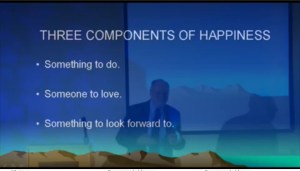
Looking at my own life and career, with the major changes of recent months, I took these three fundamentals to heart – they actually stopped me in my tracks when I first saw this slide on YouTube. These three things are actually so simple and don’t have to cost much, or anything at all, but they are so undeniably necessary for every human being. But how many people can honestly say they have all three, or give much thought to what they are.

This is exactly what I’ve been thinking and doing. I gave up administrative work and focused on the one-on-one work of seeing patients while I also moved back into my little farmhouse that calls out for me to catch up with some “deferred maintenance” (I love American euphemisms). I also carved out the time to do a substantial amount of horse and farm chores.

So I have several things to do that are meaningful to me. And this would be my addition to Dr. Livingston’s list – we have to see meaning in what we do, even if it is a job we don’t love (although I love mine) but we do it because it makes us feel valuable in some way, to society or our family.

And, speaking of family, and of love, I am deepening my relationships with my adult children and their families after years of working too hard with blinders on much of the time. And not everyone can understand this, but I love my Arabian horses and view them as family. Caring for these noble creatures and being in their presence is almost like a higher purpose.

And what I look forward to now is so different from earlier in my life. I wasted so much mental energy making long term plans before. Now at this age, with the biggest long term plan of all (growing old with my wife) suddenly evaporated, my perspective is shorter, allowing me to take in the present, appreciate the moment, in a way that has profoundly grounded me emotionally.

Back to the three fundamentals of happiness:

How many people in today’s society have defined for themselves what these three things are in their own life?

And, for me as a physician, how many patients do I see who suffer from depression, anxiety, addiction, maladjustment or dysfunctional relationships? How can I better, with whatever influence I have in my role as healer or guide, help them see how simple it can actually be to move closer to being happy?

I wrote this in 2012, in a post titled “The Secret of Life“:

Observing which of my patients live well and handle age, illness and adversity the best, I see the power of this every day.

Jungian therapist Robert A. Johnson describes in his book, “Transformation: Understanding the three levels of masculine consciousness”, how the male psyche evolves from simple man (exemplified by Don Quixote), who asks “What’s for dinner?” to complicated man (Hamlet), who asks “What does it all mean?” to enlightened man (Faust), who asks “What’s for dinner?”

(Here I am again, seven years later, realizing how one has to work at this being grounded kind of thing because modern life pulls us in so many distracting directions…)

With everything published these days about physician burnout, I also think Livingston’s three principles of finding happiness can be useful professionally for doctors. Aside from the love we need in our personal lives, I think doctors today have become distracted from the fundamental need to feel love for humankind, empathy with people, who now are increasingly cast as consumers or “populations” in the scripting of our work lives.

(I also, obviously perhaps, think that what we do has become separated from what we were trained to do, hope to do and need to do. The agendas for healthcare today are to a great degree neither our patients’ nor our own and that spells burnout for us and frustration for our patients.)

Our society is a selfish one. Happiness has become a selfish pursuit. The harder we strive for it, the more elusive it becomes and the more despair we feel.

Happiness is like floaters in our eyes: Try to focus on them and they move out of your field of vision. Keep your eyes on what you’re doing and they’ll remain visible slightly in the periphery as long as you don’t think too hard about them.

P.S.

So here is my happiness recipe for this September Sunday:

I finished my stall cleaning. Soon I’ll make breakfast and if the sun stays around I’ll eat it outside by the horse barn.

My short term goals in life are to catch up on some filing and vacuum the downstairs. And, coming back to me trying to be enlightened man instead of complicated man – what’s for dinner? Grilled salmon and asparagus, my favorite.

I’m not planning tomorrow too hard. Today is today.

…..

A Country Doctor Reads: September 14, 2019 – Life Forms Inside Us are Controlling Our Behavior

Several news media (I first saw it on BBC’s website) recently published the picture of an insect, invaded by a fungus, compelled to climb high, then killed off only to become a means for airborne spread of fungal spores.

I had also read in The New York Times about how massospora live inside cicadas and spread between them like an STD and stimulate mating behaviors to promote its spread, even though the cicadas become grotesquely altered by the fungus (see the yellow fungal “plug” in its rear). This behavior is caused by the release of Psilocybin, a mind altering controlled substance that eases depression and anxiety in cancer patients, and cathinone, a powerful stimulant.

Interesting that one life form can alter another’s behavior, but does anything like this apply to mammals, or humans? Certainly – maybe not for fungi, but definitely other parasitic (or symbiotic) organisms and viruses. Just consider the behaviors caused by rabies infection:

This seemingly improbable concept that specific microbes influence the behavior and neurological function of their hosts had, in fact, already been established. One prime example of “microbial mind control” is the development of aggression and hydrophobia in mammals infected with the rabies virus (Driver, 2014). Another well-known example of behavior modification occurs by Toxoplasma gondii, which alters the host rodents’ fear response. Infected rodents lose their defensive behavior in the presence of feline predators, and instead actually become sexually attracted to feline odors (House et al., 2011). This results in infected rodents being preyed upon more readily by cats, and allows Toxoplasma to continue its lifecycle in the feline host (House et al., 2011). Further, a variety of parasitic microbes are capable of altering the locomotive behavior and environmental preferences of their hosts to the benefit of the microbe. For instance, the Spinochordodes tellinii parasite causes infected grasshopper hosts to not only jump more frequently, but also seek an aquatic environment where the parasite emerges to mate and produce eggs (Biron et al., 2005). Temperature preference of the host can even be altered, such as observed during infection of stickleback fish by Schistocephalus solidus, which changes the hosts’ preference from cooler waters to warmer waters where the parasite can grow more readily (Macnab and Barber, 2012). Other microbes can even alter host behavior to seek higher elevations, believed to allow the infected host to be noticed more easily by predators or to eventually fall and disperse onto susceptible hosts below (Maitland, 1994). More coercively still, microbes can influence the social behavior of their hosts, causing insects, such as ants, to become more or less social to the benefit of the parasite (Hughes, 2005). In fact, the sexually transmitted virus IIV-6/CrIV causes its cricket host (Gryllus texensis) to increase its desire to mate, causing its rate of mating to be significantly elevated and allowing for transmission between individual hosts (Adamo et al., 2014).
— Read on www.ncbi.nlm.nih.gov/pmc/articles/PMC4442490/

There is, of course, now more and more interest in the role our microbiome plays in seemingly every aspect of our lives – from mood to metabolism to immunity. The more I read about this, the more humblingly (is that a word?) fascinated I become.

The well referenced review article quoted above illustrates several already known ways our microbiome affects us, and I highly recommend reading it. I’ll zero in on how our behaviors are influenced, leaving cancer, allergies and other aspects of their influence for another post. Here are some highlights:

Germ Feee (GF) mice tend to be anxious and socially impaired. These behaviors normalize when normal gut flora is introduced.

GF mice have an increased permeability of the blood brain barrier both during fetal development and in adulthood. Some strains of clostridium and bacteroides and also the short chain fatty acid butyrate can restore normal blood brain barrier function.

Probiotics (L. Helveticus and B.longum) caused decreased self reported anxiety and decreased urine cortisol levels in humans.

Microbiota metabolize fermentable complex carbohydrate/fiber into short chain fatty acids (SCFAs) such as acetate, butyrate and propionate, which cross the blood brain barrier. Acetate influences the hypothalamus’ regulation of glutamate, glutamine and GABA. It also increases anorectic neuropeptide, which suppresses appetite.

Probiotics from fermented dairy do not alter the composition of gut microbiome, but they alter the transcriptional state and metabolic activity of the microbiota.

Autism spectrum disorder (ASD) patients have an increased incidence of constipation, increased intestinal permeability and altered intestinal microbiome. Mice with ASD like behaviors have a similar overrepresentation of gastrointestinal abnormalities. Introduction of B. fragilis has normalized intestinal permeability and reduced stereotypical behaviors, communication deficits and anxiety behaviors.

“It is becoming increasingly recognized that other psychiatric and neurological illnesses are also often co-morbid with gastrointestinal (GI) pathology (Vandvik et al., 2004), including schizophrenia, neurodegenerative diseases and depression.“

“The enteric nervous system (ENS) is directly connected to the central nervous system (CNS) through the vagus nerve, providing a direct neurochemical pathway for microbial-promoted signaling in the GI tract to be propagated to the brain on mood and behavior, including depression, anxiety, social behavior, and mate choice.“

Bifidiobacterium infantis can normalize depression-like behavior in mice to a degree similar to the antidepressant citalopram.

Finally, I got the impression in medical school that the vagus nerve was unidirectional. Now I understand that it is very much bidirectional, as quoted above. Here is a quote from another article I ran into about that:

The bidirectional communication between the brain and the gastrointestinal tract, the so-called “brain–gut axis,” is based on a complex system, including the vagus nerve, but also sympathetic (e.g., via the prevertebral ganglia), endocrine, immune, and humoral links as well as the influence of gut microbiota in order to regulate gastrointestinal homeostasis and to connect emotional and cognitive areas of the brain with gut functions (1). The ENS produces more than 30 neurotransmitters and has more neurons than the spine. Hormones and peptides that the ENS releases into the blood circulation cross the blood–brain barrier (e.g., ghrelin) and can act synergistically with the vagus nerve, for example to regulate food intake and appetite (2). The brain–gut axis is becoming increasingly important as a therapeutic target for gastrointestinal and psychiatric disorders, such as inflammatory bowel disease (IBD) (3), depression (4), and posttraumatic stress disorder (PTSD) (5). The gut is an important control center of the immune system and the vagus nerve has immunomodulatory properties (6). As a result, this nerve plays important roles in the relationship between the gut, the brain, and inflammation. There are new treatment options for modulating the brain–gut axis, for example, vagus nerve stimulation (VNS) and meditation techniques. These treatments have been shown to be beneficial in mood and anxiety disorders (7–9), but also in other conditions associated with increased inflammation (10). In particular, gut-directed hypnotherapy was shown to be effective in both, irritable bowel syndrome and IBD (11, 12). Finally, the vagus nerve also represents an important link between nutrition and psychiatric, neurological and inflammatory diseases.
— Read on www.frontiersin.org/articles/10.3389/fpsyt.2018.00044/full


I just realized none of the posts show on an iPad or a computer, but they do show on an iPhone. WordPress is working on this. In the meantime, please visit my Substack.


Osler said “Listen to your patient, he is telling you the diagnosis”. Duvefelt says “Listen to your patient, he is telling you what kind of doctor he needs you to be”.


BOOKS BY HANS DUVEFELT, MD

CONDITIONS, Chapter 1: An Old, New Diagnosis

Top 25 Doctor Blogs Award

Doctor Blogs

Enter your email address to subscribe to this blog and receive notifications of new posts by email.

Mailbox

contact @ acountrydoctorwrites.com
Bookmark and Share
© A Country Doctor Writes, LLC 2008-2022 Unauthorized use and/or duplication of this material without express and written permission is strictly prohibited. Excerpts and links may be used, provided that full and clear credit is given.