Archive Page 82

I Cured My Patient, But What Was His Diagnosis?

He cancelled his followup appointment because he was feeling fine. He didn’t see the point in wasting a Saturday to come to my clinic when he had lawns to mow and chores to do.

Less than two weeks before that he was sitting on the exam table in my office, again and again nodding off, waking up surprised every time his wife prodded him. The stack of printouts from the emergency room illustrated all the normal testing they had done.

He had experienced a brief episode of numbness in the left side of his face and felt tired with just a slight headache. When I saw him the headache was a bit more severe in the back of his head and down the right side of his neck. But his neck wasn’t stiff.

His blood sugar was 87, normal for most people, but this man had a history of diabetes although his blood sugars had steadily improved over the past year. I told him to stop all his diabetic medications although I don’t think he took notice. His wife said she would make sure he stopped them.

He had had all kinds of bloodwork and both a CT scan and an MRI of his brain. I couldn’t help worrying that he might have an aneurysm so we ordered an MRA as well. Until then my only hope of making him feel better was to make sure he wasn’t in relative hypoglycemia.

A few days later he was back, not the least bit drowsy and with a blood sugar of 138. His MRA was scheduled for the following day.

This time he had swelling, redness and extreme pain around his lower right jaw. It was an oblong, one inch induration (“bump”) and next to it, closer to his neck, there was an area of redness with a few small papules (“pimples”), none of them an actual blister. On his neck there were several small, tender lymph nodes just where I listened to his carotid artery. There was no bruit (“swishing”) to indicate a partial blockage.

The headache on the right side of the back of his head was now severe and he said his right arm hurt and felt heavy, although he didn’t have decreased sensation or strength in it – just pain when he used it.

“The right sided arm pain probably has nothing to do with the left sided facial weakness”, I explained. “The right carotid artery feeds the right side of the brain which controls the left side of the body.”

Testing his sensitivity to light touch, he winced when I touched the lowest portion of his skull and upper neck on the right and also the reddened areas on the right neck and jaw.

I minimized my EMR and pulled up a picture of the nerve supply to the face, neck and arms. I showed them that C2 and C3, the second and third cervical nerves, supply both the back of the head and lower jaw area.

“I see three or four things going on”, I started. “I’m thinking out loud here. You’re not so drowsy and your blood sugar is higher, so that could mean something. The redness and swelling by your jaw could be a bacterial infection. I don’t see where it would come from in your mouth or on your skin, but I want to give you an antibiotic. The pimples we see could be the very beginning of shingles, which can be extremely painful even before the rash and sometimes also without any blisters, so I’m going to give you an antiviral medication. And the pain in the C2-C3 region could either be shingles pain or a pinched nerve in your neck, so I’ll give you some prednisone, which could make you hungry or hyper and raise your blood sugar. Then, tomorrow, call me after the MRA, okay?”

They thanked me and left.

The following day I was busy as usual and never got a call asking for the MRA, but later I saw that the results were normal and that they had made a Saturday followup appointment, so maybe he was feeling better, I presumed.

Then, Saturday, his wife called to cancel and told me how he was feeling completely back to normal without any kind of pain, rash, redness, fatigue or drowsiness, too busy to come in.

I was left wondering exactly what was what, not an unusual situation in primary care. Was there a cellulitis? Did he have shingles with a mild encephalitis? Does he have a disc problem in his neck that might flare up again when he is off the prednisone? And did his blood sugar play any part in his altered mentation? I’ll probably never really know.

I keep coming back to the famous quote by Sir Willam Osler, “Medicine is a science of uncertainty and an art of probability”.

Aren’t We All Somewhere On the Spectrum of Disease? – The Deductible

(John Irvine was the editor of The The Health Care Blog who brought my work to that platform. His new endeavor is “The Deductible”, where this piece appeared this weekend.)

“Take mood”, I continued. “At one end of the mood spectrum there is depression and at the other there is what we call mania. Sometimes that looks like exaggerated happiness and confidence, but sometimes it is more like irritability and agitation. We can all experience any one of those moods, but usually we are somewhere in the middle. So, people are making up disease definitions depending on how far and for how long we deviate from the middle. But if we never move an inch from neutral, that’s not necessarily being healthy – I think of that as definitely abnormal.”

“I see what you mean”, he nodded again.

“As a clinician, I think of labels as a type of shorthand or mental image that I keep in mind when I approach a problem. They help me choose treatments and they help me explain things. But I tend to be slow in sticking labels on patients or in their medical records. I read a book once called ‘Shadow Syndromes’ that makes the point that looking at the extremes of whatever spectrum we are on helps us understand ourselves and can be very empowering.”

“So, Doc, do you think I’m bipolar?” He leaned forward.

https://thedeductible.com/2020/07/18/arent-we-all-somewhere-on-the-spectrum-of-disease/

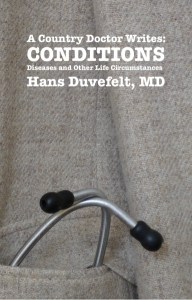
A Country Doctor Writes: CONDITIONS – Now Also in Paperback

The paperback edition of CONDITIONS is now available on Amazon and will also be distributed to bookstores. It has been fun to select and format the essays, design the cover and go through the publishing process. As I have mentioned before, I have several more books on the way. Each one will be based on my blog, but with a different theme. The second book in the series, scheduled for a Labor Day release, is about “Starting, Growing and Staying in the Medical Profession”.

Amazon doesn’t offer bulk discounts, but they allow authors to buy their own books at cost, so if anybody would like to place a bulk order for a group of medical students or similar purpose, please contact me. My email address is in the sidebar.

https://www.amazon.com/dp/B08D51CG62

Oats: Junk Food or Health Food? Ingredients are Only the Beginning

(I guess I’ll still post something new here now and then, but I’m not holding myself to any set schedule.)

The American view of which foods are healthy is much too simplified to be of any use for people who want to avoid or reverse lifestyle related illness.

Take “grains”, for example – for a long time promoted as the foundation of a healthy diet. There are still dietitians who make their living promoting this unfortunate unnuanced myth.

First, it helps to consider that humans just might not be well equipped to digest and utilize large amounts of any foods that haven’t been around for as long as we have. Farming grains is a relatively new invention. They do grow wild, but not in the quantities we are now exposing ourselves to.

Second, whether we chew, crush, cook or ferment foods makes a difference in their nutritional value. Some items in our diets are poisonous in one form and nutritional in another. For example, kidney and Lima beans, potatoes and cassava are poisonous uncooked. And this is where oats can be junk food or a reasonable, if not downright healthy, dietary choice.

There is a lot of talk these days about highly processed foods, and it conjures up images of cheese curls, and chips that aren’t made from thin slices of potatoes but baked from some type of flour. But boxed breakfast cereals, including those made from oats, and instant oatmeal belong here, too. Instant oatmeal is basically oat flour.

Why is powdered oatmeal unhealthy? Because it turns into glucose faster than eating table sugar.

So, if you eat uncooked rolled oats, you first have to chew them, then the acid in your stomach has to break them down into smaller pieces that you can digest. This process causes a slow, modest rise in blood glucose. We call this a low glycemic index food.

Notice I say blood glucose. That is what the body uses for energy. The term blood sugar is incorrect. Sugar, or table sugar, which comes from sugar beet or sugar cane, consists of one molecule of glucose and one of fructose. The enzyme sucrase splits these two molecules, just like lactase splits milk sugar into glucose and galactose. Both these breakdown processes happen in the small intestine.

Instant oatmeal actually turns into sugar right in your mouth, from the action of amylase, an enzyme in your saliva. There is also amylase in the pancreatic digestive juices that act in the small intestine, but because instant oatmeal is in powder form, there is no chewing or stomach acid required before your salivary amylase can go to work.

We call instant oatmeal a high glycemic index food: Your blood glucose starts to climb and you release insulin to get the glucose out of the bloodstream and into your cells. Then, unless you’re splitting wood or running a marathon (in which case the glucose turns into carbon dioxide and water after you’ve used up its energy), your cells turn this sudden sugar load into fat (called triglycerides, which can be stored in the liver, for example – think fatty liver disease) and possibly worse than that, the glucose spike triggers inflammation, which we now know is at the root of many of the lifestyle related diseases we didn’t see back in the days when overconsumption was not so common.

Back to the oats: Instant oatmeal is a junk food, uncooked oats, the main ingredient in Swiss muesli, are quite healthy. Consequently, cooked oats fall somewhere in between, depending on just how long you cook them. So, merely looking at the ingredients of foods we consider eating isn’t enough.

The key word is PROCESSED. If cavemen couldn’t have served it to themselves or their families, it might just be plain bad for you.

July 4 Book Release Update

The eBook is now available on Amazon. The paperback edition of A Country Doctor Writes: CONDITIONS – Diseases and Other Life Circumstances should soon also be available on Amazon and will be available through the usual bookseller distribution channels. There is a slight delay because Amazon has suddenly found many of the essays elsewhere on the Internet, so I have to prove that I published them first on my own blog. I’ve always been flattered that so many sites all over the world have republished my work, but at the moment this has (briefly) turned into a negative. Have no fear, I have the proof that my words are my own.

I am also taking the opportunity to announce that my second book in the series, PROGRESS NOTES – Starting, Growing and Staying in the Medical Profession, will be released on September 7. Notice the Holiday release schedule I’m setting for myself (Labor Day in the US)?

My next holiday release book is tentatively planned for Veterans Day or Thanksgiving, and a fourth one might turn out to be lighthearted, inexpensive stocking stuffer for Christmas.

https://amazon.com/Country-Doctor-Writes-CONDITIONS-Circumstances-ebook/dp/B08B67NR7K


I just realized none of the posts show on an iPad or a computer, but they do show on an iPhone. WordPress is working on this. In the meantime, please visit my Substack.


Osler said “Listen to your patient, he is telling you the diagnosis”. Duvefelt says “Listen to your patient, he is telling you what kind of doctor he needs you to be”.


BOOKS BY HANS DUVEFELT, MD

CONDITIONS, Chapter 1: An Old, New Diagnosis

Top 25 Doctor Blogs Award

Doctor Blogs

Enter your email address to subscribe to this blog and receive notifications of new posts by email.

Mailbox

contact @ acountrydoctorwrites.com
Bookmark and Share
© A Country Doctor Writes, LLC 2008-2022 Unauthorized use and/or duplication of this material without express and written permission is strictly prohibited. Excerpts and links may be used, provided that full and clear credit is given.


