Archive Page 78

PATIENTS: Sufferers, Consumers or Something In Between?

The word we use to describe those who come to see us in person, or seek our advice through other means of communication, is ancient and – according to some – outdated.

Patient, both as a noun and an adjective, is derived from the Latin pati, which is a word for suffering.

Not long ago, people only sought a doctor’s advice when they were feeling ill. Now, more and more, we are involved in health promotion and disease prevention. In this new role, we need to think of our relationship with those we work for as something very different and more equal. We now speak of active patient involvement and patient participation and some people call that an oxymoron. I don’t agree.

No existing or new word has replaced patient. Consumer, client, participant, partner and many others have failed to get traction.

As much as I love words and enjoy learning or contemplating their historical origins, my own thought is this:

We don’t need a new word to replace patients. Words are just words, approximations. Changing our nomenclature for ethnic minorities did not eliminate the injustices of our society, as today’s news reports have illustrated, for example.

We need to work on our view of and relationship with our patients. Retailers have consumers, lawyers have clients, teachers have students. All those relationships are continually evolving to some degree, just like the doctor-patient relationship. Keeping the word patient and staying focused on understanding what they need from us helps us avoid the trap of commercializing or trivializing our relationship the way consumers would, for example.

Old and antiquated words can still make sense when describing something new and very different: You may be driving a combustion engine automobile in the US or motor car in Great Britain, or an electric car on the European continent, measuring its efficiency in miles per gallon, liters per kilometer or Watt hours per kilometer. But we all still like to think of our vehicle’s horse power, even though we know there are no horses under the hood and who knows what hundreds of horses could really accomplish if you tried to get them to pull a vehicle. They certainly could not match the speed or acceleration we associate with horse power numbers.

Patients of today are both looking to be fixed and seeking guidance on avoiding becoming ill. Some are even coming to us seeking health. Health is more than the absence of illness, but that is not part of the everyday thinking of most doctors.

This brings me to the question of how we want to define our own role in our chosen field: If a patient today is different from a patient a hundred years ago, how well has health care adapted to that evolution? I know drug companies are very much stuck in the old model of fixing suffering by external means. They promote the notion of artificial interventions creating active, smiling but still overweight diabetics with better blood sugar control, for example. That is not quite health or even the absence of disease, only the mitigation of some of the worst effects of illness.

Health care has largely failed to meet the needs of those patients who look for real health, beyond the absence of overt disease. That arena is now dominated by what we call alternative medicine practitioners. The Functional Medicine movement promises to bridge this gap, and maybe the medical school curriculum of the future will prepare doctors differently. But knowing how long it takes for even basic medical knowledge to change physician behavior, we will continue to muddle along the way we are for a while.

My only hope for the immediate future is that doctors, on an individual level, listen more to each patient we meet. If we acknowledge or awaken the desire for more than mitigating symptoms in some of them, it will rejuvenate us professionally and inspire us to consider the basics of health we have perhaps viewed as too trivial to bother with: nutrition, sleep, physical activity, relationships, spirituality in any of its forms, connection with the natural world. That includes respecting and listening to our own bodies.

Sure, diagnosing that insulinoma I think I saw the other day makes me a good traditional doctor for a traditional, helpless patient. But what about the handful of people who realized that the dietary changes they started to make made them feel better very quickly? They weren’t really suffering from anything serious and I didn’t really treat them in the traditional sense. But our engagement, or partnership, was just as satisfying as chasing down a rare diagnosis.
I Still Love Being a Doctor – KevinMD

On today’s KevinMD, Kevin Pho is featuring a post I wrote this January on the occasion of the 46th anniversary of my first day of medical school (described in detail here). This post touches on E&M coding and the silliness of some EMR templates, but it still ends with my honest conclusion “I love my job.”

It became clear to me that my desire for a career in medicine was because it would allow me to teach, coach, explain, motivate and guide fellow humans in medical matters. I never fantasized about heroic procedures or brilliant diagnostic victories – I have since understood they are usually a little too infrequent to sustain a doctor week after month after year.

“Helping people” is often cited as a motivator for becoming a physician, but I don’t think that is precise enough. “Repairing their body parts”, “comforting them and relieving their suffering” or “helping them understand their options” are more likely to translate into professional satisfaction.

In today’s medical practice environment, there are plenty of opportunities to do what I enjoy the most, and I receive plenty of positive feedback for doing it. My favorite compliment is probably “Nobody has ever explained it like that before”.

Read on KevinMD: https://www.kevinmd.com/blog/2020/10/meet-the-physician-who-loves-his-job.html

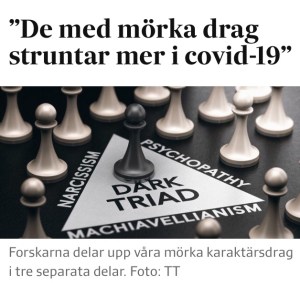
Swedish Analysis: Dark Triad Personality and Denying the Dangers of Covid-19

My Swedish morning paper has an interesting article that ties in with recent pieces in the New York Times and other US media.

The so-called “Dark Triad” of personality traits was described by Paulhus and Williams in 2002 – narcissism, psychopathy and machiavellianism. They are strongly linked to lack of empathy. This triad, according to Svenska Dagbladet, helps explain the animosity and violence expressed and perpetrated by Covid-deniers in the United States, who value their freedom not to wear masks more than the health of their fellow human beings.

The Swedish article writes about this 18 year old concept:

“But since the world was paralyzed by covid-19 this spring, the dark triad has become relevant again. A number of researchers have studied how our dark features are linked to how we acted during the pandemic. A few, albeit relatively small, studies indicate that people with strong dark features to a greater extent ignore obeying instructions during the pandemic.”

Media here are full of accounts of the violence the non-believers are capable of inflicting on those who are trying to protect their own health and others, too. This is perpetrated under the guise of protecting their own individual freedom, denying everyone else the freedom to avoid exposure to illness and death. I personally find this divisiveness in our society frightening and disheartening.

In just two examples from today’s news, an 80-year-old man was killed at a bar for asking another patron to wear a mask and the president is urging his supporters to ignore the risk of dying from Covid-19.

NYT has a piece about cognitive dissonance and the virtual bubbles Americans live in when it comes to where we get our news (Fox versus the older TV networks, for example), describing how our brains “will go to baroque lengths — do magic tricks, even — to preserve the integrity of our worldview, even when the facts inconveniently club us over the head with a two-by-four”.

We live in a divided country regarding race, climate, and so many other things. Not that I actually imagined living in a time of a worldwide pandemic of this magnitude, but I would have thought if anything could have united us, that would have been it.

I was wrong.

Courts Interpret Laws Differently – Even the Supreme Court, Depending on Individual Justices. Compare that with Interpreting Medical Science!

The arguments about nominating a new Supreme Court justice have illustrated how relative everything really is around here.

Since our Constitution is still being reinterpreted after all this time and since Roe v Wade may be reversed, depending on one 48-year-old woman’s opinion, is there any wonder why not all doctors think and act alike?

There may be laws of physics, although I don’t think all of them are immutable anymore, but there are hardly any laws in medicine. All we have to go on are data and differing interpretations of what to make of it.

It should be obvious that much of what we do in medicine is far from straightforward or universal. All we have are broad stroke images, rough ideas, of how our bodies and biomes work. Right now, as we struggle to understand how one virus differs from another, we look back and realize that some patients with Covid were dying because they were put on ventilators – and there we were, thinking we wouldn’t have enough of them.

Medicine is like a society without sophisticated laws; a culture, clan or cadre of practitioners with scientific training, intellectual curiosity and open-mindedness as well as a required amount of humility, because we are constantly navigating in uncharted and ever-changing waters. And this society is built on just a few principles, perhaps outlined best—but certainly not legislated—in the Hippocratic oath.

We face two obvious dangers: trusting our own knowledge too much and trusting conventional wisdom too blindly.

Most people think you need to be very smart and experienced to sit on the Supreme Court—or any other bench for that matter—even though the laws of the land may seem like they should be self-explanatory. Imagine how challenging it is to always be an effective physician. But is that how my profession is viewed right now?

No, we are portrayed as followers, rather than interpreters, of the science. But the truth is, we often face unique situations where there are neither laws nor good science to guide us.

And as the physicians treating our ailing president seem to be making unusual or even inexplicable treatment decisions, it should be obvious how inexact the art of treating individual patients really is.

Physicians’ Communication Skills are Overlooked and Undervalued – Today’s Exclusive on The Health Care Blog

Interviewing celebrities can make you a celebrity yourself, and it can make you very rich. So there’s got to be something to it or it would be a commodity. The world of media certainly recognizes the special skill it takes to get people to reveal their true selves. 

At the other end of the spectrum of human communication lies our ability to explain and also our ability to influence. These three aspects of what we do—elicit, explain and influence—are far from trivial, and in my opinion quite fundamental aspects of practicing medicine.

….

The problem with our work environment is that all the technology and all the well meaning efforts we are subjected to have, ironically, conspired to distance us from our patients and made us less effective than we could be.
— Read on thehealthcareblog.com/blog/2020/10/02/physicians-communication-skills-are-overlooked-and-undervalued/


I just realized none of the posts show on an iPad or a computer, but they do show on an iPhone. WordPress is working on this. In the meantime, please visit my Substack.


Osler said “Listen to your patient, he is telling you the diagnosis”. Duvefelt says “Listen to your patient, he is telling you what kind of doctor he needs you to be”.


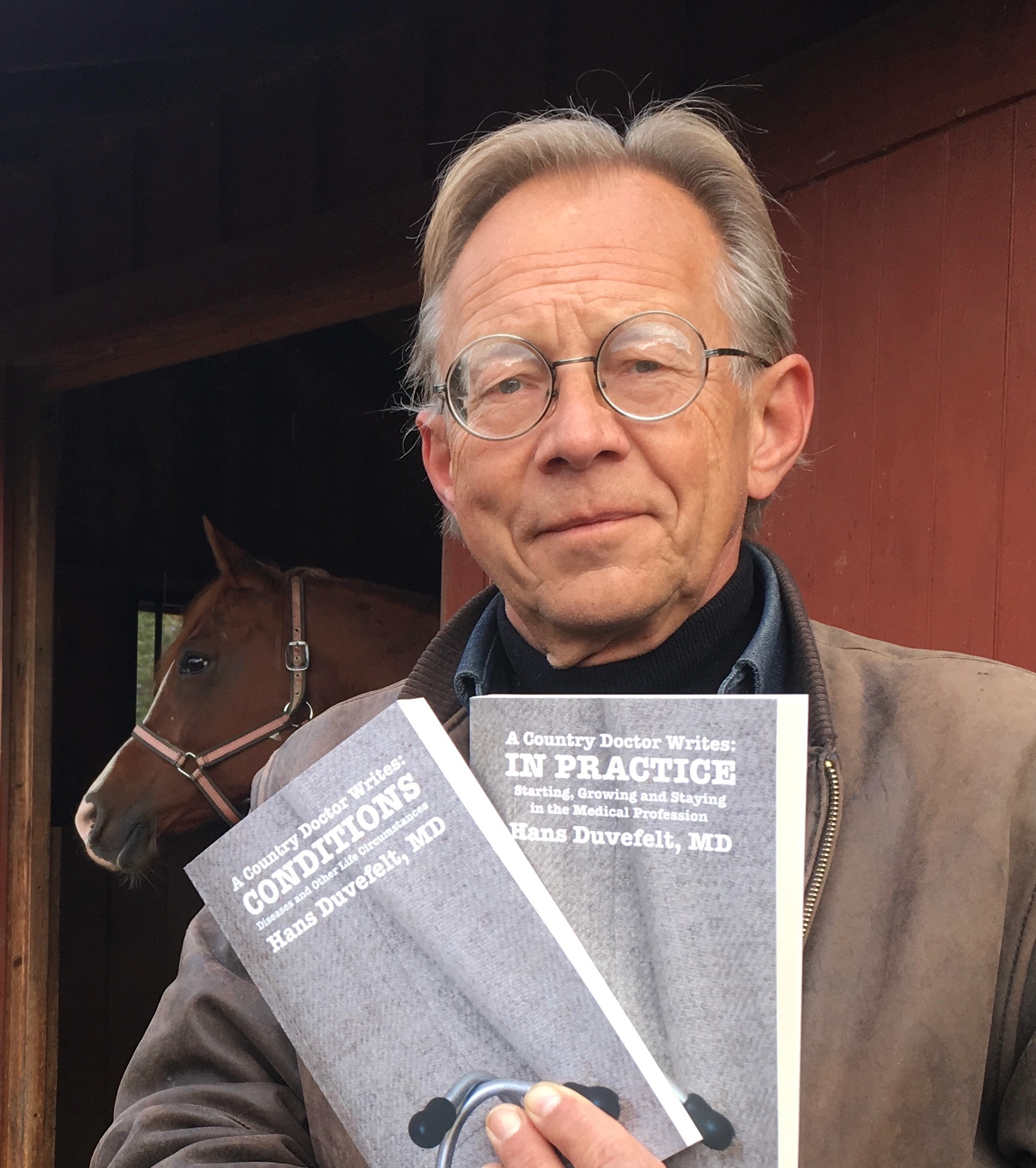
BOOKS BY HANS DUVEFELT, MD

CONDITIONS, Chapter 1: An Old, New Diagnosis

Top 25 Doctor Blogs Award

Doctor Blogs

Enter your email address to subscribe to this blog and receive notifications of new posts by email.

Mailbox

contact @ acountrydoctorwrites.com
Bookmark and Share
© A Country Doctor Writes, LLC 2008-2022 Unauthorized use and/or duplication of this material without express and written permission is strictly prohibited. Excerpts and links may be used, provided that full and clear credit is given.