Archive Page 76

Stop Bashing Nurse Practitioners: The Dunning-Kruger Effect is Everywhere

Three years ago, I wrote about the Dunning-Kruger effect, the phenomenon that makes beginners overestimate their abilities.

Fellow physician blogger Niran Al-Agba and Rebekah Bernard, MD are now on a crusade against Nurse Practitioners and Physician Assistants. They are implying that perhaps those professionals are more dangerous than doctors because of the Dunning-Kruger effect.

A beginner is a beginner, regardless of educational level, and even after years in practice there are strong clinicians and weak clinicians. I have seen Physician Assistants and Nurse Practitioners deliver better care than physicians.

The indisputable fact is that we have people with different educational levels delivering health care in this country. It gets us nowhere to argue an end to what used to be called midlevel practitioners. Instead, we need to face the facts that sometimes the wrong people are admitted to NP or PA school and once there, are often given the wrong messages during their training. And, possibly more important, sometimes the wrong staff category are placed in the wrong professional setting.

Diagnosing and treating common symptoms like abdominal pain, cough or headache are the hardest and most treacherous things we do in medicine. It takes more to do that than to do a routine physical, annual wellness visit or diabetes followup.

But what do many clinics do? They have their senior clinicians do the chronic care and their junior or less educated clinicians work the frontline triage functions.

I wrote about this six years ago in a two part essay titled It’s Time We Talk: Why Should Doctors Treat the Well and Nurses the Sick? (Part One and Part Two.)

There, I’ve said it again: Teach humility and put the right people in the right position in health care!

A Christmas Message to All Physicians From a Swedish-American Country Doctor in Maine

Near New Sweden, Maine – just like the old country…

Growing up in Sweden without a Thanksgiving holiday, Christmas has been a time for me to reflect on where I am and where I have been and New Year’s is when I look forward.

I have written different kinds of Christmas reflections before: sometimes in jest, asking Santa for a better EMR; sometimes filled with compassion for physicians or patients who struggle during the holidays. I have also borrowed original sentences from Osler’s writings to imagine how he would address physicians in the present time.

This year, with the pandemic changing both medicine and so many aspects of life in general, and with a gut wrenching political battle that threatens to erupt in anarchy or civil war within the next few weeks or months, my thoughts run deep toward the soul of medicine, the purpose of being a good doctor, even being a good human being.

We live in ideological silos, protected from dissenting opinions. News is not news if it is unpopular. Fake news and fake science are concepts that seemed marginal before but have now entered the mainstream.

As a physician, I serve whoever comes to see me to the best of my ability. But this year I have had to pay extra attention to the fact that so many people have already made up their minds about the nature and severity of the pandemic we are living with. If they don’t believe the country’s top experts, they are not likely to believe in me. Still, I try to gently state that we are still trying to figure this thing out and until we do, it’s better to be cautious.

I am starting to read about what some are now calling the Fourth Wave of the pandemic, the mental health crisis this winter may see in the wake of the physical illness we are surrounded by.

With this raging pandemic and the pandemonium it has created in our personal lives and the lives of those around us, we as doctors need to keep our priorities straight:

  • A physician’s mission is to ease suffering.
  • We save lives when we can.
  • But sometimes, all we can do is help inevitable death happen with dignity and without unnecessary suffering.
  • Because we have seen suffering and death in our work, our words of experience and our empathy can help others.
  • We are all mental health workers in the eyes of our patients.
  • We must work hard to the best of our abilities.
  • But we cannot sacrifice our own health in the process.
  • We must put our own oxygen mask on first, as during in-flight emergencies.
  • We must accept that bad things happen in spite of our efforts.
  • We must accept that in life, there is no light without darkness, no joy without sorrow, and no good without evil.
  • We must recognize that we need to make every day count, because time, and life itself, is a finite resource.

Life is certainly messy, confusing and unpredictable. And while scientists and politicians may be using their brains for thinking of ways out of the situation the world is now in, the rest of us, doctors on the frontlines, are hunkering down in our shrunken worlds – reconnecting with the soulful, inconsistent underpinnings of who we really are but were perhaps too busy to really think about, recommitting to easing suffering, one patient at a time.

Remember Hippocrates: “Ars longa, vita brevis, occasio praeceps, experimentum periculosum, iudicium difficile” — “Life is short, the art is long, opportunity fleeting, experiment treacherous, judgment difficult.”

The Year When Everything Changed: Covid, Self Care and High Tech Innovation In Medicine

Life as we knew it and medicine as we had viewed it shapeshifted so dramatically in the past year that it is still hard to believe.

Medicine has started to move from an in-person only profession to one that finally recognizes that clinical assessment and treatment have fewer boundaries than people assumed. A patient of mine with newly diagnosed mastocytosis had a productive first consultation with an immunologist hundreds of miles away right from her own living room.

Efficiency increased when we could handle straightforward clinical issues electronically, even over the telephone, and still get paid. We were liberated from the perverted and miserly view by insurers that services not delivered in person should be free, as if fast food restaurants couldn’t charge for food at the drive through.

We delivered more virtual services to allow patients the safety of staying at home and avoiding lobbies, waiting rooms and exam rooms where airborne particles might linger.

Yet, when a primary care or mental health patient is in crisis or a person with new symptoms needs to be evaluated, a video visit is sometimes not enough. Step by step, we improvised screening protocols, not knowing which would be efficient or relevant as we didn’t know quite how the coronavirus behaved and transmitted.

We had to put in place telephone triage protocols in order to steer potential Covid cases to the most appropriate sites or levels of care. We also had to find ways to promote, guide and support self care.

Americans have widely held the inappropriate belief that conditions like the common cold or a viral gastroenteritis need to be fought or treated. The infinite variety of cold remedies and the overprescribing of antibiotics illustrate the public disbelief that most viral illnesses run their course and resolve without permanent after effects. Many of my patients, for example, don’t seem to know that drugs that decrease nasal discharge can cause mucous stagnation that leads to sinus infections.

Self care is an obvious strategy to avoid overburdening the health care system and in fact to decrease community spread of the Coronavirus. But it is a psychological challenge for many people to see their symptoms for what they are instead of what they could be. A mild case of Covid-19 is less dangerous than a bad case of influenza or a typical pneumococcal pneumonia. Knowing the cause of mild symptoms isn’t necessary unless you decide to risk exposing others to whatever you have. If you hunker down, stay home and use common sense to monitor your symptoms, everyone is safer than if you go out to buy useless remedies or clog up clinic waiting rooms.

It suddenly made less sense to encourage more visits to generate more revenue. It made sense to consider not only our patients and our organizations welfare but also our communities.

Giving video or telephone advice has come into focus and for many emphasized the value of providers and patients knowing each other. The simple fact that it is easier to “read” someone you know than someone you don’t know is often overlooked by system designers and health care entrepreneurs.

Sometimes patients themselves or their family members have an easier time determining that someone is getting seriously ill than a random provider hampered by the limitations of electronic communications.

So, it seems like this pandemic will bring on more of two seemingly opposite strategies: self care and high tech innovation ranging from telemedicine to vaccine development. I applaud all of it.

Featured Again in Sweden’s Journal of General Medicine

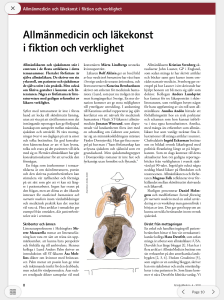
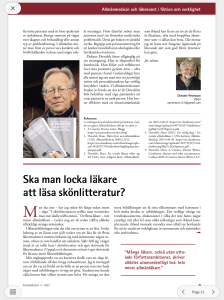
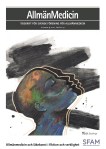
I have written a few articles for ALLMÄN MEDICIN, the Swedish Journal of General Medicine, over the years. Their December issue has the theme General practice and the art of medicine in fiction and reality. They write very kindly about my patient centered view of medicine and my book, CONDITIONS. This mention follows the recent launch of Amazon’s Swedish website, which makes my books now available there, too.

The Art of Listening: A Not-So-Simple UTI

Many clinics allow the practice of ordering antibiotics for women who claim to have symptoms of a urinary tract infection. In some cases patients bring in a sample, and in some they produce the sample in the clinic in a free “Nurse Visit”. The doctor is then expected to prescribe without evaluating the patient.

The only provider on duty one Saturday this fall, I was asked to do just that. I asked the medical assistant: “Exactly what are the symptoms and is this a patient who gets UTIs all the time?”

“Doesn’t look like it, she’s only been seen once before and that was over a year ago.”

“Gotta be seen, just double book her”, I said.

The woman was in her fifties, came in as a new patient a little over a year ago. She had a history of colon cancer and was behind on her followup colonoscopy surveillance. In that one and only visit she expressed some hesitation about getting that done because she was new in town. She wanted to think about it. She did agree to getting a mammogram scheduled, and she agreed to get some basic bloodwork – but never did. From what I could tell, the mammogram was actually never done.

Her urine had a trace of leukocytes, white blood cells, and a trace of blood, both common findings even in healthy women.

“What kind of symptoms do you have?” I asked.

“I’ve got this pressure but I don’t always go very much.”

“How long has that been?”

“About three weeks now.”

“Does it burn or sting when you go?”

“Only sometimes.”

“Do you get urinary infections often?”

“I’ve only had one in my life”, was her answer.

On exam, she was a little tender over her bladder and deep to the left, but her belly was soft and I couldn’t feel anything suspicious.

I pointed out that she had hesitated about Dr. Grogan scheduling a colonoscopy. She said she had thought that was going to happen but she never heard back.

I showed her his chart entry and explained:

“Your symptoms may or may not be from an infection. I’ll start an antibiotic for you but whether a culture shows anything or not, you’re due for your colonoscopy and you may even need a CT scan if that tenderness in your belly doesn’t go away. For that reason I really suggest we get that bloodwork going, because the CT scan would require contrast. So my suggestion is, take the antibiotic, get the bloodwork and see doctor Grogan to follow up on your symptoms.”

I messaged the receptionist to make a followup appointment and we wrapped up the visit.

A prescription for an antibiotic without a visit could have had tragic consequences. I don’t believe in accepting a patient’s self diagnosis without double checking it. I also don’t believe in prescribing without taking a look at the bigger context of the most apparent presenting symptom.


I just realized none of the posts show on an iPad or a computer, but they do show on an iPhone. WordPress is working on this. In the meantime, please visit my Substack.


Osler said “Listen to your patient, he is telling you the diagnosis”. Duvefelt says “Listen to your patient, he is telling you what kind of doctor he needs you to be”.


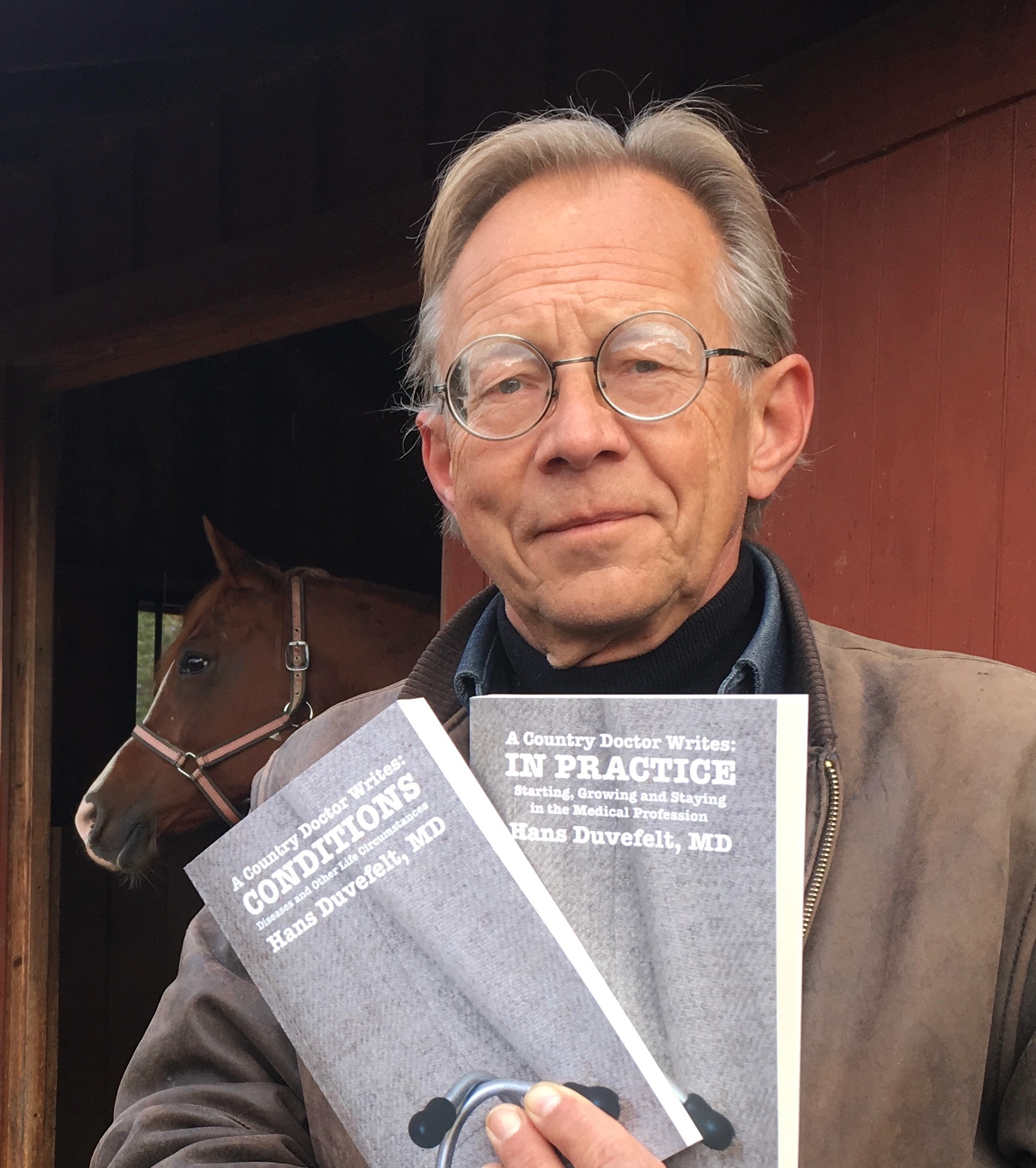
BOOKS BY HANS DUVEFELT, MD

CONDITIONS, Chapter 1: An Old, New Diagnosis

Top 25 Doctor Blogs Award

Doctor Blogs

Enter your email address to subscribe to this blog and receive notifications of new posts by email.

Mailbox

contact @ acountrydoctorwrites.com
Bookmark and Share
© A Country Doctor Writes, LLC 2008-2022 Unauthorized use and/or duplication of this material without express and written permission is strictly prohibited. Excerpts and links may be used, provided that full and clear credit is given.